
Customer experience has become a key differentiator in modern retail, but scaling it is increasingly complex. As customer volumes grow and interactions span chat, voice, social, and in-app journeys, fragmented systems often break context and slow resolution. At the same time, customers expect instant responses, personalised engagement, and seamless continuity across every touchpoint.
This is where AI is reshaping retail CX. Beyond basic automation, retailers are now using conversational and agentic AI to scale customer experience intelligently - connecting conversations, decisions, and workflows across the journey.
In this blog, we explore how retailers are using AI to build scalable customer experience, and why the shift from conversational AI to agentic AI is becoming central to modern retail operations.
Customer experience in retail has expanded far beyond the point of sale. Customers engage with brands before purchase, during checkout, after delivery, and long after the transaction ends - across multiple channels and touchpoints.
As scale increases, retailers face several challenges:
- Rising customer interaction volumes
- Fragmentation across support channels
- Growing pressure on service teams
- Higher expectations for speed and personalisation
When systems operate in silos, customers are forced to repeat themselves, agents lack context, and resolution times increase. What begins as a CX issue quickly turns into an operational bottleneck.
To scale effectively, retailers need more than additional manpower. They need intelligent systems that can manage experience complexity without increasing cost.
Retailers are no longer designing customer experience around isolated support moments. AI is enabling a shift from reactive issue-handling to proactive experience orchestration.
By analysing behaviour, intent, sentiment, and journey signals in real time, AI helps retailers anticipate needs, personalise interactions, and intervene before friction escalates.
Rather than operating as disconnected tools, AI now functions as an intelligence layer that connects customer conversations with backend workflows and operational systems.
This changes the CX model fundamentally - from responding to problems after they occur, to actively managing the end-to-end customer journey as it unfolds.
- Track orders and deliveries
- Request refunds or exchanges
- Check policies, pricing, or product information
- Get quick support without waiting for an agent
- Reducing customer wait times
- Increasing self-service adoption
- Maintaining consistent responses across channels
- Absorbing seasonal and peak-volume surges

First Layer of Customer Engagement

Where It Delivers Immediate CX Impact
However, conversational AI is still largely reactive. It responds well to questions, but often falls short when customers expect actions to be completed, not just information provided.
- Trigger backend workflows
- Update records across systems
- Coordinate between tools and teams
- Complete multi-step tasks end to end

Why Conversational AI Alone Is No Longer Enough
Traditional conversational AI typically stops at generating replies. While it can answer questions efficiently, execution often still depends on manual workflows or human agents. As retail operations grow in complexity, this disconnect between conversation and action becomes more visible - and more costly.

What Agentic AI Means for Retail Teams
Instead of responding and handing off, agentic systems can autonomously:

How Agentic AI Transforms Customer Journey
Customers resolve issues in a single flow. Context persists across steps. Handoffs reduce. Resolution becomes faster, more predictable, and easier to scale.
This transition - from conversational assistance to intelligent action - is what enables retailers to move beyond automation and build truly scalable customer experience systems.
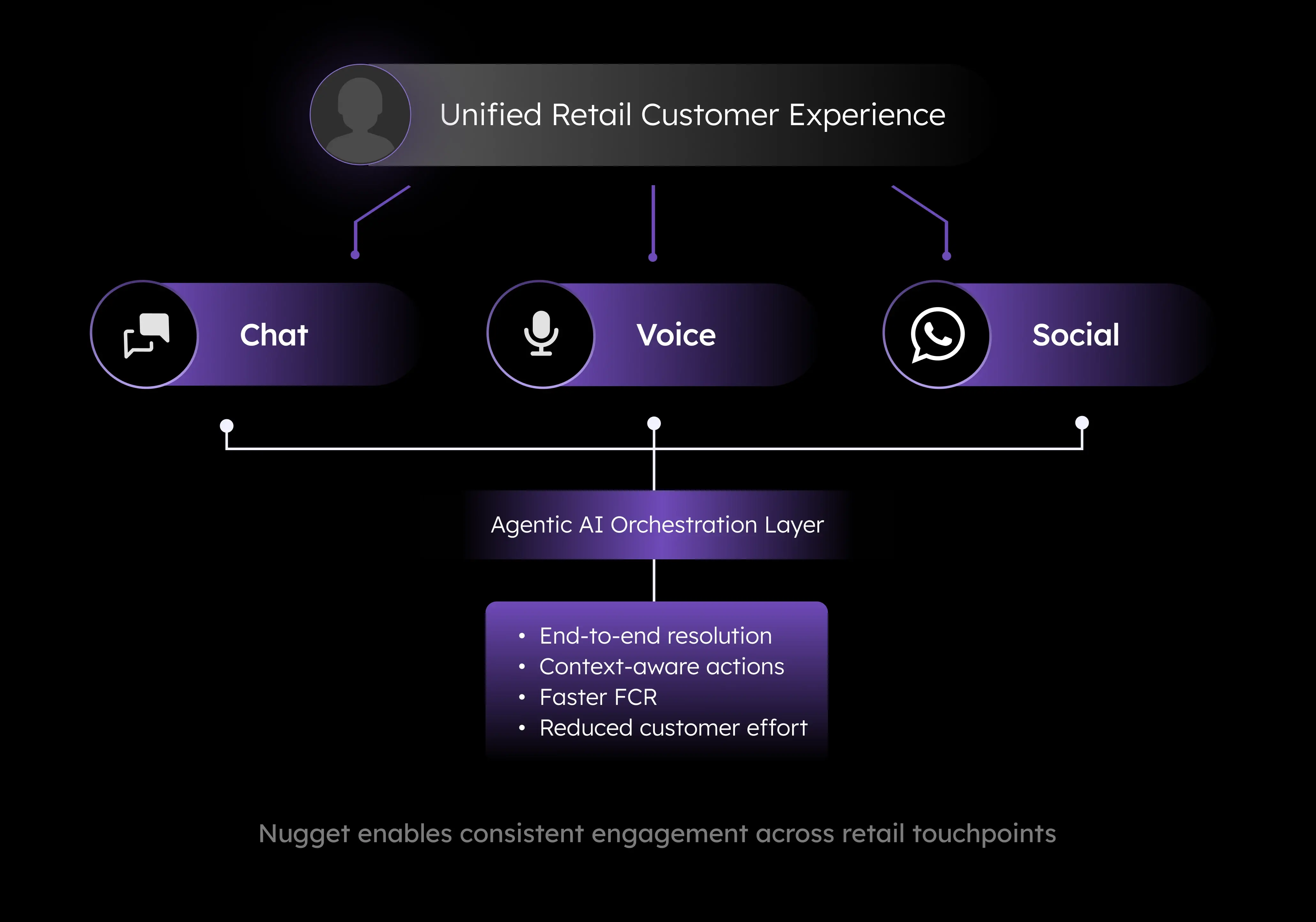
Point solutions for chat, voice, ticketing, and analytics often fragment context and slow resolution. As AI takes on a larger role across the customer journey, scalability depends on a shared system where conversations, actions, and customer data move together seamlessly.
Built AI-native from the ground up, Nugget unifies customer interactions, workflows, and context into a single agentic platform, enabling continuity across channels, teams, and touchpoints.
- Conversations continue seamlessly across channels
- Customers never repeat information
- Agents receive full visibility instantly
- Customer identity
- Interaction and conversation history
- Orders and transactions
- Past issues, outcomes, and sentiment
- Ticket creation and categorisation
- Intelligent routing based on intent and priority
- Follow-ups, updates, and escalation triggers

Unified Omnichannel Context across Customer Journeys
With a unified AI-native system:

Customer 360 as the Backbone of Personalisation
Lifeline brings together:

Workflow Automation without Losing Control
Nugget enables AI-driven automation across workflows such as:
The result is a CX foundation that scales intelligently: faster resolution, stronger continuity, and controlled automation without operational chaos.
Improved Resolution Speed and First Contact Resolution

Higher CSAT through Consistent Service Delivery

Lower Cost per Contact and Better Capacity Utilisation
Retailers often hesitate to adopt AI due to concerns around legacy systems, data security, and deployment complexity.
AI-native platforms like Nugget are built to address these challenges directly through:
- API-first architecture that integrates smoothly with existing systems
- Pre-built connectors for CRMs, commerce platforms, and helpdesks
- Privacy and security-first design aligned with enterprise requirements
This approach allows retailers to adopt AI incrementally, modernising customer experience without disrupting their existing technology stack.
AI is no longer optional in retail - it is becoming the foundation of customer experience.
From conversational interfaces to agentic workflows and unified Customer 360 visibility, AI is redefining how retailers engage customers and operate at scale. Platforms like Nugget enable this shift by connecting conversations, actions, and context into a single intelligent CX system.
As expectations continue to rise, the retailers that lead will be those that build customer experience on AI-native foundations.
Retailers can start with conversational AI for customer support and gradually expand into workflow automation and agentic capabilities using cloud-based platforms.
