Traditional Chatbots vs. AI Agents: What's Better for Insurance?
Written by: Manya Singh
Last updated: Jul 27, 2026
6 mins

Customer expectations in insurance have changed faster than support systems. Policyholders now expect instant answers, real actions, and continuity across chat, voice, and email, whether they're filing a claim, updating coverage, or checking a payment.
Traditional chatbots were built to answer questions. Modern AI agents are built to complete work. This difference is redefining insurance customer experience.
While both chatbots and AI agents aim to improve service, only agentic AI can reason, connect to core systems, and execute multi-step insurance workflows. For insurers handling high-stakes interactions like claims, billing disputes, and endorsements, this capability is no longer optional.
Conversational AI in insurance spans a wide spectrum, from rule-based bots that follow scripts to agentic AI systems that understand intent and take action. The objective is the same: fast, accurate help for policyholders. The approach on the other hand, is completely different.
A chatbot typically retrieves information, whereas an AI agent can interpret policy context, trigger workflows, and resolve cases end-to-end. This shift is especially critical in insurance, where a conversation often involves compliance, identity verification, and backend actions, not just FAQs.
- "Am I covered for flood damage from last week?"
- "Can I add my spouse to the policy effective today?"
- "Why was my claim partially rejected?"
- No understanding of policy context
- Cannot remember earlier interactions
- Require manual script updates
- Unable to complete real transactions
- Frequent handoff to human agents
- Update personal details like address or nominee
- Modify coverage or add endorsements
- Initiate or progress a claim
- Process payments or refunds

Menu-Driven Workflows and Predefined Responses

Shallow Integration with Core Insurance Systems
- Understand intent from free-form language
- Verify customer identity securely
- Retrieve policy and claims data in real-time
- Trigger backend workflows
- Learn from ongoing interactions
- Understand mixed or incomplete questions
- Remember earlier interactions in the same case
- Answer using actual policy details, not generic text
- Adjust tone when a customer sounds worried or frustrated
- Continue a conversation days later without starting from zero
- Policy and coverage details
- Claim progress
- Past conversations
- Payments and renewals
- Risk or sentiment signals
- Warn before a policy lapses
- Flag missing claim documents early
- Catch mismatches in FNOL details
- Suggest next steps like inspections or endorsements

What Makes AI Agents Different
| Dimension | Traditional Chatbots | AI Agents (e.g. Nugget) |
|---|---|---|
| Understanding | Keyword & menu-based | Contextual reasoning with LLMs |
| Action Capability | Shares links only | Executes claims, updates, payments |
| Memory | No session context | Remembers history (Customer 360) |
| Integrations | Read-only APIs | Bi-directional workflow execution |
| Channels | Basic chat/IVR | Multilingual voice + chat unified |
| Compliance & QA | Manual sampling | 100% AI-driven monitoring |
| Escalation | Blind transfer | human handoff |

Natural Language + Context Memory

Omnichannel Customer 360 with Nugget Lifeline

Proactive Service & Risk Detection
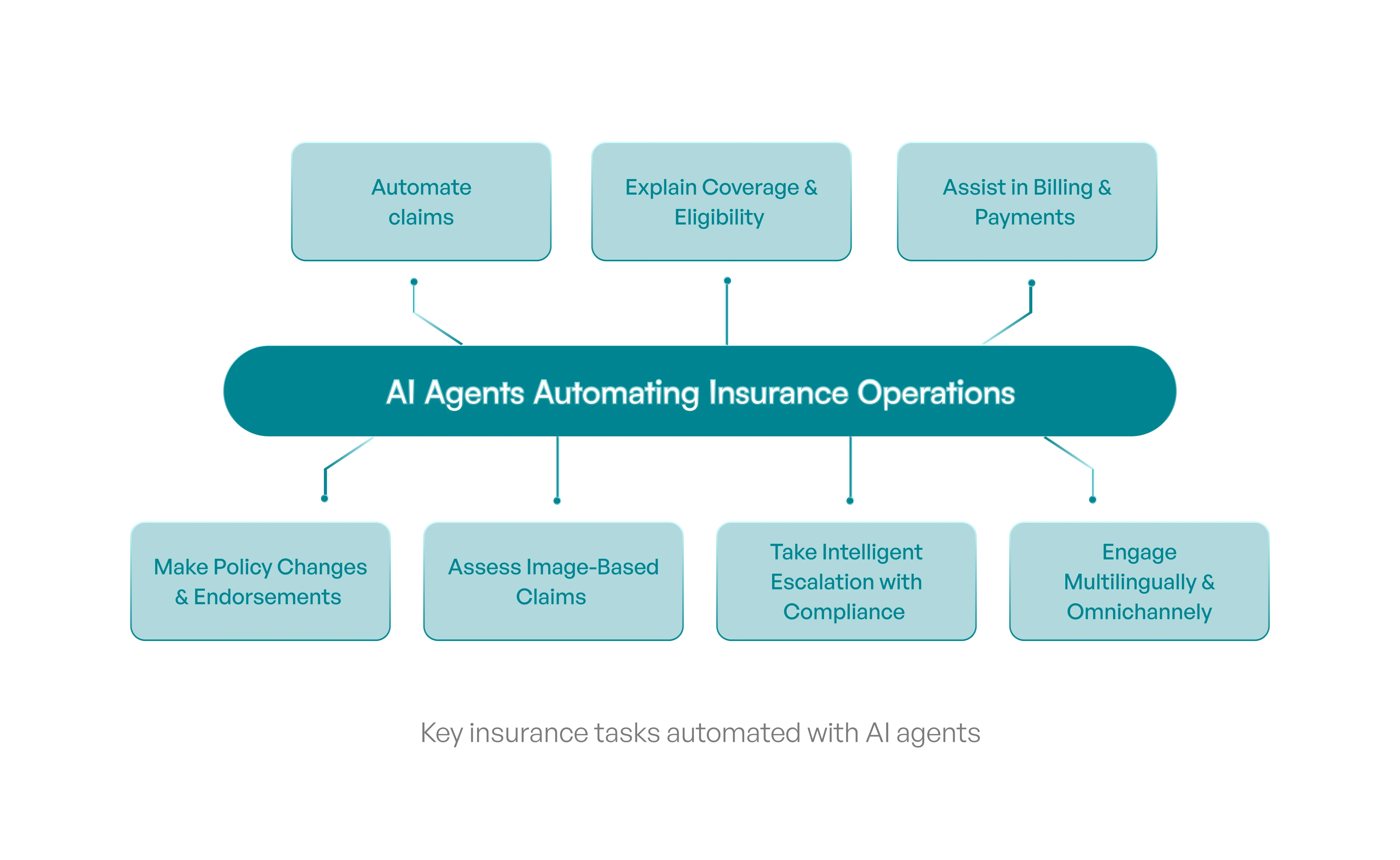
- Guide FNOL step-by-step
- Collect photos & documents
- Validate coverage
- Update claim systems
- Share real-time status
- Inclusions/exclusions
- Deductibles
- Sub-limits
- Renewal terms
- Due date reminders
- Payment retries
- Charge explanations
- Secure payment links
- Instalment changes
- Add drivers
- Change address
- Modify sum insured
- Update nominees
- Assess vehicle/home damage
- Classify severity
- Route to straight-through repair
- Flag fraud risks
- FNOL over phone
- Regional-language support
- Natural, empathetic conversations
- Secure authentication
- Detect frustration/risk
- Escalate with full context
- Attach transcripts + actions
- Maintain audit trails

Claims Automation

Coverage & Eligibility Explanations

Billing & Payments

Policy Changes & Endorsements

Image-Based Claims Assessment

Multilingual Voice AI

Intelligent Escalation with Compliance
Insurers adopting AI agents are seeing measurable improvements across operations:
40 to 60% faster resolution for routine cases
Higher FCR with context-rich handoffs
Lower cost per contact through automation
100% QA coverage via AI review
Better CSAT through consistency
Fraud & risk signals from conversation analytics
Insurers often hesitate to adopt AI because of concerns around legacy system integration, data privacy, and strict regulatory compliance.
Nugget addresses this with:
API-first connectors
Role-based governance
Secure PII handling
Audit-ready workflows
Adoption can be incremental; start with claims or billing, expand across journeys.
Chatbots answer, while AI agents resolve.
Insurance CX now demands systems that can reason, act, and orchestrate across claims, policies, billing, and voice. Nugget's agentic AI enables insurers to automate real workflows while keeping humans in control.
The winners will be insurers who treat AI not as a chatbot upgrade but as their core service engine.
How do AI agents improve insurance claims?
What challenges exist in AI adoption?
Are AI platforms suitable for independent agents?
TL;DR
Traditional insurance chatbots are designed to answer predefined questions, while AI agents can understand intent, execute workflows, and resolve customer requests end-to-end.
Insurance interactions often involve claims, billing, policy changes, and compliance requirements, making AI agents better suited for handling complex, multi-step customer journeys.
AI agents can securely retrieve policy information, initiate claims, process servicing requests, and integrate with core insurance systems without requiring constant human intervention.
Context aware conversational AI enables seamless customer experiences across voice, chat, email, and messaging channels without forcing customers to repeat information.
Beyond reactive support, AI agents proactively improve customer experience by identifying policy lapses, missing claim documents, and opportunities for policy updates or risk mitigation.
Capabilities such as multilingual Voice AI, image-based claims assessment, intelligent escalations, and Customer 360 views help insurers deliver faster, more personalized, and more efficient service at scale.
Modern AI platforms allow insurers to adopt AI incrementally while maintaining enterprise-grade security, governance, compliance, and seamless integration with existing systems.
The future of insurance customer experience lies in treating AI as an intelligent operating layer that can reason, act, and continuously optimize customer interactions rather than simply functioning as a chatbot.