Conversational AI for Insurance: From Conversations to Claims
Written by: Manya Singh
Published On: Sep 30, 2026
10 mins

Every day, thousands of policyholders reach out to their insurers. They call to clarify complex policy terms, request a binding quote, complete onboarding documentation, or make a payment. Later in the policy lifecycle, they reach out to renew coverage, submit updated policy details, file a First Notice of Loss (FNOL), check the status of an active claim, or ask what steps happen next.
The primary operational challenge facing insurance companies and the insurance industry is not a lack of communication. Insurance generates customer interactions at virtually every stage of the customer journey. The real bottleneck is that many of these customer conversations remain disconnected from the core business workflows behind them. When a policyholder asks a question, the interaction often lives in an isolated chat thread or call log while the underlying transaction remains stalled in backend databases.
Conversational AI in insurance serves as the connective orchestration layer. It bridges the gap between customer communication channels and backend core insurance systems, transforming passive dialogue into active execution.
Conversational AI for insurance refers to enterprise systems powered by natural language processing (NLP), large language models (LLMs), and machine learning that execute end-to-end workflows through natural speech and text.
It is helpful to distinguish modern insurance AI agents from basic insurance chatbots:
- Basic Insurance Chatbots: Rely on pre-scripted decision trees to surface static articles from a knowledge base. They answer questions but cannot update policy records or process transactions.
- Conversational AI Systems: AI agents that understand complex customer intent, retrieve real-time customer data, reason about policy terms, execute system actions across core systems, and perform warm handoffs to human agents when human judgment is required.
Deploying conversational AI effectively requires looking beyond individual support tickets to organize capabilities across five core stages of the policyholder lifecycle.
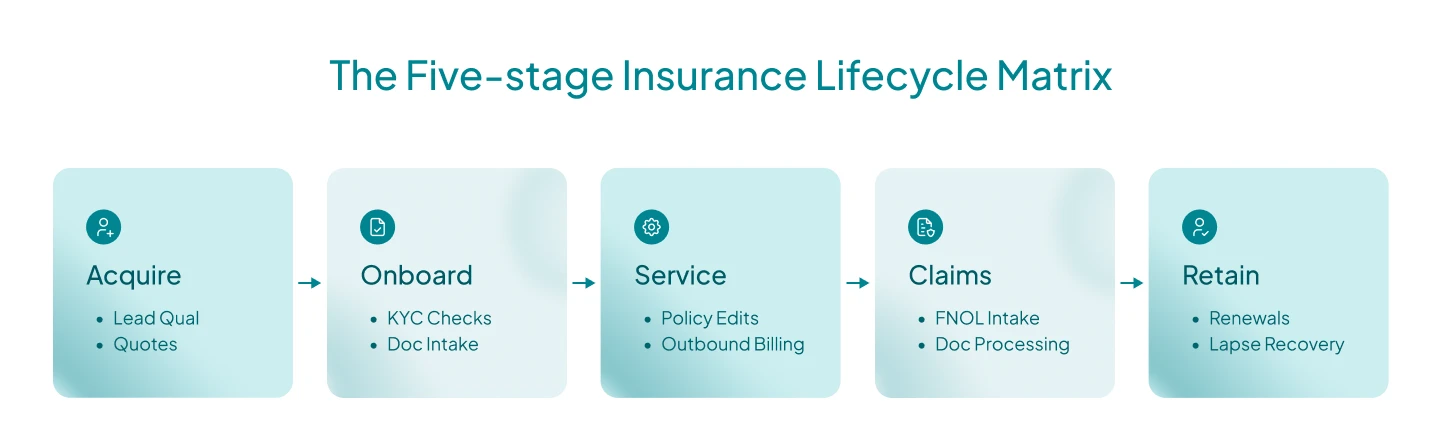
- Lead Qualification: Asking dynamic rating questions to route qualified leads.
- Quote Follow-Up: Re-engaging prospects who requested quotes across messaging platforms or email.
- Product Discovery & Recommendations: Analyzing risk profiles to recommend optimal coverage limits and deductibles.
- Application Assistance: Clarifying complex insurance specific terminology (such as replacement cost vs. actual cash value) during application fill.
- Abandoned Application Recovery: Initiating proactive reminders to applicants who drop off midway through underwriting questionnaires.
- KYC Completion: Validating identity credentials using automated document understanding.
- Document Collection: Requesting, inspecting, and confirming proof of prior coverage, vehicle inspection photos, or property deeds.
- Policy Issuance & Welcome Calls: Initiating automated outbound voice calls or WhatsApp messages to confirm policy activation.
- Coverage Explanation: Offering interactive breakdowns of policy terms, deductibles, and exclusions.
- Missing Information Follow-Up: Proactively contacting policyholders when missing data stalls policy finalization.
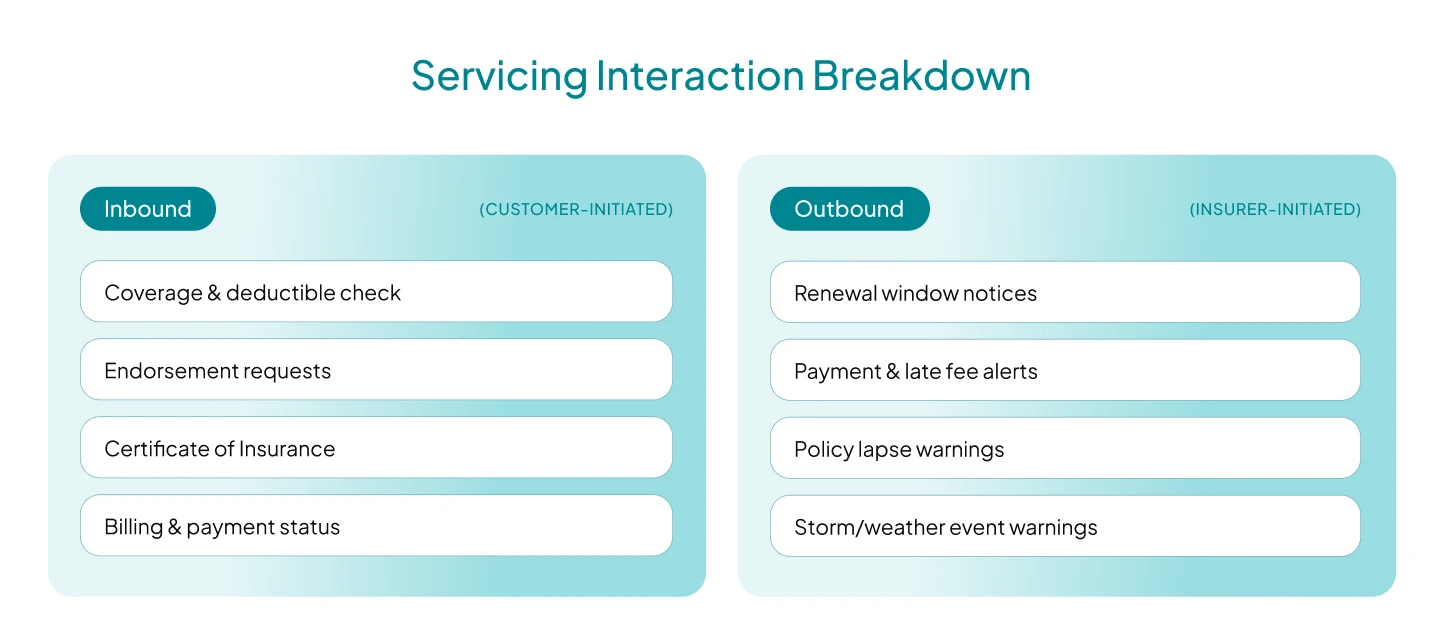
- Inbound Service Requests: Policyholders query policy details, update mortgagee clauses, add new drivers, or request instant Certificates of Insurance (COIs).
- Outbound Operational Outreach: Systems execute targeted campaigns for proactive reminders, premium payment alerts, and lapse prevention to reduce operational costs.
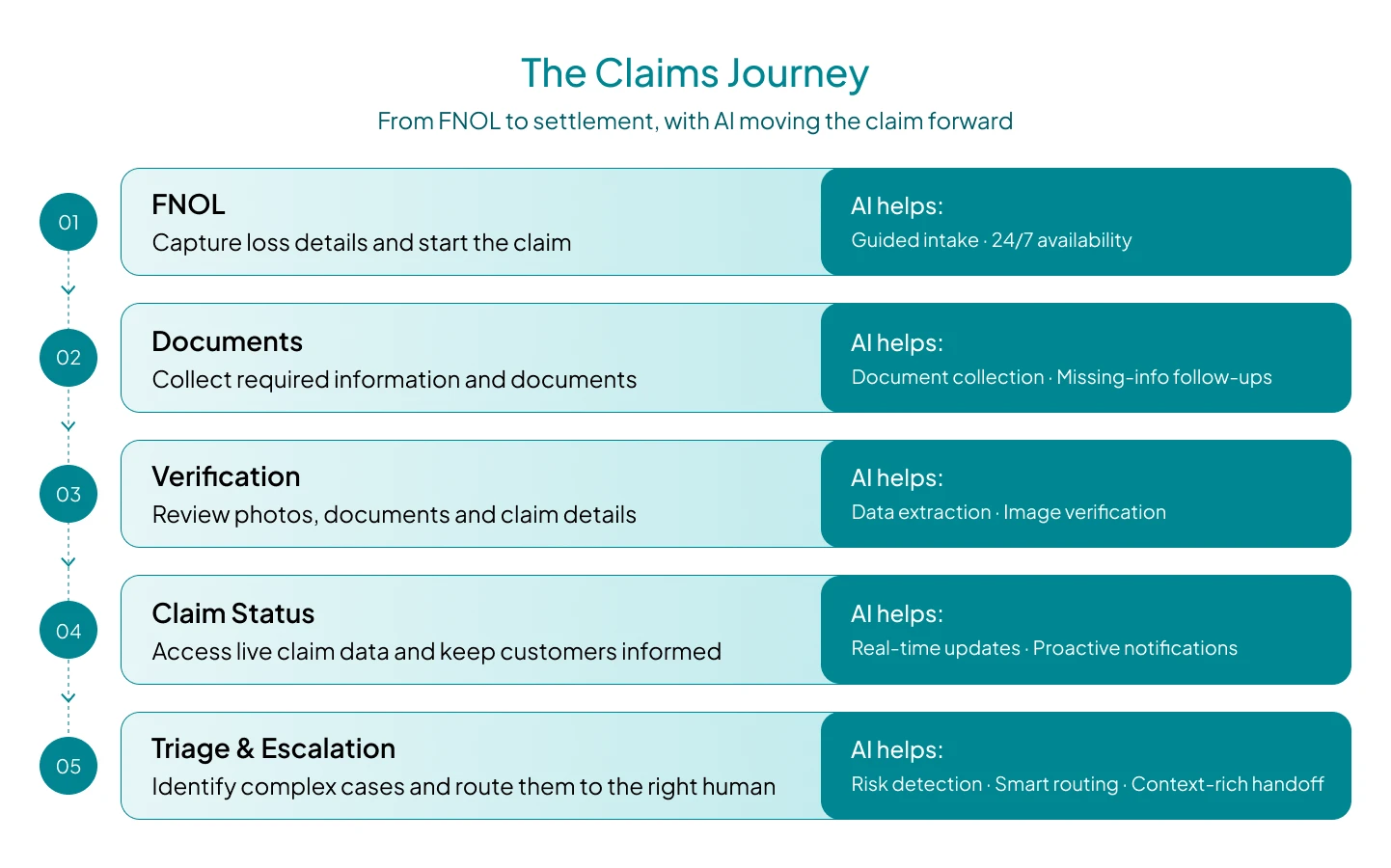
- First Notice of Loss (FNOL): Conducting dynamic, multi-channel intake across voice, web chat, and WhatsApp to capture loss details 24/7.
- Information & Document Gathering: Collecting repair estimates, police reports, and medical bills conversationally.
- Visual Claim Data Verification: Ingesting damage photos and using document understanding to verify clear image resolution.
- Real Time Data Access for Status: Reading live claim data directly from core claims engines to provide accurate progress updates.
- Automated Triage & Human Escalation: Identifying high-distress callers or complex cases involving bodily injury and executing warm handoffs to human adjusters with full context attached.
- Renewal Engagement: Re-engaging policyholders 60 days prior to expiration with annual coverage summaries.
- Lapse Prevention & Missed Premium Recovery: Initiating empathetic outbound calls to arrange payment schedules before coverage lapses.
- Surrender Prevention: Identifying policyholders inquiring about cancellation terms and routing them to retention specialists.
- Cross-Sell & Upsell Triage: Recommending relevant add-on endorsements based on life events logged in the CRM.
Acquire (Pre-Policy)
Before a policy exists, AI in insurance guides prospects through discovery and quote qualification:
By automating early touchpoints, conversational AI solutions move prospects from initial interest to completed application without overloading sales teams.
Onboard (Active Policy Transition)
Turning a binding quote into an active policy requires strict data collection and verification:
Instead of waiting for insurance customers to discover missing documentation, proactive virtual assistants initiate outreach to keep onboarding moving forward.
Service (Policy Lifecycle)
Policy servicing represents the highest-volume layer of customer service interactions. Structuring these interactions by direction highlights operational efficiency:
Claims (From FNOL to Settlement)
Claims represent the most complex and sensitive workflow in the insurance sector. The true business value of claims automation is not simply letting users ask "Where is my claim?", but actively moving the claim through the lifecycle:
According to a Deloitte Insights study on P&C insurance claims, customer claims experiences are a primary driver of long-term retention, yet claims processes rank lowest in driving positive customer sentiment. Deploying AI insurance claims support streamlines intake and reduces processing friction during these high-stress moments.
Retention and Recovery
Insurance automation drives core business outcomes beyond support volume containment:
Understanding how conversational AI operates requires looking at its technical capability progression:
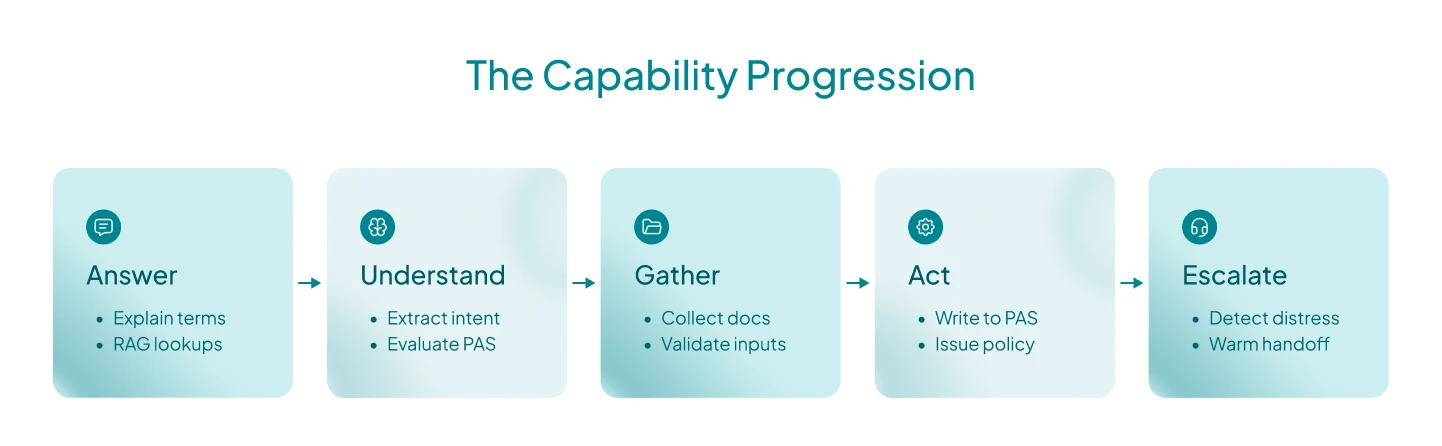
- Answer: Retrieve grounded policy information and explain coverage terms using generative AI anchored strictly to filed policy forms.
- Understand: Identify user intent, evaluate context from core insurance systems, and determine current workflow state.
- Gather: Collect unstructured inputs, damage photos, and identity verifications conversationally.
- Act: Write data back to core databases, trigger claims files, generate policy documents, and process payments.
- Escalate: Recognize when complex cases, policy ambiguity, or severe emotional distress require human intervention, transferring the complete context payload to licensed adjusters.
- Policy Administration Systems (PAS) for policy terms
- Customer Relationship Management (CRM) for interaction history
- Claims Management Platforms for FNOL and status tracking
- Payment Gateways for premium processing
- Document Repositories for loss evidence and photos
Insurance Conversations Are Not Isolated
An insurance agent requires real time data access across disparate enterprise systems:
Insurance Conversations Follow a Journey
A claim is not a single question; it is a multi-step state machine:

The AI system must recognize where the policyholder sits within this state journey across multi-turn interactions.
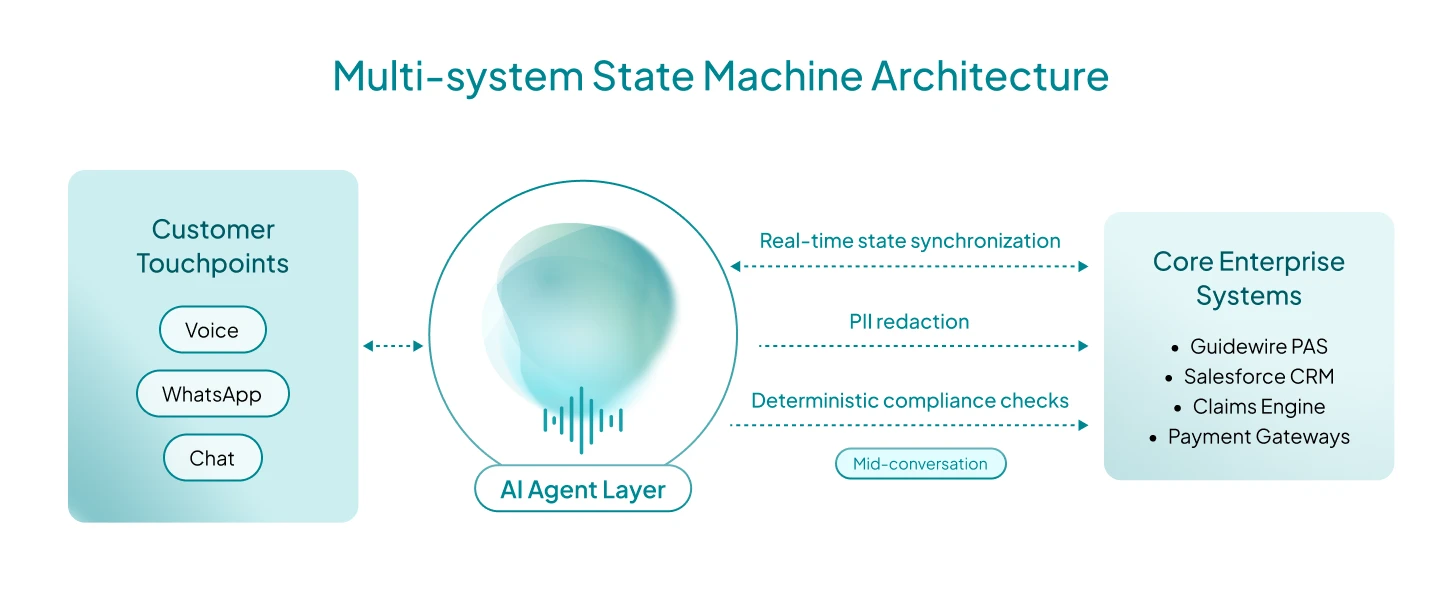
Strict Regulatory Compliance Constraints
Not Every Conversation Should Be Automated
To survive real-world enterprise operations, enterprise platforms require six core capabilities:
- Persistent Context: Carrying customer identity, active policy details, and sentiment history across sessions and channels.
- Grounded Knowledge: Anchoring responses strictly in insurer-approved policy forms using Retrieval-Augmented Generation (RAG) to eliminate hallucinations.
- Deep System Integrations: Maintaining two-way API write access to core ledgers rather than relying on read-only nightly batch exports.
- Workflow Execution: Executing real transactions, issuing policy documents, and logging system notes mid-call.
- Deterministic Guardrails: Running independent compliance layers outside the model to enforce statutory rules and state disclosures.
- Context-Rich Handoffs: Passing complete transcripts, extracted entities, and sentiment markers to human representatives during escalations.
Channels represent the interface; the underlying workflow represents the system. Enterprise systems align channels to specific customer intents:
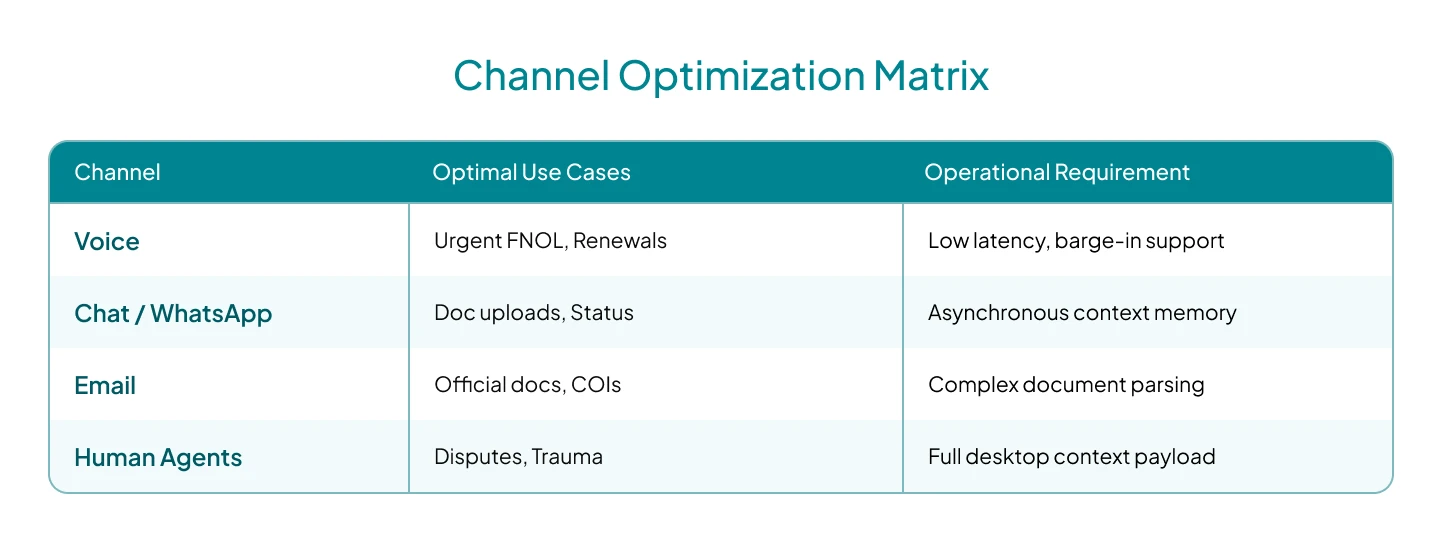
- Voice Telephony: Essential for urgent FNOL reporting, complex policy questions, and high-stress moments requiring low latency and natural turn-taking.
- Web Chat & WhatsApp: Ideal for asynchronous tasks, photo evidence submission, policy checks, and status tracking.
- Email: Best suited for formal document delivery, policy confirmations, and regulatory notices.
- Human Agents: Reserved for complex negotiations, risk evaluation, coverage disputes, and severe hardships.
Evaluating an enterprise deployment requires tracking four distinct metric categories:
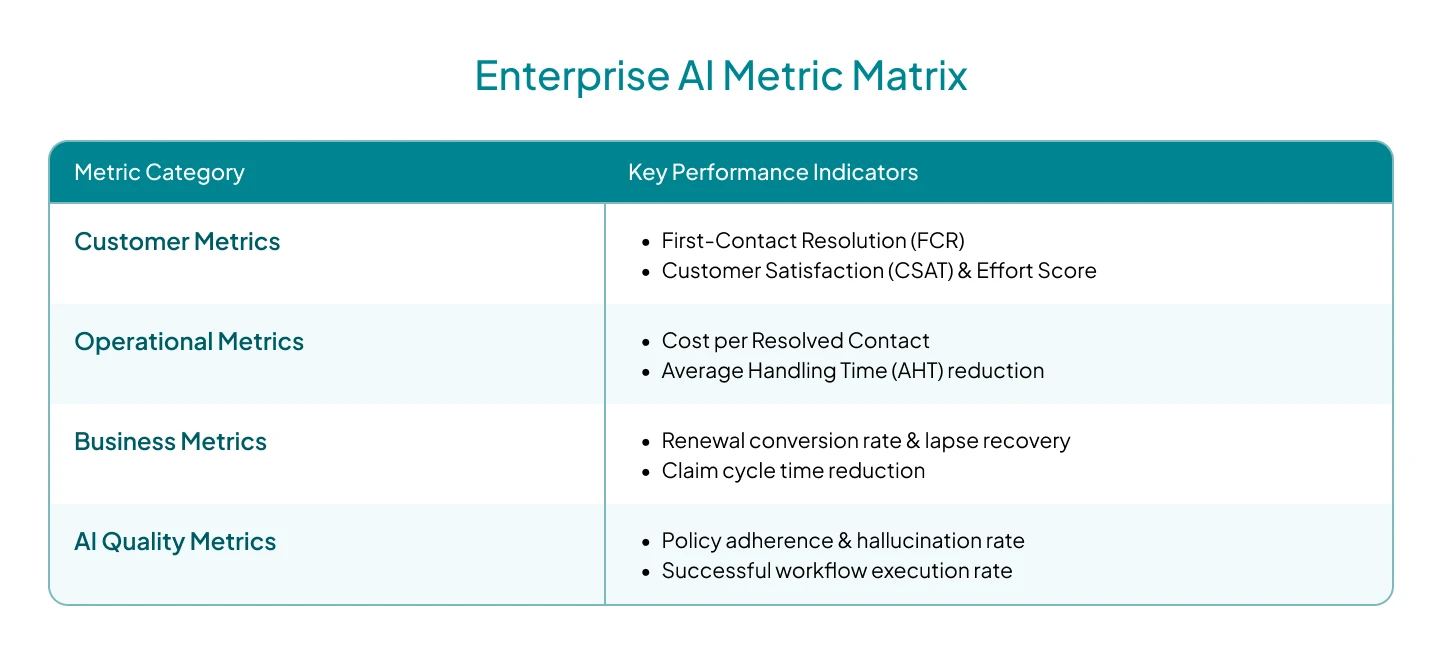
According to McKinsey & Company, insurers deploying AI across claims operations are seeing material gains: Aviva rolled out more than 80 AI models in its claims domain, cutting liability assessment time for complex cases by 23 days, improving claim routing accuracy by 30%, and reducing customer complaints by 65%.
The evolution of conversational technology in financial services is following a clear trajectory:

The major shift in the insurance business is not simply that AI will hold more conversations. It is that core insurance workflows, from underwriting support to faster claim resolution, will become executable directly through conversation.
Insurance has never lacked customer conversations. What it has lacked is a way to connect those conversations directly to the enterprise processes behind them.
Conversational AI in insurance delivers real value when it moves beyond simple Q&A to understand customer intent, access live policy context, execute backend workflows, and know precisely when to hand off to a human specialist.
When built on a deterministic orchestration platform like Nugget, conversational AI transforms insurance operations from slow, manual touchpoints into fast, compliant, and empathetic experiences.
How do AI voice agents handle regulatory compliance during insurance calls?
Can conversational AI handle claims intake during severe catastrophe (CAT) events?
How does conversational AI integrate with legacy policy administration systems (PAS)?
TL;DR
Connect conversations to workflows. Conversational AI transforms passive support chats into active workflow execution by connecting to core insurance ledgers.
AI agents drive business outcomes across acquisition, onboarding, policy servicing, 24/7 claims intake, and renewal retention.
Claims require workflow execution. The true value of claims AI lies in automating FNOL, gathering evidence, and driving claims toward settlement, not just reporting status.
Enforce clear authority boundaries. AI agents handle routine tasks and document collection, while coverage determinations, liability assessments, and complex disputes remain with licensed human adjusters.
Measure true resolution. Enterprise success should be evaluated on claim cycle times, renewal conversion, and cost per resolved contact rather than superficial call deflection metrics.