AI Agent Builders: Why Enterprises Are Moving Away from Engineering-Heavy Deployments
Written by: Manya Singh
Published On: Sep 28, 2026
9 mins

The first wave of enterprise AI adoption focused on proving basic capability. Organizations experimented with standalone chatbots, simple copilots, and isolated use cases to automate repetitive tasks and improve customer interactions. The second wave looks very different.
Today, enterprise leadership is no longer asking whether artificial intelligence works. They are asking how quickly they can deploy an AI agent builder across teams, business functions, and customer journeys without creating massive development backlogs.
Why do we need to address an AI agent builder right now? Because the traditional software development lifecycle has become the primary bottleneck to AI adoption.
Connecting a modern AI model to enterprise production workflows is rarely straightforward. Every deployment requires multiple layers of coordination: business leads define operational rules, product leads map logic, developer teams write custom code for API integrations, and technical teams validate agent behavior. By the time an agent goes live, original business requirements have already shifted.
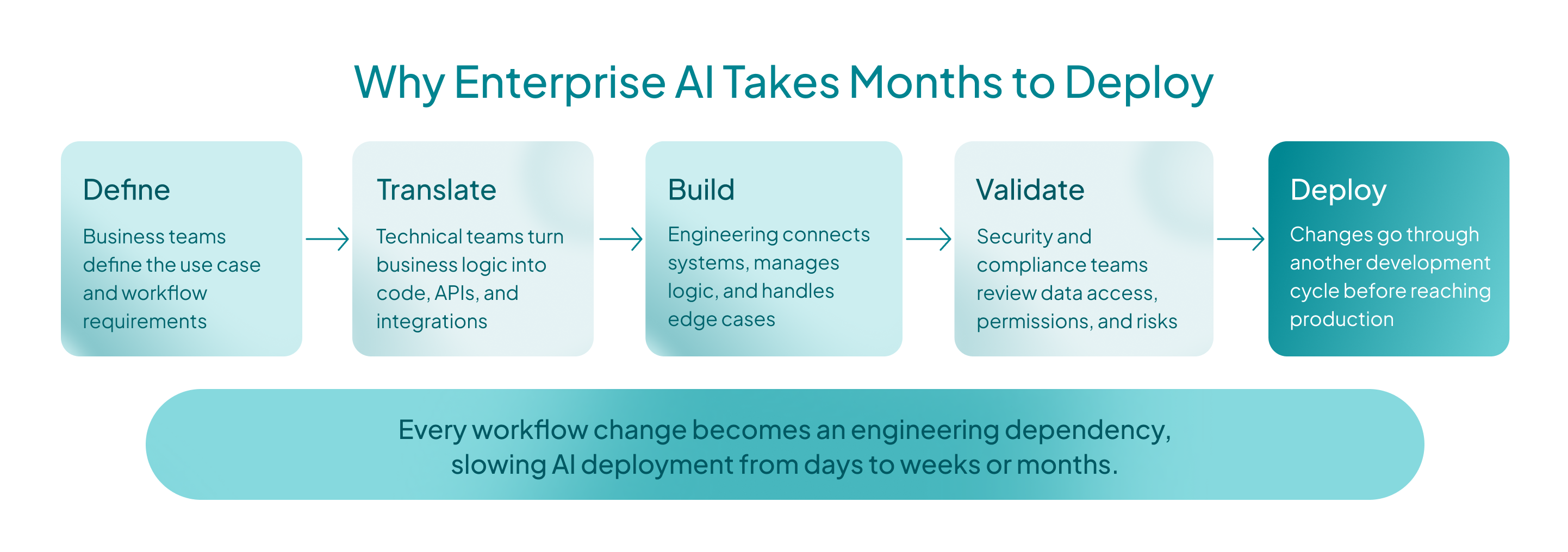
What should take days stretches into weeks or months. Every new requirement turns into a queued ticket for engineering. Business teams understand customer behavior and operational pain points best, yet they remain dependent on scarce technical resources to build agents, maintain custom JavaScript functions, and manage external API calls.
Organizations can no longer treat every agent deployment as an extended software project. They need a scalable, production-tested AI agent builder to design, test, and launch intelligent workflows without technical friction.
An AI agent builder is a platform that lets teams design, test, deploy, and improve AI agents without building the underlying orchestration infrastructure from scratch. Instead of treating every agent as a custom software project, it gives teams a structured environment to define how an agent should reason, access information, use tools, execute workflows, and operate within defined guardrails.
The difference between an agent builder and a basic chatbot or automation tool is what happens beyond the response. A chatbot can understand a request and generate an answer. Traditional automation can execute a predefined sequence of steps. An AI agent can interpret an objective, determine the steps required, use connected systems and tools, adapt to changing inputs, and complete the workflow. An agent builder provides the infrastructure to design and control that behavior.
For enterprises, that means an effective agent builder needs to cover more than agent creation. It should connect to business systems, manage context and state, support complex workflow logic, enforce permissions and guardrails, test agent behavior before deployment, and provide visibility into how agents perform once they are live. The goal is not simply to make agents easier to build. It is to make building and operating them a repeatable business capability.
And this is where the category gets complicated. Not every platform marketed as an AI agent builder is designed for the same level of complexity. Some make it easy to prototype an agent but become difficult to manage once workflows involve multiple systems, unpredictable user behavior, or production-scale execution.
That is the gap between building an agent and building one that can actually survive production.
Agentic AI tools did not emerge simply because companies wanted to build agents faster; they emerged because the role of artificial intelligence itself evolved. Enterprise systems must now understand complex user intent, execute multi-step logic, integrate with core business systems, and deliver outcomes across voice, chat, email, and messaging channels.
The market promise behind AI agent platforms is straightforward: enable non technical teams to create AI agents without writing code, design complex workflows effortlessly, connect to enterprise databases, and maintain enterprise grade security.
That is the pitch. In production, most tools fall short.
Most platforms hand users a basic prompt wrapper or a visual builder with a complex drag and drop canvas, labeling it a no code solution. These visual workflows look impressive in sales demos when handling linear tasks.
However, when pushed to execute complex tasks, handle multi agent orchestration, or run external API calls, most no-code tools stall. The drag and drop interface turns into a maze of spaghetti nodes that non technical teams cannot debug.
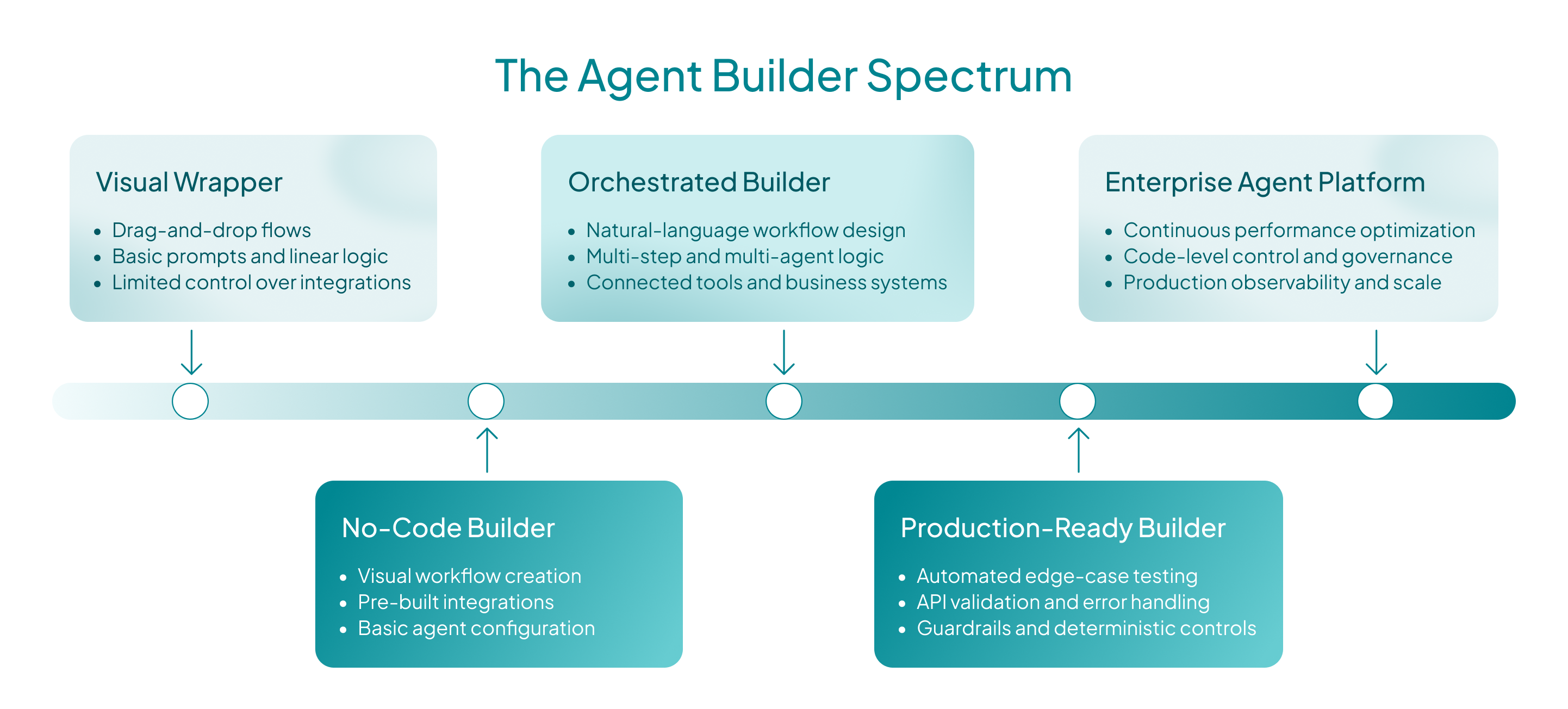
Furthermore, tools like basic low code builders or open source templates often require enterprise teams to bring their own API keys, manage Virtual Private Cloud infrastructure, or navigate complex paid plans start tiers just to access basic features.
A free plan or entry-level tier might let a solo developer build their first AI agent or set up a basic AI assistant, but scaling to enterprise volume reveals deep architectural gaps:- Lack of Real-Time State Management: Agents lose context across multi-step conversations.
- Fragile Tool Integration: Minor schema updates in external systems break live agent execution.
- Manual QA Dependencies: Teams are forced to manually review edge cases rather than relying on automated pre-deployment testing.
An AI agent builder cannot just hide raw code under a visual canvas; it must eliminate operational friction and turn agent deployment into an agile business capability.
If enterprises are going to deploy autonomous systems at scale, the operational benchmark for the right AI agent builder needs an upgrade.
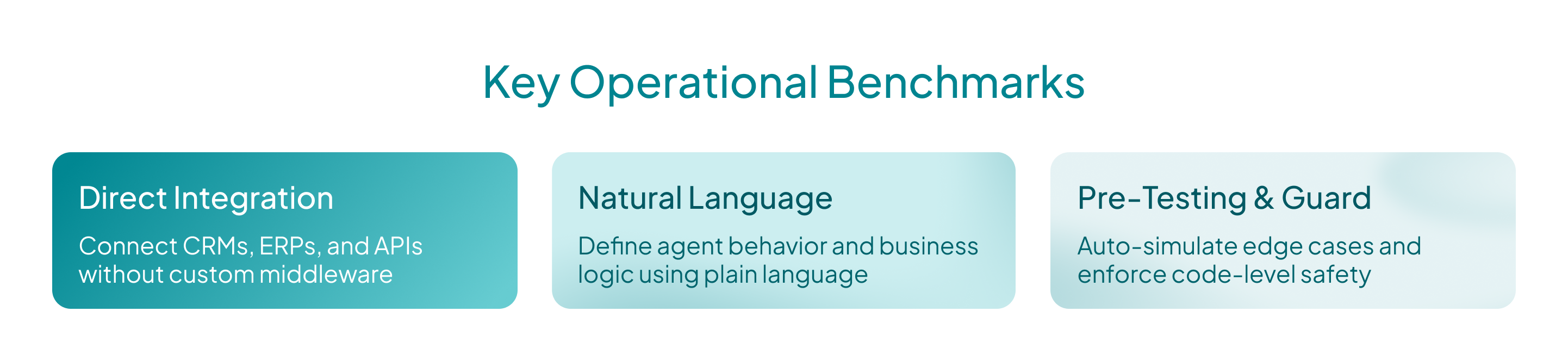
Broad Integration Support Without Technical Bottlenecks
Building Through Natural Language
Automated Diagnostic Testing and Production Guardrails
A common misconception in the market is that adopting a no code platform eliminates the need for technical understanding. Marketing campaigns often claim that anyone can build complex agents with zero preparation.
That promise is incomplete. While a no code interface removes the friction of writing code, building production-grade autonomous systems still requires technical expertise and strategic guidance.
The Role of Tech-Savvy Teams and Forward-Deployed ExpertiseEven with the best AI agent builder, enterprise workflows involve complex integrations, legacy database structures, and strict security compliance. Successfully creating your own AI agent at scale requires tech-savvy professionals who understand system architecture, data normalization, and state management.
This is why forward deployed engineers and technical leads play a vital role. They do not spend months writing routine code; instead, they serve as strategic guides. They help enterprise teams:
- Map complex workflows to proper API structures.
- Configure role based access control and AI model access control to prevent unauthorized data exposure.
- Establish human in the loop governance protocols for high-risk transactions.
- Align agent behavior with core business systems and compliance frameworks.
The ideal platform combines an accessible builder for business teams with precise control, enterprise grade security, and expert technical guidance. This hybrid model ensures implementations move quickly without sacrificing architectural rigor.
While many platforms promise speed in sales presentations, Nugget delivers it in high-volume production environments.
Nugget's builder was designed by a team that had already processed 2.2 billion production conversations, resolving the exact infrastructure flaws that break other platforms. Where alternative tools offer static node trees and incomplete prompt interfaces, Nugget fulfills what an enterprise platform ought to be: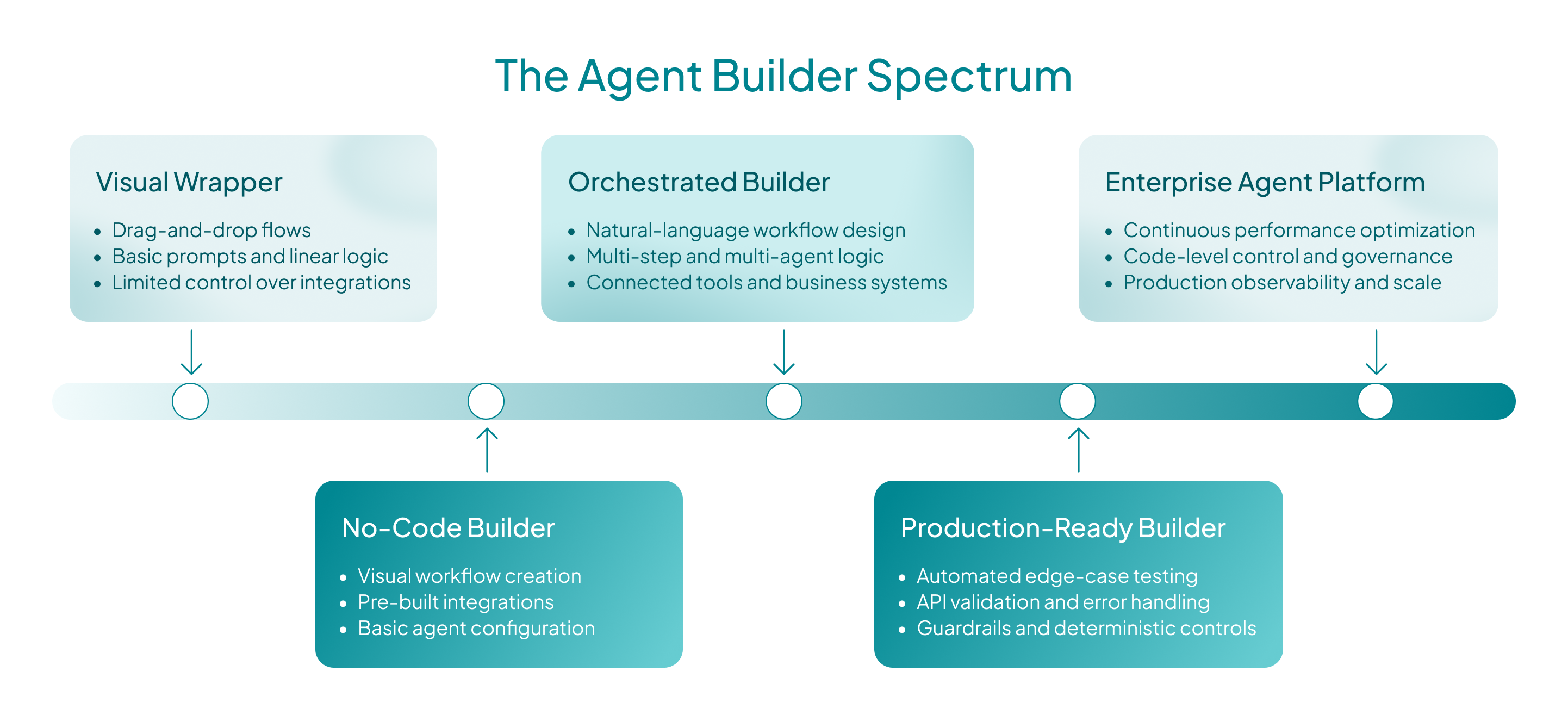
You Build by Talking, Not Configuring
Autonomous, Pre-Deployment Testing
Continuous, Data-Driven Self-Improvement
Infrastructure-Level Determinism
By combining natural language workflow design with code-level determinism, Nugget enables agents to become fully production-ready in two to three days, rather than two to three months.
Enterprise AI has reached an inflection point. The question is no longer whether organizations should adopt artificial intelligence, but how quickly they can convert technology investments into measurable business outcomes.
The primary bottleneck facing enterprises today is execution velocity. Traditional software engineering cycles cannot keep pace with changing market conditions.
An AI agent builder is designed to solve this problem by accelerating deployment, enabling cross-team collaboration, and making intelligent automation accessible across the organization.
However, choosing the right platform requires looking past visual wrappers and selecting an architecture engineered for production complexity. The future belongs to organizations that can move from idea to execution in days while maintaining full control over security, compliance, and performance.
How does a no code AI agent builder compare with custom AI development?
Why are enterprises moving away from visual drag and drop platforms?
How do enterprise platforms ensure security and compliance?
TL;DR
- Enterprise AI adoption is stalled by traditional development cycles, where minor workflow changes require custom code and engineering tickets.
- Most visual no code tools look clean in demos but fail in production, forcing technical teams back into the loop to write custom JavaScript functions and manage API retries.
- Technology alone is not enough; enterprise deployments succeed when accessible platforms are paired with tech-savvy guidance to manage architecture, security, and integration logic.
- Built on 2.2 billion production conversations, Nugget enables teams to build agents using natural language, auto-simulate edge cases, enforce code-level determinism, and deploy production-ready workflows in two to three days.