How Multilingual Voice AI Helps Enterprises Scale Across Markets
Written by: Manya Singh
Published On: Oct 26, 2026
8 mins

India is not a single market with one dominant language. It is dozens of linguistically distinct sub-markets operating within one regulatory framework. For enterprises scaling customer operations across these regions, deploying a voice AI system that only handles formal English and standard Hindi creates immediate operational friction.
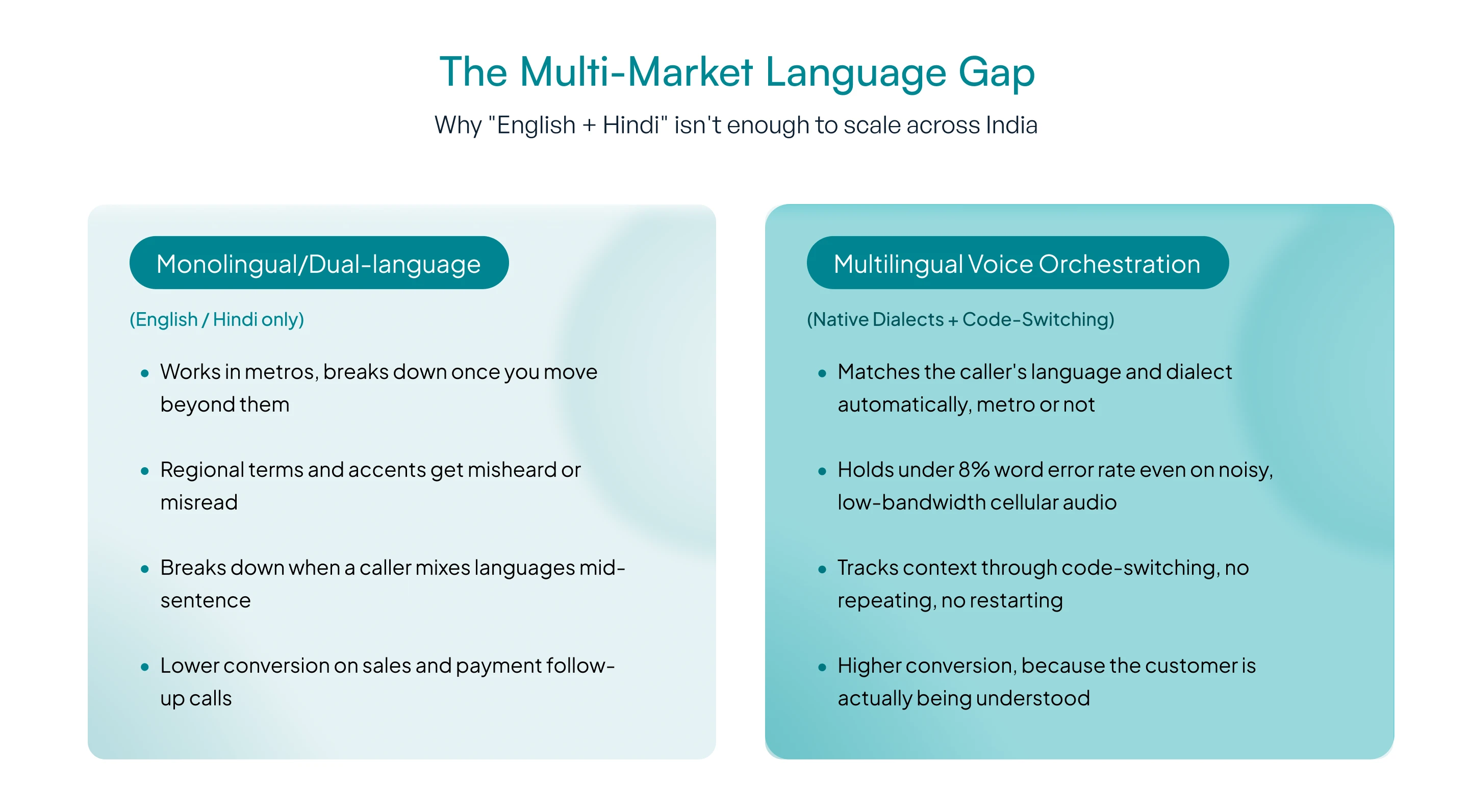
Language match is not a nice-to-have localization feature. It is a core revenue lever. This guide outlines why standard language support claims fail in production, what code-switching and dialect recognition actually require at an engineering level, and where multilingual voice AI delivers measurable business impact.
Many vendor pitch decks rely on vague claims about "hundreds of local dialects." The official baseline established by the Census of India provides a precise picture:
- 121 Spoken Languages: The census classifies 121 distinct languages spoken by populations exceeding 10,000 people.
- Five Language Families: India's linguistic diversity spans five major language families: Indo-Aryan, Dravidian, Austroasiatic, Tibeto-Burmese, and Semito-Hamitic.
- Over 1,300 Mother Tongues: The Registrar General rationalized thousands of raw field returns into 1,369 distinct mother tongues, grouped under those 121 language headings.
Because India's national census updates have faced delays, this Census of India data remains the official government baseline for enterprise market planning.
A language appearing on a vendor's feature matrix is not the same as multilingual capabilities that hold up during a live phone call.
When a platform claims to support many languages or "supports Hindi," it often means it can parse formal, standard Hindi spoken clearly into a high-quality microphone. Production reality is different. Real callers speak regional variants, mix English technical terms into Hindi sentences, and call from noisy streets over compressed cellular networks.
If the voice agent fails to parse regional pronunciation or loses context or cultural nuance when the caller switches to English mid-sentence, the interaction breaks down regardless of what the feature matrix claims.
For enterprise revenue teams expanding into new markets, matching a caller's native language directly impacts operational efficiency and conversion performance.
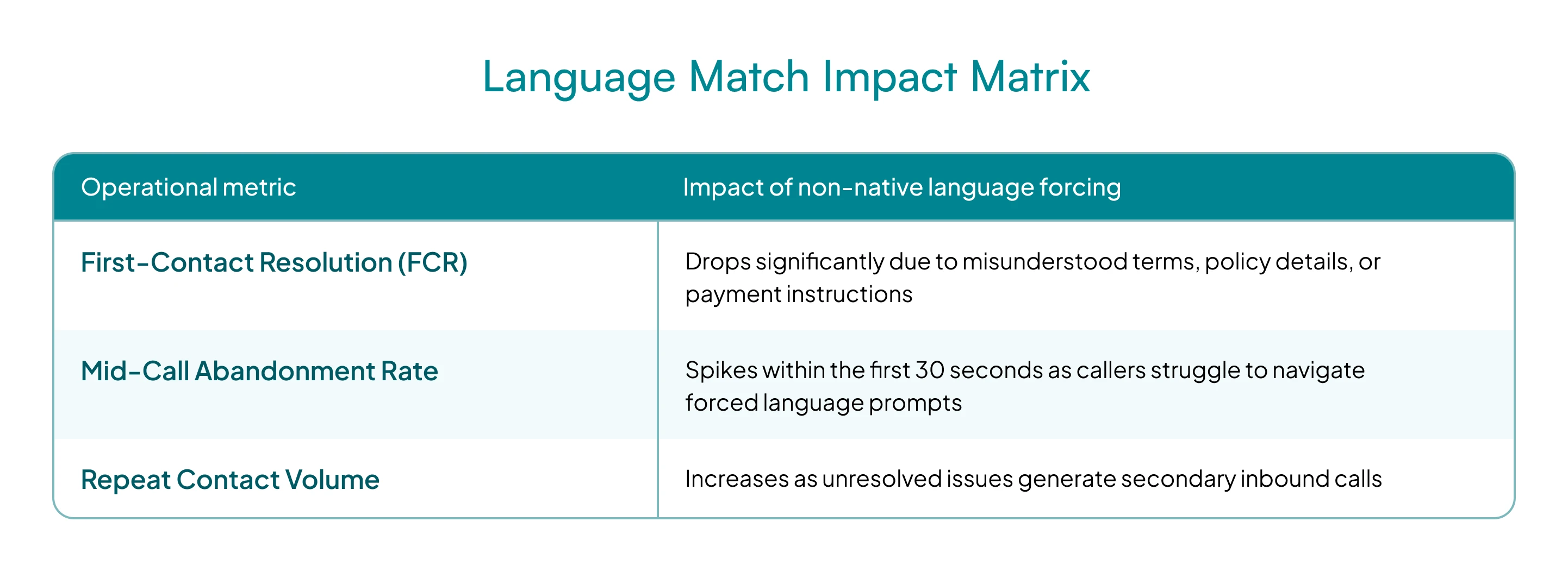
When companies deploy native language match across customer interactions, performance improves across the funnel:
- Conversion Rates: Prospect outreach voice calls conducted in the caller's native language achieve higher engagement and conversion than generic English outreach.
- Resolution Speed: Clear understanding eliminates repetitive clarification loops, shortening Average Handle Time (AHT) while improving first-contact resolution.
- Customer Retention: Delivering empathetic support in a caller's primary language builds brand trust, directly lowering churn in non-metro markets.
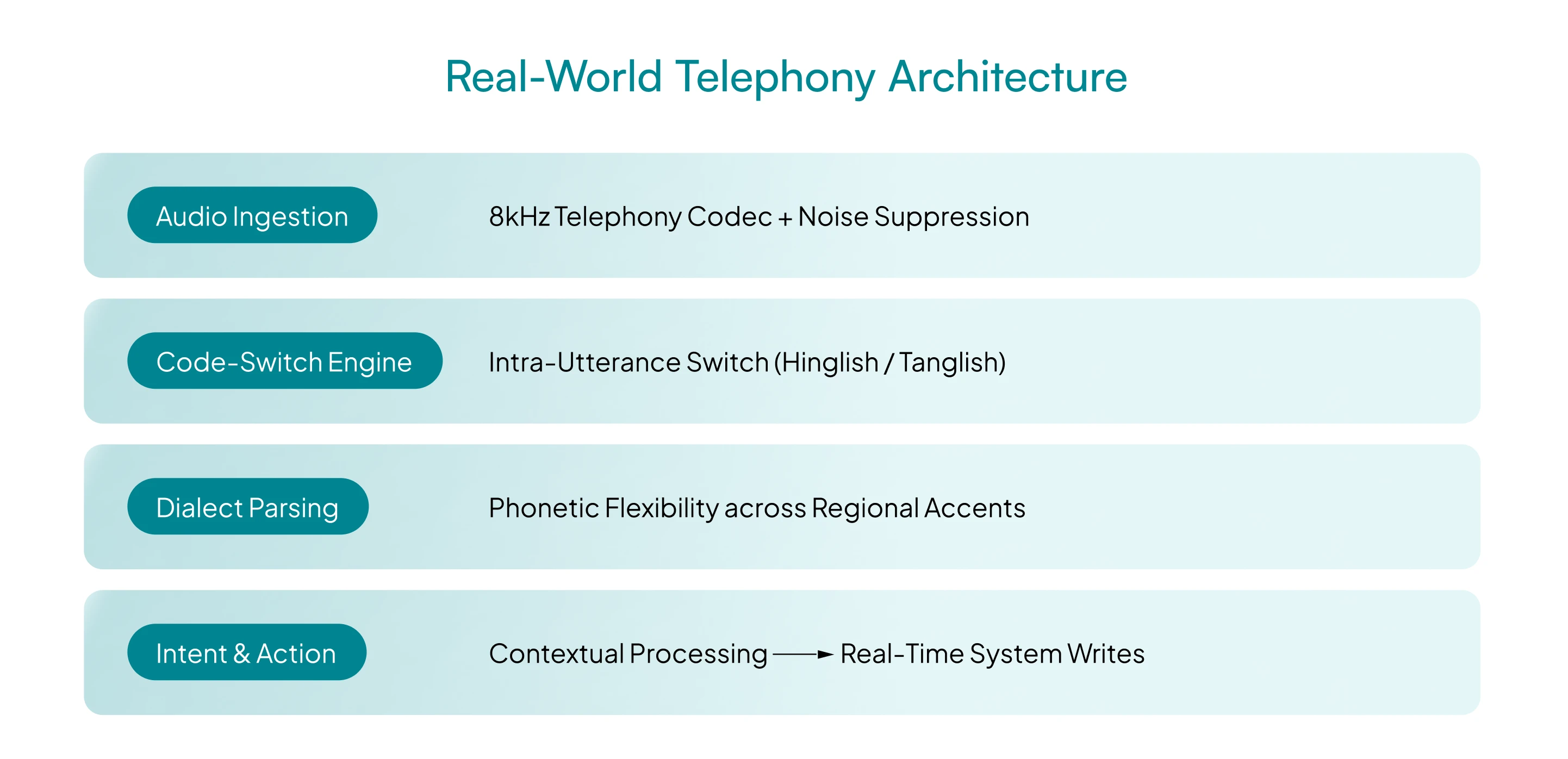
Building a multilingual artificial intelligence platform for real-world deployment requires solving two complex engineering challenges:
- Hinglish: "Mera policy renewal status kya hai, can you please check?"
- Tanglish: "Enna oda claim status check panni sollu, it's urgent."
Code-Switching Detection Within a Single Utterance
Code-switching occurs when a speaker alternates between different languages or several languages within a single sentence. In India, this is the default conversational mode rather than an edge case:
Legacy Speech-to-Text (STT) engines require setting a single target language per interaction. If a Hinglish caller utters an English phrase mid-sentence, the engine mis-transcribes the audio or drops the segment entirely.
Deploying conversational AI with multiple languages requires acoustic engines, natural language processing and large language models capable of detecting language shifts mid-utterance without resetting conversational context.Regional Dialect Recognition
Lending and Collections
Insurance Claims Processing
Banking, Healthcare, and Life Sciences
Enterprise engineering teams encounter three major operational hurdles when scaling multilingual support across global markets:
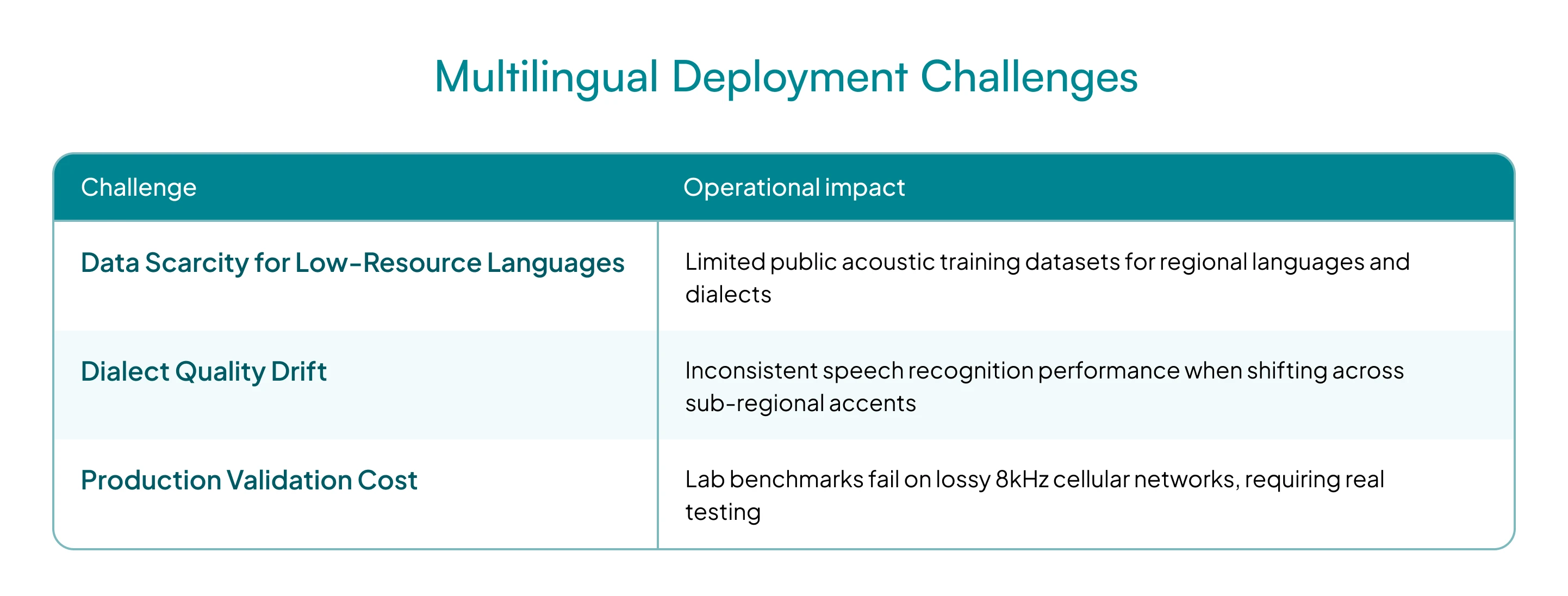
Data Scarcity for Lower-Resource Regional Languages
Dialect Quality Drift
Telephony Audio Validation Costs
Nugget treats language count as a vanity metric. Claiming support for 50 languages means nothing if the system breaks on turn two of a real phone call.
Nugget approaches enterprise AI through a dedicated orchestration platform engineered specifically with the ability to work with real-world Indian telephony conditions:
- Validated on Live Telephony Audio: Nugget trains and validates its speech engines on lossy 8kHz cellular audio containing real background noise, rather than clean studio recordings.
- Targeting Sub-8% Word Error Rate (WER): Rather than relying on lab benchmarks, Nugget targets sub-8% WER under actual production network conditions.
- Native Code-Switching Support: Nugget's acoustic models handle mid-sentence language switching (such as Hinglish, Tanglish, and Tenglish) without losing conversational context.
- Sub-700ms Voice Orchestration: Nugget manages turn-taking, barge-in, and context-switching in sub-700ms latency windows, ensuring conversations feel natural across every supported language.
Expanding across India's diverse markets requires a voice strategy that respects linguistic reality. A single-language or dual-language deployment inevitably limits reach, conversion, and trust in the regions where growth is fastest.
The key takeaways remain that deploying a multilingual conversational AI technology stack is not about translating static scripts. It is about building acoustic and orchestration layers that survive dialect variation, code-switching, and real telephony noise.
By deploying domain-trained multilingual AI on one platform, enterprise leaders convert linguistic diversity from an operational barrier into a competitive advantage.
What is code-switching in voice AI, and why is it critical for Indian markets?
How does telephony audio quality affect multilingual speech recognition?
Can a multilingual voice AI agent switch languages mid-conversation if requested by the user?
TL;DR
India is a multi-language market. The Census of India classifies 121 major languages and 1,369 rationalized mother tongues. Supporting English and Hindi alone leaves significant reach on the table.
Supporting a language on paper does not guarantee real world performance. Voice models must survive lossy 8kHz cellular audio, background noise, and regional pronunciation.
Code-switching is mandatory. Conversational speech naturally mixes languages (Hinglish, Tanglish). Voice AI must detect language shifts mid-sentence without losing context.
Language match drives business outcomes. Delivering services in a caller's native language drives improved customer satisfaction, faster resolution, and lower churn.
Nugget validates for production. Nugget targets sub-8% Word Error Rates under real telephony noise, handling code-switching and regional dialects in sub-700ms latency windows.