Speech Analytics: The Enterprise Guide to AI-Powered Call Analysis
Written by: Manya Singh
Published On: Oct 15, 2026
9 mins

Most contact centers operate with a massive operational blind spot. Today, the vast majority of enterprises evaluate customer experience by having human quality assurance analysts manually review a tiny sample of recorded calls, typically just 1% to 2% of total customer calls. This means that over 98% of voice interactions occur completely in the dark, generating zero structured data, zero compliance tracking, and zero valuable insights to drive operational efficiency.
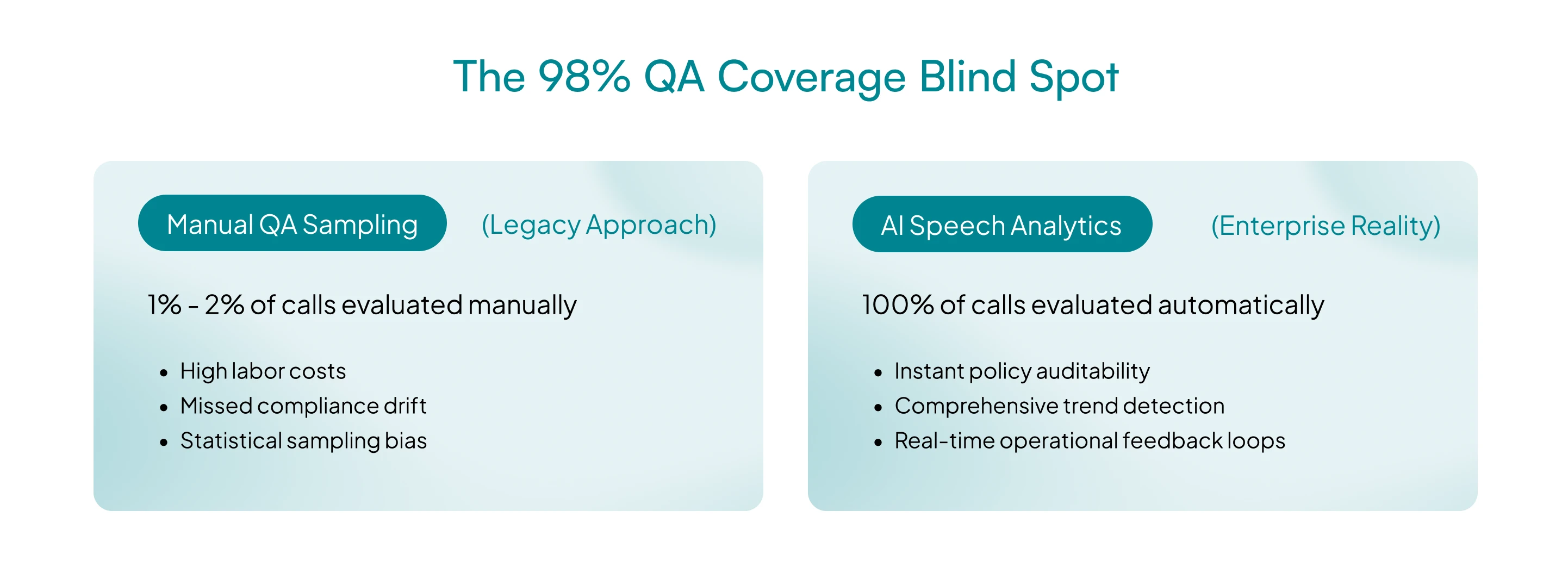
Relying on manual spot-checks is no longer viable for enterprise operations. Utilizing speech analytics software transforms voice calls from unsearchable audio data into structured, real-time intelligence assets.
Why is speech analytics important? Because it shifts organizations from reactive QA to proactive governance. This guide outlines how a speech analytics solution actually works, why moving from sampling to 100% coverage transforms contact center performance, and how enterprise teams connect offline analytics directly to real-time agent execution.
Speech analytics is not a single feature or a basic transcription tool. It is an integrated category combining speech and text analytics, speech recognition, and natural language processing (NLP) capabilities designed to process unstructured phone calls and customer conversations at scale.
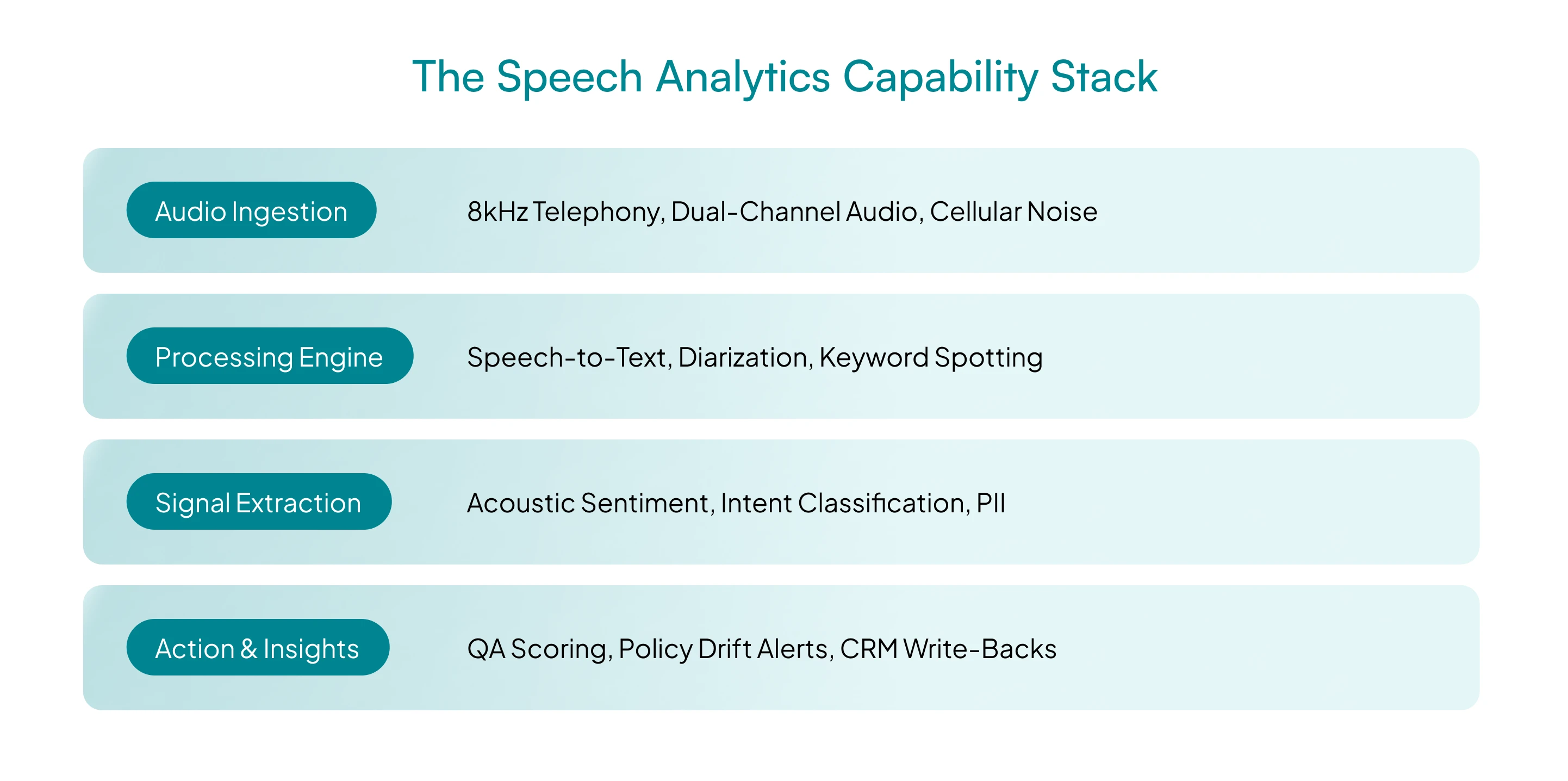
A comprehensive enterprise speech analytics platform comprises five key features:
High-Accuracy Transcription & Speaker Diarization
Keyword and Phrase Spotting
Acoustic Sentiment and Emotion Detection
Intent and Root-Cause Classification
Aggregate Pattern and Trend Detection
The fundamental limitation of manual QA is statistical rather than operational. Inspecting 1% of calls is a sampling flaw that leaves enterprise teams vulnerable to systematic operational risks.
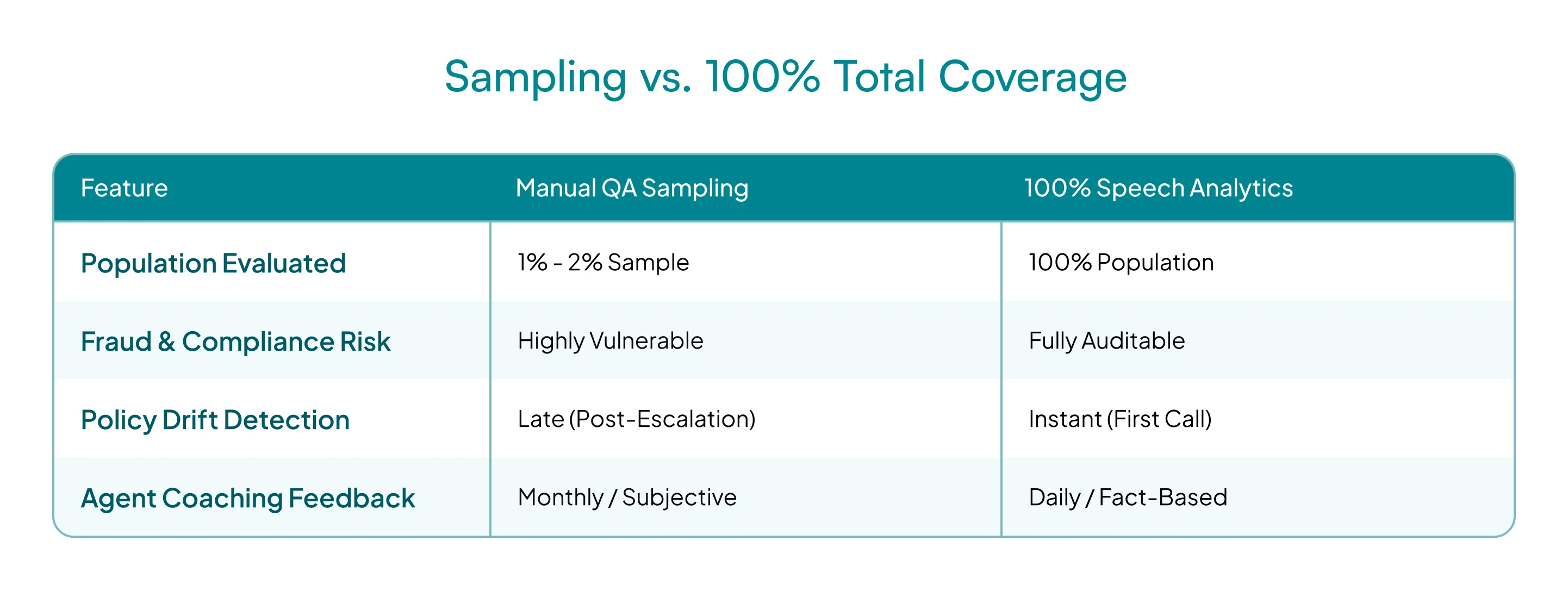
When QA teams evaluate a small, random selection of calls, critical failures slip through unnoticed:
- Silent Compliance Failures: If an agent omits a legally required disclosure on 10% of their calls, a 1% random sample will likely miss the violation entirely, exposing the enterprise to regulatory penalties.
- Undetected System Outages: When a subtle software bug causes payment failures for a specific customer segment, manual QA takes weeks to identify the pattern. Total call coverage highlights the spike in specific phrase mentions within hours.
- Unfair Agent Scoring: Human QA sampling often penalizes agents based on a single bad interaction caught in a random pull, rather than evaluating their true average performance across hundreds of calls handled over the month.
Shifting to 100% coverage via speech analytics tools converts quality management from subjective spot-checking into an objective, data-driven governance framework.
When integrated into contact center operations, a speech analytics solution delivers value across multiple business functions:
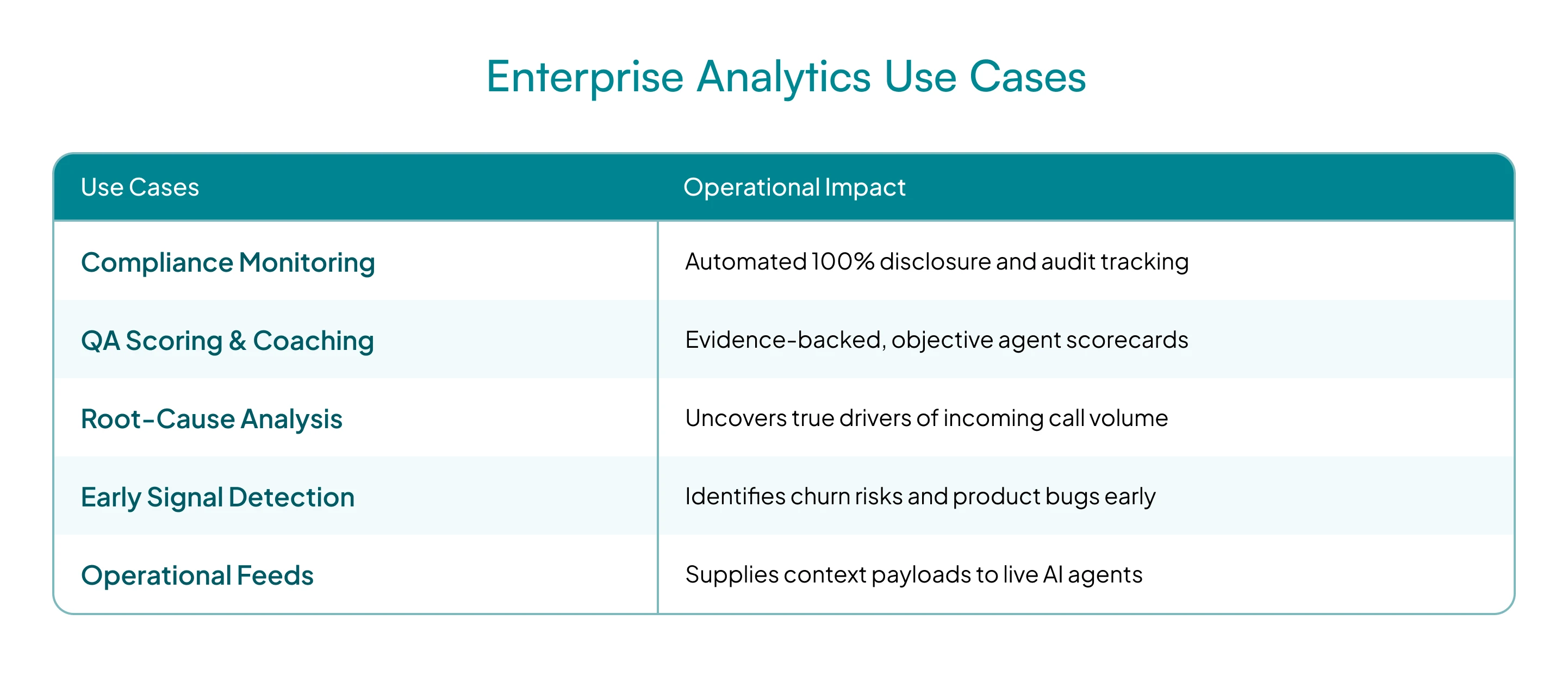
Automated Compliance and Disclosure Monitoring
Objective QA Scoring and Targeted Agent Coaching
Root-Cause Analysis Across Call Volume
Early Signal Detection and Reducing Customer Churn
Feeding Structured Signals into Agent-Assist and Routing Engines
While speech analytics provides deep operational visibility, it is important to recognize its structural boundaries: analytics tells you what happened, but it cannot act on the information autonomously.
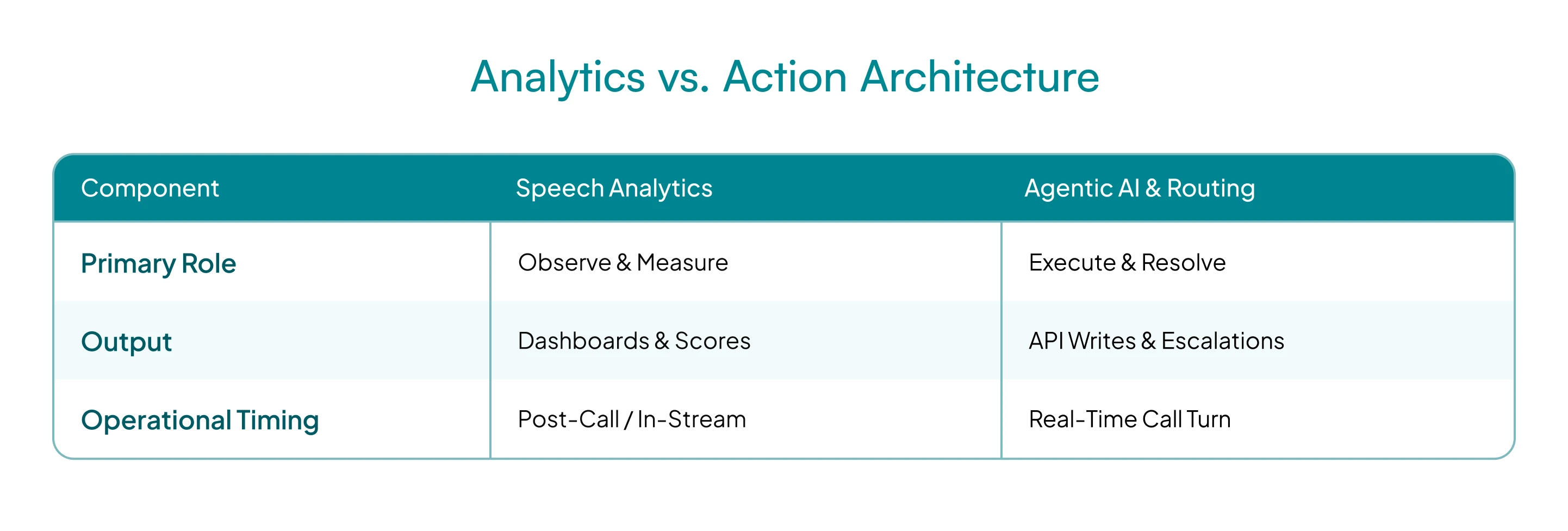
Identifying that a customer is highly frustrated or that an agent is struggling with a complex process is only half the battle. If the analytics engine operates in isolation, those customer insights sit passively in a management dashboard while the customer churns.
To close the loop, enterprise teams must use speech analytics in tandem with agentic execution systems across voice and digital channels. An analytics engine detects the compliance gap or escalation risk; agentic AI platforms and dynamic routing harnesses are what act on that signal in real time to implement corrective measures.
Nugget bridges the gap between passive call observation and live operational execution by embedding speech analytics directly into its core orchestration architecture to improve operational efficiency.
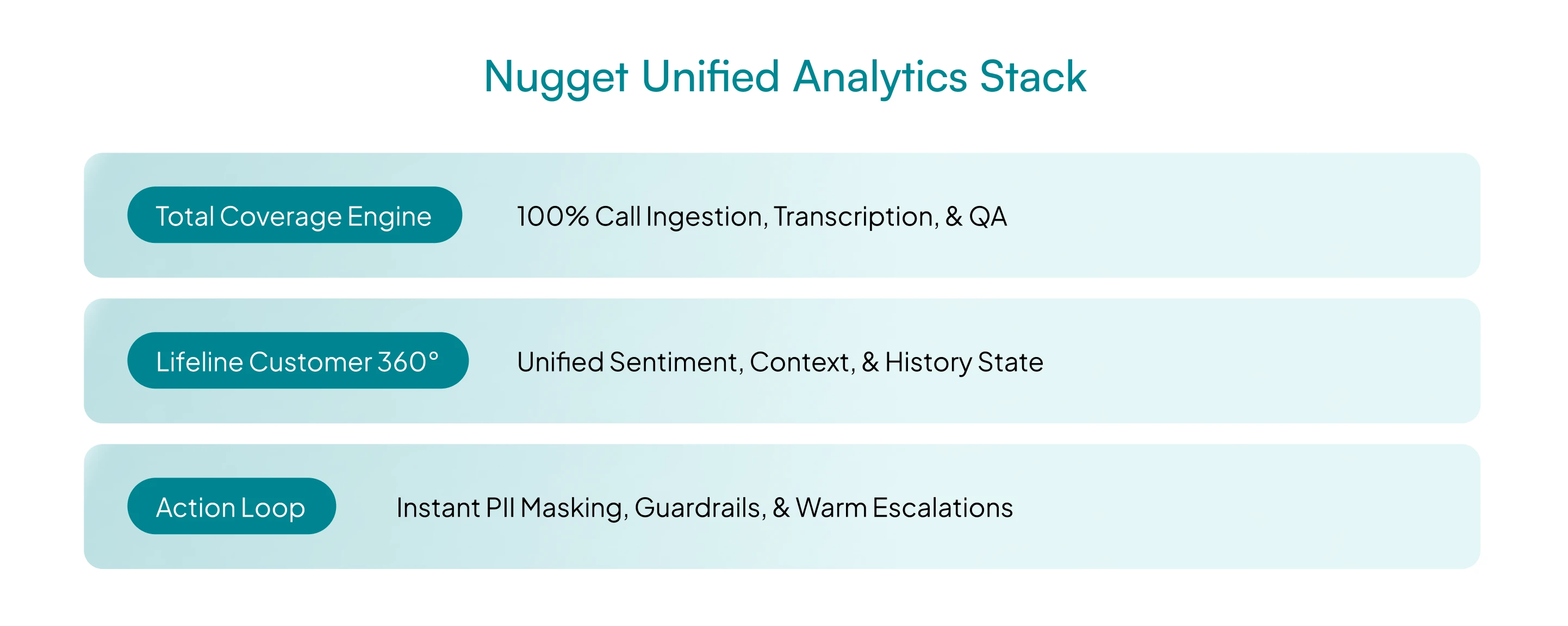
- 100% Ingestion & Quality Monitoring: Nugget enables teams to analyze customer interactions across 100% of live voice interactions rather than relying on manual QA samples, ensuring every conversation is scored for policy adherence and service quality.
- Unified Lifeline Customer 360 Context: Customer feedback and signals extracted during call analysis do not sit in isolated reporting tools. Nugget feeds sentiment signals, extracted entities, and intent trajectories directly into its unified context engine, making them instantly available if the customer switches to WhatsApp or chat.
- In-Stream PII Redaction & Guardrails: Nugget runs real-time security harnesses that redact sensitive PII (such as card numbers and PINs) from audio streams and transcripts before data reaches analytics storage or language models.
- Production-Tested Latency & Reliability: Engineered to survive high-concurrency enterprise environments, Nugget maintains flat latency profiles and full-duplex audio processing across cellular telephony networks.
Deploying enterprise speech analytics to extract actionable insights transforms contact centers, lowers compliance exposure, and accelerates resolution.
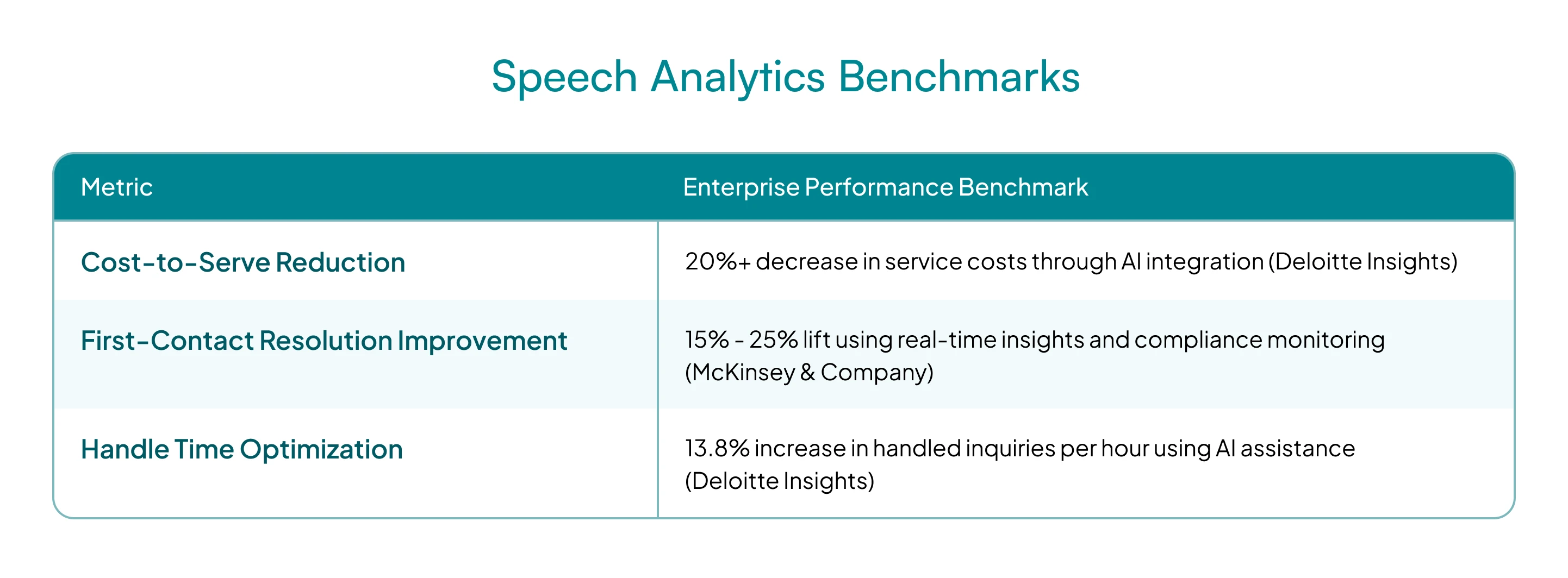
Enterprise data illustrates the operational impact of leveraging artificial intelligence to extract meaningful insights:
- Lower Cost-to-Serve: Data published by Deloitte shows that 39% of service leaders report lower cost per contact as a result of AI, while 43% believe AI will let them reduce contact center costs by 30% or more within three years.
- Improved Agent Efficiency: Research from Deloitte shows that 64% of service leaders report higher agent productivity from AI.
Audio Quality and Accent Variations
Integration with Existing Workflows and Sales Optimization
Avoiding "Insight Fatigue"
Speech analytics is no longer a luxury tool reserved for post-call quality audits. It is essential enterprise infrastructure that transforms unstructured voice conversations into structured, searchable operational intelligence.
By moving from 1% manual QA sampling to 100% total call coverage, organizations eliminate compliance blind spots, uncover the true root causes behind call volume, and coach agents using objective evidence rather than subjective impressions.
When connected directly to a real-time orchestration platform like Nugget, speech analytics bridges the gap between observation and action, turning insight into live operational execution.
What is the difference between speech recognition and speech analytics?
How does speech analytics handle PII and data privacy compliance?
Can speech analytics evaluate live calls in real time, or is it only post-call?
TL;DR
Eliminate the 98% blind spot. Manual QA sampling evaluates only 1% to 2% of calls, leaving over 98% of customer interactions unmonitored.
Coverage beats accuracy alone. Moving to 100% total call coverage turns quality control from subjective spot-checking into comprehensive, objective governance.
Acoustic signals reveal true sentiment. True speech analytics evaluates vocal tone, pitch, and hesitation alongside text to detect customer frustration.
Analysis must lead to action. Speech analytics identifies frustrated callers or compliance gaps, but it must connect directly to agentic execution systems to resolve them.
Deloitte data shows 39% of service leaders report lower cost per contact and 64% report higher agent productivity from AI.