Voice AI Use Cases for Fintech Customer Support: From Demos to Production
Published On: Oct 8, 2026
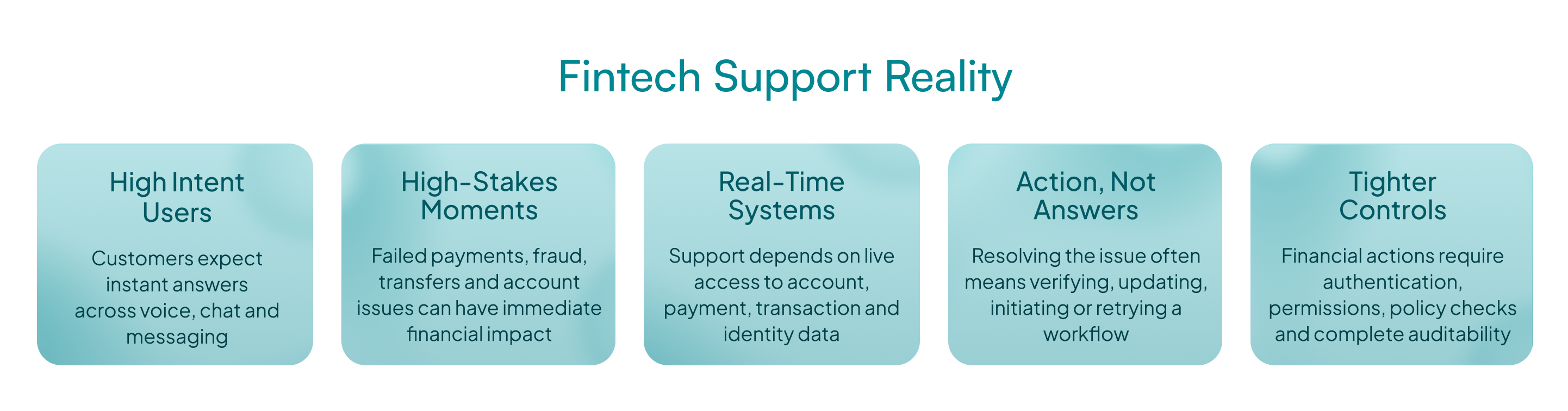
Fintech companies are based on a completely different economic model from that of traditional financial institutions. Since they do not have a network of physical branches or conventional multi-tier call centers, the digital-first fintechs have to set up their support systems from the beginning. In the case of a customer contacting a fintech, the consequences are almost immediate. Rather than simply asking a general question about mortgage rates or looking around at the range of products, they are facing time-critical financial difficulties, for example a payment that has been declined at a register, a suspected fraudulent charge on a virtual card, or the app login being locked.
While text chat handles routine digital queries well, urgent moments force customers straight to the phone to hear a reassuring voice. This guide focuses specifically on concrete voice AI use cases in fintech support: where voice AI for fintechs drives real operational resolution, why text chat falls short during critical moments, and what a production-grade voice AI architecture requires.
Implementing fintech voice AI is an operational shift away from rigid IVRs toward automated natural conversation. For modern companies, fintech teams, and early adopters, adopting AI agents is not just about adopting new AI or AI tools; it is about building a modern infrastructure requirements stack that delivers a clear competitive edge across industries.
Why Voice Specifically, Not Just Chat, Matters in Fintech
Text chat works well for low-urgency inquiries like updating a profile bio or checking a rewards balance. However, relying solely on text chat during urgent financial moments creates friction.
When a customer's debit card gets declined during a transaction or an unauthorized transfer alert fires, typing into a chat widget feels painfully slow and rigid. Customers naturally seek a phone line to speak to someone immediately. If that phone call lands in an automated system that forces them to navigate complex keypad menus or wait on hold, customer trust drops instantly.
2
Acoustic Signals and Emotional Context
Text messaging strips out emotional nuance. In contrast, voice audio carries vital acoustic signals, including speech pace, vocal pitch, hesitation, and background stress. A customer whose account was locked due to a false-positive fraud trigger sounds fundamentally different from a user calling to ask about routine direct-deposit posting times. Voice bots analyze acoustic sentiment in real time, adjusting tone, accelerating resolution paths, or escalating high-distress callers directly to specialized human agents in fraud teams. Maintaining this human touch preserves trust during high-stakes banking interactions.
Core Voice AI Use Cases in Fintech Support
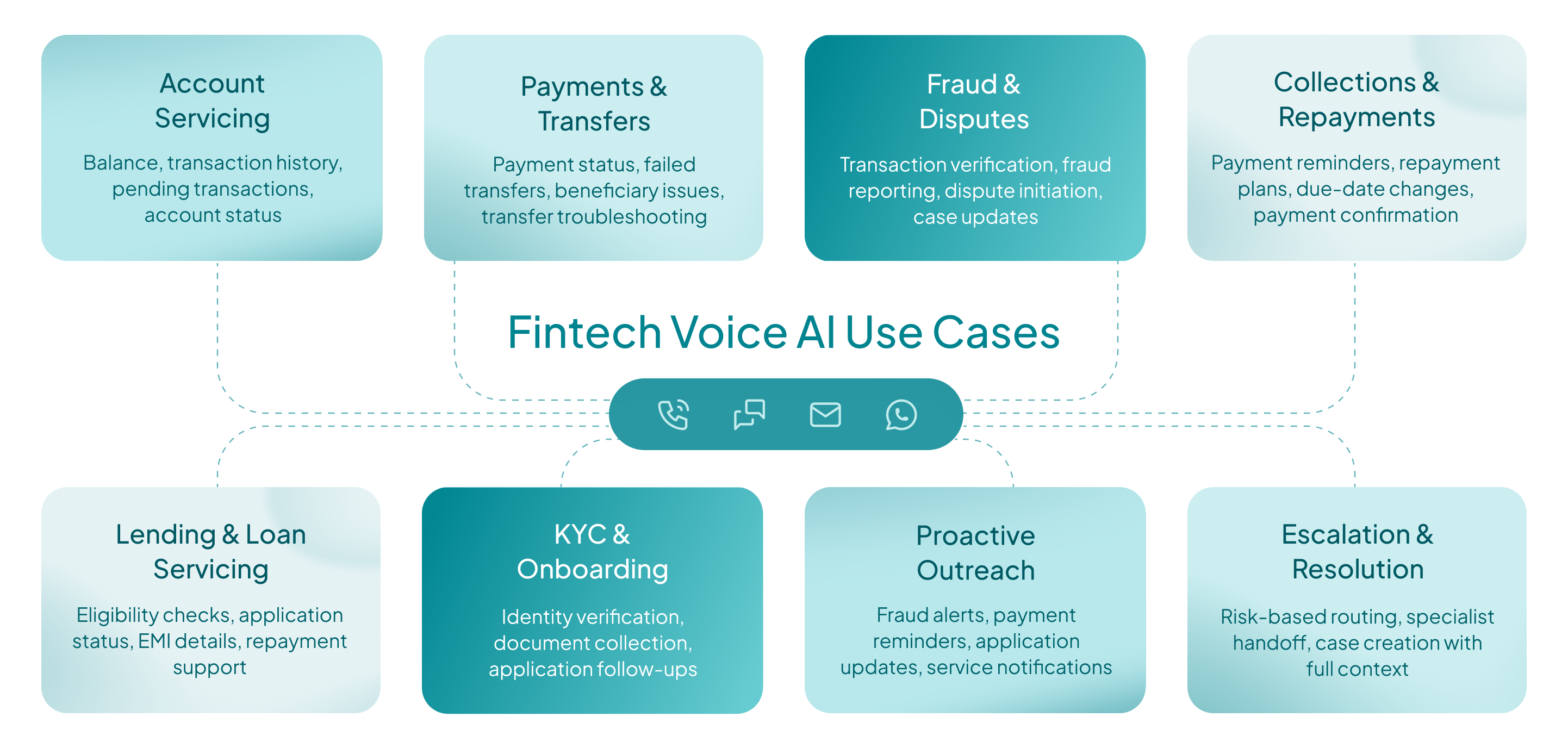
To deliver measurable ROI and the core benefits of voice AI, fintech teams choose to deploy voice agents across specific, high-volume operational paths rather than using generic greeting bots.
1
Balance, Transaction, and Payment-Status Queries
The highest-volume call driver in consumer
financial services is checking recent account activity, performing balance checks, or requesting account updates. A fintech voice agent authenticates the caller, connects directly to core banking ledger APIs, and reads back balances, pending merchant holds, or clearing dates in natural language.
2
Card Lock, Unlock, and Immediate Replacement
Losing a physical card or suspecting a breach requires rapid action. A fintech voice AI agent verifies the user's identity, locks the card in the card-issuing processor mid-call, issues a temporary virtual card directly to the user's mobile wallet, and orders a physical replacement without transferring the call.
3
Fraud Alert Verification and Dispute Initiation
When an automated fraud detection model flags a transaction, speed prevents loss. Outbound fraud alerts powered by conversational AI call the user, confirm whether they authorized the charge, and take instant action to conduct transactions safely. If unauthorized, the agent blocks the card, logs dispute details, and initiates a chargeback file directly into the fraud engine.
4
Failed Payment Troubleshooting
When an ACH transfer fails or a recurring subscription gets declined due to insufficient funds, users often do not understand the raw decline code. Voice AI agents interpret error codes, explain the issue clearly (such as an expired card or daily spending limit breach), and walk the user through instant retry steps.
5
KYC and Onboarding Identity Verification
During account management setup, Know Your Customer (KYC) failures cause user drop-off. Outbound or inbound voice agents walk new users through document re-submission, verify identity details against compliance databases, and guide them through selfie or biometric verification steps.
6
Proactive Outbound Communication
Proactive outreach prevents inbound call surges.
AI agents deliver automated outbound calls for time-sensitive events, including low-balance warnings ahead of scheduled bills, suspicious login alerts, setting a travel notice, or sending service disruption notices to engage customers.
Many voice AI platforms perform well during controlled, 30-second vendor demos but fail under real production traffic.
Deploying production-grade voice AI in financial technology requires three technical pillars:
- Authentication Before Action: A voice agent cannot answer account questions or lock a card without verifying identity first. Production platforms integrate with OAuth 2.0, multi-factor authentication (MFA) push triggers, or voice biometrics before granting read/write access.
- Real-Time System Execution: A voice agent that merely reads static articles is just an expensive search bar. Production systems require two-way API write access to core banking ledgers, card management platforms, and transaction monitoring gateways to complete transactions end-to-end within a single interaction turn.
- Dialect and Code-Switching Resilience: Fintech users represent diverse demographics. Voice engines must provide a multilingual voice capable of handling multiple languages, regional accents, background acoustic noise, and mid-sentence code-switching over lossy 8kHz cellular connections.
Security and Compliance Considerations Specific to Voice
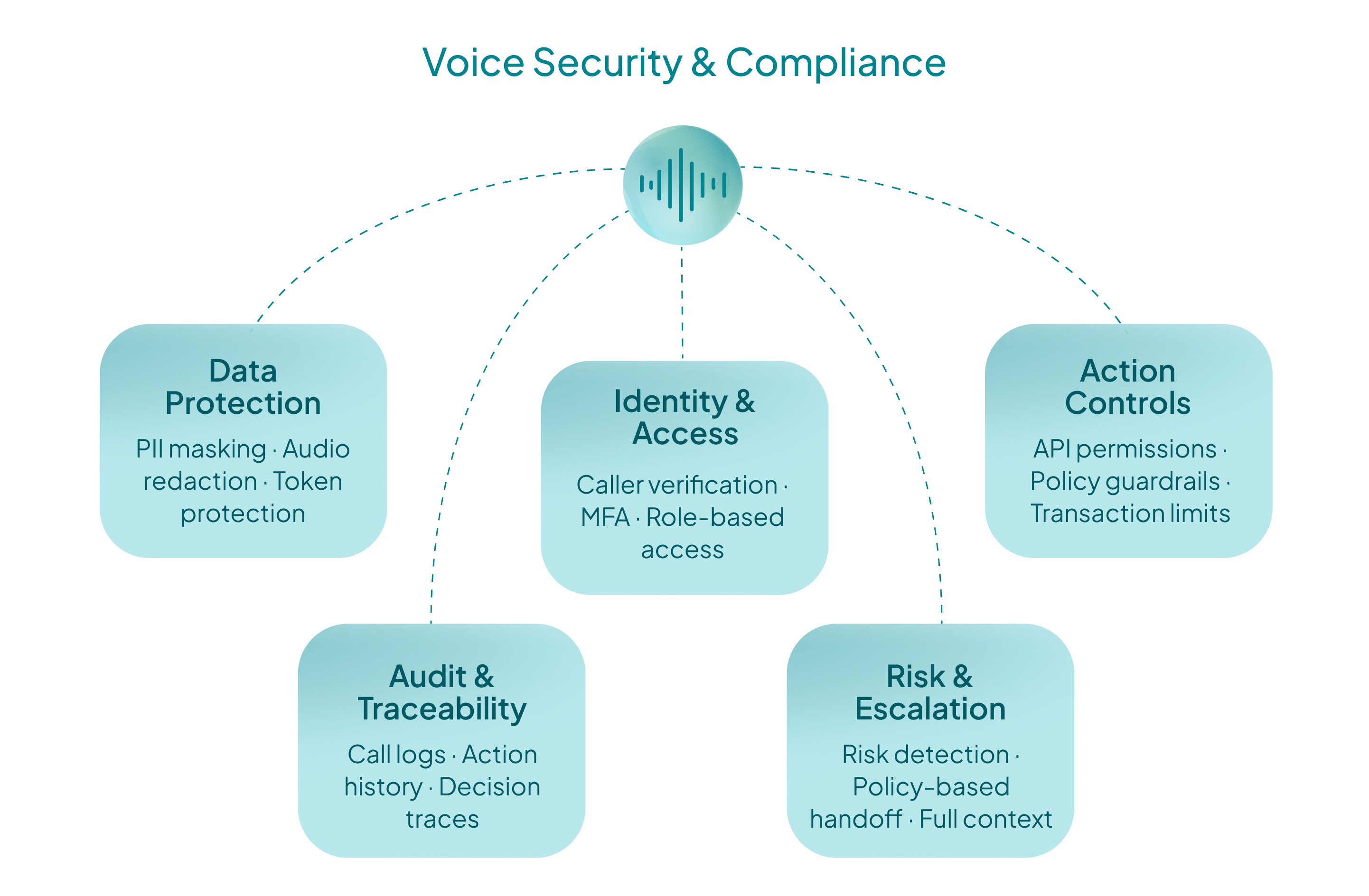
Voice AI introduces distinct security and compliance constraints that text-based interfaces do not face.
Fintech compliance teams must address three critical security and regulatory requirements:
1
In-Stream PII Masking in Audio Logs
Call recordings and transcript logs containing sensitive data or sensitive financial data (like credit card numbers, CVVs, or Social Security numbers) create compliance exposure. Enterprise voice AI platforms run in-stream redaction to ensure PCI DSS compliance, stripping PII from audio streams and text logs before they reach storage or language model endpoints.
2
Anti-Spoofing and Voice Authentication
Synthetic voice cloning makes audio-only identity verification risky. Production systems enforce zero-trust authentication, triggering a secure push notification to the user's mobile app or requiring a one-time passcode (OTP) before authorizing high-risk transactions like wire transfers or password resets.
3
Deterministic Guardrails over Unconstrained Generation
Generative language models naturally attempt to keep conversation flowing, which can lead to unscripted promises or policy errors. Voice AI systems require deterministic guardrails that enforce code-level strict regulatory requirements, ensure mandatory disclosures are spoken, enforce escalation rules, and prevent the system from exceeding its authorized permissions. These safeguards maintain full audit trails to ensure system logs remain audit ready with complete audit trails.
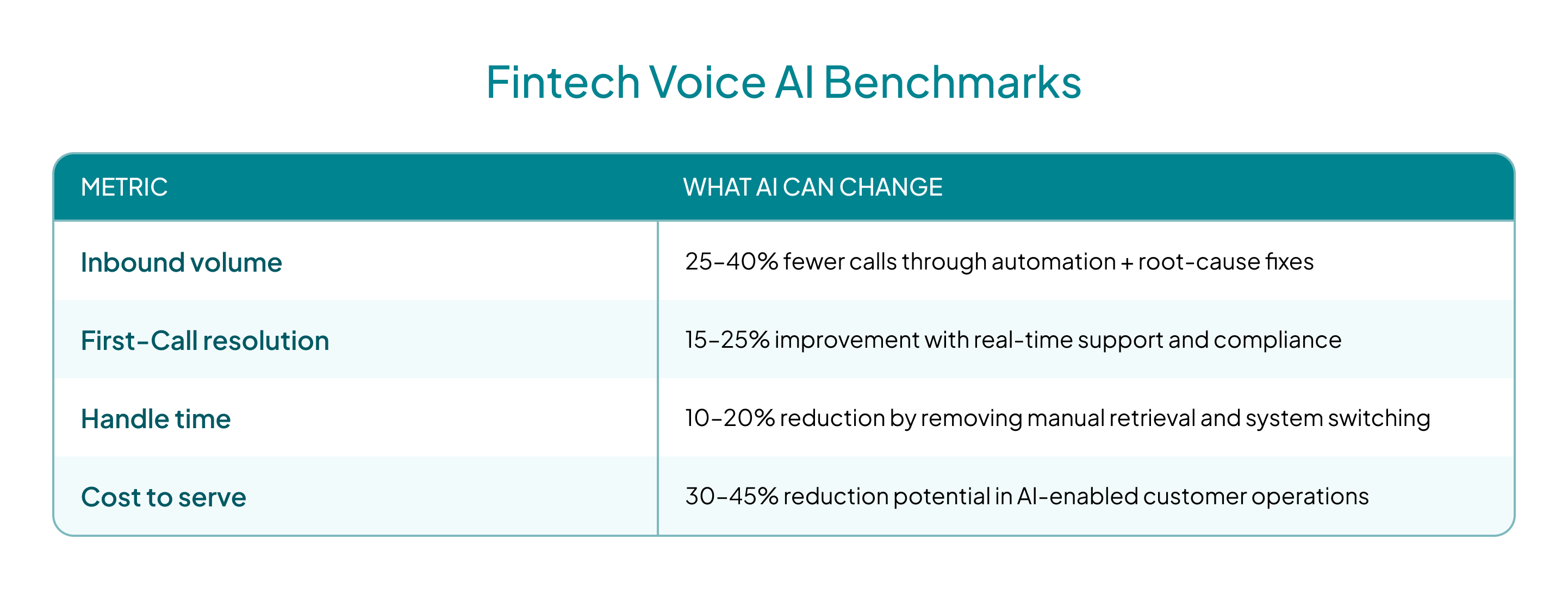
Implementing voice AI across fintech customer support shifts operations from high-cost agent queues to automated, instant resolution, boosting customer satisfaction, customer engagement, and operational efficiency.
Enterprise research highlights the measurable impact of AI adoption across financial operations:
- Inquiry Automation Trends: Research by McKinsey & Company reveals that 35% of organizations plan to fully automate over 60% of inbound customer care inquiries by 2028, with 62% expecting caller authentication and post-call summaries to be completely automated.
- Cost and Productivity Gains: Data published by Deloitte shows that 39% of service leaders report lower cost per contact and 64% report higher agent productivity as a result of AI.
Common Adoption Challenges
Fintech engineering and CX teams face specific operational challenges when working to scale voice AI across their business:
1
Voice Authentication Across Accents and Languages
Speech-to-Text (STT) models often struggle with non-standard accents, background cellular noise, or code-switching. Deploying voice AI globally requires acoustic models fine-tuned on diverse regional telephony audio rather than clean studio recordings.
2
Real-Time Core Banking Integrations
Voice AI requires sub-second response times to feel natural. If a core ledger or integration with a fraud detection API takes 3,000 milliseconds to respond, the voice agent experiences unnatural pauses. Systems require optimized middleware and connection pooling to keep total latency under 800 milliseconds.
3
Managing High-Distress Fraud Escalations
When a caller reports a major account takeover or stolen funds, forcing them through prolonged automated steps increases frustration. Voice AI systems must recognize distress early and execute warm handoffs, transferring the caller to a human fraud specialist alongside a complete desktop context payload.
Voice AI in fintech support is not about replacing human care teams or installing pre-recorded IVR trees. It is about delivering instant, zero-wait resolution during high-anxiety, time-sensitive financial moments. By automating routine inquiries, executing instant card locks, verifying fraud alerts, and delivering proactive updates, voice AI allows fintechs and banks to scale support operations without inflating costs.
When powered by a production-tested platform like Nugget, voice AI transforms customer support into a fast, secure, and reliable operational asset that generates data driven insights for the future of finance.
How does voice AI verify user identity during a call?
Voice AI verifies identity by integrating with zero-trust security layers, triggering multi-factor authentication (MFA) push notifications to the user's mobile app, verifying one-time passcodes (OTPs), or processing voice biometrics before granting access to account data.
What happens when a voice AI agent encounters a complex fraud dispute?
When an inquiry involves complex fraud or high customer distress, the voice AI agent recognizes the context, packages the caller's verified identity, intent summary, and transcript history, and performs a warm handoff to a human fraud specialist.
How does voice AI maintain low latency over 8kHz phone lines?
Production voice AI platforms manage latency by using dedicated streaming harnesses, low-latency Speech-to-Text pipelines, optimized API middleware, and parallel guardrail processing to maintain response times under 800 milliseconds.
TL;DR
Voice matters during urgent moments. Fintech users switch from chat to voice during high-stakes events like card declines, fraud alerts, or locked accounts.
Authentication before action is mandatory. Systems must execute zero-trust MFA or biometric checks before revealing account details or locking cards.
Real-time write access is required. Voice AI must execute actions in core banking ledgers, not just surface static help articles.
Security layers protect data. Enterprise deployments enforce in-stream PII masking, anti-spoofing controls, and deterministic policy guardrails to maintain regulatory compliance.