AI Agents for Call Centers: Why the Headcount Question Is the Wrong Question
Written by: Manya Singh
Published On: Sep 24, 2026
15 mins

Only 20% of customer service and support leaders say artificial intelligence has let them reduce agent staffing. 55% say staffing stayed flat while their teams absorbed higher volume, says Gartner.
That is the most important finding in the whole debate about AI agents for call centers, and almost nobody is reading it correctly.
Search this category and you get two camps. The optimists say AI replaces center agents. The moderates say AI augments them. Both are arguing about the same number: how many call center agents stay on the floor. The tired assumption sitting underneath both positions is that the value of an AI call center solution equals the cost of the human it removes.
The survey record does not support either camp. The dominant outcome is not a smaller team, and it is not a happier version of the same team. It is the same cost base carrying more work, at hours and peaks nobody could previously staff.
Which makes the useful questions different from the ones being asked. How much volume can you absorb without adding heads. How much of what happens inside those customer calls can you actually see. Neither one is a headcount question, and neither one shows up in a cost-per-call table.
Call the first one Capacity Elasticity. It is what enterprises are actually buying when they buy conversational AI for the contact center, and it is measured in volume absorbed per fixed cost base, not in seats removed.
The headcount instinct is not stupid. It is arithmetic. Gartner's 2022 forecast put labor at up to 95% of call center costs, spread across roughly 17 million call center agents worldwide. When 95% of your cost line is people, every efficiency conversation collapses into a staffing conversation within about ninety seconds.
The operating model makes it worse. Capacity is planned against a forecast that is always wrong in one direction or the other. Overstaff and you carry idle occupancy you cannot bill for. Understaff and queue time, abandon rate and attrition all climb together, and the attrition bill lands on the same cost base as a permanent tax: recruit, train, ramp, lose, repeat.
So the cost base is real and the pressure on it is real. That is exactly why the headcount line is the least reliable place to take the savings from. It is the one number in the model that depends on a hiring decision holding for three years.
An AI agent for a call center is a system that understands what a caller wants using natural language understanding and natural language processing, decides what to do about it, takes the action inside your existing systems, and closes the request end to end across voice and digital channels. The conversation is the interface. Resolution is the outcome. That is the difference between a scripted interactive voice response setup and virtual agents: a bot collects information and hands it on, while AI agents finish the job.
Now the record on what buying those virtual assistants actually produced.
Gartner expects half the companies that cut customer service staff because of AI to rehire by 2027, under different job titles. And the ceiling on the substitution thesis is firmer than the category admits: Gartner predicts none of the Fortune 500 will have fully eliminated human customer service by 2028.
Read those two alongside the 55%. Enterprises did not buy a smaller team. They bought the ability to take more volume on the team they have.
Capacity Elasticity is the ability to absorb a volume increase, a seasonal peak or an after-hours shift outside standard business hours without adding headcount and without a drop in service quality. It changes what you measure. Not seats removed. Volume absorbed per fixed cost base, and what happened to customer experience while you absorbed it.
One piece of self-discipline the category never offers you: an AI call system that handles only the easiest 20% of routine requests has not bought you elasticity. It has bought you a plateau, and the plateau will show up in month four when volume moves and the agent cannot.
There is no cost-per-call table in this post. The $7 to $12 human versus $0.40 AI comparison that anchors almost every page on this topic traces back to vendor blogs with no published methodology, and building a business case on it is how CFOs end up defending a number they cannot reconstruct.
Here is what actually moves. Four levers, and they behave nothing like each other.
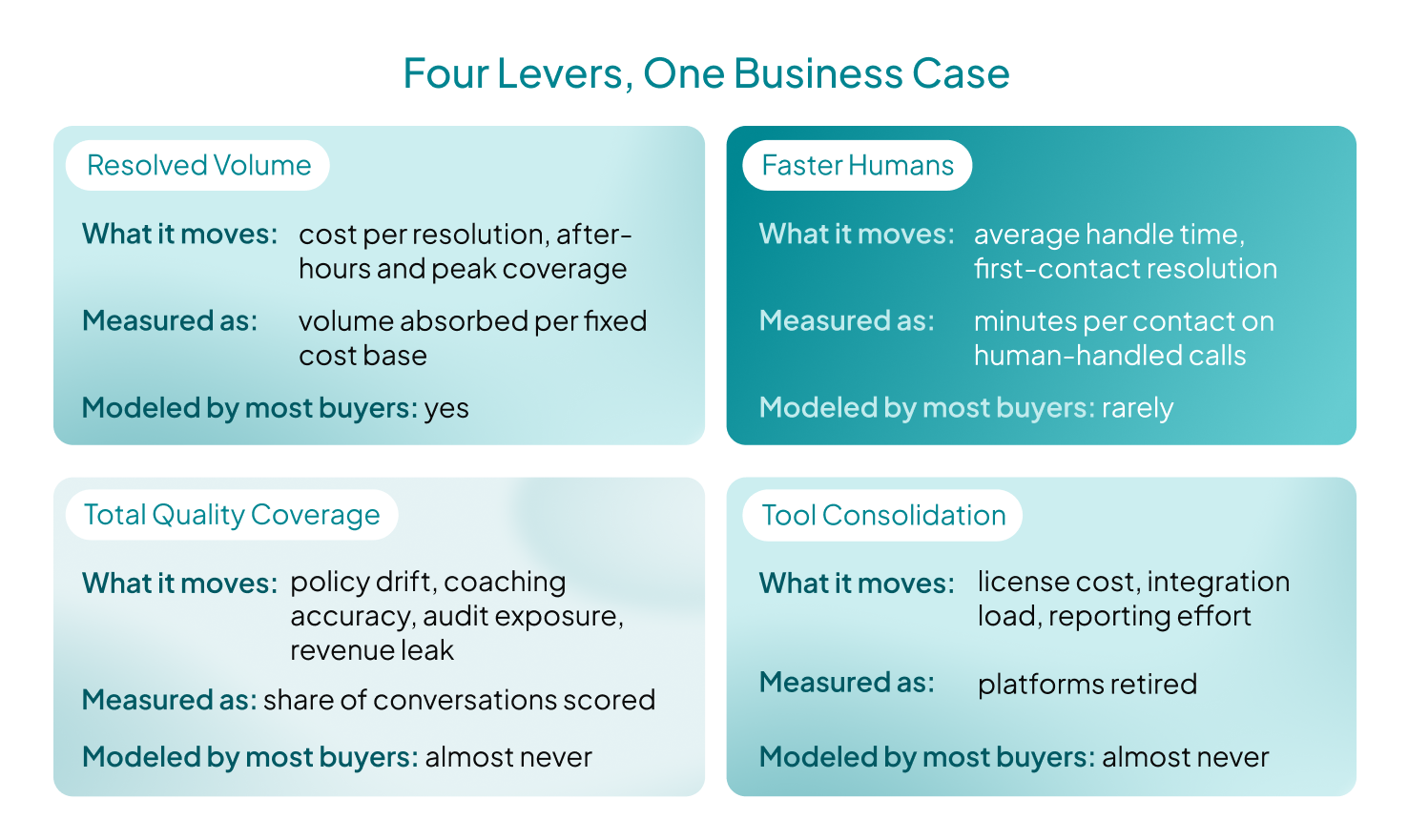
- Lever 1, resolved volume: Calls the voice AI agent or AI voice agents complete end to end, including the ones at 2am and on the fourth day of a sale, eliminating repetitive customer inquiries. This is Capacity Elasticity, and it is the only lever the category discusses. Moves reduced operational costs per resolution and coverage.
- Lever 2, faster humans: Handle time on the calls human agents still take when receiving real time agent assistance. Most third-party evidence sits behind this lever. Almost no coverage does.
- Lever 3, total quality coverage: Moving the quality assurance denominator from a sample to the whole population. A governance capability, a coaching input and a revenue-leak detector, all at once.
- Lever 4, tool consolidation: Platforms retired. Salesforce found that 88% of service leaders are prioritizing technology integration to bring customer data together and eliminate silos, which is the same problem stated as a cost.
According to Deloitte, 43% of organizations believe AI will let them cut contact center operational costs by 30% or more over the next three years. Most of the models behind that belief contain lever one and nothing else.
That is why the payback goes missing in month four. Not because the technology failed. Because three quarters of the return was never in the model.
Every calibration session you have ever sat in rested on a sample. A QA analyst pulls a handful of calls per agent per month, scores them against a rubric, and the organization extrapolates from there to a view of quality across millions of customer interactions. That is not a lapse. It is the only thing human service teams could ever have done.
Automated call handling and automated quality monitoring do not change the scorecard. They change the denominator. Every conversation gets scored across digital channels and voice agents, not a slice chosen by roster or at random.
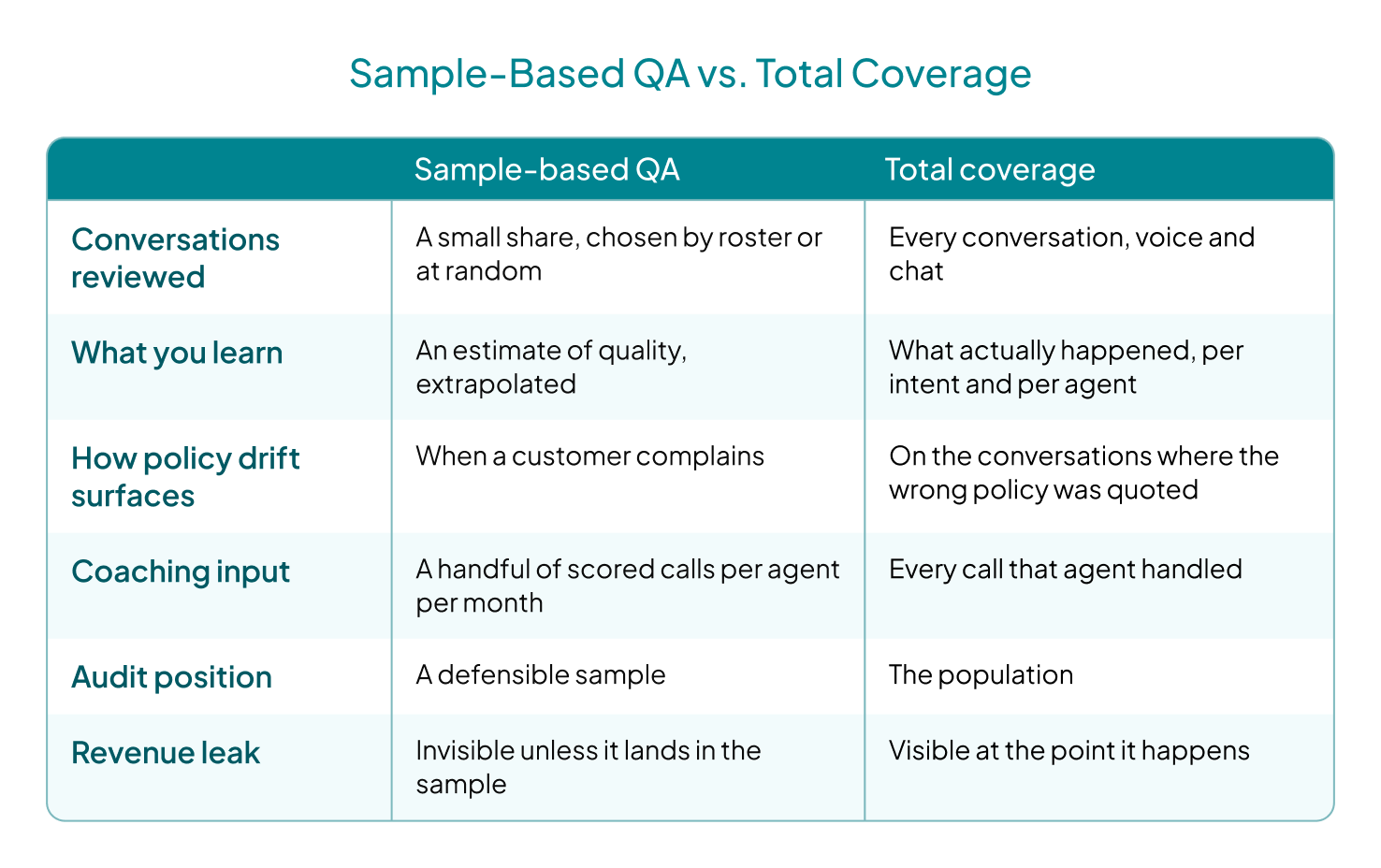
That sounds like a compliance upgrade. It is closer to a new instrument, because analyzing historical data at 100% scale exposes four things a sample structurally cannot:
- Policy drift: After a pricing change, a fee change or a regulatory update, you see the conversations where the old policy was still being quoted, not the one complaint that eventually surfaced it.
- Where handle time is actually climbing: By intent, not by team average.
- Revenue leak at the point it happens: The save conversation that was never attempted, the eligible offer never made.
- An audit position that covers the population: Meeting strict data privacy rules rather than relying on a defensible-looking fraction of data.
The stakes are not abstract. According to PwC, 32% of customers will walk away from a brand they love after a single bad experience. If you review a sample, you are choosing not to know which conversations those were. That is the accumulated blind spot underneath the metrics most CX teams are still reporting on.
One honest limit, because the category will oversell this. Total coverage is a measurement capability, not a quality guarantee. It tells you what happened on every call. What you do about it is still a management decision.
The category treats agent assist as three bullets on the way to the cost table. It is the lever with the most evidence behind it.
64% of service leaders already report higher agent productivity from AI, says Deloitte. That is not a 2029 projection. That is a report about work already done using AI powered tools.
The role is being rewritten, not deleted. According to Gartner, 84% of service leaders plan to add new skills to the agent role and 58% plan to move agents into knowledge bases specialist roles, while 91% report direct pressure from executive leadership to execute implementing AI. That last number is worth sitting with. It explains why the workforce question feels louder than the data warrants.
Here is the receipt nobody in this category uses. At Zomato, average handle time went from 13 minutes to 9 minutes. That did not happen to a bot. It happened to the human teams who stayed, driven by real time insights and real time data access.
And the uncomfortable half, said out loud rather than hidden: Zomato's agent count also went from 4,000+ to around 1,000. That followed call center automation moving from 60% to 80%+. Headcount was the consequence, not the target, and a program designed around the headcount number would have reached it slower and held it worse.
"Escalates intelligently while preserving context" appears on nearly every page ranking for this query. Not one of them explains how. A single clause is the entire published specification for the most failure-prone moment in the system.
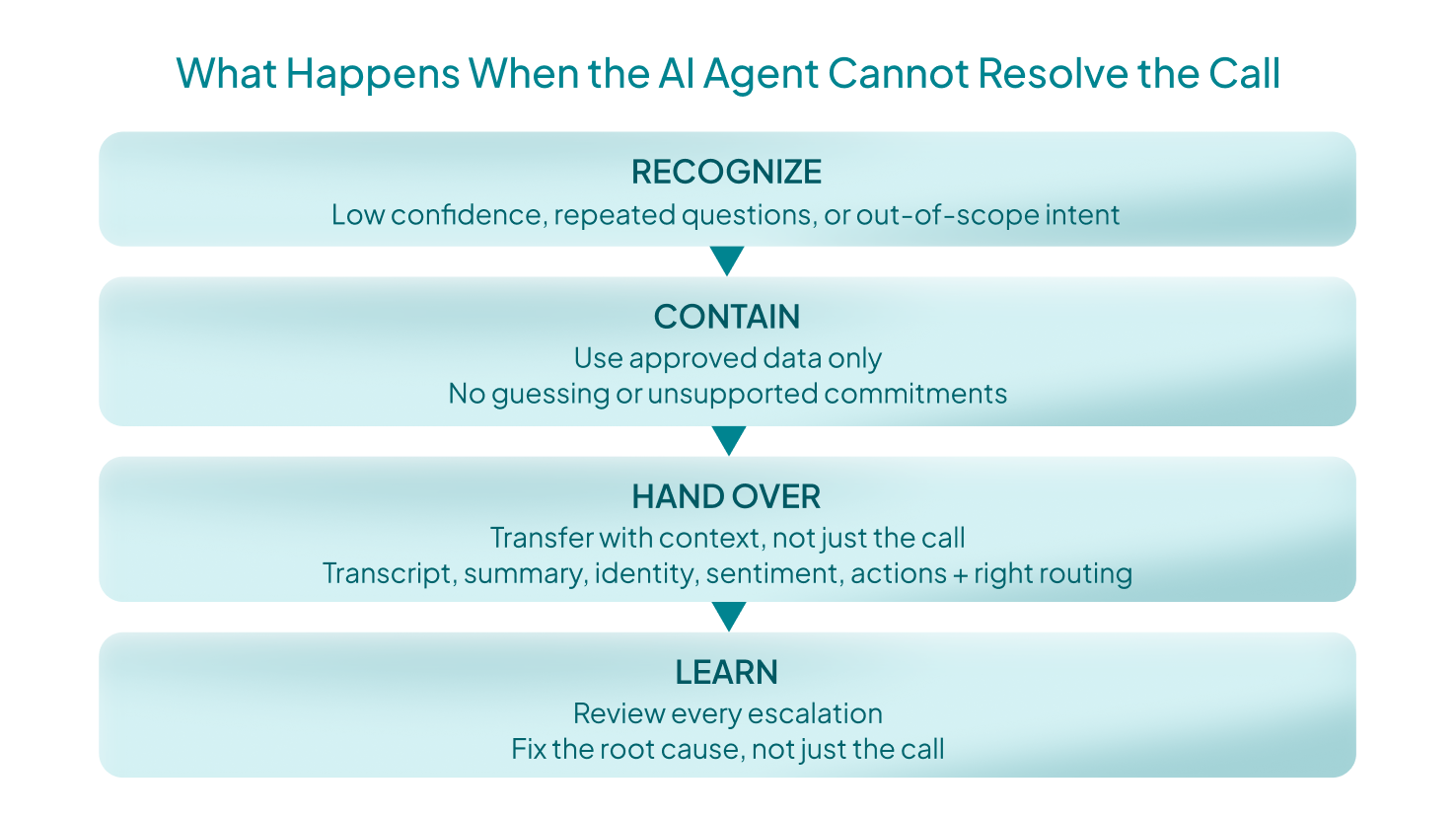
So here is the mechanism, in four steps.
Recognize
Escalation fires on a detected condition, not on the customer giving up. Low model confidence. An intent outside the agent's approved scope. The customer repeating themselves, which is the earliest reliable signal that the conversation has stopped progressing.
Contain
Between the trigger and the transfer, the agent answers only from approved data and policies. It invents no policy, no number and no commitment, and it states plainly when something is out of scope. This is the step that makes escalation safe to perform rather than something the design tries to avoid, and it is why containment is not the same thing as resolution.
Hand over
When the agent cannot complete the conversation, it transfers everything the human needs to understand what happened and pick up from where the agent left off.
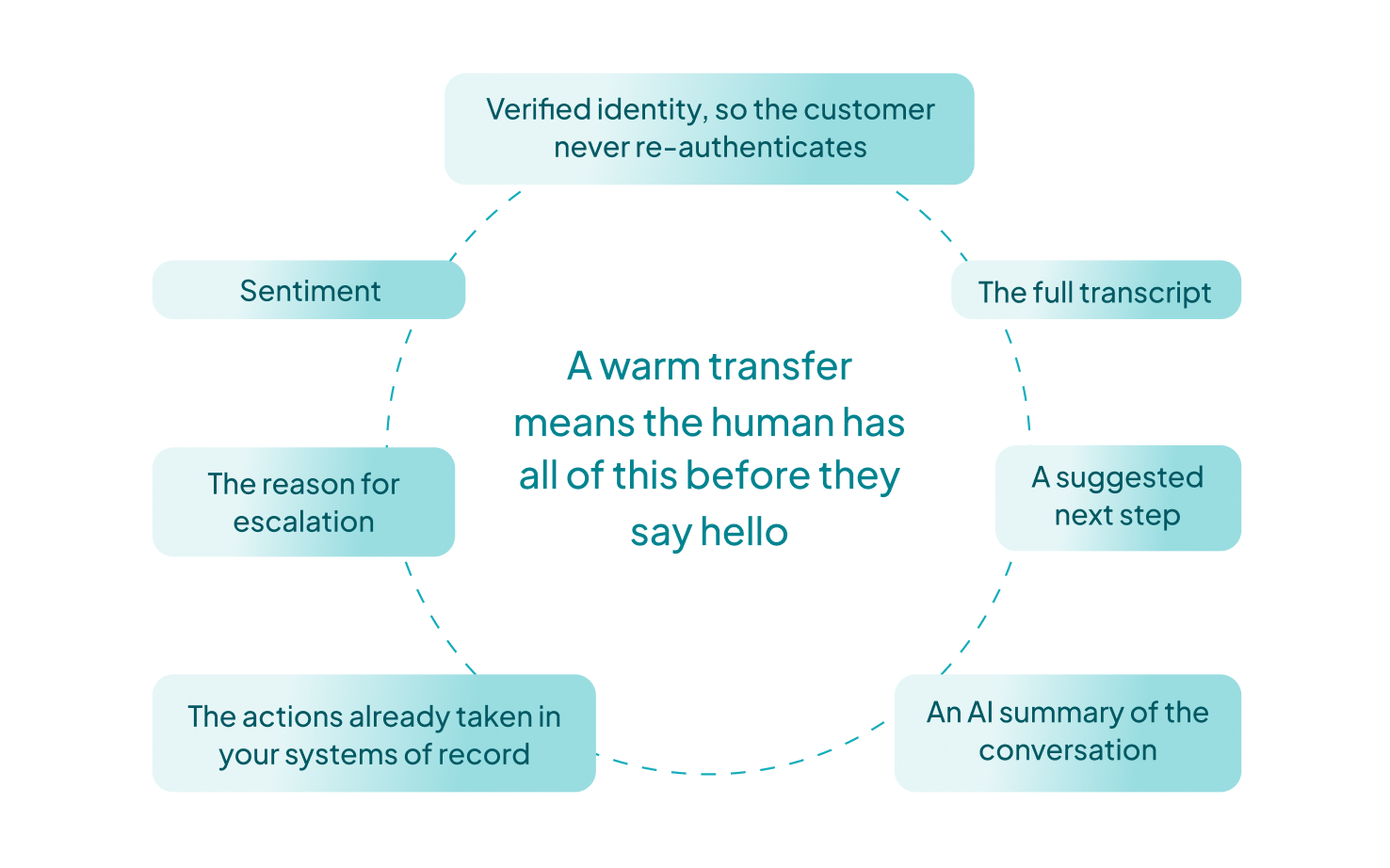
Plus routing by team, skill, language and priority, a callback the system actually keeps if no agent is free, and handback to the AI for the follow-up work once the human is done. A cold transfer, by contrast, is a queue, a re-verification and a customer explaining it a second time. Over 70% of consumers get frustrated when they have to repeat information.
Learn
Every escalation is bucketed and reviewed so the same trigger stops producing the same transfer. This is the step that keeps automation off the plateau, and it is the one most implementations never build.
The receipt: Dot & Key cut manual escalations from about 200 to about 20, with AHT falling from 10 minutes to 3. The escalations that remain are the ones that should have been escalations.
BFSI
Retail and Commerce
Healthcare
The industry sells availability as a feature. Always on, infinite concurrency, no shift change. Availability is the easy part. Nobody quantifies whether quality still holds at hour 19, on the fourth day of a sale, or on the eleven millionth ticket of the month. That is the engineering problem, and it is the only reason Capacity Elasticity is real rather than theoretical.
Nugget was built for that specific problem, inside one of the world's largest customer operations, before it was offered to anyone else.
- Every conversation is checked, not a sample: Total quality coverage is a shipped capability, which is what makes the argument three sections up operational rather than aspirational.
- Multi-agent validation on every call: A response generator streams the reply in real time using large language models. In parallel, a context validator checks that the reply rests on the correct understanding and discards it before the customer ever hears it if it does not. A guardrails agent watches the full conversation for drift while preserving customer context. Idle time while the agent is speaking is used to think ahead, so the checking does not cost the caller a pause.
- A reliability baseline enforced as behavior: It does not go silent, does not repeat itself word for word, does not loop, always leaves the customer an exit, degrades gracefully, and does not drop the call.
- A continuous feedback loop: Every conversation feeds back and machine learning models update continuously, not on a quarterly review cycle. This is the answer to month four.
- Consistency, evidenced rather than asserted: a 99.9% uptime SLA on a rolling 18-month average, across 2 billion+ conversations, 85% automation coverage and 2,000+ apps built without code.
Zomato is one of our prime real world examples at volume: 11 million monthly tickets, support cost reduced from $20M to $9M, 8 to 10 legacy tools consolidated into one platform, and improving customer satisfaction (CSAT) by 25%. Both Zomato and Dot & Key are Indian operations, proving what holds up at consumer scale compared to traditional contact centres.
The headcount question was never the interesting one. The survey record now says so plainly: 20% reduced staffing, 55% held it flat and took more volume, and half of the companies that did cut are expected to be hiring again by 2027.
So run a different set of numbers before your next pilot. Volume absorbed on a flat cost base. Handle time on the calls humans still take, which is where 13 minutes became 9. The share of your conversations you can actually inspect. The number of platforms you retired. Baseline all four before go-live, because you cannot claim a lever you never measured.
Then specify the handoff. Write the seven fields a warm transfer must carry into your requirements document and refuse the phrase "escalates intelligently while preserving context" as an answer. Every one of the four levers leaks at exactly that moment.
The buying criterion for the next twelve months is not cost per call. It is whether the thing stays consistent at hour 19 and in month four. Because the return on AI agents for call centers shows up in the calls you no longer have to staff for and the conversations nobody used to look at, not in the agents you no longer employ.
How do AI agents integrate with existing contact center infrastructure?
Can AI call center agents handle multiple languages and regional dialects?
What key features separate basic chatbots from modern AI voice agents?
TL;DR
Only 20% of customer service leaders report reducing agent staffing because of AI, while 55% report flat staffing with higher volume, and Gartner expects half the companies that did cut to rehire by 2027. The headcount axis is the wrong axis.
Four levers move the money: resolved volume, faster humans, total quality coverage and tool consolidation. Most business cases model only the first, which is why the payback goes missing in month four.
Quality control was always a sampling problem. AI changes the denominator from a sample to every conversation, which makes it a governance capability, a coaching input and a revenue-leak detector at the same time.
Agent assist is the lever with the most evidence behind it. 64% of service leaders already report higher agent productivity, and Zomato's average handle time went from 13 minutes to 9 minutes for the agents who stayed.
The handoff is the product. A warm transfer carries transcript, summary, escalation reason, verified identity, sentiment and actions already taken, and Dot & Key's manual escalations fell from about 200 to about 20.