Conversational AI: What makes it different, and how it's transforming customer support
Written by: Manya Singh
Last updated: Jul 27, 2026
6 mins

They say good communication is the key to a strong partnership. Turns out, it's a serious competitive edge in business too.
For decades, business communication has been slowed down by repeated queries, lost emails, hold music and agents juggling six tabs just to find one refund status.
But what if those limitations could be shattered, replaced by conversations powered by intelligence on par with ChatGPT's IQ (it clocks in at 136), and the emotional sensitivity to truly get you? This is what conversational AI is doing for businesses today, across both text and voice channels.
Businesses adopting it are already seeing real gains, 80% automation on routine tickets, faster resolution times, and CSAT scores rising alongside efficiency. By combining advanced language models with deep learning for Natural Language Understanding (NLU), these conversational AI systems interpret intent, respond naturally, and take real-time actions. It turns clunky, repetitive support flows into seamless conversations that actually get things done. It's about enabling organisations to create scalable, AI-native infrastructure that doesn't just reply, it understands, decides, and resolves.
In this article, we'll peel back the layers of conversational AI, revealing how it's cracking the code of intelligent dialogue and becoming the secret weapon for business transformation.
Traditional "AI" support tools are really just glorified decision trees. As soon as a user blends two requests like "My refund is late" and "My address changed", the script breaks, the interaction restarts, and an already frustrated customer lands in a live agent queue.
In contrast, modern conversational AI runs on large language models and contextual reasoning to deliver instant resolution across workflows and touchpoints. It can:
- Parse multiple intents in a single sentence
- Pull relevant data from order, payments, or CRM systems
- Execute next-best actions automatically, often without human handoff
- Sound natural and human-like by managing contexts and adapting to tone and preference
Gartner projects that by 2026 conversational AI will shave $80 billion off global contact centre labour costs as automation rates climb and agent workloads shrink (Source: CX Today). However, this isn't about cost-saving, it's about reshaping the customer support space for the better.
Banks are clearing KYC queries in seconds instead of minutes. Quick commerce players like Blinkit resolve "delivery + refund" issues in a single chat. Telecoms have lifted first contact resolution and NPS at the same time. We're seeing 40% faster handling times, significant CSAT gains, and double-digit improvements in operational efficiency.
When you add faster resolutions, 24x7 coverage, and the consistency of a single source of truth, conversational AI rewires the entire service P&L and becomes a strategic lever for growth.
So what really powers conversations that feel natural, intelligent, and eerily almost human?
It's not just a basic chatbot responding to scripts. Behind the scenes, there's a powerful combination of technologies that work together to understand what users are saying, figure out the right response, and keep improving over time.
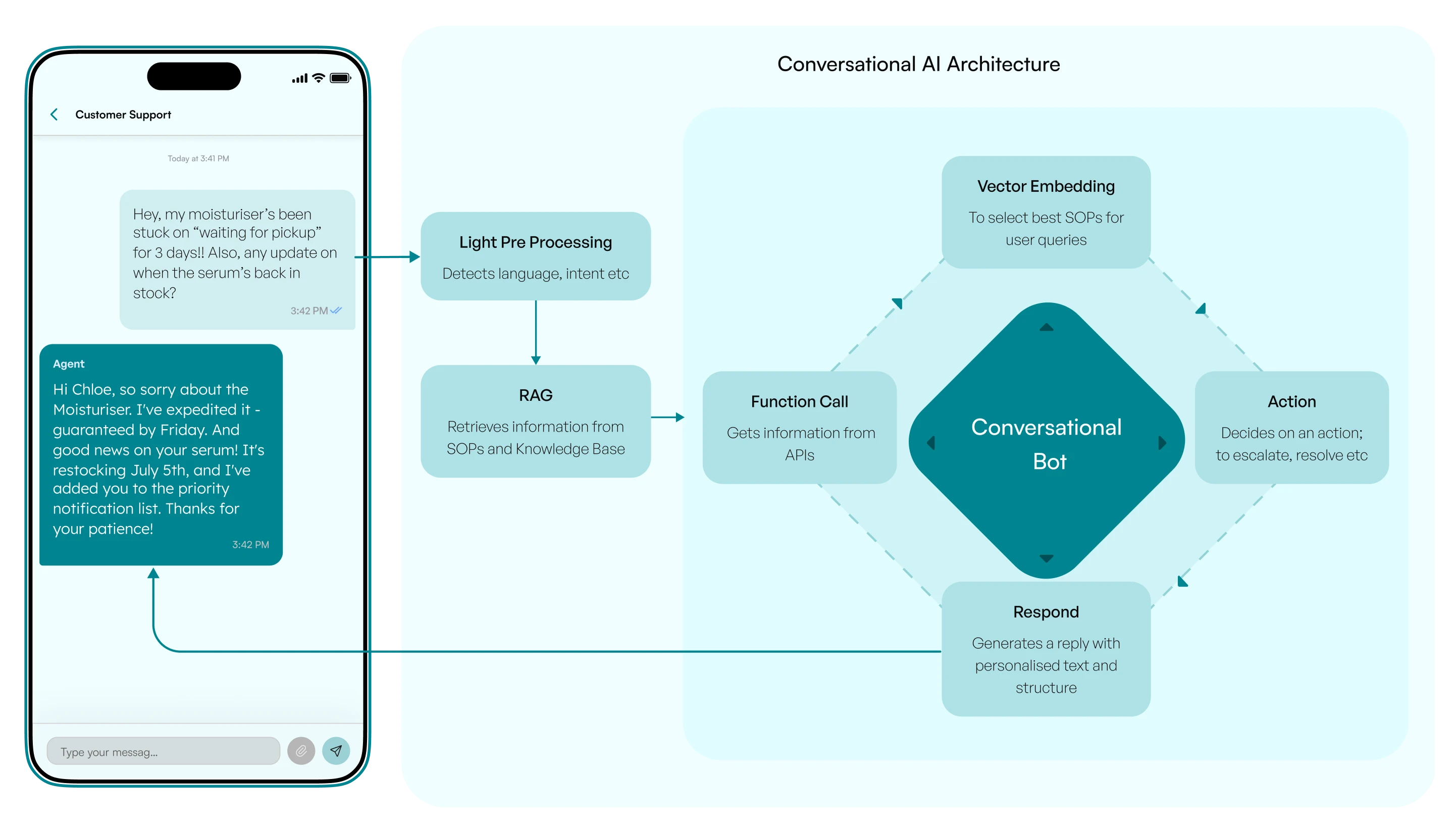
Let's break down how this technology really works using a real-life customer issue:
Meet Chloe, a loyal but annoyed shopper, asking for an order update and if her serum is back in stock. The AI assistant replies in seconds. Looks simple, but that one response pulls order status, inventory data, and automation workflows together behind the scenes.

E-Commerce & Retail

Fintech & BFSI

Hospitality

Employee Experience

Healthcare
We're past the pilot phase. With advancements in emotionally intelligent, multilingual, and multimodal AI, conversational systems are no longer side features, they're becoming core business infrastructure.
Brands investing now aren't buying tools. They're building a long-term advantage in how they sell, support, and scale. Conversational AI is already reshaping how businesses operate day to day, turning workflows into experiences, and interactions into outcomes.
It's not a trend. It's a shift. And it's happening faster than most businesses realise.
Nugget is built to be your brand's frontline brain. Whether it's decoding a 2 AM "Where's my order?", calming a borrower with live loan updates, or explaining tax jargon like it's pop culture, Nugget handles it all with conversational precision.
What sets it apart is the tech under the hood. Powered by conversational Gen AI, Nugget goes beyond scripts to understand intent, pull real-time context, and resolve queries end-to-end without sounding robotic or needing constant human handoff.
Already active across industries, from E-Commerce and BFSI to HR and logistics, Nugget turns chaos into clarity, effortlessly, endlessly, and always in context.
Curious to see the impact in action? Explore our Zomato x Nugget case study to see how Conversational Gen AI is powering support at scale in one of India's most dynamic customer ecosystems.
TL;DR
Conversational AI goes beyond traditional chatbots by understanding intent, managing context, and resolving customer requests across channels in real-time.
Businesses are using conversational AI to automate routine support, improve resolution rates, reduce handling times, and deliver better customer experiences at scale.
Powered by technologies like LLMs, NLU, and workflow automation, conversational AI doesn't just answer questions, it takes actions across business systems.
From retail and BFSI to healthcare and employee support, conversational AI is transforming how enterprises sell, support, and engage with customers and employees.
Conversational AI is rapidly becoming core business infrastructure, helping enterprises build scalable, intelligent customer experiences that drive both operational efficiency and growth.