AI Lead Qualification: A Complete Guide
Written by: Manya Singh
Published On: Oct 15, 2026
8 mins

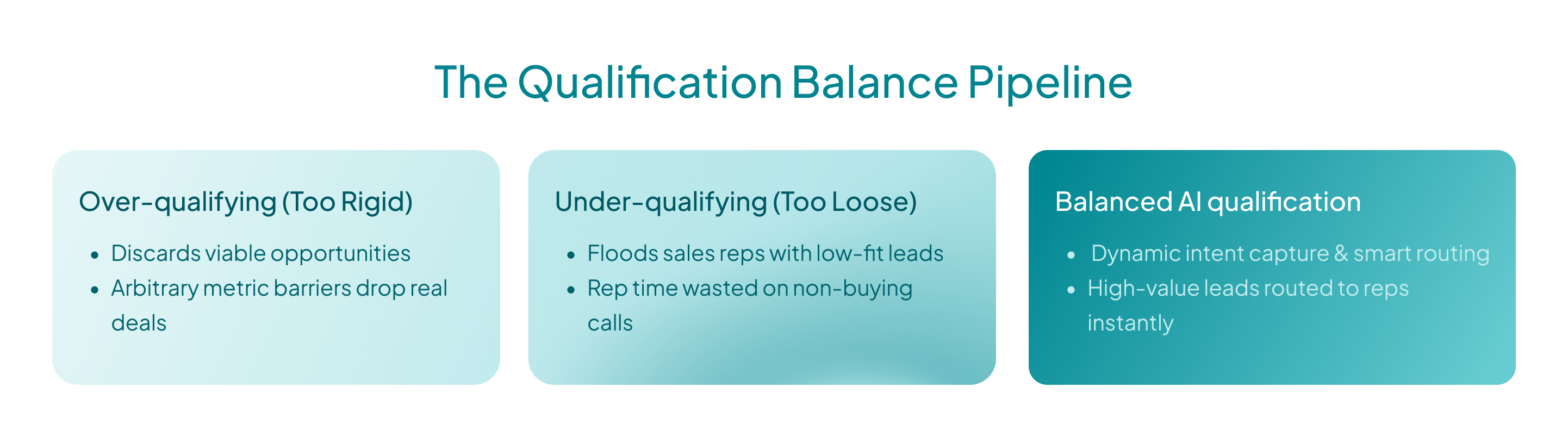
Every sales pipeline has a capacity limit. When marketing teams generate a wave of incoming leads, the immediate operational challenge is deciding where sales reps should spend their hours. Getting lead qualification wrong harms a business in both directions:
- Over-qualifying creates an overly rigid barrier, turning away potential customers and discarding revenue opportunities because a lead failed a arbitrary metric.
- Under-qualifying floods account executives with unworked, low-fit prospects, forcing sales teams to spend hours on discovery calls that never convert.
AI lead qualification transforms how revenue teams evaluate, rank, and route prospects. By using artificial intelligence to analyze behavioral data, demographic signals, and real-time conversations, organizations can score incoming leads instantly without adding administrative overhead.
This guide covers traditional qualification frameworks, the three structural approaches to lead qualification, how to design criteria for your specific ideal customer profile (ICP), and how AI systems optimize every stage of the sales pipeline.
Before automating your process, it helps to understand the underlying logic of standard sales qualification frameworks. While each framework prioritizes different data points, they all share a single goal: determining whether a sales lead is worth pursuing.
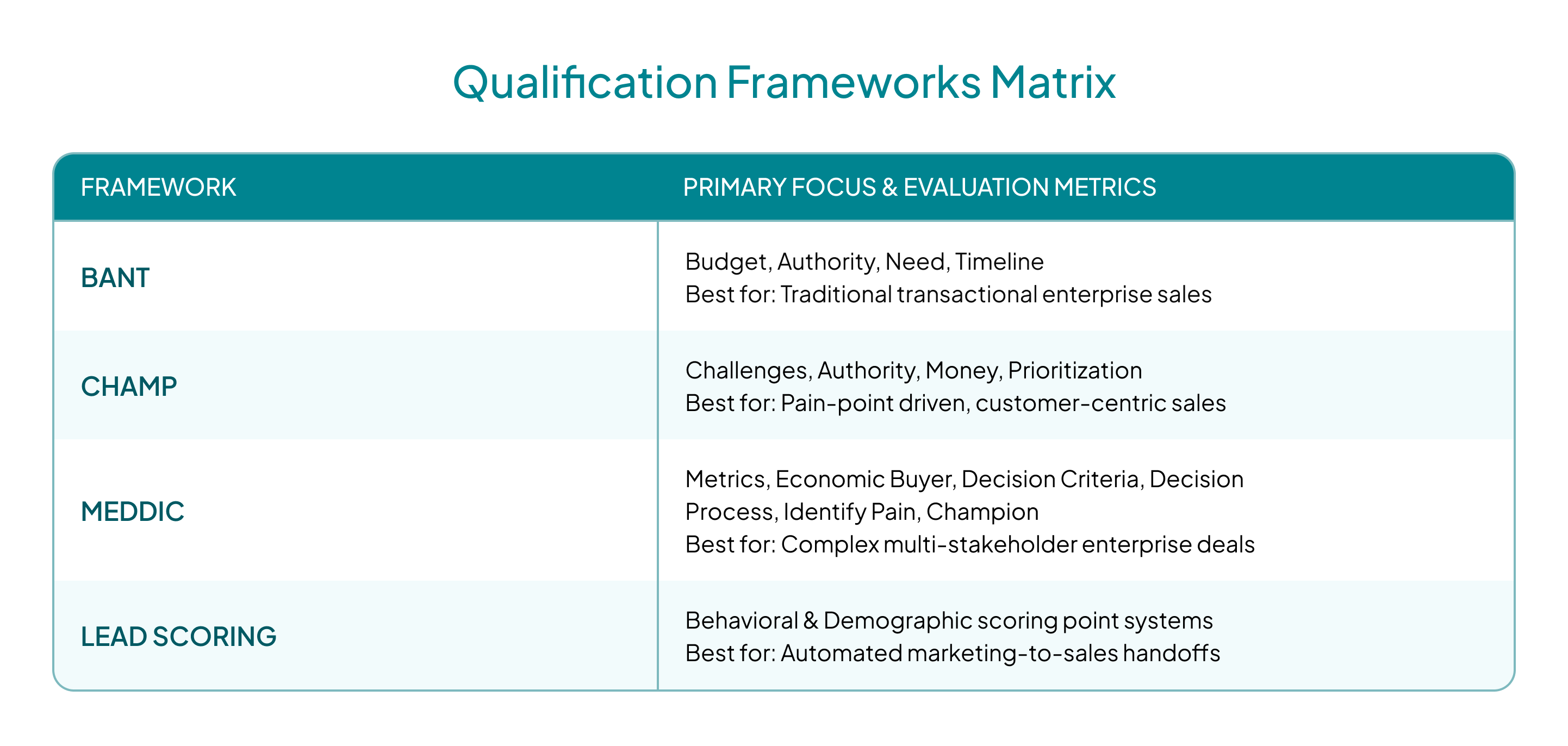
- Budget: Can the prospect afford your AI solution or service?
- Authority: Does the contact have the decision-making power to sign a deal?
- Need: Does the prospect have a specific problem your product solves?
- Timeline: When does the buyer plan to make a purchasing decision?
- Challenges: What specific operational friction is the buyer experiencing?
- Authority: Who manages the budget and signs the contract?
- Money: Does the organization have the financial resources to solve the challenge?
- Prioritization: How urgent is this problem compared to other internal initiatives?
BANT (Budget, Authority, Need, Timeline)
Developed by IBM, BANT evaluates four strict parameters:
While BANT provides clear guardrails, strict adherence can eliminate high-growth startups or modern buying committees where budget is allocated after value is proven.
CHAMP (Challenges, Authority, Money, Prioritization)
CHAMP flips BANT by placing prospect pain points first:
MEDDIC (Metrics, Economic Buyer, Decision Criteria, Decision Process, Identify Pain, Champion)
Traditional Lead Scoring
Organizations generally qualify leads using one of three methodologies:
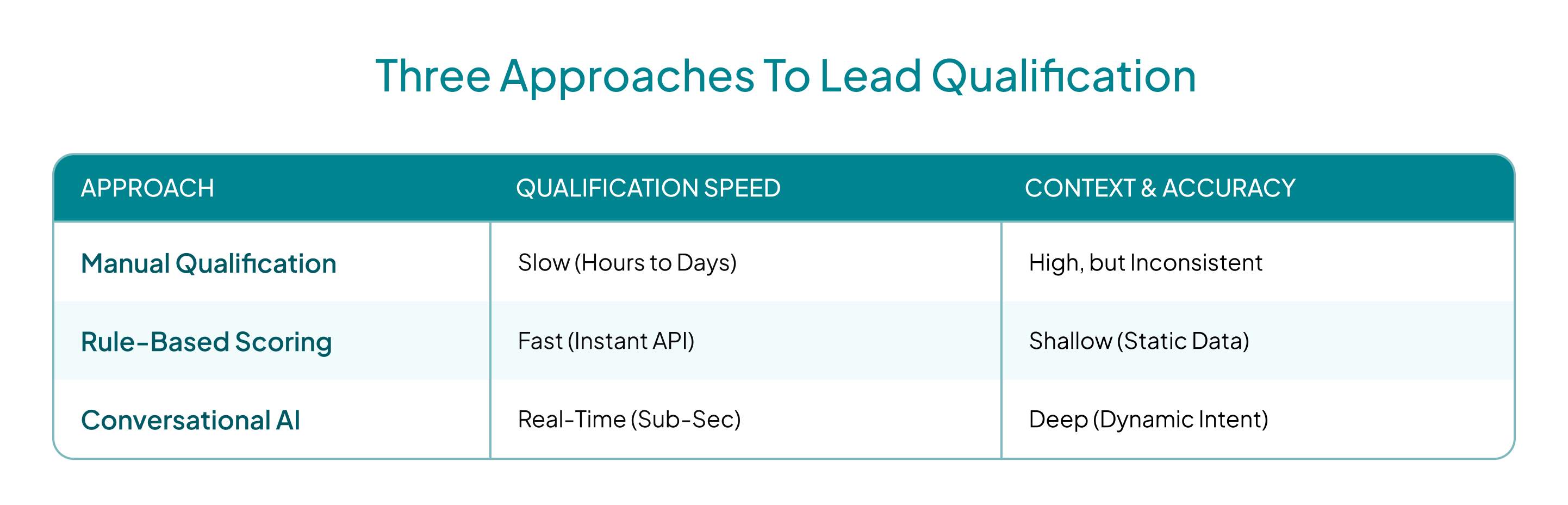
- Pros: Allows deep human judgment, nuanced context gathering, and personal relationship building.
- Cons: Exceptionally slow, expensive, and subject to inconsistent qualification standards across reps.
- Pros: Instant, scalable, and removes manual entry tasks.
- Cons: Shallow. A high job title visiting a pricing page might score high, but if they are researching for a university paper or lack active budget, static rules fail to catch the discrepancy.
Manual Lead Qualification
In a purely manual setup, sales reps or sales development representatives (SDRs) review inbound leads individually. They research company data, check LinkedIn profiles, and conduct 15-minute discovery calls to ask qualifying questions.
Rule-Based Scoring & Data Enrichment
Rule-based systems use lead enrichment tools to automatically append firmographic data to website forms. When a prospect submits an email, third-party APIs populate job title, company size, industry, and location, while an automated rule engine calculates a score.
Conversational AI Qualification
To automate lead qualification effectively, you must define explicit rules for what constitutes a sales-ready lead.
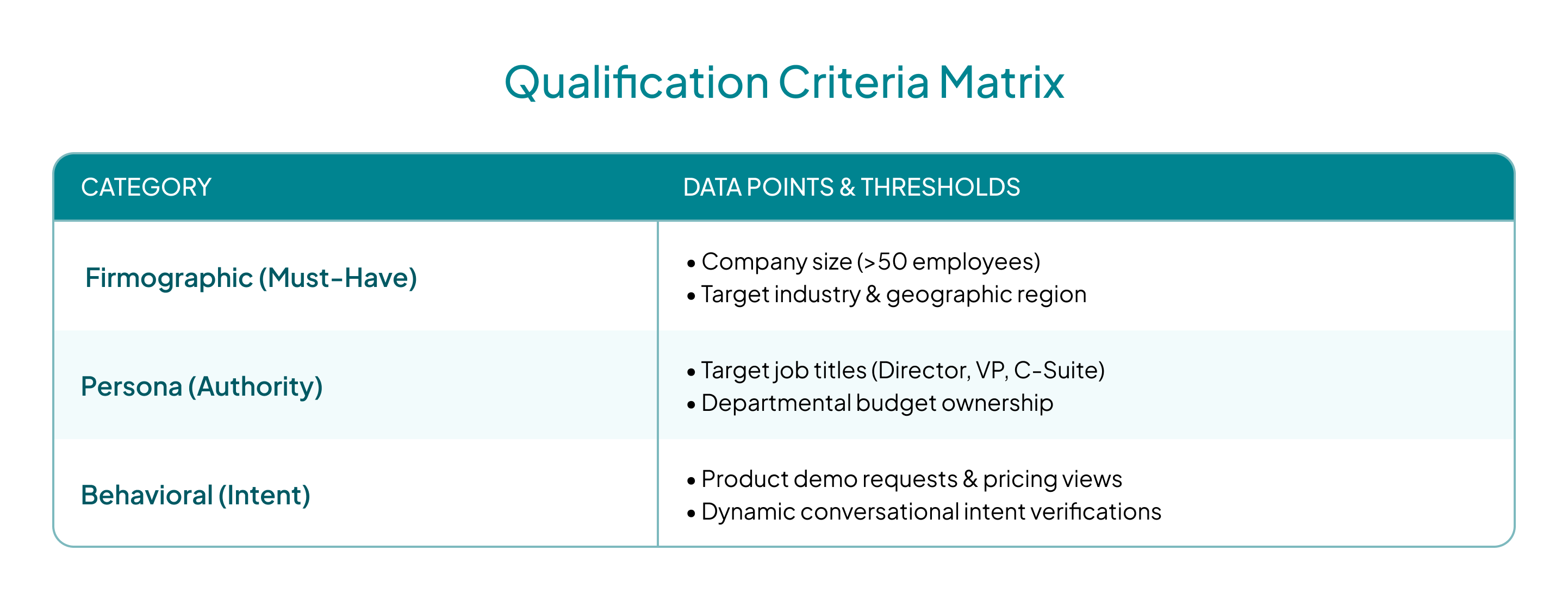
- Minimum and ideal company size
- Target industries and geographic locations
- Specific job title levels that hold purchasing authority
- Hard Deal-Breakers (Must-Haves): Operating in a supported region, using compatible tech stack tools, or meeting minimum employee thresholds. If a lead fails a must-have criterion, they should route to self-serve resources or automated email sequences.
- Soft Indicators (Nice-to-Haves): Specific software integrations used, secondary team size, or recent funding announcements.
Map Your Ideal Customer Profile (ICP)
Start by identifying common traits among your highest-value, longest-retained customers. Analyze historical data in your CRM systems to uncover:
Establish "Must-Have" vs. "Nice-to-Have" Thresholds
Divide your qualification criteria into hard deal-breakers and soft preference indicators:
Define Dynamic Routing Rules
Establish clear routing rules that send sales qualified leads to the right internal team based on score and intent:
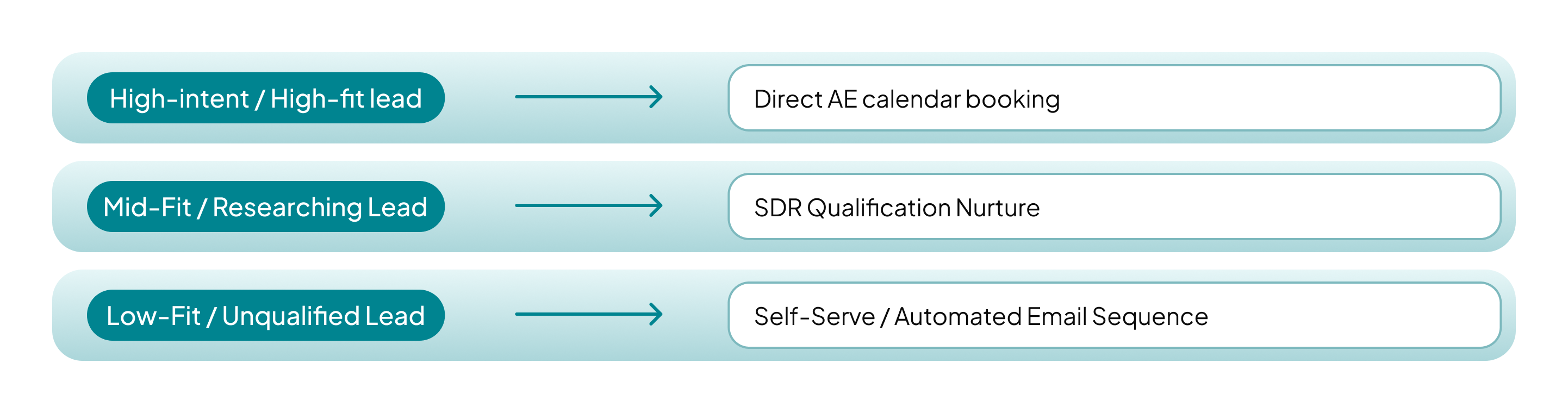
Setting distinct thresholds ensures high-value opportunities receive immediate attention from senior reps, while lower-tier leads receive automated, scalable nurturing.
Deploying AI technology across your lead management process enhances performance at every touchpoint:
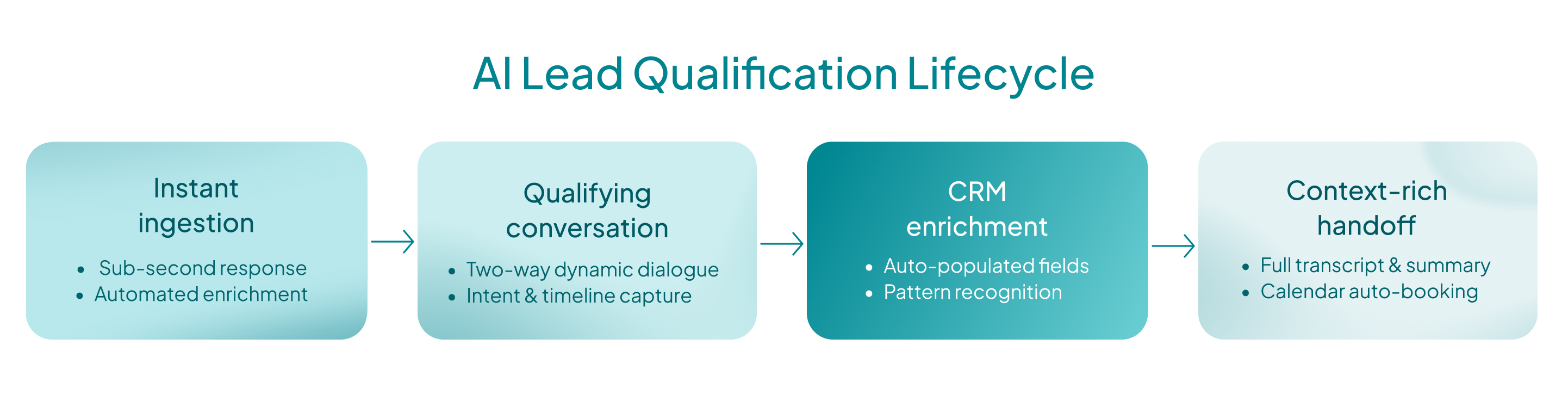
Inbound Response Speed
The Qualifying Conversation
CRM Data Enrichment and Pattern Recognition
Context-Rich Handoff to Human Reps
Over-Qualifying and Discarding Real Revenue
Under-Qualifying and Overwhelming Sales Reps
Static Criteria that Fail to Evolve
Implementing AI lead qualification delivers measurable improvements in response speed, rep productivity, and pipeline velocity.
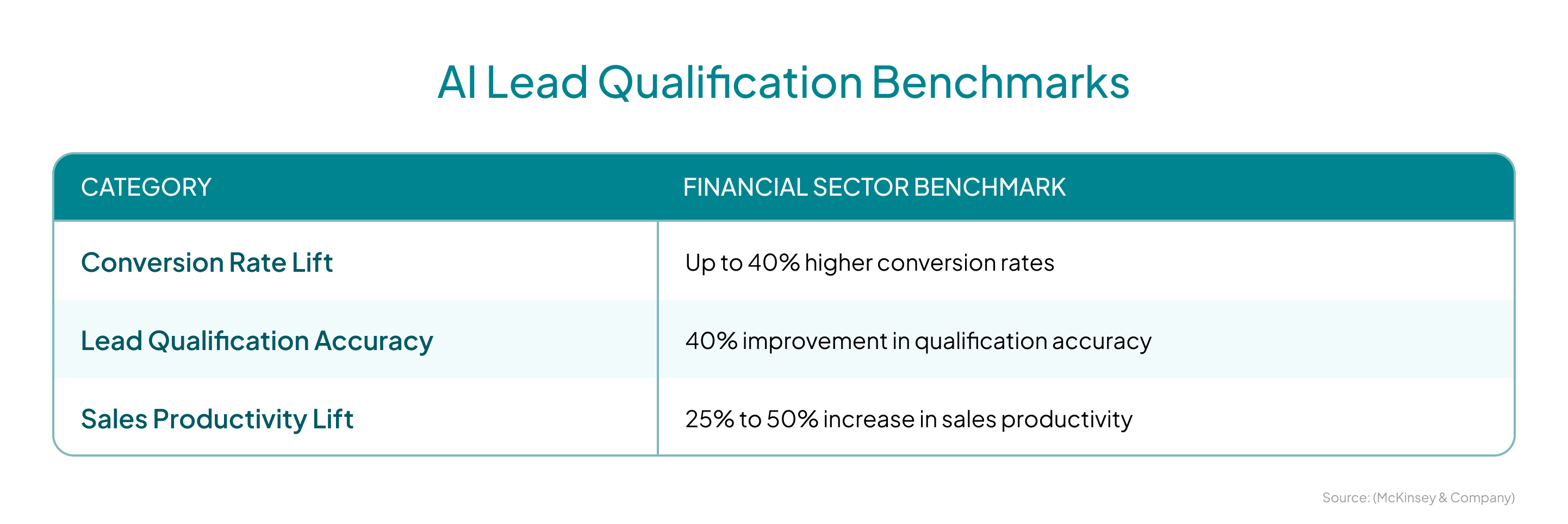
Enterprise research illustrates the bottom-line impact of deploying AI powered lead qualification:
- Pipeline and Engagement Gains: A field example published in McKinsey & Company's study on generative AI in B2B sales describes a company that used gen AI to identify new opportunities, improve prioritization, and personalize outreach at scale, generating more than $1 billion worth of new opportunities, increasing its pipeline by 10 percent, and more than doubling click-through rates in the first fiscal year.
- Increased Rep Productivity: Research from McKinsey & Company shows that companies which have empowered their sales teams through technology, including automation, report consistent efficiency upticks of 10 to 15 percent, alongside more time spent in front of customers and less time on back-office activities.
Effective lead qualification is about balance: giving qualified prospects a fast, frictionless buying experience while protecting your sales team's limited capacity from low-fit traffic. AI lead qualification resolves this tension by responding instantly, conducting genuine two-way conversations, enriching records automatically, and routing only sales-ready opportunities to human reps.
How does AI lead qualification differ from traditional lead scoring?
Can AI lead qualification integrate directly with existing CRM systems?
How does AI lead qualification handle unqualified leads without ruining customer experience?
TL;DR
Speed drives conversion. Responding to inbound leads instantly via AI conversational agents prevents drop-off and significantly boosts engagement while interest is at its peak.
Look beyond static forms. Combining firmographic data enrichment with interactive two-way conversation provides deeper, more accurate qualification than scoring rules alone.
Define explicit ICP criteria. Establish clear "must-have" and "nice-to-have" thresholds to categorize qualified leads and establish dynamic routing rules.
Eliminate manual rep administrative tasks. AI agents auto-populate CRM systems, summarize prospect pain points, and book meetings directly on rep calendars.
McKinsey reports that tech-empowered sales teams see consistent efficiency upticks of 10 to 15 percent, with one gen AI deployment increasing pipeline by 10 percent and more than doubling click-through rates.