AI Voice Agents for Debt Collection: The Shift from Pressure to Precision
Written by: Manya Singh
Published On: Oct 5, 2026
9 mins

In consumer lending and debt recovery, the operational bottleneck is rarely a lack of desire to collect debts. It is the cost and compliance friction of trying to make contact at scale. Manual debt collection calls are expensive, operationally rigid, and fraught with regulatory risk. A single missed disclosure, an unrecorded consent revoke, or phone calls placed outside reasonable hours can result in costly legal proceedings, penalties under RBI guidelines, or legal disputes over unfair practices.
At the same time, traditional automated solutions like auto-dialers and interactive voice response (IVR) trees have largely burned out consumer trust. Callers recognize canned audio within two seconds, ignore pre-recorded voicemails, and hang up on rigid phone trees during the outbound collection process.
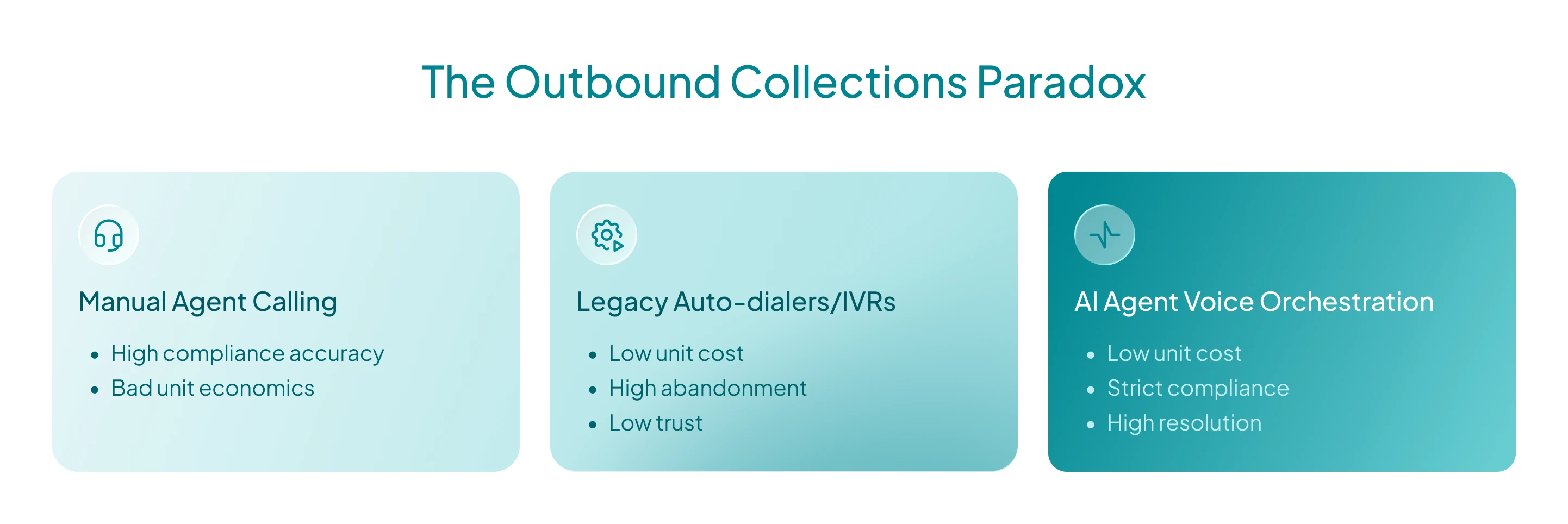
Fixing outbound collection strategies requires fundamentally rethinking the contact model. Modern AI debt collection voice agents do not just automate calls; they handle two-way negotiation, maintain deterministic compliance under RBI guidelines and applicable statutory frameworks, and execute backend system actions in real time.
This guide examines what voice AI in debt collection looks like in production, why legacy outbound models fail, and how Nugget's orchestration architecture differs from standard auto-dialers.
Unsustainable Unit Economics
Inconsistent Scripting and Compliance Exposure
Poor Debtor Experience in Sensitive Moments
Fragmented Data Logging
An AI voice agent for debt collection is not an auto-dialer playing a pre-recorded audio file. It is a state-aware conversational entity capable of holding natural, two-way dialogue while adhering to strict business logic, RBI guidelines, and federal laws across all parties involved.
Unlike legacy IVR systems, voice AI agents in a collection company or collection agency:
- Understand Unstructured Input: They process interruptions, regional accents, mid-sentence topic changes, and ambiguous statements regarding money owed like "I can't pay the full balance this week, but I get paid next Friday."
- Execute Real-Time Disclosures: They deliver mandatory regulatory debt information, recording notifications, and disclosures smoothly within natural conversation without sounding robotic.
- Maintain Pacing and Sentiment Awareness: They monitor the caller's acoustic tone, slowing down or softening language if the borrower displays emotional distress or confusion regarding their delinquent accounts.
- Execute Immediate System Writes: They log payment terms, trigger digital payment links, update payment status, or update account statuses directly in the loan ledger during the call turn.
Generic voice tools rely solely on raw model prompts, which often break when encountering complex compliance boundaries or real-world cellular noise. Nugget approaches collections through a dedicated orchestration harness designed specifically for high-concurrency, regulated enterprise operations.
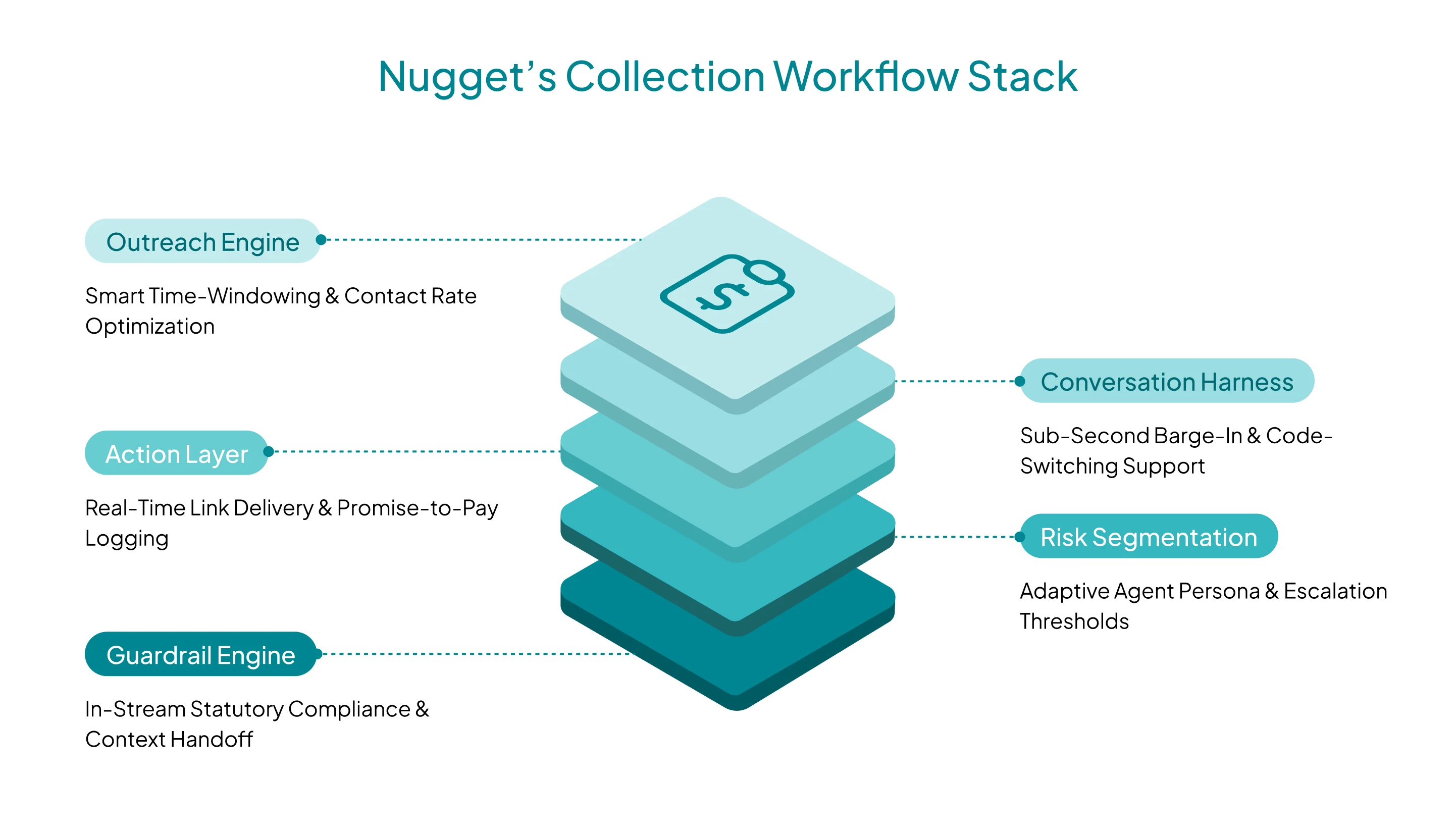
Smart Outreach and Retry Orchestration
Promise-to-Pay (PTP) Capture and Reminders
Payment Link Delivery Within the Conversation
Risk-Segmentation Based Agents
Context-Aware Human Escalation
In debt recovery, compliance errors carry direct financial liability and risk reporting to credit bureaus or impacting a consumer's credit report. An AI agent cannot operate on probabilistic assumptions when executing regulatory disclosures.
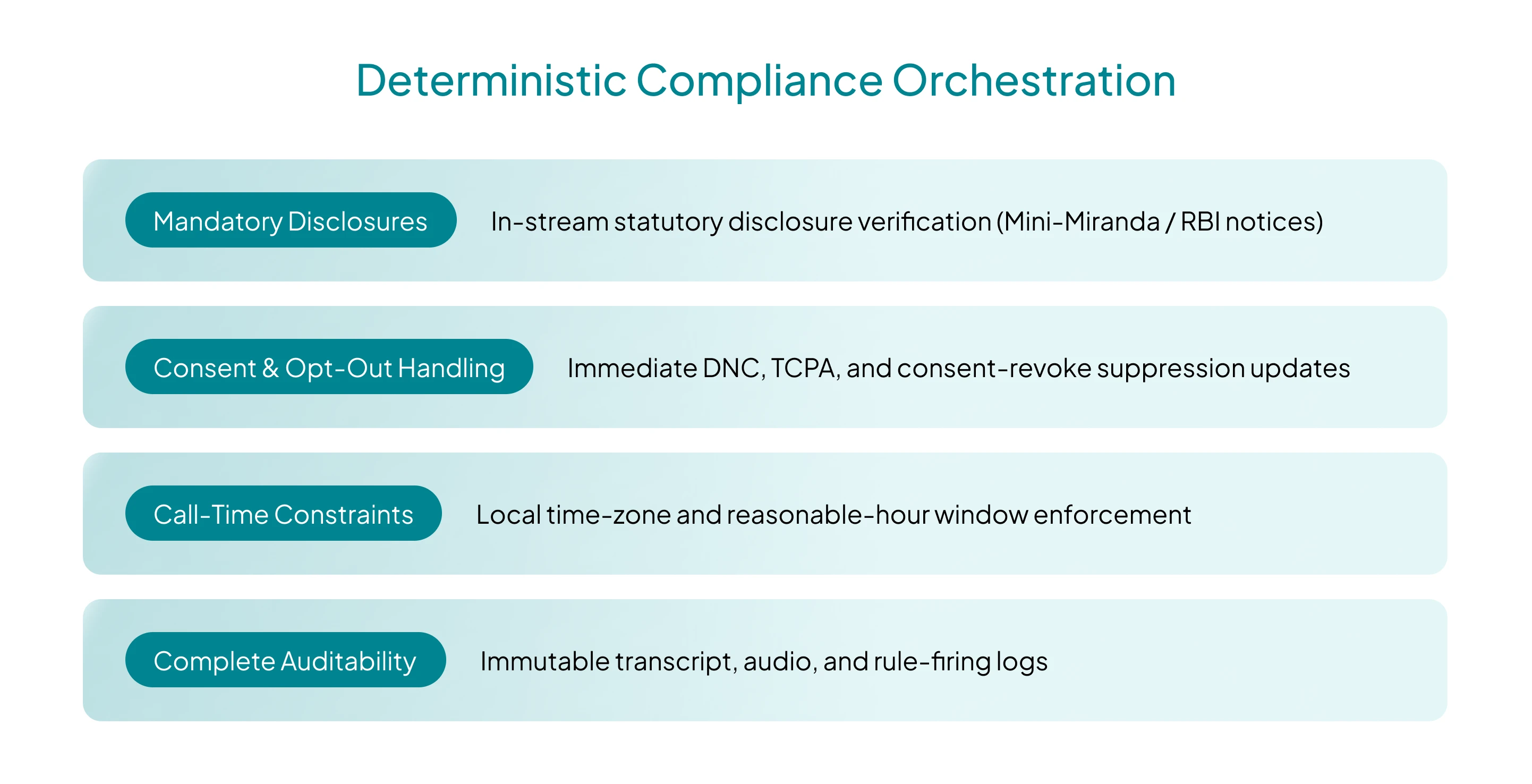
Nugget enforces compliance at the system layer through structural design:
- In-Stream Disclosure Injection: Mandatory recording disclosures and regulatory statements are executed deterministically before sensitive account details or collect interest terms are discussed.
- Instant Opt-Out Processing: If a consumer states "Stop calling me" or "I revoke consent," the platform registers the opt-out instantly, updates suppression lists across all systems, and gracefully terminates the call without resorting to deceptive practices.
- Audit-Ready Traceability: Every call turn generates an immutable transcript and reasoning trace, logging the exact rule that fired for compliance audits across all collection practices.
- Acoustic Sentiment Monitoring: If a caller's voice registers high distress or frustration, the system automatically adjusts its tone or routes the call to a specialized human representative to safeguard their financial health.
Implementing AI voice agents in debt management shifts outbound operations from high-friction dialing to cost-effective resolution through proactive communication.
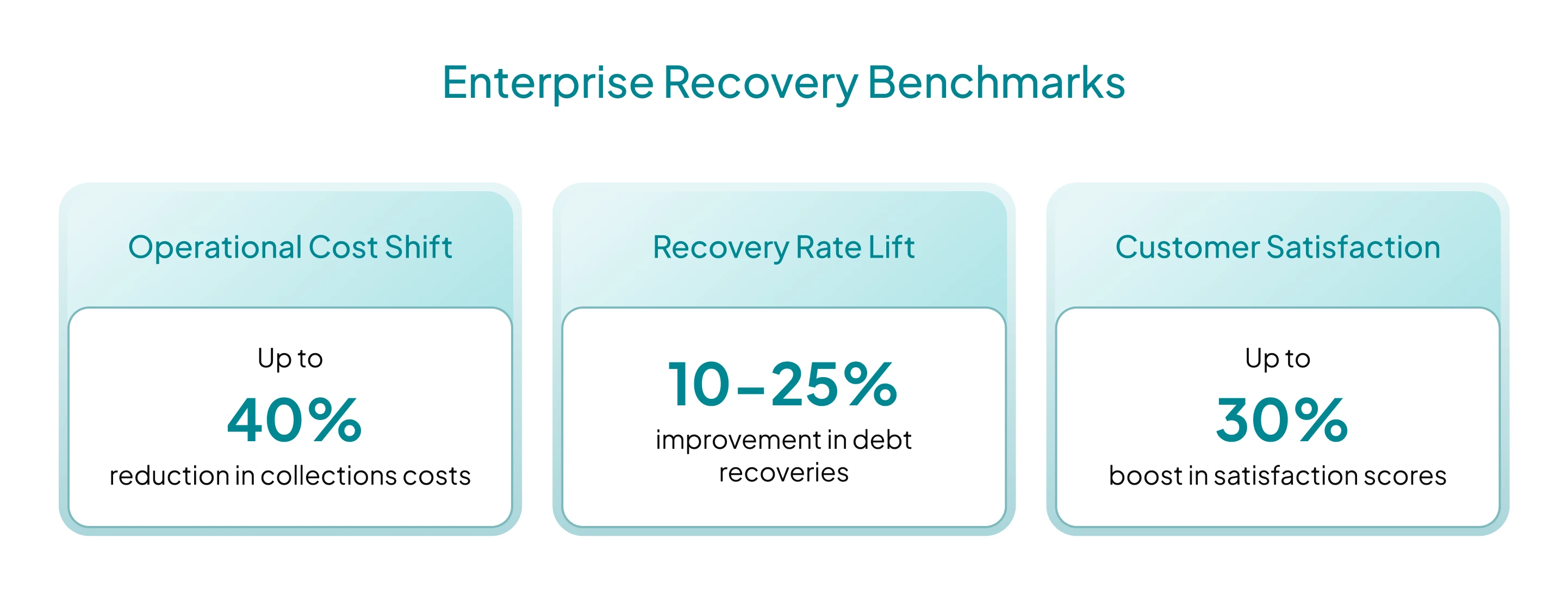
Research from global management consultancies illustrates the operational impact of AI technologies in credit and collections:
- Operational Cost Reduction: According to research published by McKinsey & Company, financial institutions leveraging advanced AI capabilities in credit and collections can reduce operational costs by up to 40% by automating routine contact tasks and streamlining agent workflows, often replacing predictable flat fee models with scalable digital infrastructure.
- Increased Recovery Rates: Additional data from McKinsey & Company reveals that deploying AI-driven predictive strategies and dynamic engagement models drives a recovery rate improvement of about 10% across consumer portfolios.
- Improved Borrower Satisfaction: Research by McKinsey & Company shows a 30% boost in customer satisfaction scores when organizations transition from aggressive manual calling to personalized, AI-driven proactive communication that helps consumers make informed decisions for their financial planning.
Integration with Legacy Loan Management Systems
Balancing Automation with Empathy
Multi-Jurisdictional Regulatory Patchworks
AI voice agents in debt collection are not meant to replace human recovery teams. Their true value lies in absorbing high-volume, repetitive outreach, sending payment reminders, and managing early-stage late payments while enforcing strict regulatory compliance on every turn.
By automating routine contact, verifying promise-to-pay commitments, and delivering seamless payment links directly within the call stream, voice AI allows human specialists to focus on complex negotiations, severe hardships, and disputed accounts.
When built on a deterministic orchestration harness like Nugget, conversational AI transforms outbound collections from an expensive, high-risk cost center into a predictable, compliant recovery engine.
How do AI voice agents handle regulatory compliance during collection calls?
Can an AI voice agent process a payment directly during a phone call?
What happens when a borrower disputes a debt or reports financial hardship to the AI agent?
TL;DR
Beyond Auto-Dialers: AI voice agents hold multi-turn conversations, process natural interruptions, and execute backend system updates rather than playing pre-recorded audio.
Driven by Resolution: Voice AI agents increase recovery rates by capturing structured Promise-to-Pay agreements and sending instant, secure payment links within the call.
Deterministic Compliance: Systems enforce FDCPA, TCPA, and RBI guidelines by guaranteeing statutory disclosures, respecting call windows, and processing opt-outs instantly.
Contextual Human Escalation: Complex cases involving bankruptcy, hardship, or disputes route smoothly to human agents with complete conversation context attached.
Proven Financial ROI: According to McKinsey, applying AI to collections reduces operational costs by up to 40% while boosting recoveries by about 10%.