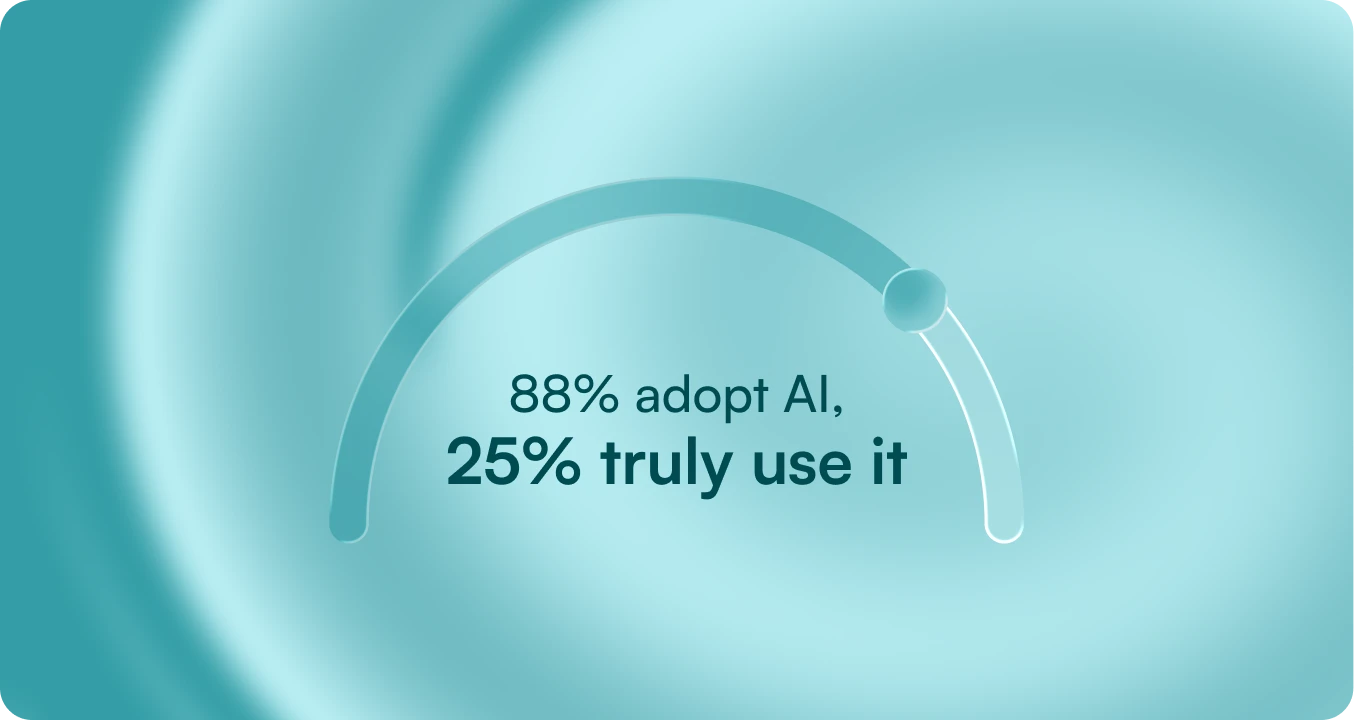
Contact Center Automation: How AI Is Rewriting the Rules of Customer Service
Written by: Manya Singh
Last updated: Aug 27, 2026
12 mins

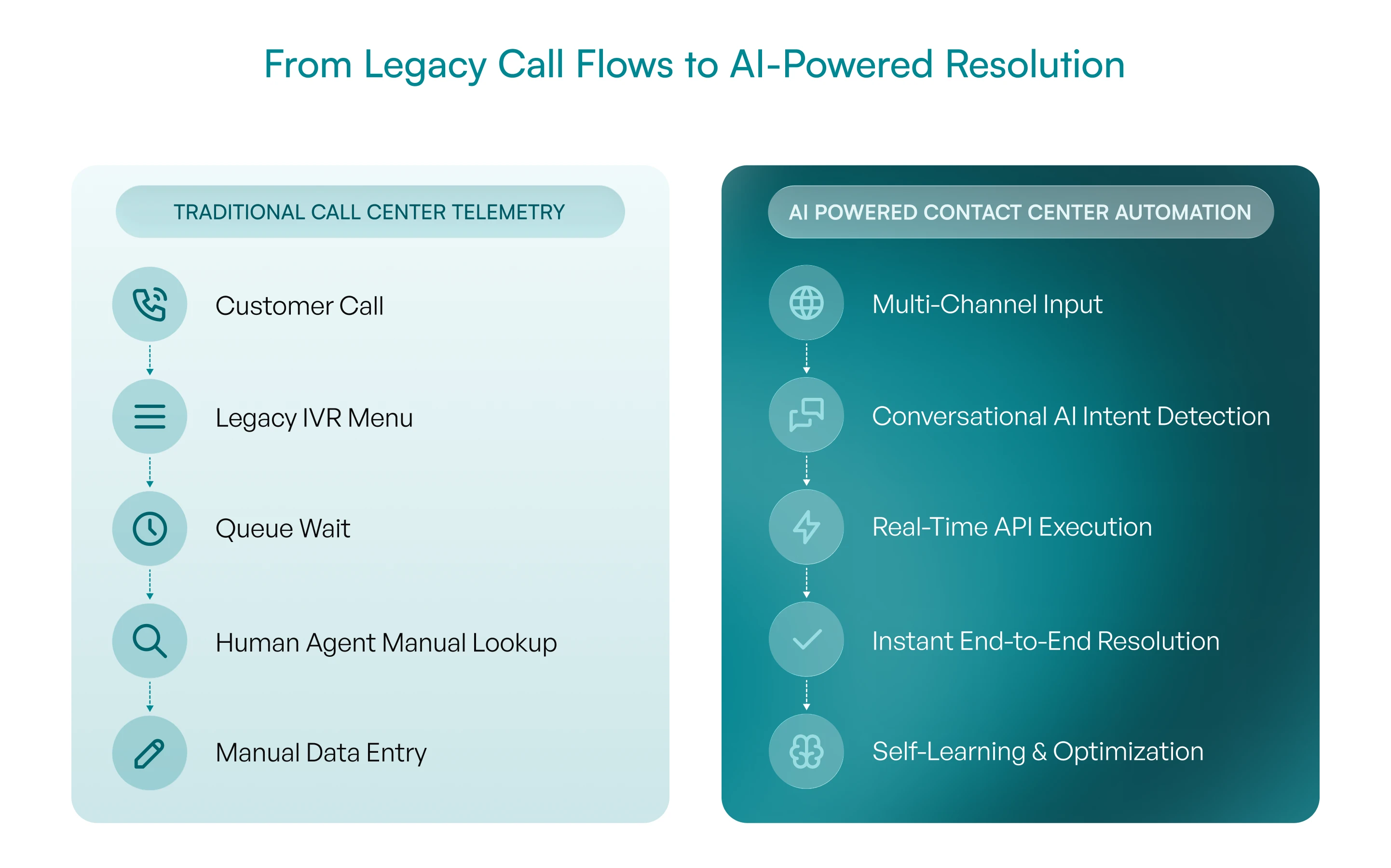
For decades, the traditional call center operated on a straightforward equation: customer problem in, human agent out. A customer called, an agent picked up, gathered context, searched through systems, figured out what needed to happen, and executed it. Then documented everything and moved to the next call.
That model worked, but it was built for a world with much lower interaction volumes, far fewer channels, and significantly more predictable customer behavior. The world contact centers operate in today looks nothing like that.
McKinsey's March 2025 analysis of over 30 organizations found that 50% to 60% of customer interactions remain transactional, despite years of investment in self service tools, self service options, and digital channels designed specifically to reduce them. Add to that the fact that 57% of customer care leaders expect customer calls and overall call volume to increase over the next one to two years, and the math starts looking uncomfortable. More customer conversations across more channels with higher customer expectations, and the same reluctance to simply hire more people to handle them.
The obvious answer is contact center automation. The less obvious truth is that most of what gets called center automation today is still automation around the conversation rather than automation of the work inside it. Intelligent call routing to direct customers to the right queue is useful. Answering a frequently asked customer query with a basic bot is useful. But neither solves the underlying problem if the customer still needs human agents to check their account, interpret a policy, update a record, or process a payment. The real opportunity begins when AI moves beyond answering and starts acting, and that is precisely where the conversation about modern contact center automation tools is changing customer experience.
Contact center automation is the strategic use of software, artificial intelligence, and connected workflows to handle customer interactions and the complex customer service operations behind them with limited or no human involvement. That definition is deliberately broader than a basic AI chatbot, because the category has moved well beyond simple scripts.
Enterprise teams have been deploying service automation tools for years: interactive voice response menu trees, advanced IVR systems, scheduled callbacks, automated notifications, and rules-based ticket handling. These automation technologies created real efficiencies. What modern, ai powered tools add is the scope to automate customer service processes that require judgment, context, and multi-step execution across existing systems, the kinds of complex customer inquiries that legacy, rule-based systems simply could not touch.
The difference becomes clearest through an example. A customer calls a bank about a credit card payment that has not shown up in their account. A traditional interactive voice response setup routes them to the payments queue. Conversational ai understands what they are asking. Agentic ai agents can identify the intent, authenticate the caller against historical customer data, retrieve the payment status from backend systems, check whether it is within the standard processing window, explain the situation, and trigger automated workflows if something actually went wrong, all within the same interaction, without human intervention at any point.
Gartner predicted in March 2025 that agentic AI could autonomously resolve 80% of common customer service issues by 2029, with a projected 30% reduction in operational costs. The important part of that figure is not the percentage itself but what it implies: AI is moving from generating simple responses to completing complex, multi-step tasks. The conversation is the interface. The deep service delivery automation happens underneath it.
Understanding this distinction is what separates enterprises that are building real automation programs from those that are deploying simple chatbots and calling it transformation.
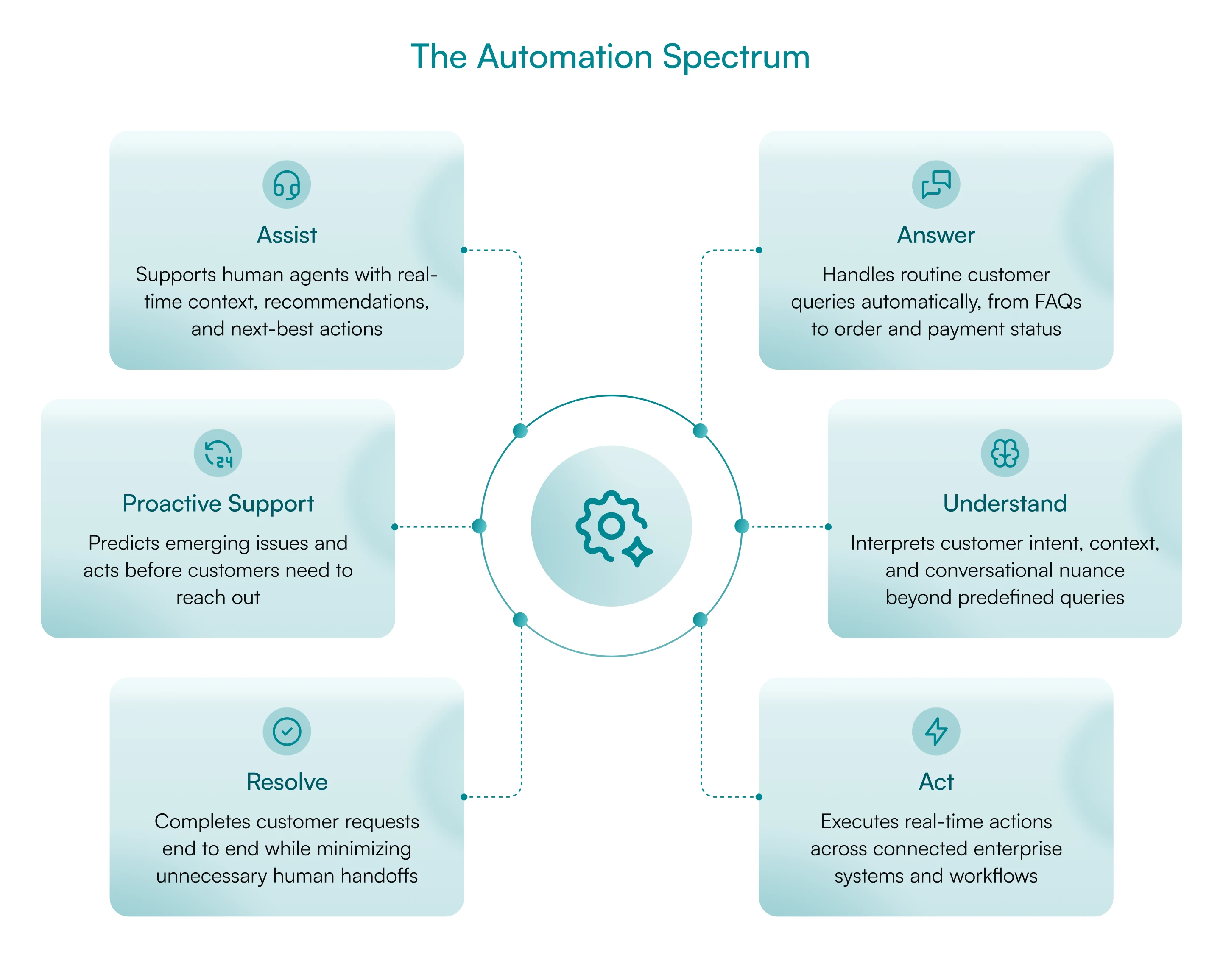
Assist
Answer
Understand
Act
End-to-end resolution
Proactive support
The wrong approach to building a center automation roadmap is asking what AI can do in a vacuum. A far more productive question is: where are human agents spending time on repetitive tasks that do not actually require human judgment?
Strong candidates for call center automation typically share several operational characteristics: high volume, repeatable workflows, clear business rules, accessible customer data, and a highly measurable outcome. But here is where many programs make a mistake: technical simplicity and business value are not the same thing.
Password resets, basic FAQ responses, and order status tracking are easy to automate. They are also among the lower-value targets for driving long-term cost savings. The real operational leverage sits in complex customer service processes that combine high volume with meaningful operational costs or significant business impact, even when those workflows require sophisticated automation technologies to deploy initially.
McKinsey & Company found that organizations which successfully reduced interaction volumes had done more than deploy AI. They had systematically addressed broken processes, integration gaps, and operational risks that were generating avoidable customer inquiries in the first place. That is the deeper strategic opportunity. A financial institution might automate thousands of simple balance inquiries, but automating a complex loan-servicing workflow or a proactive retention touchpoint produces far greater commercial value and better customer satisfaction scores.
Before an interaction even begins, proactive automation creates immense value through automated workflows: appointment reminders, payment collections, renewal notifications, and service disruption alerts that prevent inbound calls entirely. During live calls or digital chats, it manages account servicing, payment processing, claims coordination, and technical troubleshooting. Afterward, it automates post-call documentation, updates records, and triggers compliance reviews.
Across every touchpoint, analyzing customer data from customer conversations provides continuous, data driven insights into product issues, policy confusion, and process bottlenecks that no human team ever had the time to surface systematically.
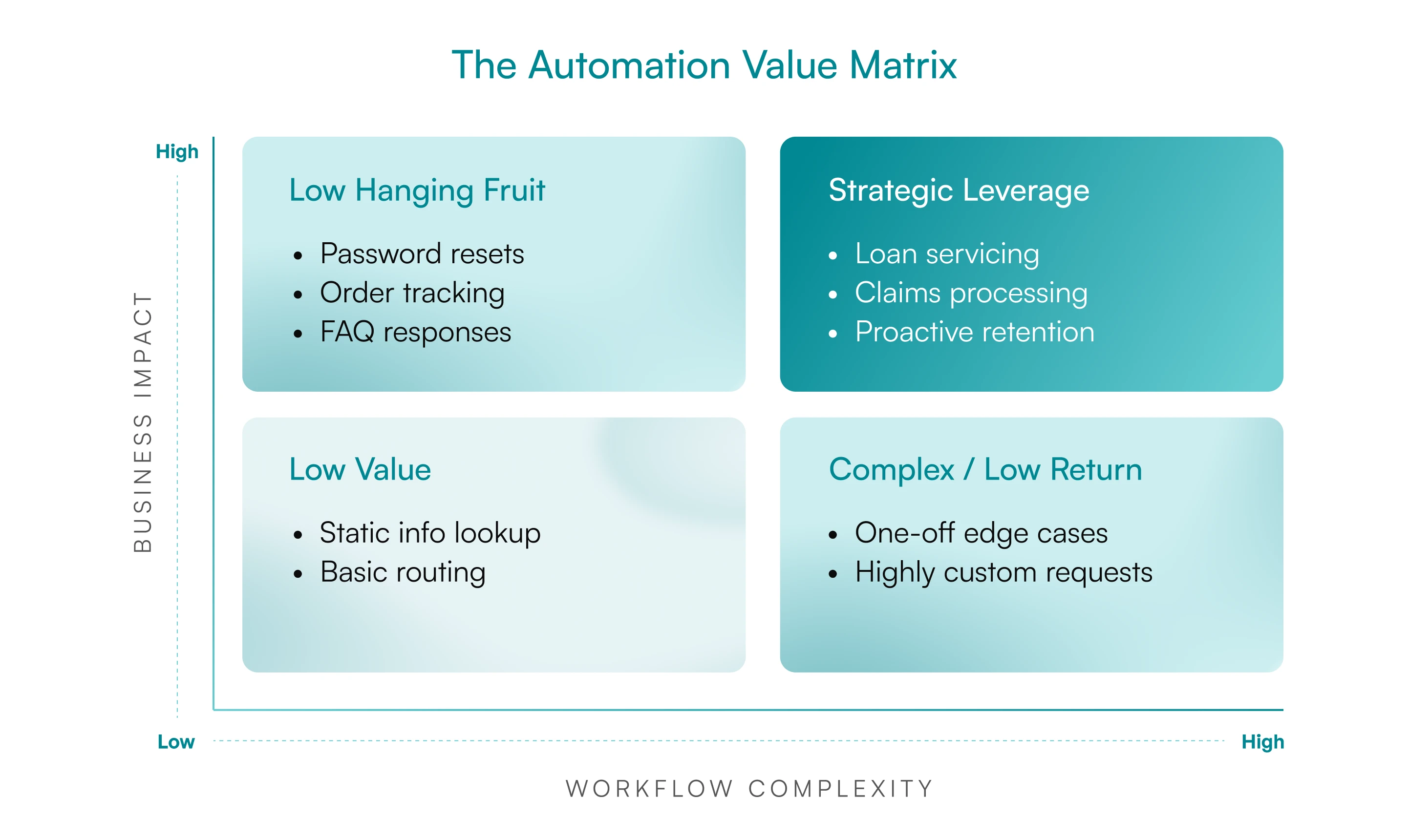
The right strategy maps the full customer journey, identifies time consuming tasks with the highest operational volume, and prioritizes deployments based on business impact rather than technical simplicity.
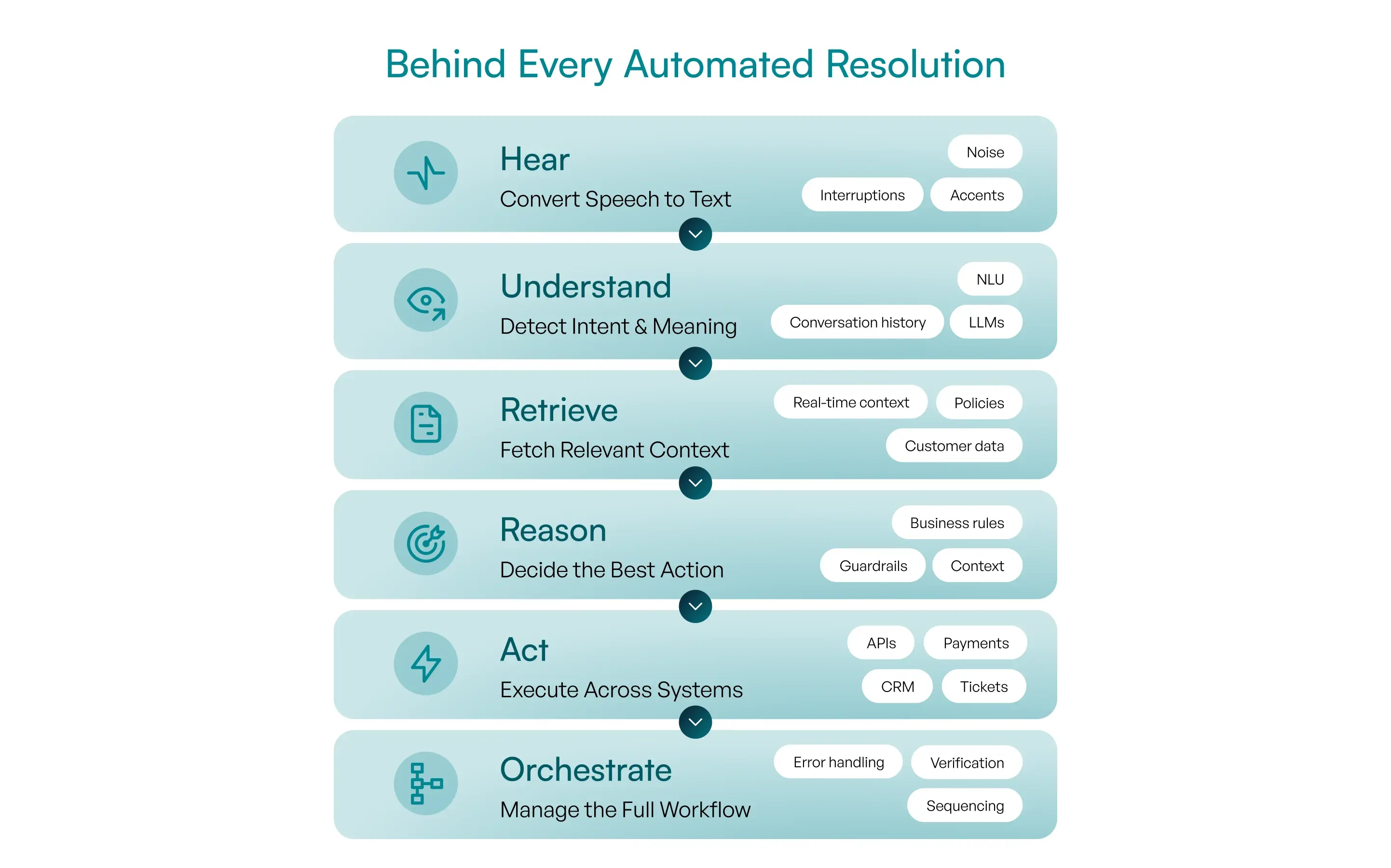
The easiest way to misunderstand contact center automation tools is to think the AI model itself is the entire solution. The AI is simply how the customer interacts; the actual automation happens across the connected systems, business rules, and automated workflows that transform a raw customer request into a verified outcome.
For voice channels, the process begins with speech recognition: converting spoken audio into structured text while handling background noise, interruptions, regional accents, and the unpredictable conversational patterns that real callers produce. From there, natural language understanding decodes what the customer actually needs. The same phrase can represent completely different customer needs depending on context, and the system must categorize the intent correctly before executing downstream actions.
Once intent is established, the platform pulls context: who is this customer, what prior interactions have they logged, what does their account reflect, and what occurred earlier in this call? Large language models reason across these real-time inputs to determine the optimal next step, rather than forcing the customer down a rigid decision tree.
Knowledge retrieval adds another operational layer. Enterprise AI systems should not generate responses from generic training data. They must pull from current, compliance-approved knowledge bases and real-time customer history at the exact millisecond they are needed, ensuring responses remain accurate even when policies update daily.
Enterprise system integrations are where a conversation transforms into an active operation. Without real-time API connections to CRMs, payment processing gateways, ticketing platforms, scheduling tools, and internal databases, virtual agents can only explain what should happen, they cannot execute the work. Modern agentic architectures treat this integration layer as foundational because conversational value relies entirely on backend execution capability.
Workflow orchestration is where technical complexity lives. A simple refund involves user authentication, transaction verification, eligibility checks, payment execution, CRM record updates, and customer confirmations, in the exact required sequence, with error handling if any step times out. AI models should never have unconstrained access to execute every system action. Sensitive enterprise workflows require explicit business rules, role-based security boundaries, and defined escalation paths built in from day one.
Good automation systems know precisely when to stop. When a customer faces a complex fraud situation or an edge case outside the system's design parameters, the platform must execute intelligent routing to transfer the call to human agents. The handoff must carry full context, including conversation history, intent, and verified details. An agent who has to ask the customer to repeat their problem immediately destroys whatever goodwill the automated system built.
The vendor demo is always easy. A cooperative test user asks a clear, well-phrased question. The AI answers flawlessly. Everyone in the boardroom leaves impressed. Then real production volume happens.
In the real world, customers interrupt mid-sentence, pivot topics halfway through a workflow, speak with heavy regional accents that underperform against test baselines, dial in from noisy streets, demand unmapped requests, and arrive already angry from a previous unresolved friction point. Backend APIs time out under load. Customer records contain conflicting data. A business policy changes overnight, but the knowledge base was not updated to reflect it.
These are not edge cases. They are the daily reality of contact center operations at scale, exposing the massive gap between what automation promises in controlled pilots and what it delivers in live production environments.
Input variability presents a constant challenge. Callers do not speak in clean prompts. Voice channels compound this with network jitter, poor audio quality, and natural conversational cadence that lab environments fail to replicate. A system that achieves a 95% success rate on curated test scripts can suffer severe drop-offs when exposed to thousands of unscripted customer calls.
Scaling up fundamentally alters the risk profile. A broken workflow logic step in a small pilot impacts ten interactions. The same logic error at enterprise production scale impacts thousands of users simultaneously. Infrastructure that was not engineered for high concurrency, deep reliability, and graceful failovers will break at peak volume hours.
Then there is the operational visibility gap. Once human agents stop handling every interaction manually, management loses direct line-of-sight into individual conversations. An enterprise might see that its automated tools processed 80% of volume last month without knowing which of those calls ended in genuine resolution, which generated immediate repeat contacts, which workflows silently failed after an API update, or which customer segments were consistently dissatisfied. High containment rates and surface-level automation metrics do not answer those critical questions.
Gartner's June 2025 finding that 50% of organizations anticipating major AI-driven workforce reductions will abandon those plans by 2027 reflects this exact operational reality. Automation does not eliminate operational complexity from customer service; it shifts complexity into software engineering and platform governance. Whether that system is built to handle edge cases, monitored closely enough to catch quality drift, and continuously optimized based on real production data determines whether the platform yields a positive return on investment.
The direct financial and operational benefits of mature contact center automation are clear: significantly lower cost per interaction, reduced average handle times, lower repeat contact rates, consistent compliance execution, and better utilization of human agent capacity.
When call center automation tools handle repetitive tasks and routine inquiries, human agents focus on high-stakes, emotionally complex interactions. This shift directly improves agent performance, reduces burnout, and increases job satisfaction among support staff, leading to lower agent attrition rates across the enterprise.
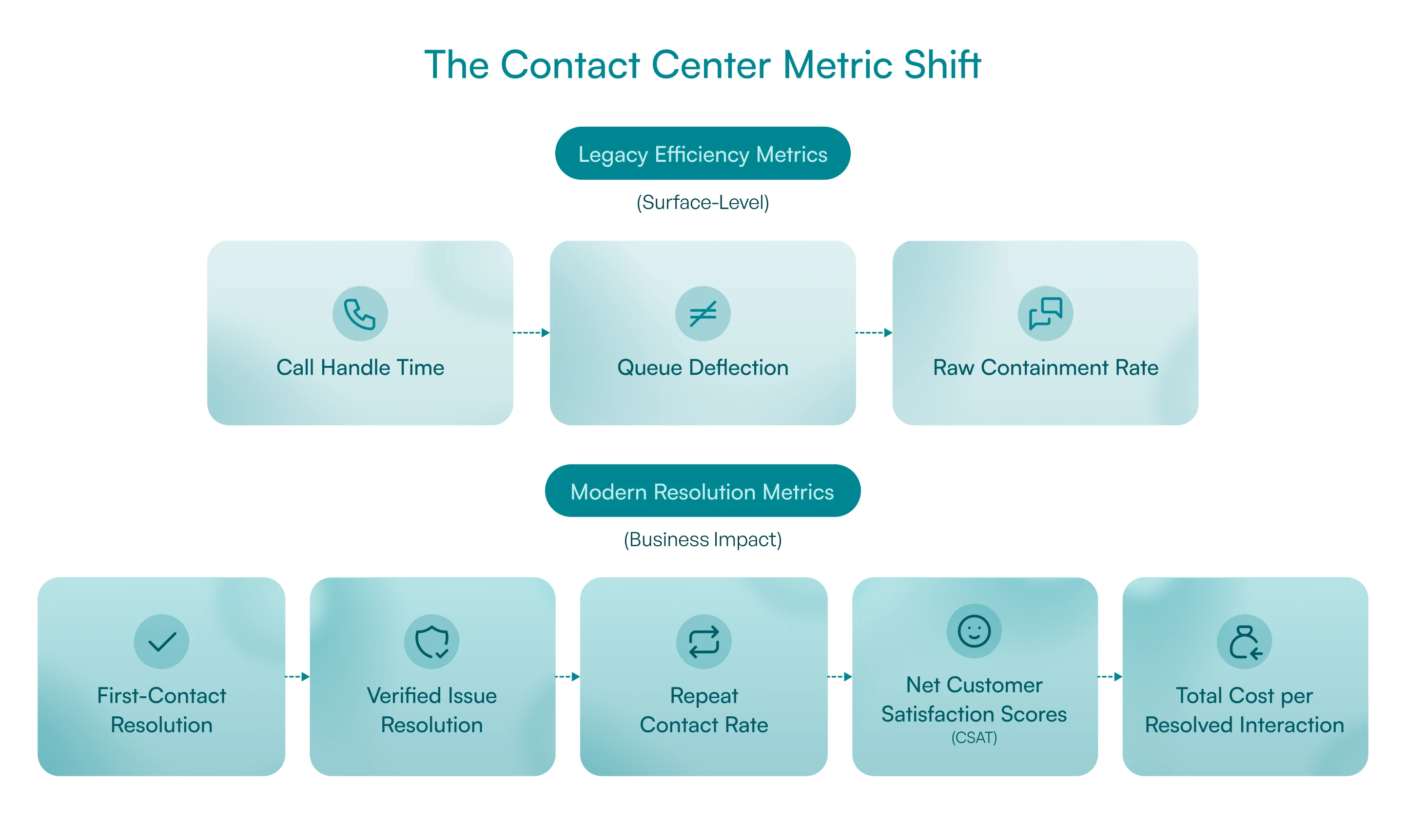
However, the far more compelling executive business case emerges when service automation reaches verified resolution. The support organization stops being viewed purely as a cost center to minimize and becomes an agile operational layer that delivers measurable commercial value. Gartner's December 2025 survey revealed that 55% of organizations handle higher customer volumes with stable staffing levels after deploying AI. That is the true operational leverage: serving a growing user base with efficient service and higher service quality, without a linear increase in operating costs.
The key performance indicators that matter are not raw automation volume or deflection percentages. They are first-contact resolution, repeat contact rate, escalation rate, customer satisfaction scores, and total cost per resolved interaction. An enterprise that optimizes these performance metrics simultaneously builds a sustainable competitive moat.
The contact center began as a physical room where callers spoke to human workers. Software later made it easier to route calls, look up account data, and automate simple menu choices. Artificial intelligence fundamentally transforms the model once again.
Modern contact centers can now understand customer intent in real time, reason across complex historical context, execute actions in connected enterprise databases, and resolve customer queries end-to-end without requiring human intervention at every step with both inbound and outbound calls. This is not an incremental efficiency upgrade. It redefines what the contact center is: shifting it from a reactive cost center into an intelligent, automated operating layer between the enterprise and its customers.
Gartner's March 2025 prediction that agentic AI will autonomously resolve 80% of common customer service issues by 2029 highlights where the market is heading. But the immediate question for enterprise leaders today is not whether AI will eventually reach that benchmark. It is what architectural choices they make right now regarding which workflows to automate, how integrations are built, and how the platform behaves when real-world production gets messy.
The enterprises that gain the greatest return from contact center automation over the coming years will not be those that attempt to automate the highest raw percentage of calls. They will be the organizations that automate the right high-value workflows, measure verified resolution over simple deflection, deploy architectures engineered for high concurrency, and continuously optimize platform performance and streamline operations using real production data.
Automation is not the ultimate goal. True resolution is.
What is the difference between containment and resolution?
Does contact center automation replace human agents entirely?
How should enterprise leaders measure contact center automation ROI?
TL;DR
- The traditional call center was built around manual human labor handling every task from intake to resolution. Modern AI is changing that model, but much of what is marketed as automation today only automates the conversation, not the backend work itself.
- The true leverage point begins when AI systems can act rather than just answer: authenticating users, querying databases, executing transactions, and resolving customer inquiries end-to-end within a single interaction.
- Automation exists along a spectrum, ranging from AI-assisted human agents to fully autonomous resolution and proactive outreach that prevents inbound call volume entirely.
- Sales demos always look flawless; production is where real complexity surfaces. Unscripted callers, background noise, regional dialects, and API timeouts will test platform architecture in ways pilots never reveal.
- Gartner's June 2025 research shows that 95% of customer service leaders plan to retain human agents as a strategic component of their AI strategy. The objective is not an agentless contact center, but an optimal division of labor where AI handles routine tasks and human teams focus on complex, high-empathy scenarios.
- Containment rate is a misleading metric. Trapping a caller in an automated loop without solving their issue drives up customer effort and repeat contact rates. Verified resolution, first-contact resolution, and total cost per resolved interaction are the true metrics of success.