Everything You Need To Know About AI Voice Agents
Written by: Manya Singh
Last updated: Aug 21, 2026
14 mins

The conference floor has been calling voice artificial intelligence the next big thing for years. What changed last year in 2025 is that it stopped being the next big thing and became a business decision enterprises are making right now.
Enterprise deployments of voice AI agents have moved out of the pilot stage and into production. What used to be a proof of concept running quietly in one department is now showing up as a live, customer-facing system that handles real call volume, day in and day out. This isn't a story about experimentation anymore. It's a story about enterprises betting real budget, real infrastructure, and real customer interactions on the technology working.
The conversation has shifted accordingly. It's no longer about whether voice AI works in theory. It's about whether it works for your business, in your operations, at your scale.
The more useful question is no longer "Is voice AI worth it?" It's "What does a successful deployment of AI voice agents actually look like?"
Voice AI is often reduced to "AI that talks." That definition is technically correct and strategically useless.
At an enterprise level, deploying AI voice agents means implementing a conversational system that can understand spoken human speech, interpret intent in real time, make decisions, trigger actions across backend systems, and resolve customer requests through natural conversations and language support. The conversation is simply the interface. Resolution is the outcome.
The reason AI voice agents have become one of the fastest-growing segments of enterprise AI is that they solve something service businesses have struggled with for decades: delivering scalable, human-like voice interactions without scaling operational complexity alongside it.
Modern AI voice agents excel at call handling across high call volumes, handling thousands of simultaneous conversations while maintaining full context, adapting to interruptions, switching languages mid-conversation, and executing API calls into connected systems. They do not just replace menu trees or reduce call volumes. They give enterprises complete control over how customer interactions scale.
The most successful deployments of AI voice agents today are not trying to generate lifelike speech or sound human for the sake of sounding human. They are designed to deliver faster resolutions, higher customer satisfaction, and measurable operational outcomes at scale.
For decades, IVR setups defined what phone system automation looked like: "Press 1 for support. Press 2 for billing. Press 3 to hear these options again."
The problem was never automation. It was that customers had to learn how the system wanted them to behave.
IVR setups operate on predefined pathways. They work when customers follow expected patterns and quickly break when conversations become even slightly unpredictable. Every additional workflow adds complexity, and every deviation creates friction.
AI voice agents flip that model entirely. Instead of forcing customers to navigate rigid menus, modern AI voice agents adapt to how customers naturally communicate. Callers can interrupt, change topics, ask follow-up questions, or explain problems in their own words without restarting the call while the agent listens.
More importantly, AI voice agents are not constrained to answering basic questions. They understand conversation patterns, execute business logic and support workflows in real time.
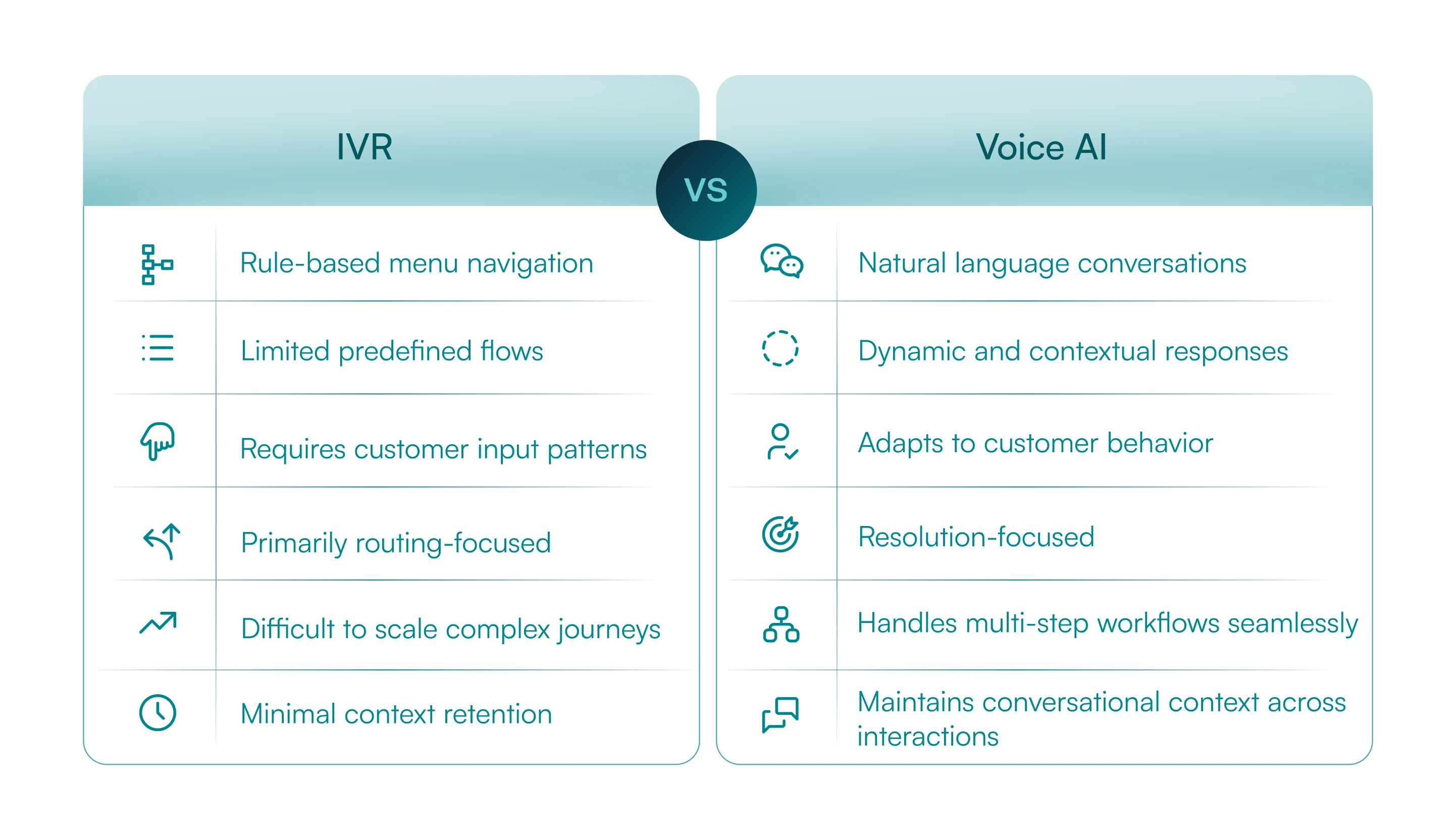
The shift from legacy IVR systems to AI voice agents is not about replacing buttons with conversations. It is about upgrading your phone lines from simple call routing into an enterprise ready voice engine that elevates the entire customer experience beyond support teams.
The capabilities of enterprise AI voice agents have evolved significantly over the last two years. Today's advanced systems are expected to do far more than answer FAQs or automate simple support tasks.
Modern AI voice agents can:
- Understand natural language across regional accents, different accents, and code-switched conversations.
- Execute multi-step workflows across existing systems using real-time API calls.
- Access live customer data to deliver personalization with no human intervention.
- Conduct outbound calls intelligently for proactive customer engagement and lead qualification.
- Manage inbound calls and route complex queries using intelligent warm transfers to a human team.
- Perform automated quality monitoring across live calls on multiple channels.
- Deliver reliable multilingual support across multiple languages.
- Escalate conversations to human agents while preserving full context.
- Orchestrate multi-agent workflows using one agent for specialized tasks while maintaining enterprise grade reliability.
- Generate natural-sounding voice responses using text-to-speech technology.
These capabilities become even more powerful when AI voice agents move beyond basic chat into full agentic execution.
A customer asking for an order update is straightforward. A customer calling on phone lines during or outside business hours, requesting a delivery modification, changing their payment method midway through, and asking for sms follow ups introduces significantly more complexity. Enterprise AI voice agents are built specifically for that second scenario.
The benchmark for enterprise ready voice technology is no longer whether an agent can deliver natural-sounding speech. It is whether AI voice agents can resolve complex customer requests reliably in production with consistent quality.
Voice AI feels simple when it works well. Underneath that simplicity sits an orchestration layer of technologies operating simultaneously within milliseconds.
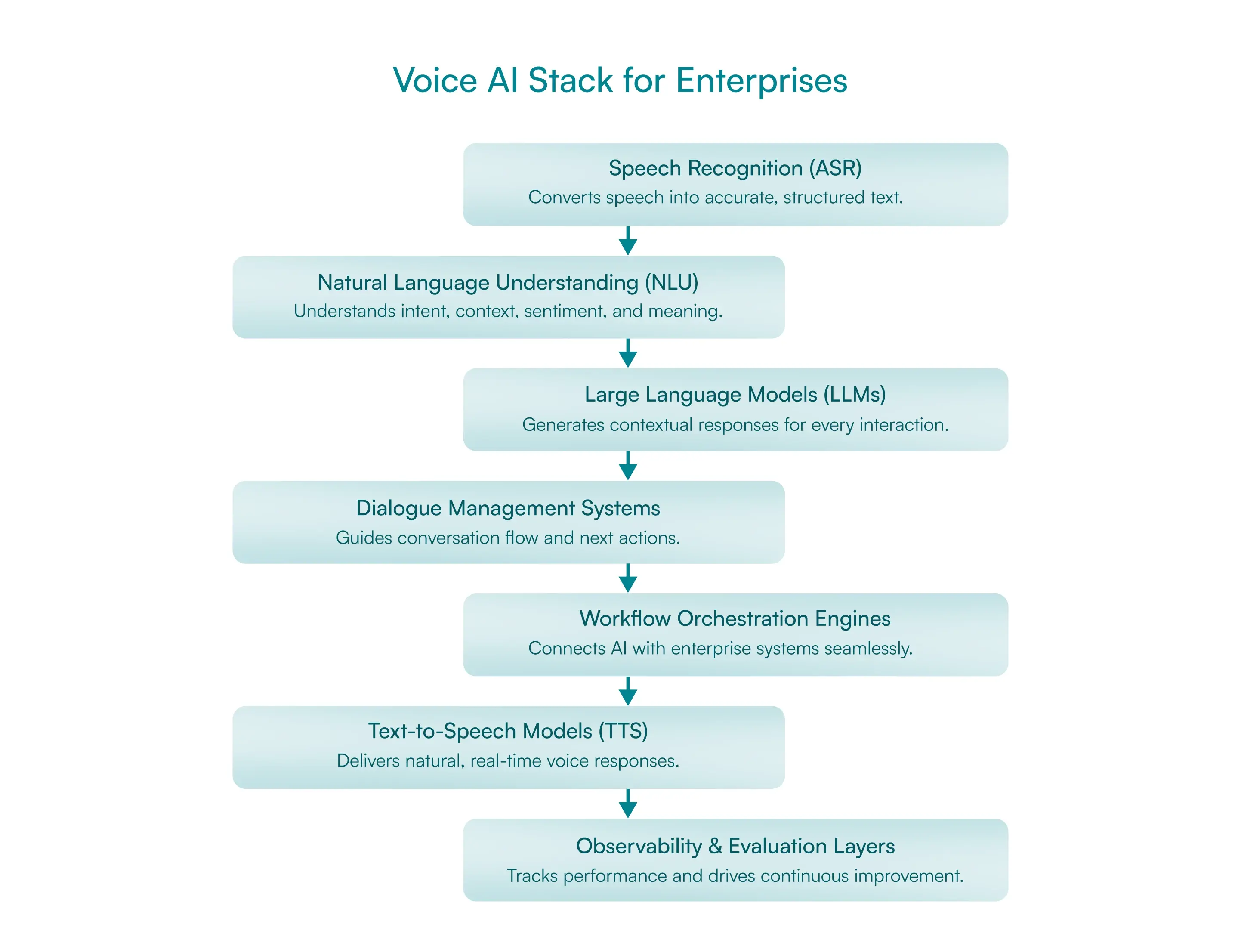
All of these components operate in real time. When a customer speaks on live calls, the system isn't simply converting speech to text and reading a script. It uses speech recognition, understands intent, queries backend systems, validates workflows, and executes actions before the customer notices a pause.
The baseline voice synthesis, voice quality and performance of AI voice agents depend far less on any single component and far more on how seamlessly these technologies work together under the hood and seamlessly support flows.

BFSI
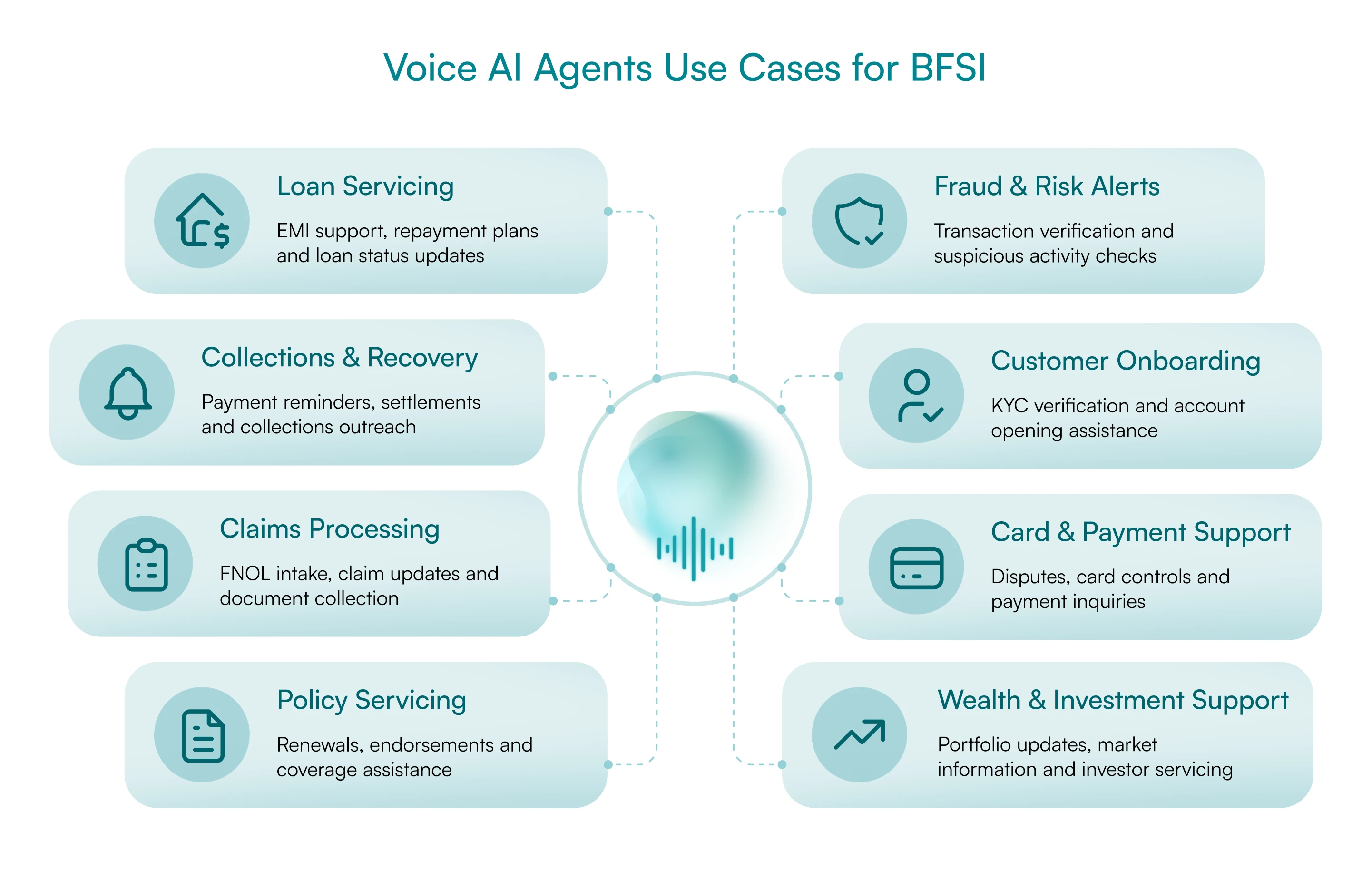
In financial services, AI voice agents automate balance inquiries, EMI reminders, loan servicing, and collections outreach. Customers expect immediacy and more control when dealing with financial transactions. Modern AI voice agents authenticate users, retrieve account information in real time, guide callers through complex processes, and perform warm transfers for sensitive situations, all while adhering to enterprise grade security.

E-Commerce & Retail

Healthcare

Travel & Hospitality
Travel and hospitality enterprises use AI voice agents to manage booking modifications, cancellations, loyalty program queries, and service recovery. When travel disruptions strike, deploying AI voice agents to handle high call volumes on inbound calls becomes the difference between great service and brand crisis.
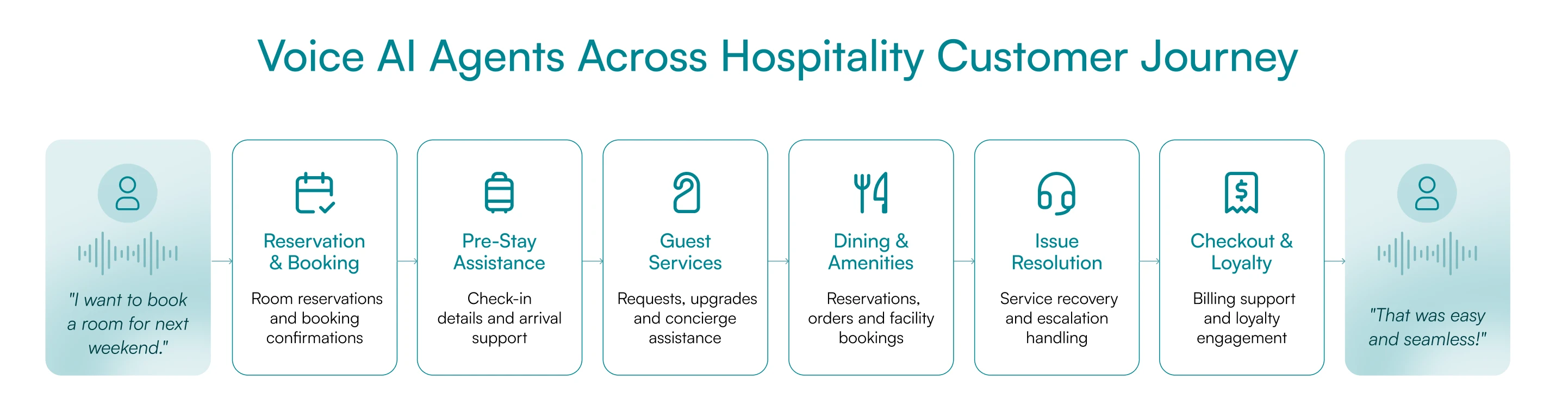

Telecommunications & Contact Centers
The first wave of voice AI adoption was driven by necessity. Contact centers were struggling with rising call volumes, high turnover, and legacy automation. AI voice agents emerged as the logical next step.
Today's demand is driven by business pressure, technological maturity, and economics.
Industry projections from Gartner show that conversational AI will reduce contact center labor costs by $80 billion globally in 2026. That is an executive-level business case. According to survey data from Gartner, 91% of customer service and support leaders are under direct executive pressure to implement AI.
At the same time, the underlying technology has caught up with enterprise expectations. Earlier voice systems relied on rigid decision trees that broke under unpredictable inputs. Modern AI voice agents powered by large language models can understand, reason, and execute complex task flows naturally over phone calls, with engineering support enabling deeper integrations and more complex workflows.
The demand makes sense. What enterprises continue to underestimate is the operational complexity of deploying AI voice agents in production environments.
Here is what rarely makes it into a vendor pitch deck: recent reporting indicates that 78% of enterprises have AI agent pilots running, but only 14% have successfully scaled an agent to organization-wide operational use.
The technology works but scaling AI voice agents in real-world conditions is where deployments stall, no matter how dedicated technical resources are.
Production environments are fundamentally different from controlled demos. Demos operate on clean audio and scripted flows. Production involves real customers, regional accents, different accents, background noise, poor network conditions, and edge cases nobody planned for.
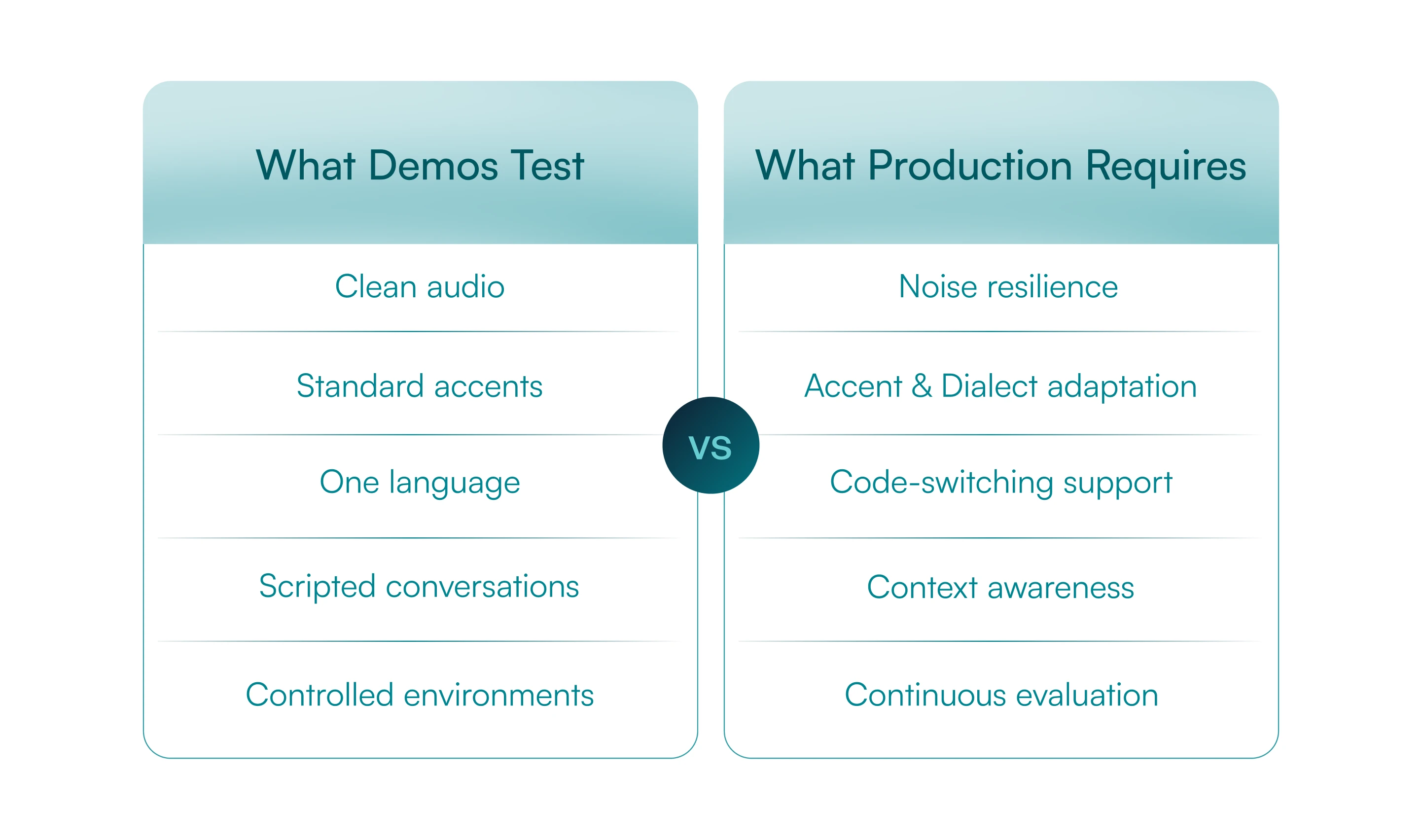
A customer calling from a noisy street, switching languages mid-conversation, or asking an unexpected question is not an exception. It is production reality. Word error rates that sit comfortably below 5% in a quiet lab can spike past 10% to 15% in real telephony conditions, crossing the threshold where users hang up.
Production is also unforgiving at scale. A logic error in a demo affects one conversation. In production, it impacts thousands of live calls simultaneously. Gartner research shows that AI-powered customer service initiatives fail at nearly four times the rate of other AI projects when deployed without proper infrastructure.
The biggest mistake enterprises make when evaluating AI voice agents is measuring how good the conversation sounds in a demo rather than whether the problem gets solved in production.
Did the customer get what they needed? Was the right workflow triggered? Was the issue resolved without adding operational overhead?
An AI voice agent can achieve impressive containment rates and still fail to deliver business outcomes. Containment simply means the caller did not reach a human. Resolution means the customer's problem was actually solved.
The first generation of voice AI was built to converse. It could listen, understand, and respond. What it could not do was execute work.
Agentic AI voice agents change what enterprises should expect from automation. The conversation is no longer the end goal; outcomes are.
An agentic AI voice agent does not stop at answering questions. It validates customer information, queries live CRMs, processes payments, updates records, triggers sms follow ups, and confirms resolutions, all within a single call. Instead of handing work off to another system, it completes the task end-to-end.
This changes how enterprises measure success. The question is no longer whether the voice sounds human enough. It is whether the AI voice agents resolved the issue accurately and efficiently at scale.
Production-grade agentic AI voice agents require:
- Real-time API integrations that allow agents to act on live enterprise data.
- Dynamic intent resolution that adapts as customers change requirements mid-call.
- Intelligent escalation logic that preserves full context during warm transfers to human teams.
- Complete audit trails and call analytics that capture every decision and action taken by the agent.
Multi-agent orchestration takes this further. Rather than relying on one agent to handle every scenario, enterprises deploy specialized AI voice agents across specific workflows and business functions.
A customer calling about a billing dispute can transition smoothly to an upgrade conversation without repeating information. The orchestration layer manages context, routes calls intelligently, and ensures every action remains fully traceable.
Moving from conversation to resolution changes how customer operations run. Yet even with multi-step workflow capabilities, many enterprise deployments hit a wall when encountering how humans actually communicate.
Accuracy statistics for AI voice agents are usually presented as global averages. That is convenient for marketing, but misleading for real-world deployments.
Code-switching, regional accents, different accents, and conversational nuances are not edge cases. They are how people speak every day.
In multilingual environments, customers frequently switch languages within a single sentence. Technical terms are often spoken in English while the rest of the sentence uses a regional language. Traditional speech models struggle in these scenarios, leading to higher error rates and poor customer experiences.
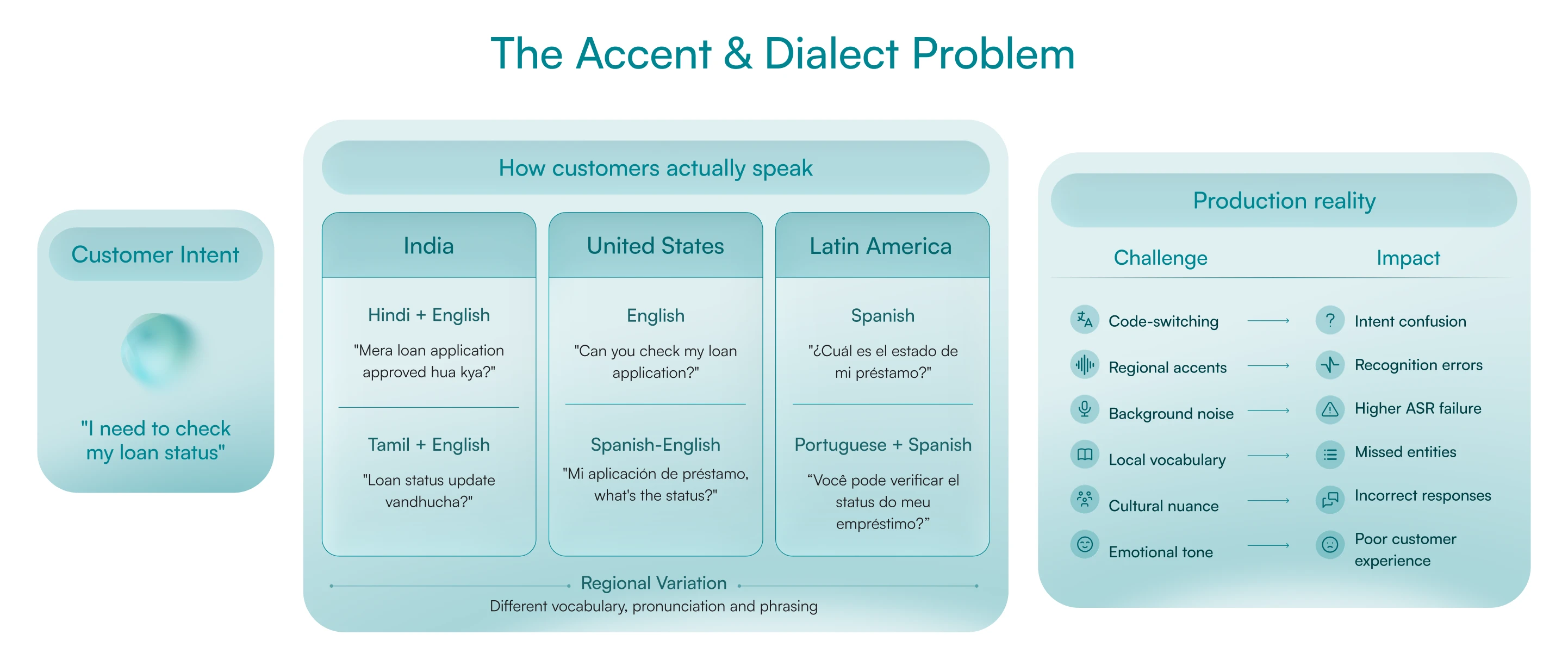
The implication for enterprises is clear: AI voice agents that perform well in one market may struggle in another despite serving the same use case.
Voice AI is not deployed against benchmark datasets. It is deployed against millions of real customer conversations happening across diverse accents, environments, and edge cases. Successful deployment comes down to selecting AI voice agents that are trained, tested, and validated for real-world linguistic diversity.
Every enterprise voice AI conversation eventually lands on latency. How fast does the agent respond? Is there a pause? Does it feel human?
Latency matters. Nobody wants to talk to an agent that takes two seconds to respond. But latency is rarely what breaks a production deployment.
Deployments fail because of problems that vendors rarely show in demos:
- An agent that does not know when to escalate a call.
- An outbound campaign workflow that repeatedly dials customers at the wrong time.
- A QA process that reviews only a small fraction of conversation logs.
- A handoff that loses customer context during warm transfers.
- An agent that performs well in English but fails when customers code-switch mid-sentence.
- An integration that works in isolation but fails when multiple systems interact in real time.
These are everyday operational challenges that determine whether AI voice agents deliver real business outcomes.
At Nugget, we built our platform from the ground up to solve these exact challenges. Developed inside Zomato and battle-tested across billions of customer interactions, we learned early that deploying AI voice agents is an orchestration problem, not just a speech problem.
The most successful enterprise deployments are built for the complexity of real customer interactions.
Can your AI voice agents handle a customer changing their intent midway through a call? Can they retry unanswered outbound calls intelligently? Can they identify failure patterns across millions of conversations before customers complain? Can they resolve issues across channels and backend systems without losing context?
Latency gets you through the demo. Architecture gets you into production.
Voice AI has moved beyond experimentation. For modern enterprises, deploying AI voice agents is becoming core customer experience infrastructure.
Adoption alone is not the benchmark for success. Production-ready AI voice agents require intelligent orchestration, robust backend integrations, continuous optimization, and an architecture built for real-world complexity.
The enterprises seeing the highest return from AI voice agents are not simply automating conversations. They are automating end-to-end business outcomes.
The next generation of voice automation will not be defined by who has the flashiest demo. It will be defined by who can consistently deliver accurate, contextual, and scalable resolutions in production.
Because the future of AI voice agents is not just about sounding human. It is about operating intelligently at enterprise scale.
Is investing in AI voice agents worth it for enterprises?
Why do so many pilots for AI voice agents fail to reach production?
How important are regional dialects and accents for AI voice agents?
Is latency the most important metric when evaluating AI voice agents?
TL;DR
- Voice AI is no longer an emerging technology. Enterprise adoption of AI voice agents is accelerating rapidly as organizations move from pilots to full production.
- Most deployments do not fail because the underlying models are weak. They fail because moving AI voice agents from a polished demo to a production system involves natural language understanding, unhandled edge cases and real-world complexity.
- Agentic AI voice agents shift the focus from simple conversations to complete resolutions. Enterprises need agents that execute workflows, query backend systems, and resolve tasks.
- Regional accents, code-switching, and dialect variations are not edge cases. They are real-world communication patterns that dictate whether AI voice agents work outside controlled environments.
- While low latency is important, the true differentiators for AI voice agents in production are system architecture, integration depth, and long-term reliability at scale.