Voice AI in Production: From Working Demo to Production Reality
Written by: Manya Singh
Published On: Oct 5, 2026
11 mins

Gartner expects more than 40% of agentic AI projects to be canceled by the end of 2027, citing escalating costs, unclear business value, and inadequate risk controls. Meanwhile, only 30% of organizations surveyed on agentic AI have fully deployed anything, while 47% are still piloting.
Read those together and you get the shape of the problem. Nearly every enterprise has a voice AI pilot, yet very few have scaled one to survive production.
The usual explanation is that the technology is not ready and a better model will close the gap. If you are a CX leader, the most useful thing anyone can tell you this year is that this is wrong. Pilots do not fail to scale because the model is not good enough. They fail because the production vs demo gap means the pilot was a fundamentally different test.
An AI demo or a 30-second call is a reasonable thing for a busy buyer to run. It just cannot see the real work required for production readiness.
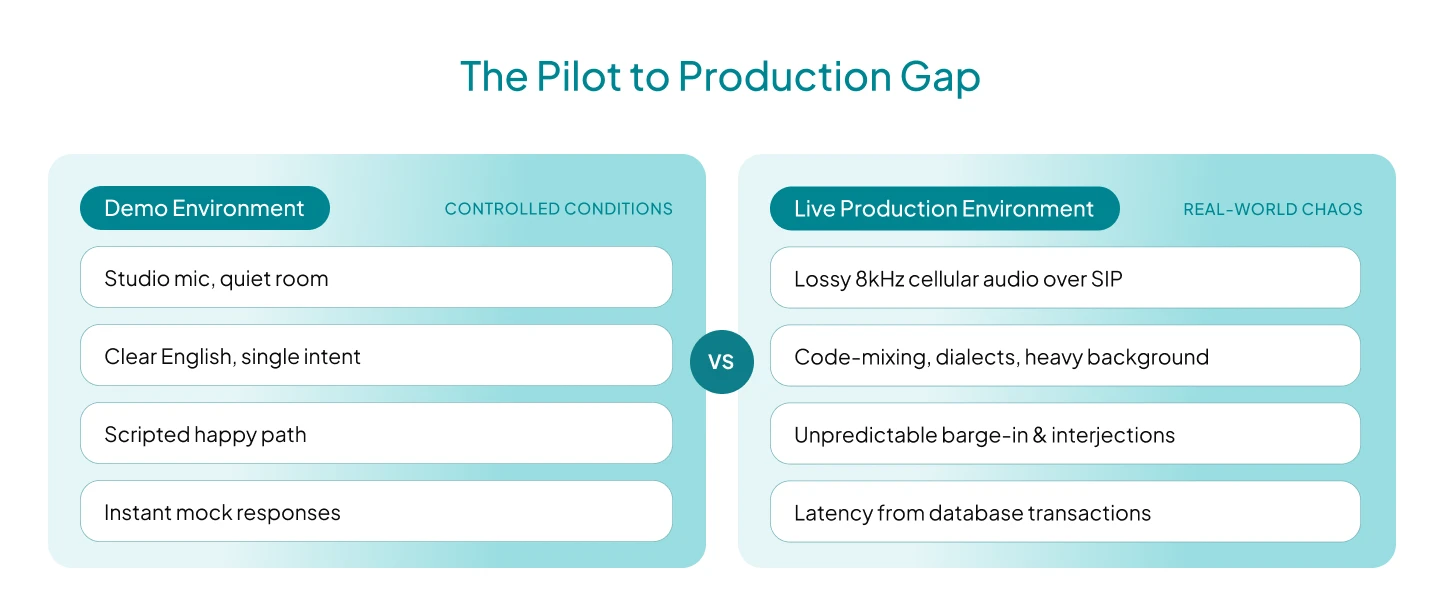
Think about what a demo environment call actually contains: a scripted happy path the vendor chose, demo data, a quiet room, a good microphone, clear English enunciated, one intent from start to finish, nothing to look up mid-sentence, nobody interrupting, and thirty seconds of runtime. In a controlled demo, controlled conditions ensure almost nothing goes wrong, and edge cases are quietly excluded.
Now put the same AI initiative into a live production environment. The audio is 8kHz over a carrier you do not control. There is a bus, a television, a family in the room. Real users speak two languages inside one sentence, and they may be annoyed, evasive, or lying. Your CRM takes three seconds to return a database query. Interruptions land on almost every turn. All of it repeats under real load from thousands of concurrent users tens of thousands of times a day.
These are not the same test. The first demonstrates speech synthesis and a model holding one intent for four turns, which is real and worth having, but it is just the tip of the iceberg, the smallest part of the product. Passing a demo therefore predicts very little about whether a system is production ready, which raises the obvious question of what actually fails when real data hits real systems.
Here is the most useful frame we know, and it comes from reading complaints rather than benchmarks.
When a production system or voice agent fails, the customer never says the prosody was unconvincing. They say something much more specific about system behavior:
- "It cut me off." The agent started talking while the customer was still finishing a sentence. That is turn-end detection failing under real load.
- "It talked over me." The agent could not tell a real interruption from someone saying "mm-hmm." That is barge-in versus backchannel management.
- "It didn't understand me." Two languages in one sentence. That is code-mixed recognition falling apart on low-bandwidth servers.
- "The line went dead." Your backend systems took three seconds to respond because of a congested database connection pool or slow background job, and no contextual filler was spoken over the wait.
- "It promised me something." A discount or a date nobody authorized, now on a recording. That is a containment failure due to lack of guardrails.
- "I had to start again." The call changed subject and the agent could not follow it across. That is a failure in multi-turn context switching.
- "It behaved differently today." The model underneath moved during the deployment process for new features, and nobody caught the regression before the customer did.
Not one of those is a voice quality problem. Not one is fixed by a better voice or a larger model. Every single one is an orchestration failure in production architecture.
Each issue also converts into a number your finance team already tracks as operational risk. Being cut off drives repeat contacts and pushes handling time up. Being talked over drives mid-call abandonment. Mis-heard code-mixing produces wrong actions and rework. An unauthorized promise is compliance exposure. And without structured monitoring and structured logs, nobody can explain why anything failed, so fix cycles run in months.
The evidence that this compounds is stark. Only 27% of customers say they would try a chatbot again after a negative experience, and while 49% say they would have used one if offered, just 7% actually did in their most recent service interaction according to Gartner. Gartner calls it a leaky bucket. You do not get the attempt back.
That is the real cost of shipping an unvetted pilot into production, and it explains why the industry's favorite metric is actively misleading.
Deflection, or containment, measures the share of contacts that never reached a human. It is the number most vendors lead with, and it has a hole in it big enough to drive a rollout through.
A call the customer abandoned in frustration was deflected. A call where the agent confidently gave the wrong answer was deflected. Both count as wins. Meanwhile, 85% of CX leaders say customers will drop brands that cannot resolve an issue on first contact according to Zendesk, which is the outcome deflection is least able to see.
The only honest commercial unit is cost per resolved contact, which is containment multiplied by cost per attempt, with resolution defined and the denominator stated. It is the one number that makes a cheaper, worse agent look expensive, which is precisely why you rarely see it on a vendor slide.
Gartner's guidance to service leaders lands in the same place, recommending reliability over reach and describing a good deployment as a connector to human support rather than a containment trap. It is also why 87% of customers say access to a human agent is essential when a company uses generative AI in customer service as per Gartner, 2026. Pick the right unit and the technical argument reorganizes itself around a single word.
The market says voice AI and means text-to-speech, because that is the only layer a person can perceive without instrumentation. In practice, around twenty-five components have to cooperate on every turn: listening and turn-taking, recognition and language handling, reasoning and memory, tool calls into your database, workflow routing, guardrails, escalation rules, dialer and SIP, model fallback, monitoring, regression testing, and tenant isolation.
Three of those twenty-five are the voice. They are also the only three a buyer can hear in a standard AI demo.
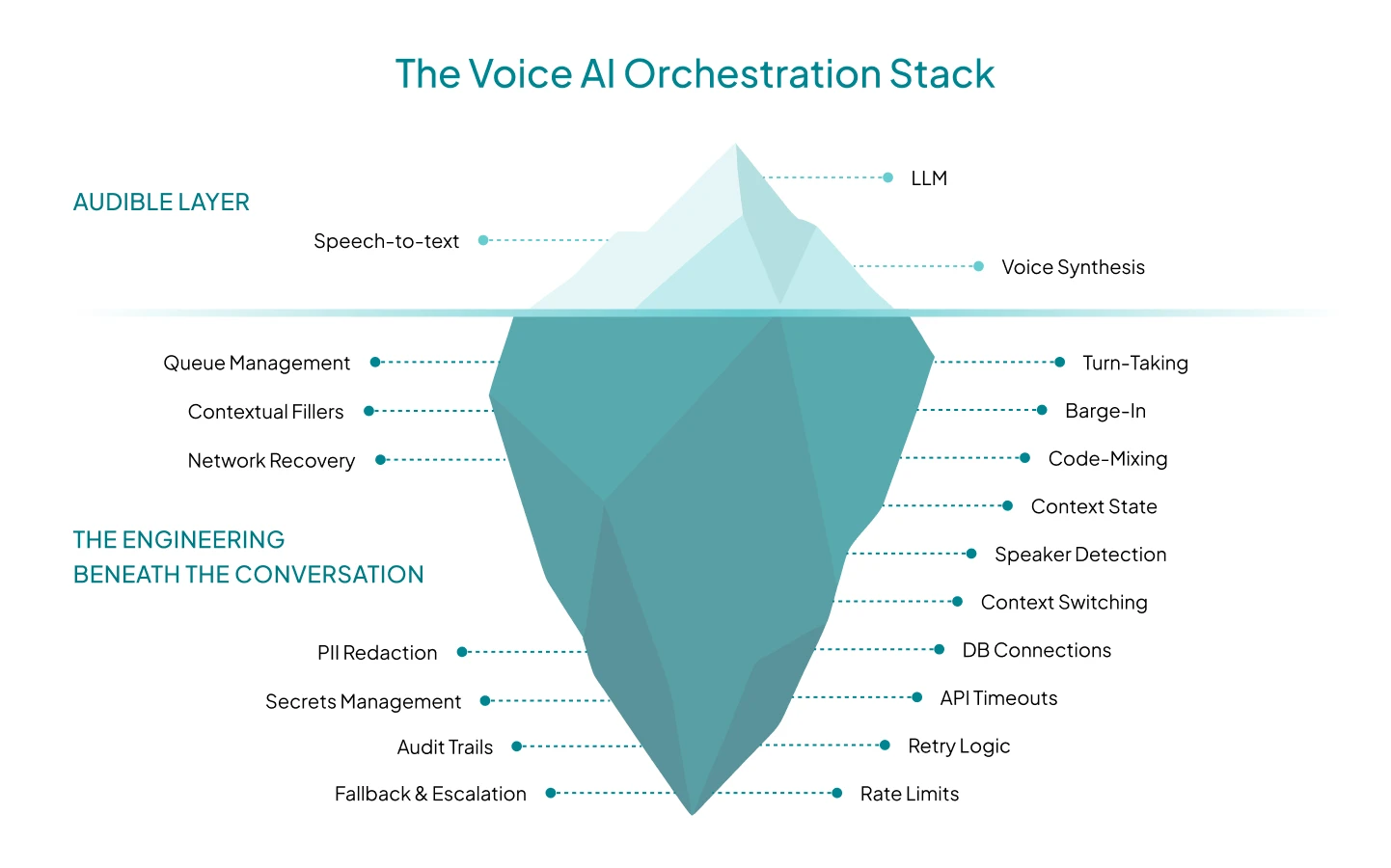
This is what makes the build-versus-buy conversation so lopsided. An LLM plus speech-to-text, text-to-speech, and basic tool use is genuinely about two weeks of work for a capable engineering team, and it will demo well. We concede that immediately, because arguing otherwise is not credible for developers. However, the eighteen problems underneath the waterline represent years of software development work, and they are equally important because they decide whether the software survives contact with users under real load.
Which is why "we'll just build it on an LLM" is the most expensive sentence in enterprise CX. The follow-up question writes itself: Who on your team owns those eighteen problems, what is their plan for error handling when a rate limit or network timeouts hit, and what else were they going to build for the business this year?
Nugget was built inside a high-concurrency consumer operation before it was offered to anyone else, which means the long tail of failure modes got solved before it was ever sold. Three things follow from that, and none of them is a feature tour.
The first is the harness. The things that make a real call work do not live in the prompt. They live in a set of controls that most buyers never see:
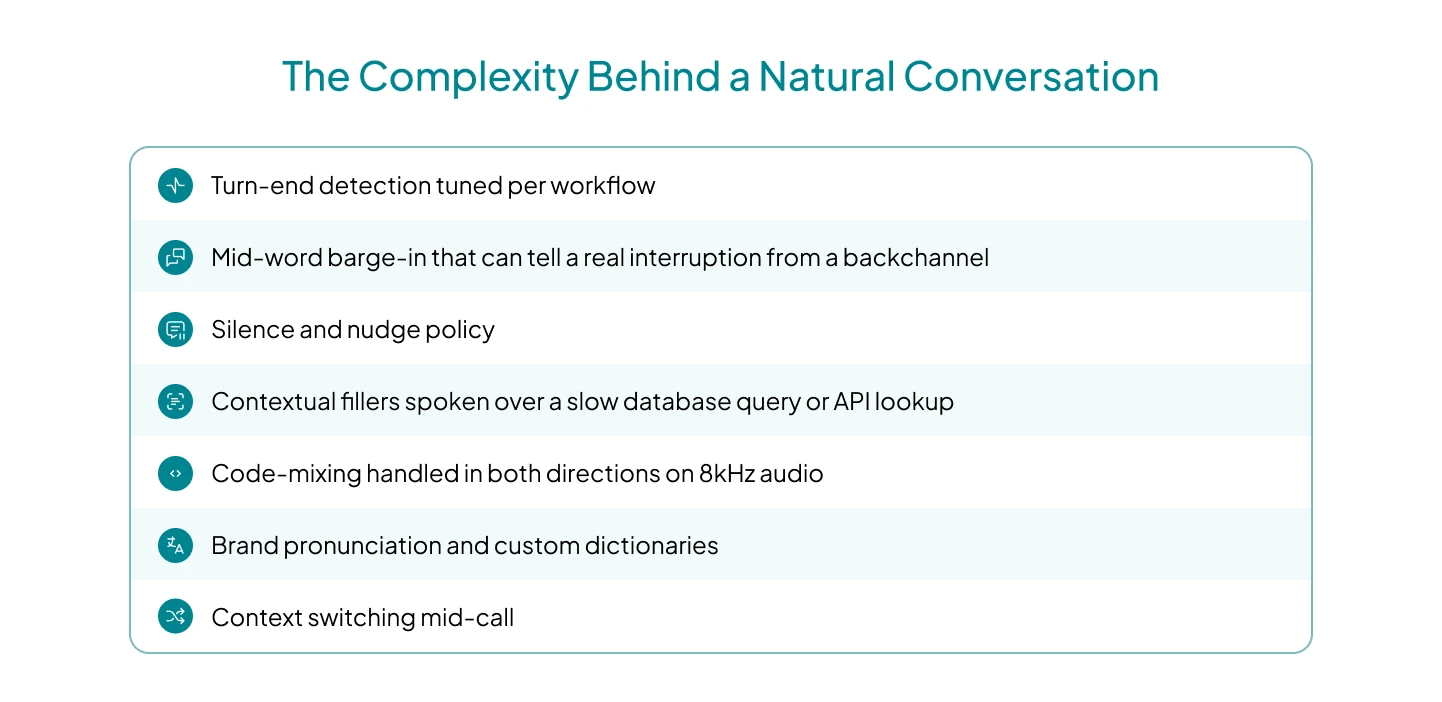
Every one of those sits outside the model, in configuration and on the streaming path. The distinction is not academic. It is exactly why a prompt-level competitor can accept the identical instruction, demo it convincingly, and still break on turn two. The prompt is not the product. It is also why swapping the model underneath does not reopen a compliance review, since the harness does not move when the model does. Our guide to AI Voice Agents covers turn-taking mechanics and system orchestration in more depth.
A guardrail agent constrains what can be said before it is said, so the agent cannot offer a discount you never approved. An observer agent watches the live call and can flag, correct, or escalate while the line is still open. Customer data, user emails, and PII are redacted in-stream, so they never reach stored audio logs or publicly accessible endpoints. Escalation is warm, carrying the transcript, the reason, and the context across. And the audit trails include reasoning traces with the guardrail rule that fired attached to the turn.
The point of all of it is inspection and control. Clients audit us, they do not trust us, and the line we will stand behind is that we would rather escalate a call than fake an answer on it.
Nugget runs customer support across Zomato, Blinkit, and Hyperpure at a call and ticket volume that breaks most platforms. The Zomato deployment moved support cost from $20M to $9M and automation from 60% to more than 80%. Those are platform-wide figures across chat and voice rather than voice-only outcomes, and we would rather say so than let you assume otherwise.
Accountability has a clear boundary, and we believe in defining it upfront. Agent behavior, latency inside the agent, transcription quality, guardrail adherence, and tenant isolation are ours, and we expect to be measured on them. Dialer pacing, number reputation, and backend API response times are shared responsibilities, because end-to-end execution relies on the speed and health of your core systems. Carrier routing and your customer's handset fall outside our control entirely, but we measure them anyway so nobody has to guess where a delay occurred. A vendor who claims to own the entire phone network is telling you something useful about the rest of their answers.
The architecture question is not settled, whatever you may have been told. We build on speech-to-speech models and deploy them today where the workflow allows, because they offer a lower latency ceiling and richer prosody. However, speech-to-speech is not yet ready to carry a regulated call for three specific reasons: tool calling is less predictable, there are fewer places to embed deterministic guardrails, and there is no native transcript to hand an auditor. For these reasons, regulated traffic runs on a cascaded architecture. When that calculus changes and it will, nothing in our platform harness needs rebuilding, because the harness sits outside the model. Anyone telling you the architecture question is settled is selling you a roadmap as a fact.
If that reads like a lot of nuance, that nuance is the product. The same engineering discipline applies whether managing outbound collections on voice or servicing complex insurance claims, which is the core argument for choosing a unified enterprise platform over funding a point solution per workflow.
You will not learn much about production readiness from another AI demo. You will learn a great deal by putting your vendor through this four-question production readiness checklist:
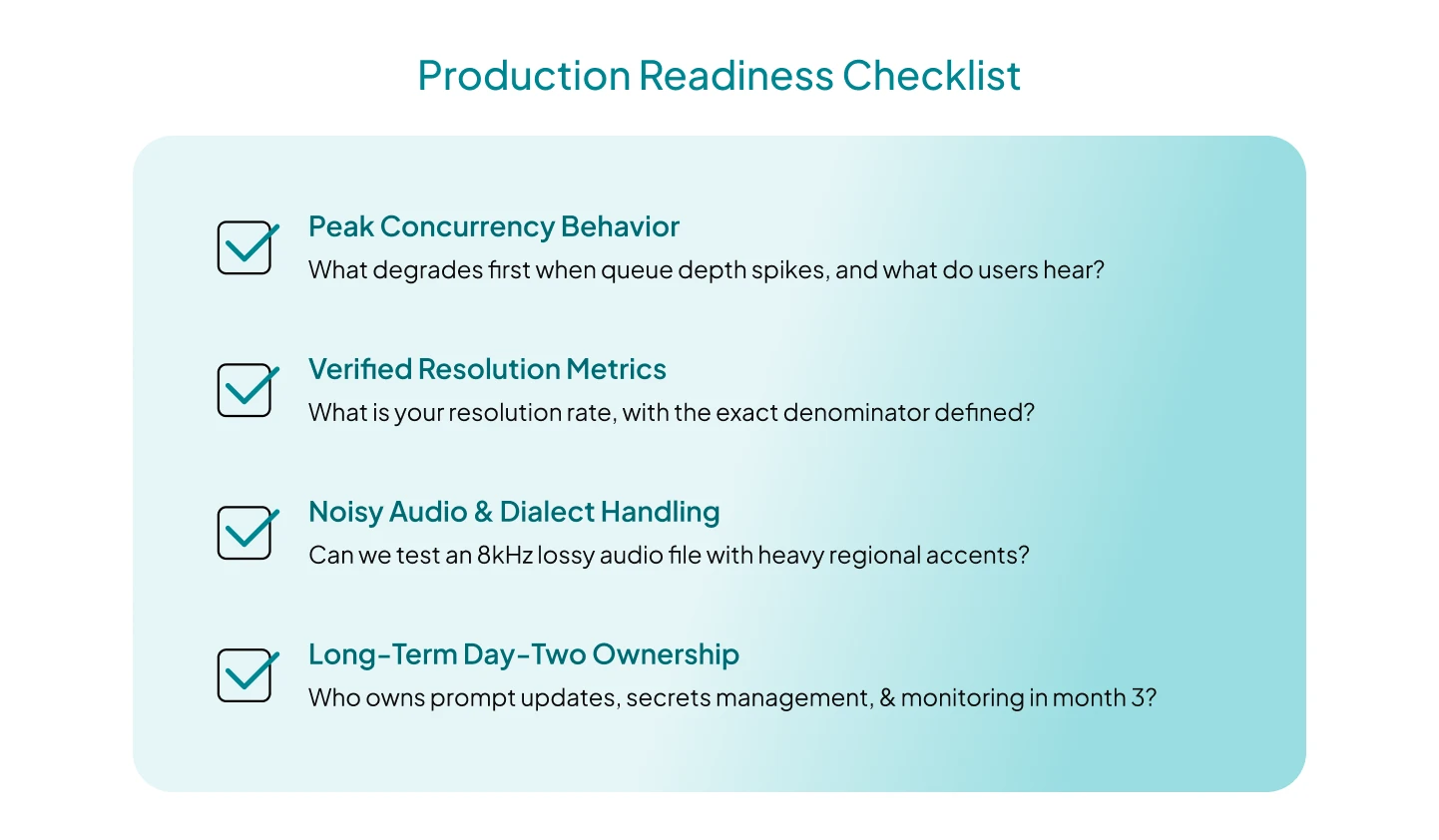
- What happens at peak concurrency? Not just the maximum number of concurrent users supported, but the specific system behavior. Ask what degrades first, how the queue depth behaves, and what the customer experiences while something breaks.
- What is your resolution rate, with the denominator defined? If the answer is a containment number that includes abandoned calls, ask again until you get a true cost per resolved contact.
- What happens on a noisy call, in an accent your demo did not use? Ask to hear a sample running over lossy cellular audio rather than studio-quality test data.
- Who owns the agent in week six? If the answer is an internal engineering team spending hours managing api keys, secrets management, and database connections, you have bought a project rather than a platform.
There is one more signal, and it is the most diagnostic of all. When you say "it doesn't sound natural," listen to what happens next. On production software that has been battle-tested in a live production environment, most of those complaints resolve to a named component and a settings change. On a platform that has only been tested under controlled conditions in test environments, they resolve to an architectural rebuild.
None of this argues that voice AI does not work. It plainly does, and the reason we can be this specific about the failure modes is that we have hit all of them at volume and we have solved for each of them.
It argues that the evaluation process is broken. A 30-second AI demo selects for speech synthesis and single-intent coherence, which are the two things least likely to determine whether your deployment process reaches production and survives first hour traffic. The category has optimized for winning that evaluation, and buyers have reasonably assumed the evaluation measures something that matters.
So change the test. Ask about the problems under the waterline, ask for resolution metrics with a clear denominator, and ask who owns system maintenance in month three. Vendors built to scale in production find those questions easy, and their answers are boringly specific. That is the tell.
TL;DR
Pilots fail because the test is different. Nearly every enterprise has a voice AI pilot, but very few reach production readiness because a 30-second demo in controlled conditions excludes real-world chaos.
Production is messy, live calls involve 8kHz lossy cellular audio, background noise, code-mixing, unexpected barge-ins, and slow database query latencies.
Customers complain about orchestration, not voice quality. Turn-taking errors, talking over callers, unhandled code-mixing, and unauthorized promises are orchestration failures, not voice synthesis issues.
Deflection is a misleading metric. Containment counts abandoned calls as wins. Cost per resolved contact is the only honest metric for measuring ROI.
Only 3 of 25 components are audible. Building a basic LLM demo takes two weeks, but solving the 22 hidden orchestration problems (guardrails, secrets management, queue depth, error handling) takes years of engineering.