Agentic AI: How AI Agents Move from Answers to Actions
Written by: Manya Singh
Published On: Sep 14, 2026

For most of the last three years, AI in the enterprise meant an artificial intelligence system that answered a question well. Agentic AI is the first version of that technology built to do something about the answer. That distinction, between generating a response and executing a task, is the entire story of where enterprise AI is heading in 2026, and it is also where most of the confusion about the term comes from.
Strip away the marketing and agentic AI describes a specific loop: observe, reason, plan, act, verify. An agentic system takes in the current state of the world, reasons about what needs to happen, plans a sequence of steps, acts on that plan using external tools and software systems, then checks whether the action actually worked before moving on.
That loop is how agentic AI extends capability beyond the three technologies it keeps getting lumped in with:
- Generative AI: Produces content. It writes the email, drafts the summary, answers the question. It does not check whether the email got sent or take a second step based on what happened after.
- Predictive AI: Forecasts an outcome, like churn risk or demand, but leaves the decision and the action to human teams.
- Robotic Process Automation (RPA): Executes a fixed script against a stable interface. It is reliable precisely because it does not reason. Change the interface or the input format and the script breaks.
Agentic AI systems reason about the goal, adapt the plan when conditions change, and act through tools rather than through a scripted UI path. That agentic AI's ability is a meaningfully different (and riskier) proposition than anything that came before traditional AI, which is why the rest of this piece spends more time on failure modes than on core AI capabilities.
An agent is not one of many standalone AI models. It is an integrated stack, and the plumbing underneath the reasoning is what actually determines whether it survives production.
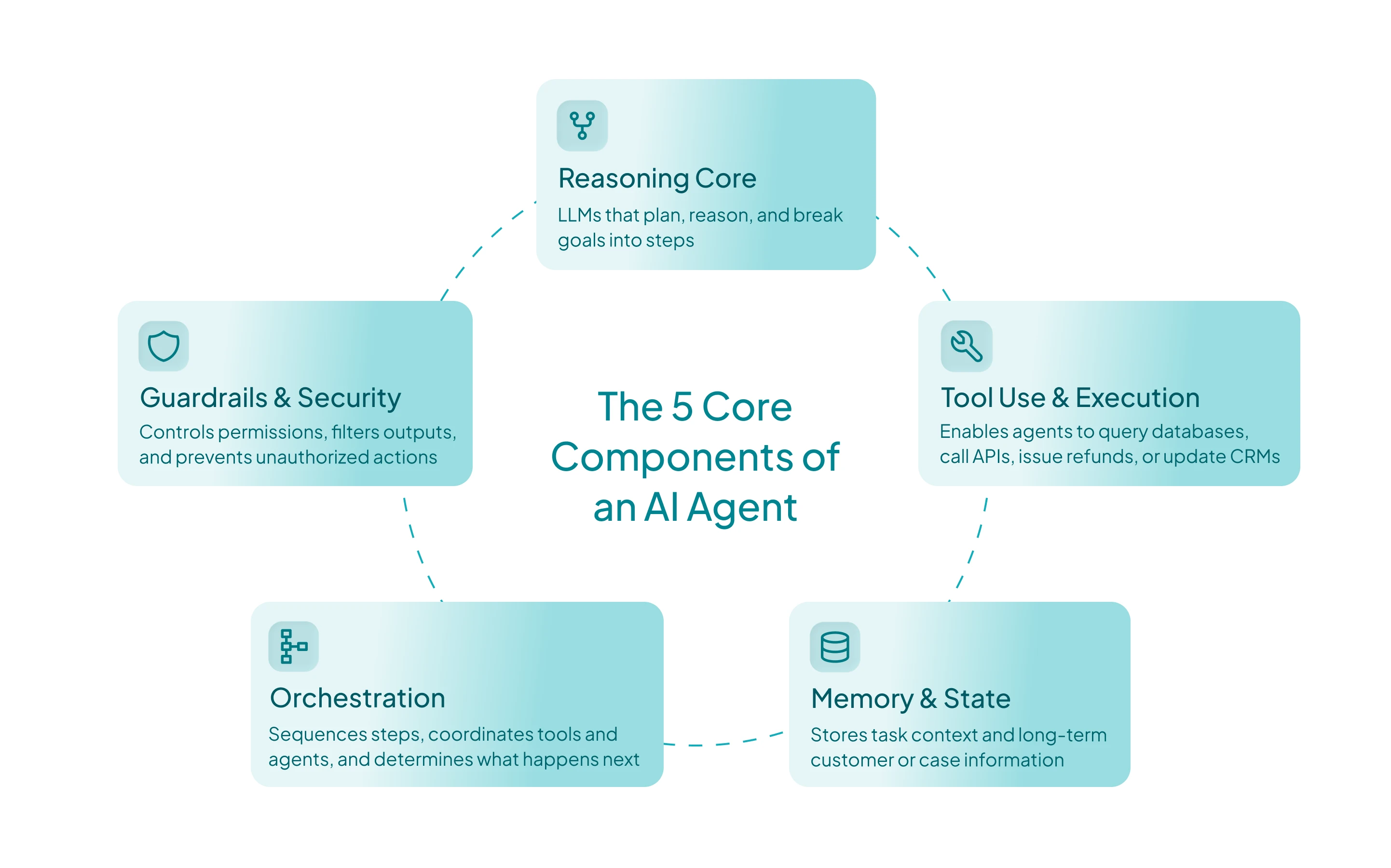
What changed in 2026 is not just the reasoning core. It is the plumbing around it: standardized protocols for tool use and agent-to-agent communication matured enough that connecting an agent to real enterprise systems stopped being a bespoke integration project. That unglamorous infrastructure work is what made moving from basic chatbots to genuine contact center automation a realistic 2026 roadmap item instead of a research project.
Implementing agentic AI is not a single capability level. It is a ladder, and most enterprises are lower on it than their vendor decks suggest:
- Assistive: The agent drafts a recommendation while human agents do everything else under constant human oversight.
- Supervised: Autonomous agents execute an action, but require human supervision or approval first.
- Autonomous: The agent executes with minimal human intervention or zero human intervention, operating within a defined scope.
- Multi-Agent: Multiple agents coordinate across a workflow, handing off tasks assigned to other agents seamlessly.
The hinge on this ladder is not machine learning reasoning quality. It is the jump between rungs two and three, specifically the jump from retrieval and deflection (looking up an order status, answering a policy question) to authenticated writes into order, billing, and existing systems (issuing a refund, changing a subscription, updating a payment method).
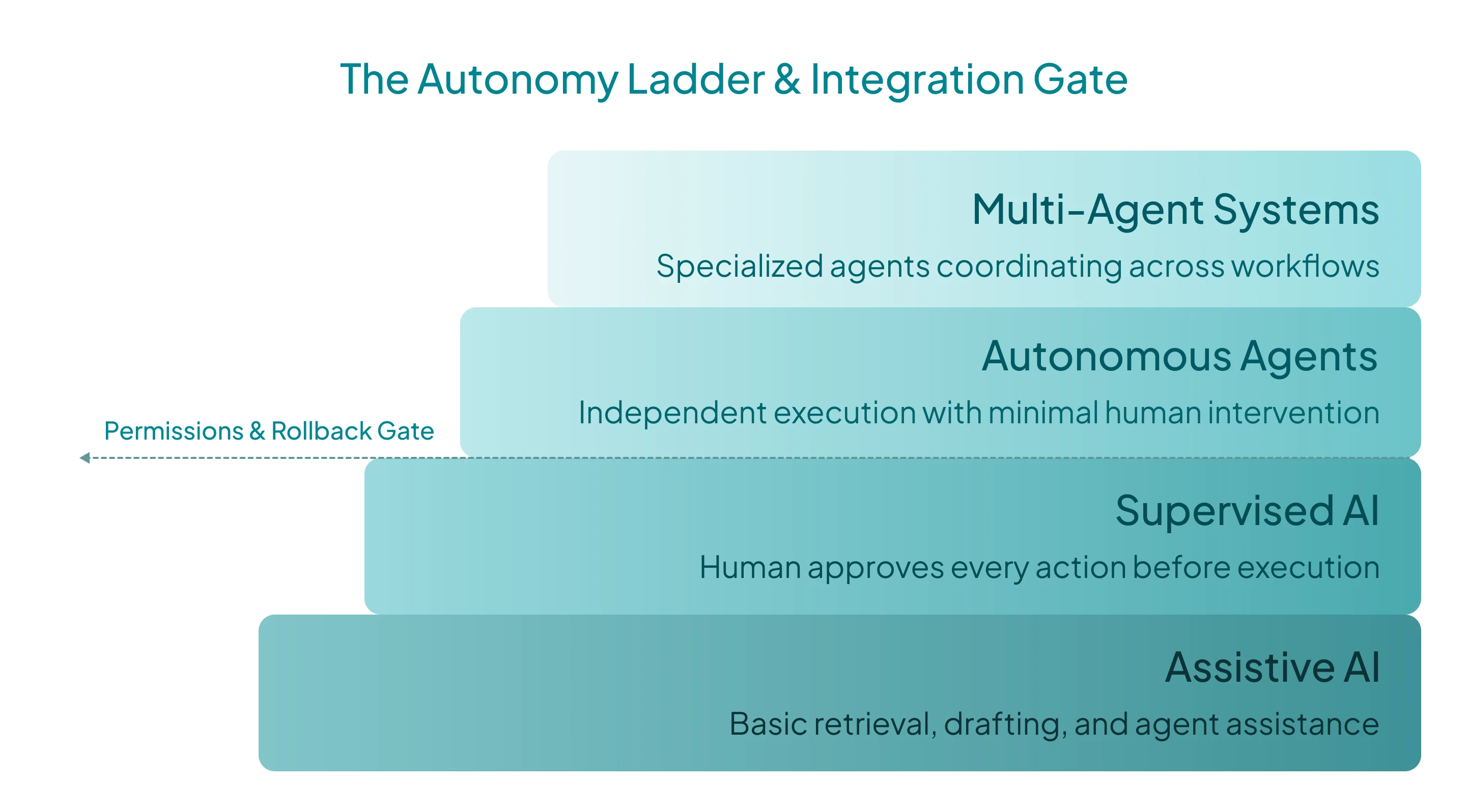
That jump has almost nothing to do with whether the model is smart enough. It has everything to do with permissions, idempotency, and rollback:
- Permissions: Does the agent have write access it should not have, and can that access be scoped narrowly enough to matter?
- Idempotency: If the agent's action is retried after a timeout, does it issue the refund twice?
- Rollback: If the action was wrong, is there a clean way to reverse it, or is the mistake now permanent?
Reasoning was never the hard part. This is why choosing a conversational AI platform increasingly comes down to how the vendor handles write access and security risks, not how good the demo looks.
"Agent washing" is Gartner's term for rebranding a standard chatbot or scripted workflow as an "agent" without adding meaningful autonomous decision making. It is common enough that it deserves a simple test.
If a system cannot write to downstream software systems, cannot revise its own plan mid-task when new information arrives, and produces no audit trail of what it decided and why, it is a chatbot with a new label, not an agent.
This used to be a marketing problem. It is becoming a compliance one. As regulators start asking how agentic AI makes decisions and by what authority, a system that overclaims autonomy it does not have creates a real liability gap: an organization telling regulators a decision was "AI-driven and reviewed" when there was no meaningful reasoning loop or audit trail behind it.
Most multi agent systems architecture diagrams show five or six boxes labeled "planner," "researcher," "executor," and so on, all passing messages to each other. That diagram is popular. It is also, for most enterprise business processes, a description of unnecessary complexity rather than a working system.
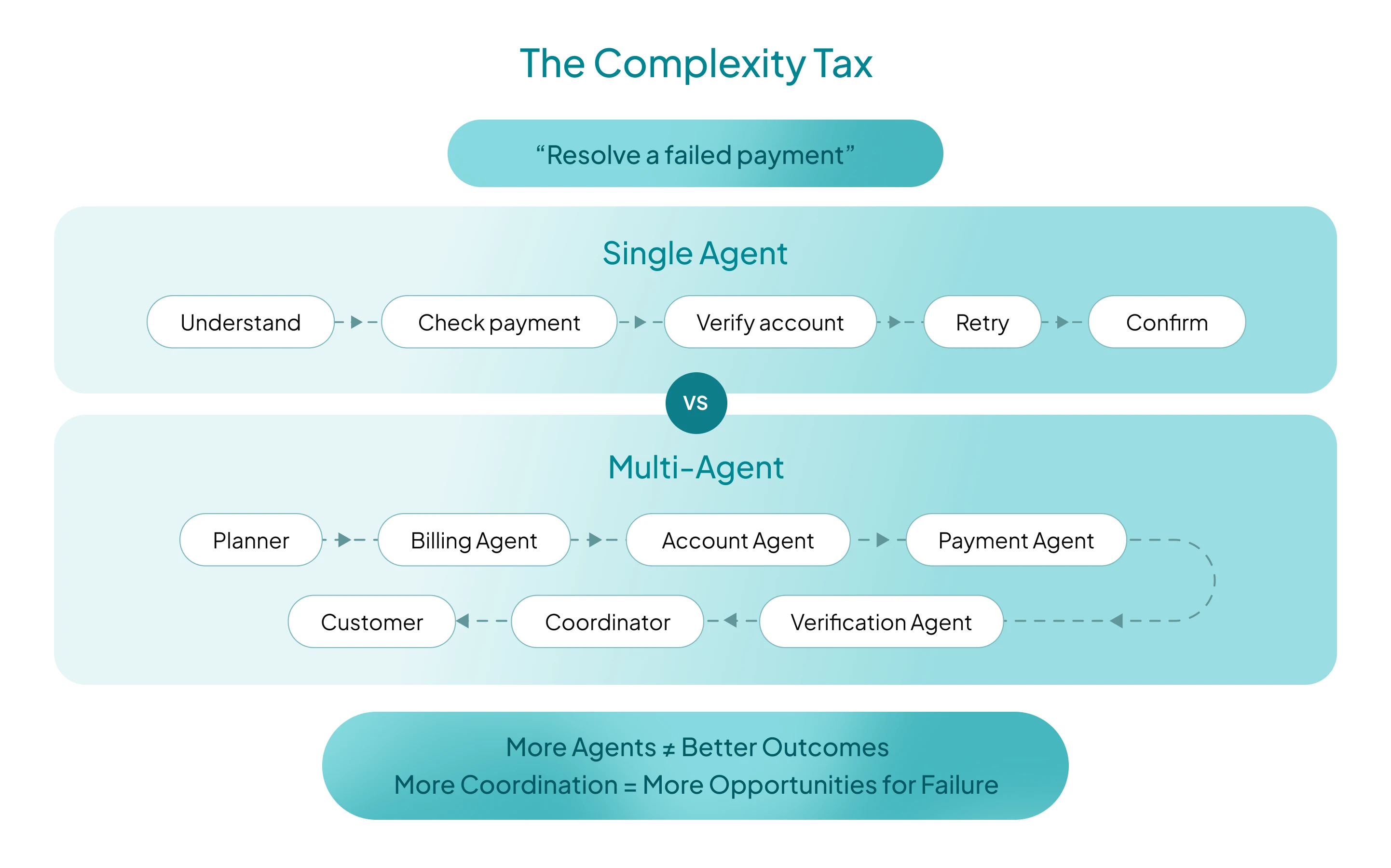
Two things worth being honest about:
- More context is often worse, not better: Passing every sub-agent's full output to every other sub-agent floods the reasoning core with irrelevant information and increases the odds of AI agents losing track of human intent and the main goal.
- Single-agent-first is the right default: One well-scoped agent with clear tools and clear guardrails outperforms a five-agent swarm on most tasks, because it removes the coordination failure modes (handoff errors, conflicting sub-goals, duplicated actions) that multi agent orchestration introduces.
Multi agent orchestration earns its complexity when complex workflows genuinely span domains that need specialized agents, different tools, and different guardrails, not because the architecture diagram looks more sophisticated.
The failure modes that matter are not the ones showcased in demos when attempting to automate complex tasks.
- Silent tool failures: The agent calls the refund API, the call times out, the agent's reasoning concludes the task succeeded, and it tells the customer the refund is on its way. The refund never posted. Nobody finds out until the customer calls back.
- Runaway loops: The agent gets stuck retrying a failed step, burning processing power and API calls, and in the worst case, taking the same action repeatedly.
- Context loss: Long-running tasks drop earlier context as the workflow extends, and the agent starts acting on a stale or incomplete picture when trying to analyze data or process unstructured data.
- Prompt injection through customer text: Once an agent has write access to external systems, a customer's message becomes a potential attack surface. Text embedded in a support ticket or chat message can attempt to redirect the agent's plan toward an action it should not take.
None of these are hypothetical. They are the reason adopting agentic AI in high-stakes environments like AI customer support is being rolled out carefully with narrow scopes and human oversight, rather than handed full autonomy on day one.
The headline statistics about how agentic AI is expanding are all true and all incomplete on their own, so treat each one as a description of a different stage of the funnel.
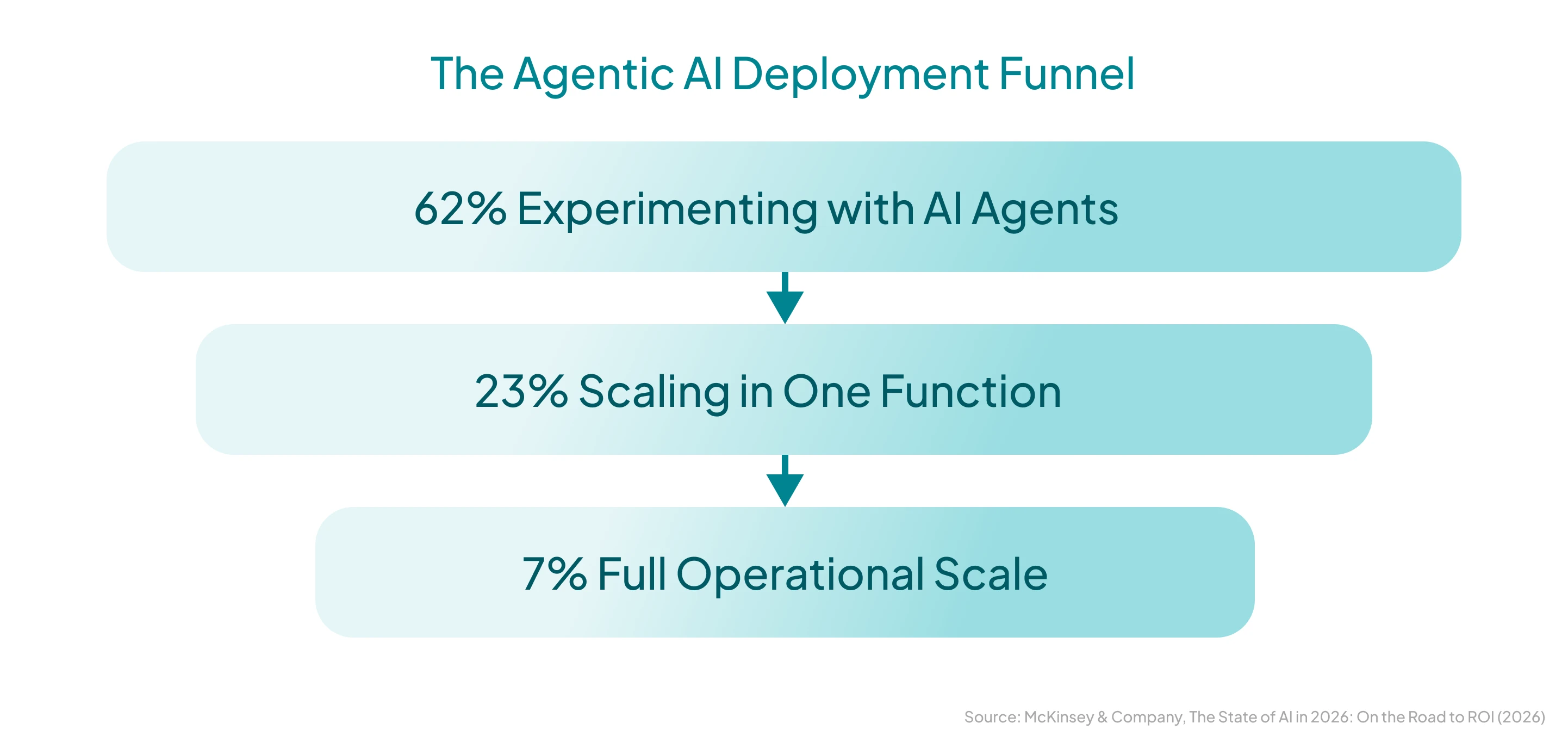
Adoption is real and accelerating. McKinsey's State of AI in 2025 survey found that 62% of organizations are experimenting with AI agents and 23% are scaling them in at least one business function, with the strongest returns concentrated in functions like software engineering and IT, where organizations report cost reductions of 10% to 20%.
But experimentation is not production, and production is not guaranteed to last. Gartner predicts that more than 40% of agentic AI projects will be canceled by the end of 2027, citing rising costs, unclear business value, and inadequate risk controls as the leading causes.
Even where AI is deployed, the return is uneven. MIT's "GenAI Divide: State of AI in Business 2025" report found that 95% of enterprise generative AI pilots showed no measurable impact on profit and loss, with only about 5% of integrated deployments extracting real, attributable value.
And most agentic systems still never reach that stage at all. Teradata's 2026 "Arrested Automation" study, based on a survey of 1,000 senior technology and data leaders, found that only 7% of enterprises have reached full operational scale with agentic AI, largely because underlying enterprise data across data sources was never structured for an agent to act on reliably.
Read together, the picture is consistent: interest is nearly universal, production is rare, and durability at production is rarer still.
The uncomfortable part of intelligent systems is not the underlying technology. It is who is accountable when autonomous systems act and get it wrong.
Gravitee's State of AI Agent Security 2026 report, based on a survey of more than 900 executives and technical practitioners, found that only 14.4% of organizations report all of their AI agents going live with full security and IT sign-off. The rest are shipping agents with partial review, or none, into systems that can issue refunds, change billing, and write to customer records.
That gap surfaces two questions almost nobody has a clean answer for yet:
- If an agent issues a refund it should not have, who eats that cost, the business unit that owns the workflow, the vendor that built the agent, or the customer who benefited from the error?
- If an agent starts behaving badly in production, where is the kill switch, and who has the authority to pull it?
Until those two questions have organizational owners, "agentic" and "governed" are not the same word, and treating them as interchangeable is how regulatory costs are realized.
Deflection rate, the metric almost every organization still leads with, was built for a world where AI could only answer questions. It rewards an agent for closing a conversation without human involvement, which is a fine goal when the worst outcome is an unresolved question.
It is a dangerous goal once agents operate independently and write to other systems, because it rewards the agent for closing tickets, not for closing them correctly. An agent that reports success without verifying the underlying action passes a deflection-rate test perfectly.
The more honest performance metrics for enabling AI agents to execute real work:
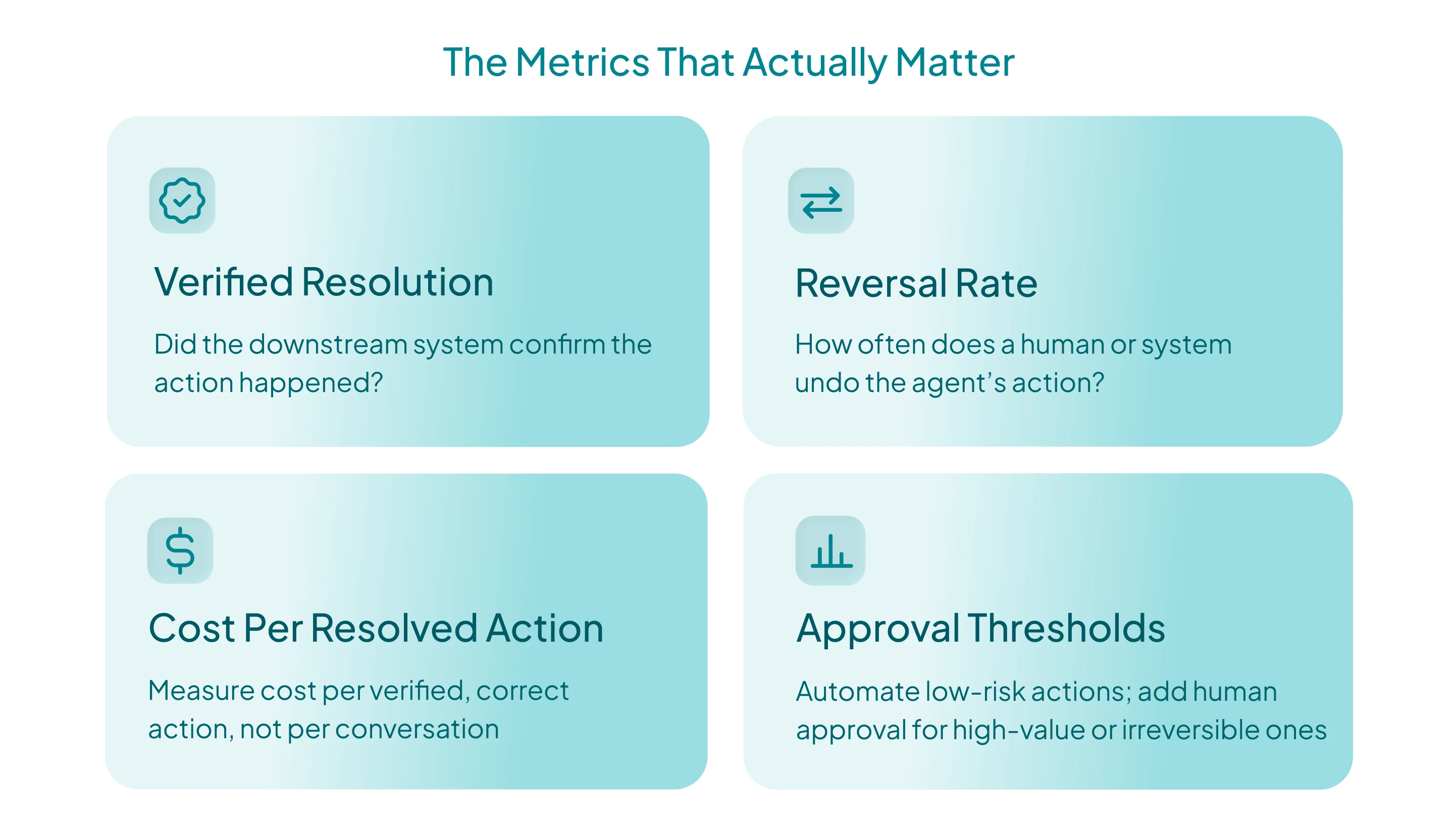
This is also where understanding how frustration and risk show up in a conversation before it escalates becomes an input to the approval threshold itself, not just an AI sentiment analysis metric. Visibility into what an agent actually did across thousands of interactions turns from a nice-to-have dashboard into the only way to catch a silent tool failure before a customer does.
Supply Chain Management
Financial Institutions
Software Development
Customer Relationship Management
The reasoning problem is largely solved by natural language processing and large language models. The permissions, verification, and governance problem is not, and that is the gap between an agentic AI pilot that looks impressive in a demo and one that survives contact with a real order system, a real billing system, and a real customer typing something the agent's designers never anticipated. The organizations that treat that gap as the actual work, rather than a footnote after the model is chosen, are the ones that will still have their agents running in 2027.
What defines agentic AI and how does it differ from generative AI?
How do agentic AI agents learn and adapt over time?
What are the main business benefits of agentic AI?
TL;DR
Agentic AI runs on an observe, reason, plan, act, verify loop, which is what separates it from generative AI, predictive AI, and RPA.
The hard part was never reasoning, it is the jump from safe retrieval tasks to authenticated writes into order, billing, and CRM systems, governed by permissions, idempotency, and rollback.
Multi-agent architectures look sophisticated on a diagram but often add complexity without adding value, so single-agent-first is the right default for most workflows.
62% of organizations are experimenting with AI agents per McKinsey, but Gartner forecasts 40%+ of agentic AI projects will be canceled by 2027, and only 7% of enterprises have reached full operational scale per Teradata.
Just 14.4% of organizations ship all their AI agents with full security sign-off, according to Gravitee, leaving open questions on accountability and kill switches.
Deflection rate rewards the wrong behavior once an agent can act. Verified resolution, reversal rate, and cost per resolved action are the metrics that actually reflect whether agentic AI is working.