Decoding Conversational AI: A Complete Guide for Enterprises
Written by: Manya Singh
Last updated: Aug 14, 2026
13 mins

Customer conversations have always been at the heart of enterprise success. What's changing is who's driving them.
Enterprises have been investing in chatbots, self-service portals and automation tools to reduce support costs. While they improved efficiency, they rarely solved customer problems, often collecting information before handing conversations to human agents.
Today's customers expect more. They compare every support interaction with the fastest, most seamless digital experiences they've had. At the same time, enterprises face rising support volumes, increasingly complex customer journeys and growing pressure to improve customer satisfaction while controlling costs.
This is where conversational artificial intelligence has become a strategic advantage.
Powered by generative AI, machine learning, large language models, reasoning capabilities and enterprise integrations, modern conversational AI platforms understand context, interpret intent and execute tasks across business systems. Unlike earlier automation, today's conversational AI technology is designed to simulate human conversation, enabling enterprises to deliver faster, more personalized support at scale. The goal is no longer to automate conversations, but to resolve customer requests from start to finish.
According to Gartner , by 2029, agentic AI is expected to autonomously resolve 80% of common customer service issues while reducing operational costs by up to 30%. The shift has already begun, with enterprises moving beyond pilots to production-scale deployments powered by AI agents and enterprise-ready conversational AI solutions.
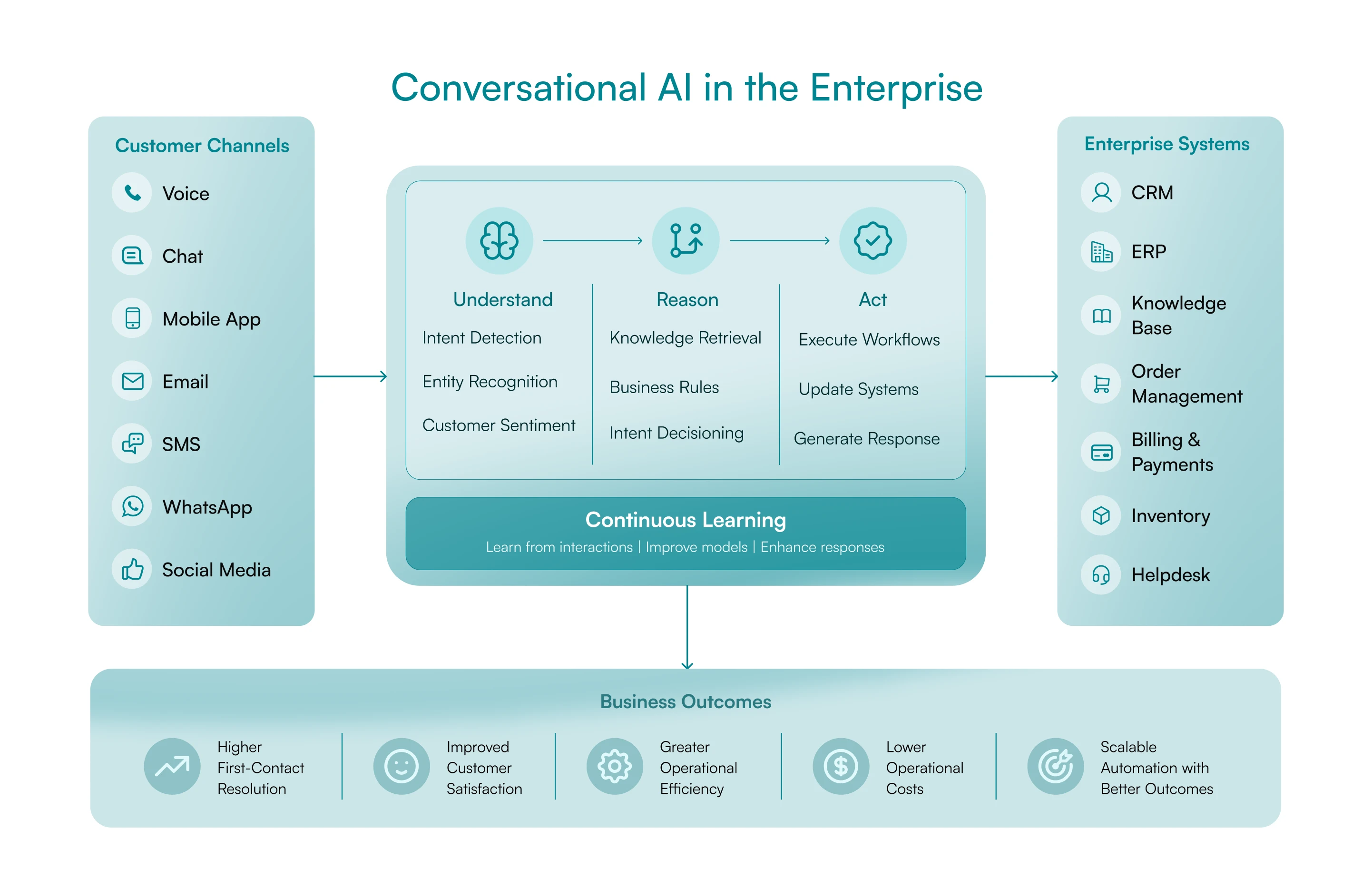
This guide explains what conversational AI is, how conversational AI works, what conversational AI is used for, why customer experience is driving adoption and how to choose the right conversational AI platform.
Conversational artificial intelligence, commonly known as conversational AI, enables computers to understand, process and respond to human language across voice, chat, email and messaging channels using artificial intelligence, machine learning, natural language processing (NLP) and natural language generation.
If you're wondering what conversational AI is used for, the answer extends far beyond answering questions. Enterprises use conversational AI systems to automate customer support, manage sales inquiries, schedule appointments, process payments, resolve billing issues and execute workflows across multiple business systems. Modern conversational AI applications also personalize interactions by drawing on past interactions, browsing behavior and customer preferences to deliver more relevant experiences.
Unlike rule-based chatbots, conversational AI technology understands intent, interprets context and adapts as conversations evolve. Instead of following scripted decision trees, modern conversational AI platforms combine generative AI, reasoning capabilities and enterprise integrations to retrieve information, complete tasks and resolve customer requests with minimal human intervention. Continuous learning from training data, combined with new generative AI capabilities, allows these platforms to improve AI performance, generate more accurate AI responses and deliver increasingly natural conversations over time.
The difference between conversational AI and chatbots is ultimately the difference between answering questions and solving problems. While a chatbot may provide instructions, AI agents powered by conversational AI can understand context, retrieve information, determine the appropriate response, take action and complete requests. Rather than simply replying, they are designed to answer user queries, maintain conversational flow and support the entire customer journey from inquiry to resolution.
As a result, enterprises now measure success through business outcomes such as first-contact resolution, customer satisfaction, operational efficiency and automation, rather than chatbot engagement alone. Increasingly, they also evaluate response quality, the relevance of AI responses, and the platform's ability to deliver relevant responses across every interaction.

Natural Language Processing (NLP)

Natural Language Understanding (NLU)

Dialogue Management
Dialogue management controls how conversations progress. It decides when to ask follow-up questions, execute workflows or escalate to a human agent, enabling conversational AI systems to maintain a natural conversational flow instead of following rigid scripts.
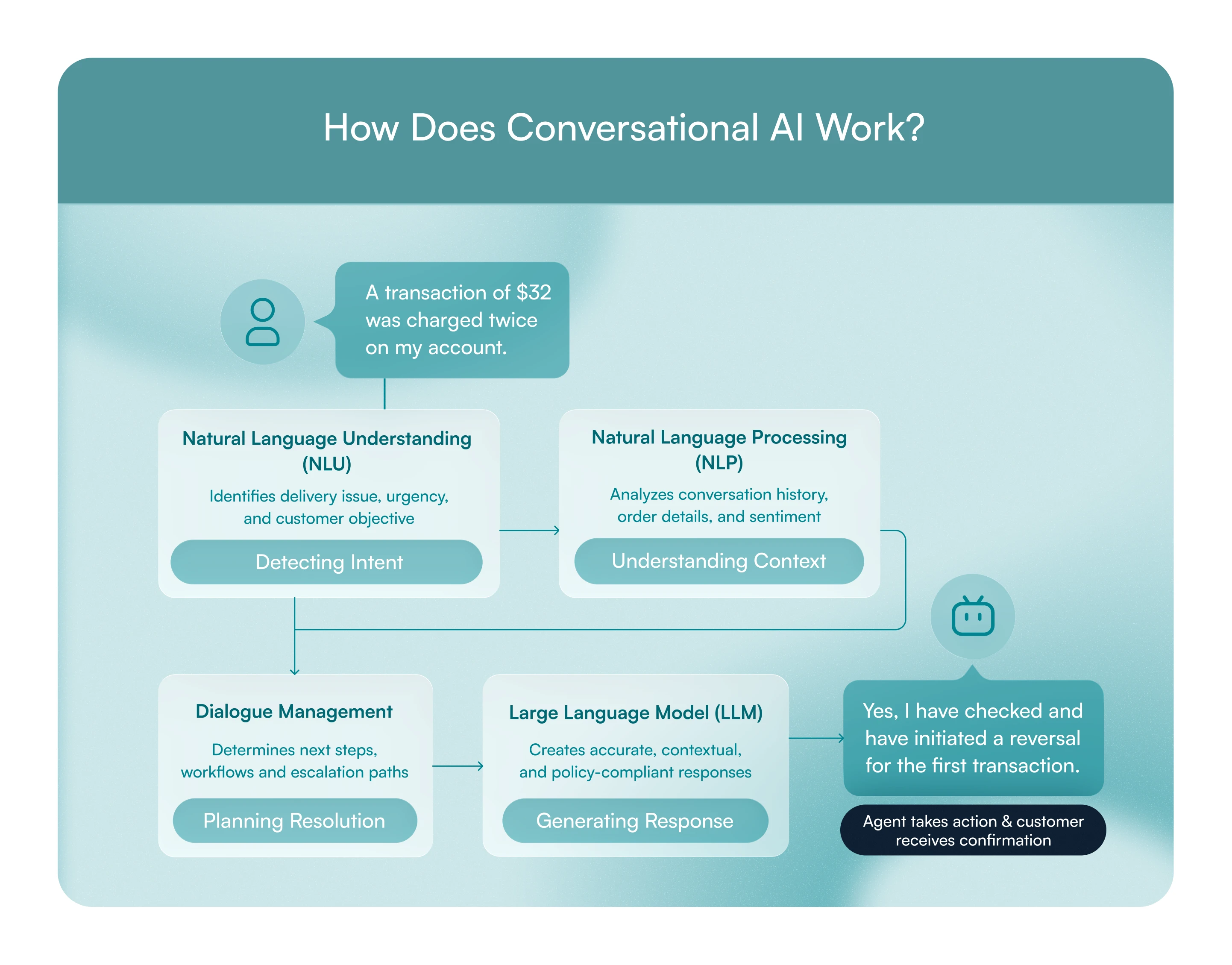

Large Language Models (LLMs)

Enterprise Integrations

From Conversations to Outcomes

Speech-to-Text (STT)

Text-to-Speech (TTS)

BFSI
Banks and financial institutions use conversational AI to automate balance inquiries, transaction disputes, loan updates, KYC verification and account servicing. In regulated environments, AI agents also deliver consistent policy enforcement and auditability at scale while understanding customer history to provide faster, more personalized experiences.
Debt recovery and collections has become another high-impact use case, with AI voice agents handling repayment conversations, scheduling follow-ups and improving recovery rates while reducing operational costs.Claims management is one of insurance's most resource-intensive processes. Conversational AI solutions streamline first notice of loss, document collection, claim updates and policy inquiries, while human teams continue to manage underwriting and settlement decisions. AI also improves the customer journey by providing timely updates and relevant responses throughout the claims lifecycle.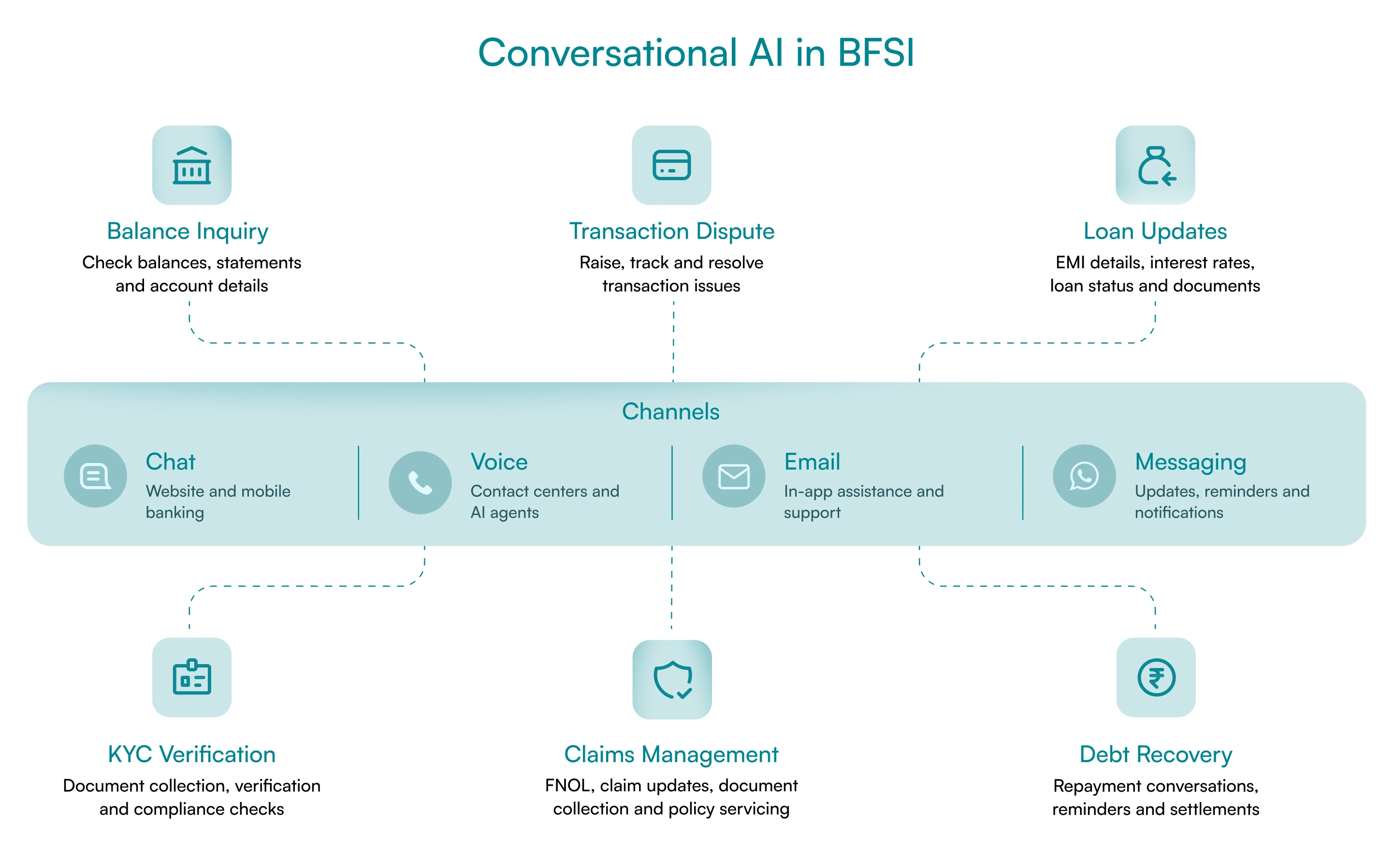

Retail and E-Commerce

Healthcare
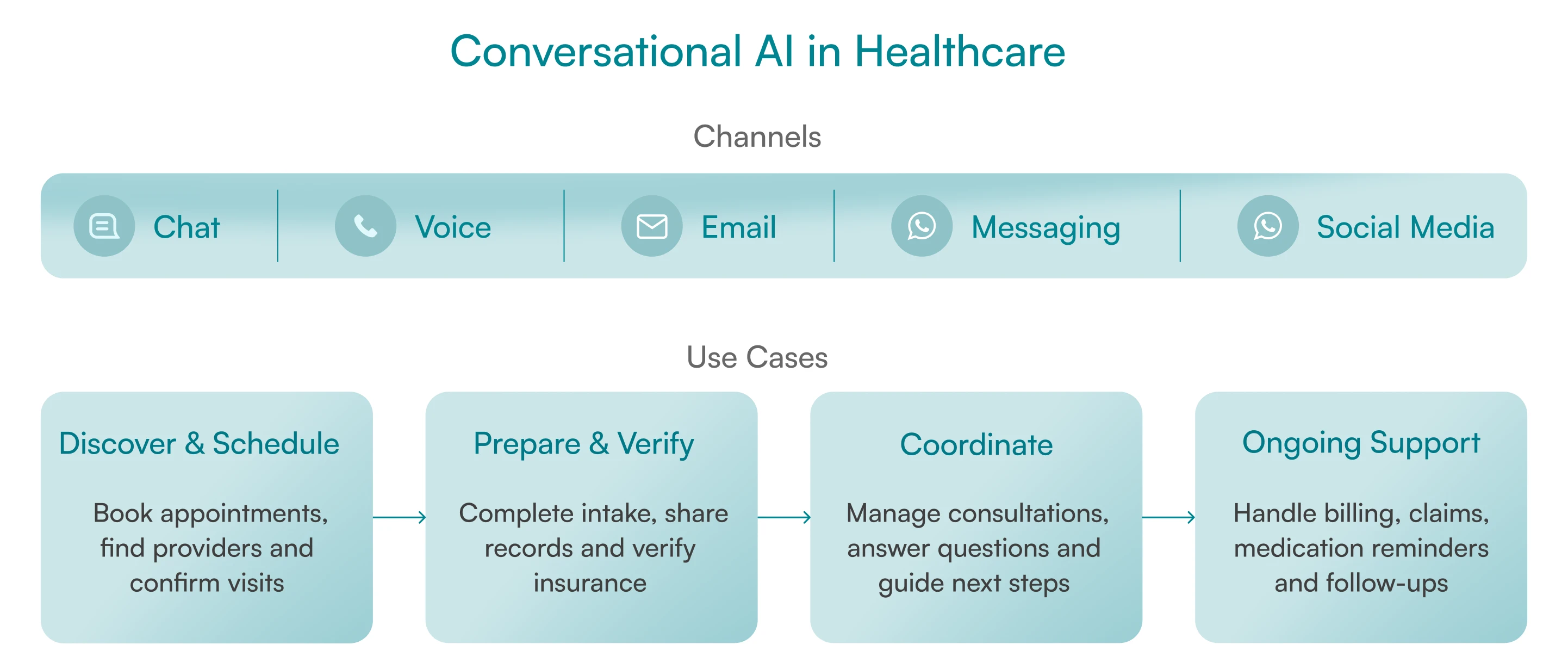
Healthcare providers use conversational AI systems for appointment scheduling, medication reminders, billing inquiries and post-discharge follow-ups. Routine communication is automated, while medically sensitive or urgent cases are seamlessly escalated to the appropriate teams. By understanding context and previous patient interactions, AI delivers more personalized support without compromising clinical judgment.

EdTech

Telecom
Conversational AI is no longer an emerging technology. According to The Business Research Company , the global market is expected to grow from $13.64 billion in 2025 to $42.51 billion by 2030, at a 25.5% CAGR.
Three factors are driving this growth.
First, advances in large language models have transformed conversational AI software, making it far more capable than earlier AI-powered chatbots and conversational AI bots. Modern AI systems can process user intent, answer questions, handle complex queries, and support natural conversational interfaces, allowing enterprises to deploy sophisticated solutions without building models from scratch.
Second, the economics is compelling. By automating routine tasks and enabling a single conversational AI agent to support thousands of interactions simultaneously, enterprises improve operational efficiency while reducing the cost of service delivery. At enterprise scale, the impact is substantial.
Finally, conversational AI has moved beyond pilots. Enterprises are no longer asking whether it works. They're deciding how quickly they can scale it across the business and enhance conversational AI with enterprise data, automation and integrations.
Customer experience has become the biggest driver of conversational AI because it's where the business impact is most immediate.
Every support team manages enormous interaction volumes, and every delay, transfer or unresolved query increases costs while reducing customer satisfaction. Traditionally, scaling meant hiring more agents. Today, virtual assistants, voice assistants and enterprise conversational AI software resolve repetitive requests, answer frequently asked questions, manage user queries and free human teams to focus on complex customer inquiries that require empathy or judgment.
Leading enterprises are also changing how they measure success. Instead of focusing on how many conversations were deflected, they measure how many customer issues were fully resolved. Customers don't care whether they spoke to a human or AI. They care whether their problem was solved quickly, accurately and with minimal effort throughout the entire customer journey.
As conversational AI moves from pilots to enterprise-wide deployment, every organization faces the same question: build or buy?
Building can make sense for highly specialized use cases or organizations with deep AI expertise. It offers greater control, flexibility and the ability to tailor every layer of the stack.
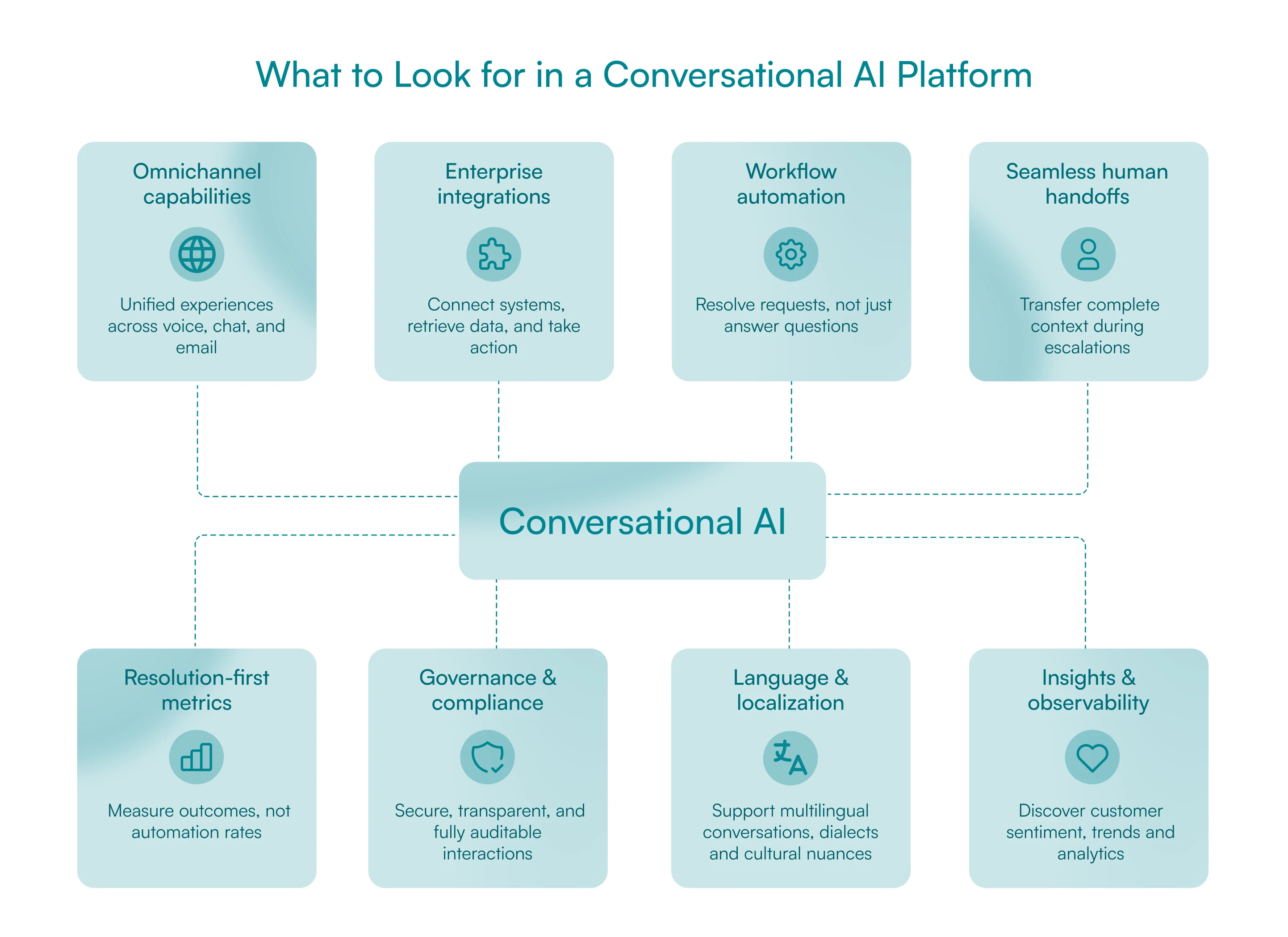
However, deploying conversational AI at enterprise scale requires far more than an AI model. It demands an ecosystem of capabilities, including automatic speech recognition, dialogue management, knowledge retrieval, natural language generation (NLG), workflow automation, multilingual support, governance, analytics, security and seamless integration with existing systems.
Maintaining that ecosystem is an ongoing engineering commitment. As AI models evolve and compliance requirements change, every layer of the platform must evolve alongside them. What makes conversational AI successful isn't a single model, but the ability to combine intelligence, automation and enterprise workflows into one reliable, production-ready system.
But there's another factor that's often overlooked: experience.
Enterprise AI doesn't fail because teams can't build a model. It fails because production environments introduce challenges that are difficult to anticipate until you've operated at scale. Customers interrupt mid-sentence. Network conditions fluctuate. Regional accents reduce speech recognition accuracy. Business policies change overnight. Integrations fail. Escalations happen at the wrong time. Seemingly small edge cases become operational problems when they occur thousands of times a day.
Those lessons don't come from documentation. They come from running millions, sometimes billions, of real customer conversations.
That's why many enterprises choose to buy rather than build. They're not just purchasing software. They're benefiting from years of production experience embedded into the platform itself. The guardrails, workflows, testing frameworks and operational best practices have already been shaped by real-world deployments, allowing teams to avoid problems they may not even know to expect.
For most organizations, the challenge isn't building AI. It's building an enterprise-ready AI platform informed by experience as much as technology.
The strongest conversational AI platforms combine proven production expertise with enterprise automation, workflow orchestration and continuous optimization, enabling organizations to focus on business outcomes instead of rebuilding lessons that specialists have already learned.
Understand your customer interactions
Start with predictable, high-volume journeys
Measure resolution, not automation
Build seamless escalation paths
Continuously optimize
Track business outcomes
One of conversational AI's greatest advantages is that its impact is measurable from day one. Before deployment, establish a baseline using metrics such as support volume, average handling time, first-contact resolution, CSAT, escalation rates and agent utilization. These benchmarks make it easier to measure business impact as adoption grows.
After launch, focus on metrics that reflect real business outcomes:
- Resolution rate
- First-contact resolution
- Customer satisfaction (CSAT)
- Average handling time
- Escalation rate
- Automation rate by use case
- Cost per resolved interaction
Together, these provide a far more meaningful picture of success than automation rates alone.
Conversational AI has evolved from a customer support tool into a strategic enterprise capability. The conversation is no longer about whether the technology works, but how quickly it can deliver measurable business outcomes.
The enterprises seeing the strongest results aren't building AI for its own sake. They're deploying it where it delivers the greatest operational impact and investing in platforms that combine conversations, workflows and enterprise intelligence into a single ecosystem.
That's the thinking behind Nugget. Built on years of production deployments across high-volume enterprise environments, Nugget brings together AI-powered conversations, workflow execution and enterprise intelligence across voice, chat and email, helping enterprises automate customer interactions without compromising governance, scalability or customer experience.
As conversational AI continues to evolve, the platforms that succeed won't simply generate better conversations. They'll solve customer problems, execute real business workflows and deliver measurable value at enterprise scale.
What is conversational AI used for in enterprises?
What is the difference between conversational AI and a chatbot?
How do I choose a conversational AI platform?
TL;DR
Conversational AI has evolved from simple chatbots into enterprise systems that understand context, automate workflows and resolve customer requests across voice, chat and email.
Enterprises are adopting conversational AI to improve customer experience, increase operational efficiency and scale support without compromising service quality.
The greatest value comes from deploying AI in high-volume, predictable workflows, measuring success through business outcomes rather than automation rates alone.
For most organizations, buying a proven conversational AI platform is more practical than building one, provided it offers enterprise integrations, governance, omnichannel support and workflow execution.
As the technology matures, the platforms that will lead are those that combine conversations, workflows and enterprise intelligence to deliver measurable business outcomes at scale.