AI Customer Retention: How AI Agents Prevent Churn
Written by: Manya Singh
Published On: Nov 16, 2026
7 mins

Customer acquisition costs have climbed across nearly every industry, switching between providers has gotten easier, and customer churn increasingly happens quietly. There is no complaint, no angry call, just a lapsed renewal or a subscription box company losing a customer who simply stopped opening the app. By the time churn rate shows up in a monthly report, the moment to do something about it has usually already passed.
This is where AI customer retention is becoming less of a nice-to-have and more of a structural requirement. AI for customer retention is not about replacing human agents with a chatbot. It is about catching the signals that predict churn risk early enough that a human, or an AI agent working alongside one, can actually do something about it. This piece covers what effective customer retention strategy actually requires, what the data says about AI customer retention strategies that work, and how Nugget fits into that picture.
Most retention programs are built to react. A customer cancels, and only then does a win-back email go out. By that point, the decision has usually already been made, and a discount offered after the fact rarely repairs the actual reason someone left in the first place.
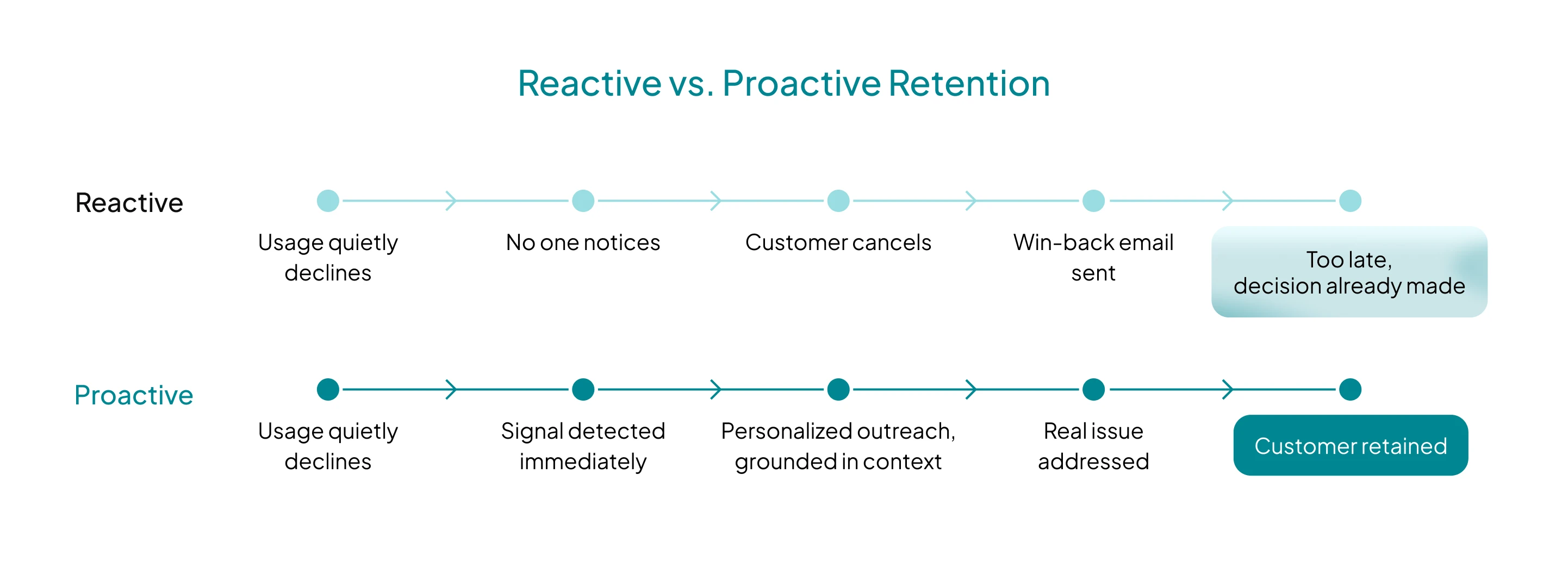
McKinsey's research on AI-powered "next best experience" programs found that companies using AI to anticipate customer needs and deliver personalized interactions at the right moment saw customer satisfaction improve 15 to 20 percent, revenue increase 5 to 8 percent, and cost to serve drop 20 to 30 percent. Separately, Deloitte Digital's 2026 research into AI-driven personalization, based on surveys of 1,000 consumers and 480 brand leaders, found that high-maturity organizations were far more likely to report that personalization actually improved customer retention, 44 percent said so, compared to just 32 percent among lower-maturity organizations. The gap between reactive and proactive retention is not a marginal one. It shows up directly in customer retention rate.
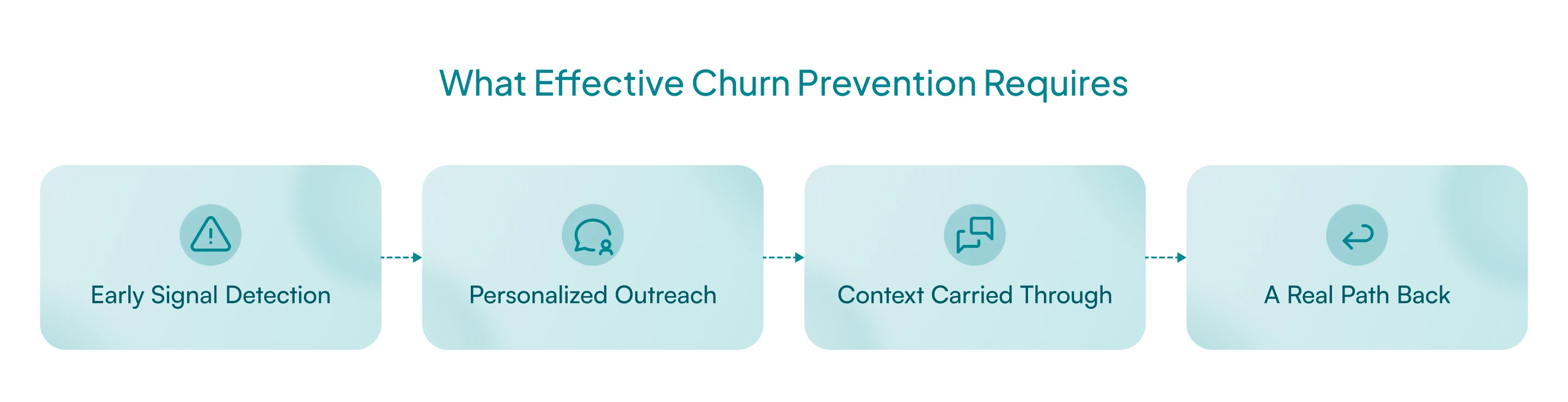
Before getting to how Nugget approaches this, it helps to be specific about what a real customer retention strategy needs, not as a feature list, but as a set of capabilities that have to work together.
Early signal detection: Catching disengagement through actual customer behavior and tone, declining usage patterns, missed renewals, repeated service interactions about the same issue, rather than waiting for a cancellation request to arrive. Predictive analytics and machine learning models exist specifically to identify at risk customers before they decide to leave, using historical and real-time customer data rather than guesswork.
Timely, personalized outreach: Reaching an at-risk customer through a real conversation rather than a static message, something relevant to their specific situation. Generic loyalty programs and blanket discount emails sent to every customer at once rarely move the needle, because they ignore customer concerns that are often highly specific to that one account.
Context carried from the signal to the conversation: Whoever reaches out, whether a human agent or an AI agent handling the call, needs to know why a customer is at risk, not just that they are. Leveraging customer data at the moment of outreach, rather than after the fact, is what separates a genuinely personalized interaction from a scripted retention call.
A real path back, not just a retention call: Addressing the actual reason someone is leaving, pricing, a product gap, a past service quality issue, rather than simply asking them to stay. This is what encourages repeat purchases and builds customer relationships that last well past a single saved renewal.
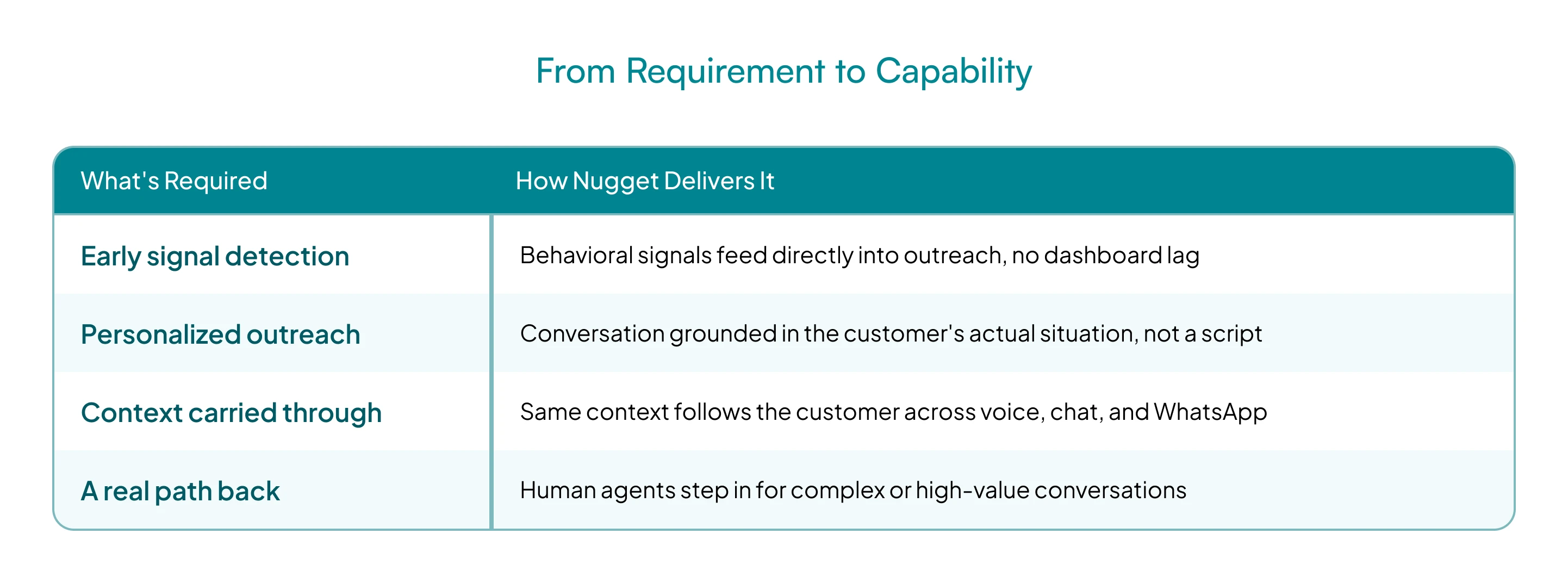
Nugget's approach to AI customer retention is built directly around the four requirements above, not as a separate add-on but as part of the same conversational AI platform used across the rest of the customer journey.
Behavioral signals, declining usage, support friction, missed engagement, feed directly into proactive engagement rather than sitting in a dashboard waiting for someone to notice. When an AI agent or a human agent reaches out, it does so with the customer's actual account history, service interactions, and current situation already in view, so the conversation addresses the real reason behind the churn risk instead of offering a generic save. For customers who prefer to continue over voice or WhatsApp, the same context carries through, so nothing gets lost in the handoff.
This is also where automating routine tasks, rather than just generating a response, actually moves the needle. Freeing human agents from manually reviewing every account for churn signals means the team's time goes toward the at risk customers who actually need a real conversation, not toward sorting through usage reports to find them. AI tools built this way do not replace the judgment a human brings to a sensitive retention conversation. They make sure that judgment gets applied to the right accounts, at the right time.
The value of getting this right compounds. Customers who are retained rather than churned do not just represent saved revenue in a single month, they represent customer lifetime value that keeps growing with every renewal, every instance of customers making multiple purchases, and every bit of customer loyalty that a single well-timed, well-informed conversation helped preserve. Boosting customer satisfaction at the moments that matter most, when a customer is quietly deciding whether to stay, is consistently one of the highest-leverage ways to boost profits without spending more on new customer acquisition.
Retention outreach that feels invasive or over-automated can backfire, reaching out the moment someone's usage dips even slightly risks feeling intrusive rather than helpful, so getting the threshold right matters as much as catching the signal in the first place. Knowing when a human has to take over, a complex pricing negotiation, a genuine complaint, a long-standing relationship that deserves a personal touch, is just as important as knowing when an AI agent can handle the conversation on its own. And data quality underpins all of it. Predictive churn prediction models are only as good as the customer data feeding them, and stale or incomplete records will quietly undermine even a well-designed retention workflow.
Retention efforts and customer experience are not two separate initiatives competing for the same budget. Leveraging AI across both at once is what actually works, because the same retention workflows that reduce churn also tend to improve customer experience for every customer, not just the ones flagged as at risk.
Consistent service quality across every interaction, not just the ones triggered by a churn signal, is what helps improve customer retention over the entire customer journey. Customers expect this consistency by default now, and customer expectations only continue to rise. Meeting them requires more than AI powered dashboards, it requires AI models and AI systems that actually act on customer feedback rather than just collecting it, and artificial intelligence applied consistently enough that existing customers feel the difference whether or not they were ever flagged as a retention risk.
Done well, this is how a business retains customers for the long run, and customers retained this way rather than constantly replaced with new customers are the ones who actually build a durable business. Customer engagement built this way, with customers engaged through genuinely personalized content and a seamless engagement experience, is how a business can boost customer satisfaction measurably, and loyal customers who feel delighted rather than merely retained are the ones who encourage repeat purchases without needing another discount to do it. Businesses that focus on how to delight customers at every stage, not just the at-risk ones, find it far easier to retain customers over the long term. That combination, reduce churn on one side and deliver tailored experiences that maximize customer lifetime on the other, is what actually drives revenue growth and long term business success, far more than either effort could achieve working in isolation. Businesses that build lasting relationships this way are not just retaining customers, they are compounding the value of every customer relationship they already have.
Retention is no longer something a business can leave to a reactive win-back email after a customer has already decided to leave. Anticipating customer needs early, grounding outreach in real customer data, and delivering personalized experiences at the exact moment they matter is what separates sustainable growth from a retention strategy that is always one step behind. AI customer retention, done well, is not about automating away the human relationship, it is about making sure the right conversation happens before the decision to leave is already final.
Does AI customer retention replace human retention teams?
How does Nugget identify customers at risk of churning?
What makes personalized retention outreach more effective than a generic win-back offer?
TL;DR
Customer churn increasingly happens quietly, without a complaint, which means waiting for a cancellation request is already too late.
McKinsey found AI-powered personalized engagement lifts customer satisfaction 15-20%, revenue 5-8%, and cuts cost to serve 20-30%.
Deloitte Digital found high-maturity personalization organizations report improved customer retention nearly 1.4 times more often than low-maturity ones.
Effective retention requires early signal detection, personalized outreach, carried context, and a real path back, not just a discount.
Nugget combines behavioral signal detection with AI agents and human agents working from the same customer context to intervene before churn becomes final.
Getting this right compounds customer lifetime value and reduces the need to constantly replace churned customers with new ones.