What Happens to a Conversation After It Ends: Post-Call Analytics Explained
Written by: Manya Singh
Published On: Nov 16, 2026
8 mins

Most teams treat the end of a call as the finish line. It isn't. It's the point where call analytics, the part that actually determines whether the call mattered, begins.
A call that ends politely and a call that genuinely resolved something look identical from the transcript alone. The agent said the right words either way. The customer said "thanks, that's helpful" either way. The only way to tell the difference is to look at what happens in the window right after the call ends, and for most organizations running a call center on phone calls alone, almost nothing happens there at all. Raw call data piles up, call logs accumulate, and call analytics data sits unused because there is no call analytics software actually processing it into something a team can act on.
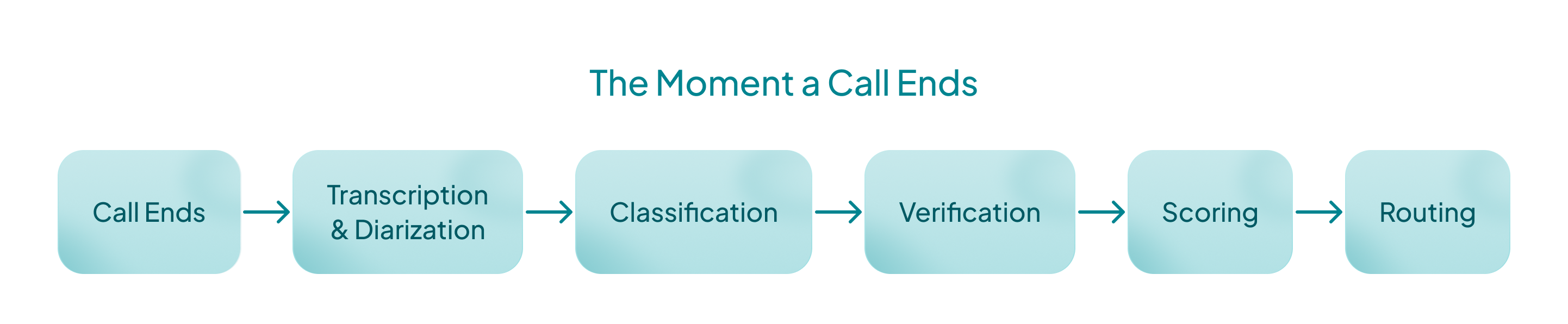
This piece walks through what should happen in that window, where most post-call pipelines quietly stop short of it, and how Nugget approaches call analytics end to end.
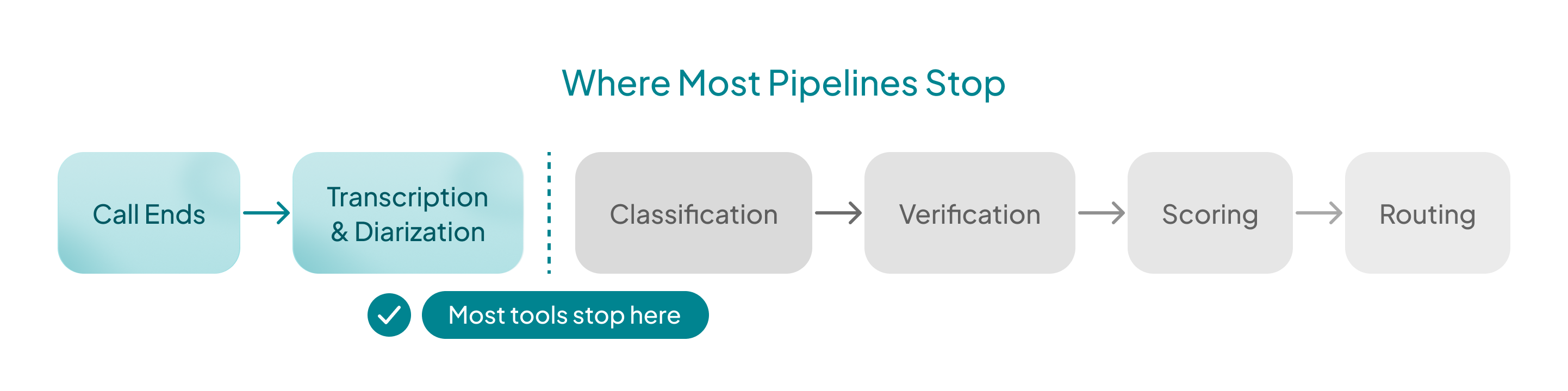
Transcription and diarization
Classification
Verification
Scoring
Routing
Each stage depends on the one before it. Skip verification and scoring has nothing real to measure against. Skip routing and even a perfectly scored call never reaches anyone who can act on it.
A call analytics solution is only as useful as the call metrics it tracks and what it does with them. The basics matter: call volume across a given date range, call duration, first call resolution, and a clear breakdown of call types, inbound, outgoing calls, missed calls, abandoned calls, and calls answered. Good call tracking also separates active calls and ongoing calls from completed call history, so a team can see what is happening right now, not just what already happened.
None of this is useful as a pile of data points sitting in a report. A real call analytics platform turns call data into key metrics that service teams and sales teams can actually use: identify trends in call flow before they become a pattern serious enough to show up in customer satisfaction scores, identify patterns in why calls are happening in the first place, and connect call recordings back to the specific moments that explain a dip in agent productivity or a spike in complaints.
Most call analytics tools do the first step, sometimes the second, and call it analytics. A transcript sitting in a searchable dashboard isn't post-call analytics. It's a storage problem with a search bar attached.
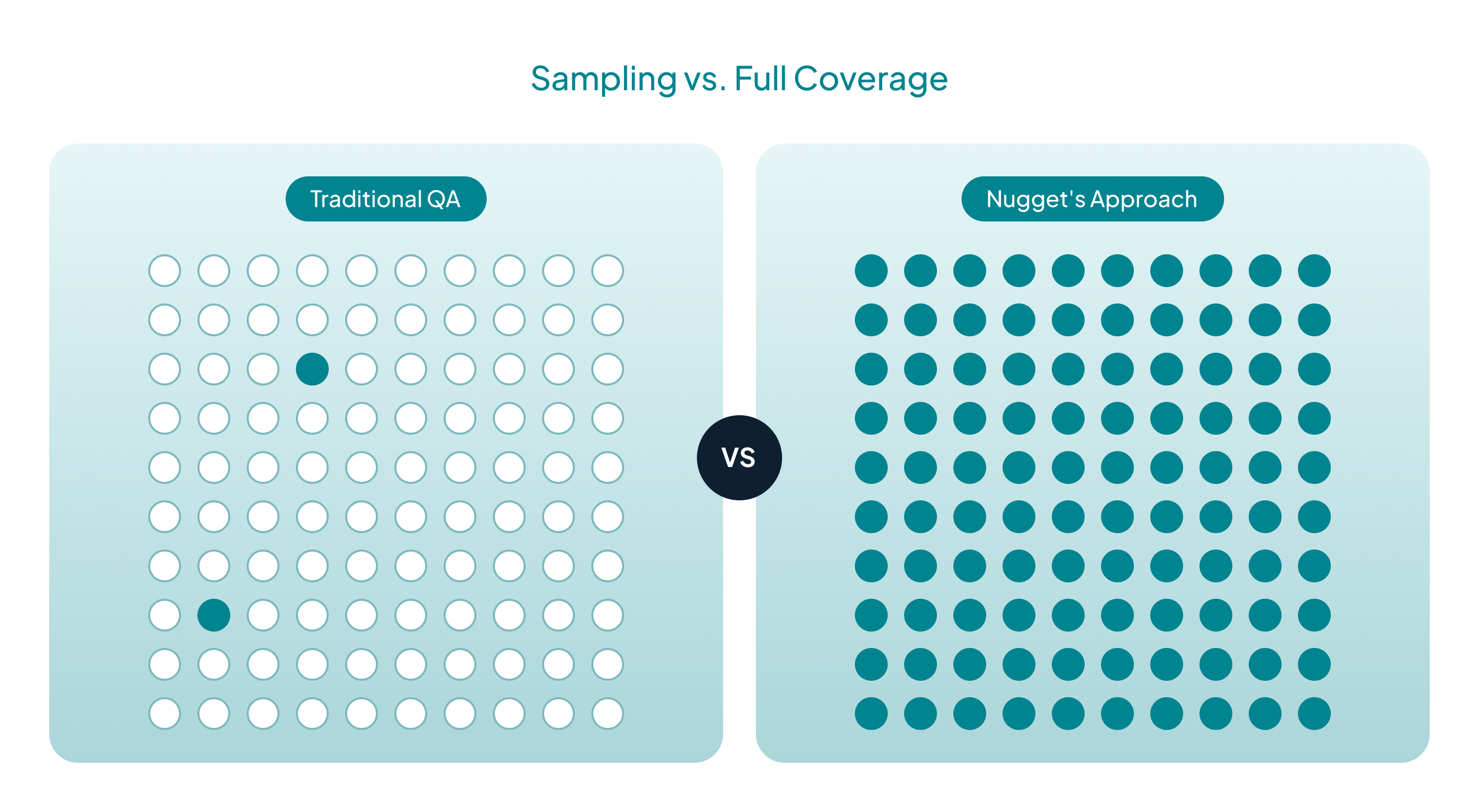
This matters more than it sounds like it should, because of how little of the total call volume most teams actually review. Manual QA programs are capped by how many calls a single analyst can realistically review in detail each day. According to McKinsey & Company, manual assessment covers less than 5 percent of total conversations, with human bias potentially compromising accuracy, while AI-driven call center analytics can realistically cover 100 percent of them.
A sample that small isn't a minor gap. It means the overwhelming majority of customer interactions a business has over phone conversations generate no structured insight at all, and the small share that do get reviewed are rarely the calls that actually needed a closer look.
This is the sharpest distinction in the whole pipeline, and the one most post-call tools skip entirely.
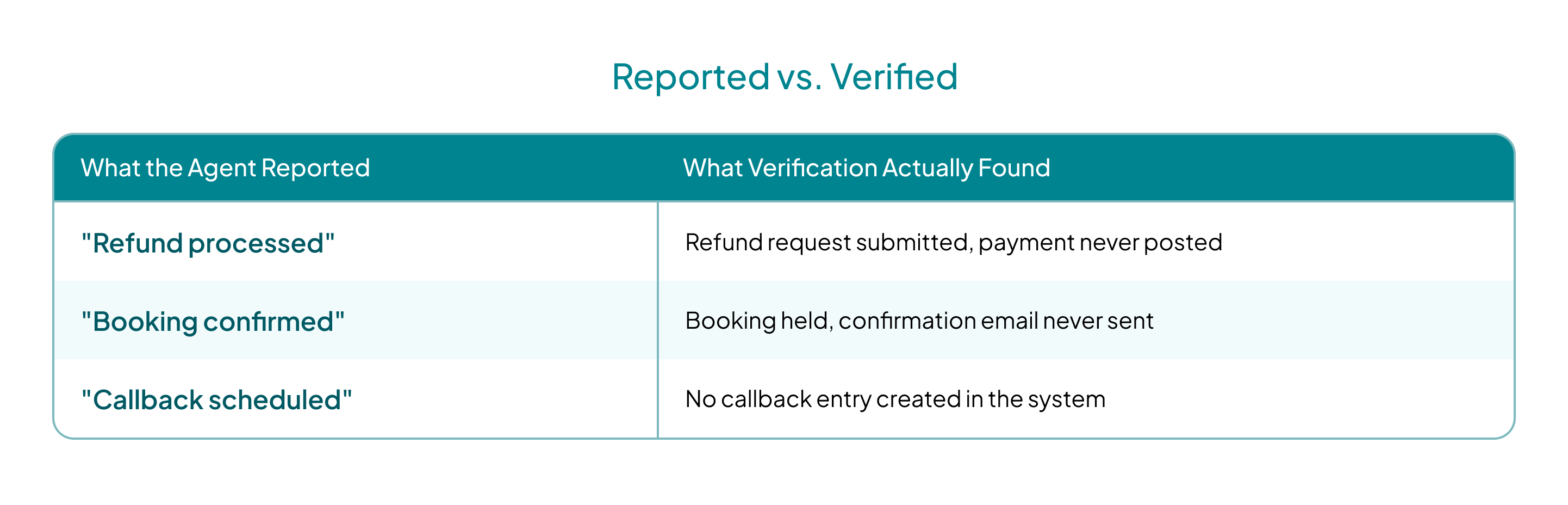
An agent can report that a refund was processed, a booking was confirmed, or a callback was scheduled, and be wrong. The call ends, the transcript reads clean, the sentiment analysis looks fine, and the refund never actually posted. Nobody finds out until the customer calls back a second time, frustrated, and now the problem is worse than it would have been if it had been caught the first time.
This is the same failure mode covered in how agentic AI's silent tool failures let a reported success mask an action that never actually happened, just showing up specifically in the post-call window instead of mid-conversation. Verification exists precisely to catch the gap between what an agent reported and what a system of record actually confirms.
Descriptive analytics that only describe what already happened are a start, not an end point. The real value of a conversation intelligence layer is turning analytics data into informed decisions rather than a historical record nobody revisits. Analyzing data from thousands of calls at once surfaces valuable insights and actionable insights that a human spot-checking a handful of calls would never notice: a shift in customer sentiment tied to a specific product change, a new objection pattern showing up across a sales team's outgoing calls, or a service performance gap tied to a specific call flow step rather than a specific agent.
This is also where historical data and past performance earn their keep. Trend analysis across months of call history can reveal whether a fix actually worked or whether the same problem is quietly recurring under a different surface symptom, something a single month of data driven insights could never show on its own.
This is where the five stages stop being a general framework and become a specific mechanism.
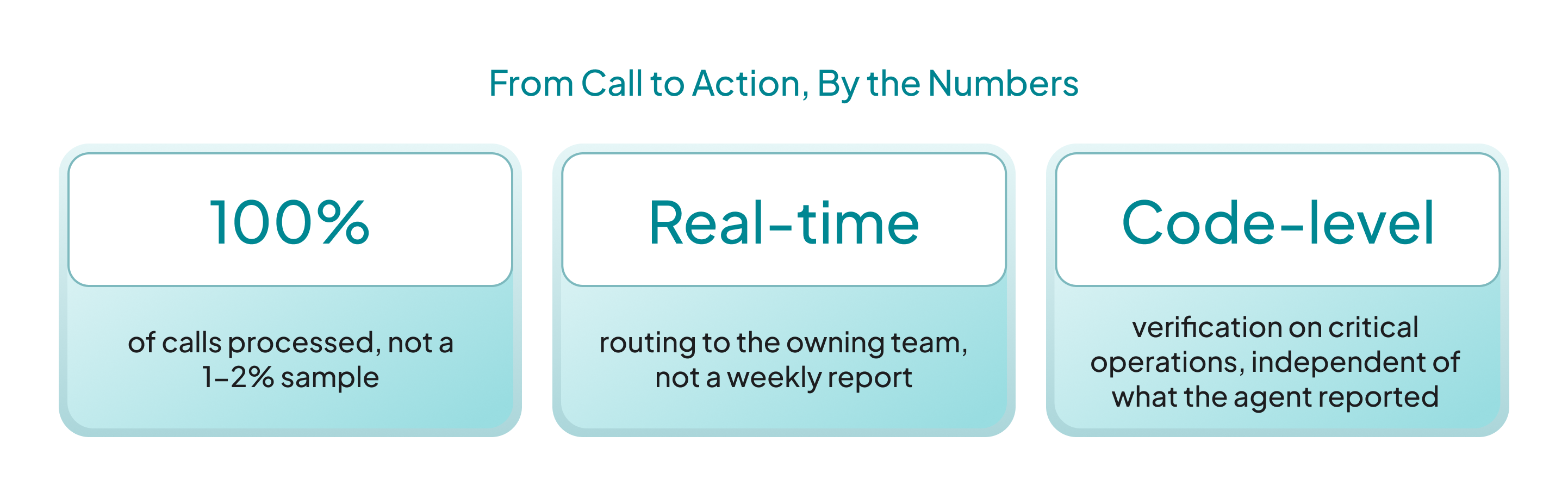
Every interaction is benchmarked against a real quality standard, built from recordings of an organization's own top-performing human agents, not a generic scorecard applied the same way regardless of what the call was about. An insights layer classifies issues by theme, delivery, product, pricing, usability, and routes them to the team that actually owns that theme automatically, instead of leaving a human to sort through flagged calls manually. Identified performance gaps surface as one-click optimizations rather than a report someone has to translate into an action. And critical operations, the kind that actually touch a customer's money or their booking, are verified at the code level, independent of whatever the agent itself reported happened.
None of this treats the end of a call as a wrap-up step. It treats it as the start of a pipeline that runs on its own, every time, without waiting for a human to go looking.
Verification and scoring only mean something if they're actually running on all of it. The same coverage argument that makes manual QA sampling unreliable at under 5 percent applies just as directly here: a verification layer that only checks a sample of calls will miss the exact failures it exists to catch, because those failures don't announce themselves in advance. A silently failed refund looks exactly like a successful one in every way except whether the money actually moved.
Call recordings and call analytics data almost always include sensitive data, account numbers, identity details, sometimes payment information read aloud mid-call. Treating this as a risk management problem rather than an afterthought is part of what a serious call analytics platform has to do by default. Data protection has to extend to every stage of the pipeline, not just storage, transcription, classification, verification, and scoring all touch the same sensitive data, and every one of them needs to ensure compliance with how that data can be accessed, retained, and acted on.
The value of a post-call pipeline like this shows up in what it catches before a customer has to call back a second time, and in how much faster a real quality gap gets surfaced to the team that can actually fix it, instead of waiting for a monthly report to flag a pattern that's been happening for weeks. Speech analytics that enhance customer engagement and improve customer experience both depend on this loop closing quickly, since the same insight that helps a service team fix a recurring issue also helps a sales team understand marketing effectiveness by tying call outcomes back to the campaign or channel that generated the call in the first place, strengthening operational efficiency, agent performance, and team performance across the board.
Getting enough signal to build a meaningful benchmark against, rather than scoring every call against a one-size-fits-all standard based on business needs that vary by team. Avoiding alert fatigue when a system is capable of flagging far more than any team can realistically act on in a day. And keeping a human in the loop for the genuinely ambiguous calls, the ones where the right next step isn't obvious even with full context, rather than trying to auto-resolve everything a pipeline happens to touch.
A call ending is not the same as a call being handled. The five steps that happen afterward, transcription, classification, verification, scoring, and routing, are what actually determine whether a conversation produced something a business can act on, or just another entry in a call log nobody will ever open again.
Does post-call analytics just mean a transcript and a sentiment score?
How is verification different from scoring a call for quality?
Why does this need to run on every call instead of a sample?
TL;DR
What happens in the window right after a call ends is what determines whether it actually mattered.
Transcription, classification, verification, scoring, and routing, each one depends on the step before it.
Manual QA covers less than 5 percent of total conversations, according to McKinsey, leaving the overwhelming majority of conversations unreviewed.
An agent saying a refund was processed and a refund actually posting are two different claims, only one of which can be checked against a system of record.
Benchmarked scoring against top-performing human agents, automatic theme-based routing, one-click optimizations, and code-level verification on critical operations.
A verification layer that only checks a sample will miss exactly the failures it exists to catch.