How Nugget's AI Agents Support Admissions and Reduce Dropouts in EdTech
Written by: Manya Singh
Published On: Nov 12, 2026
9 mins

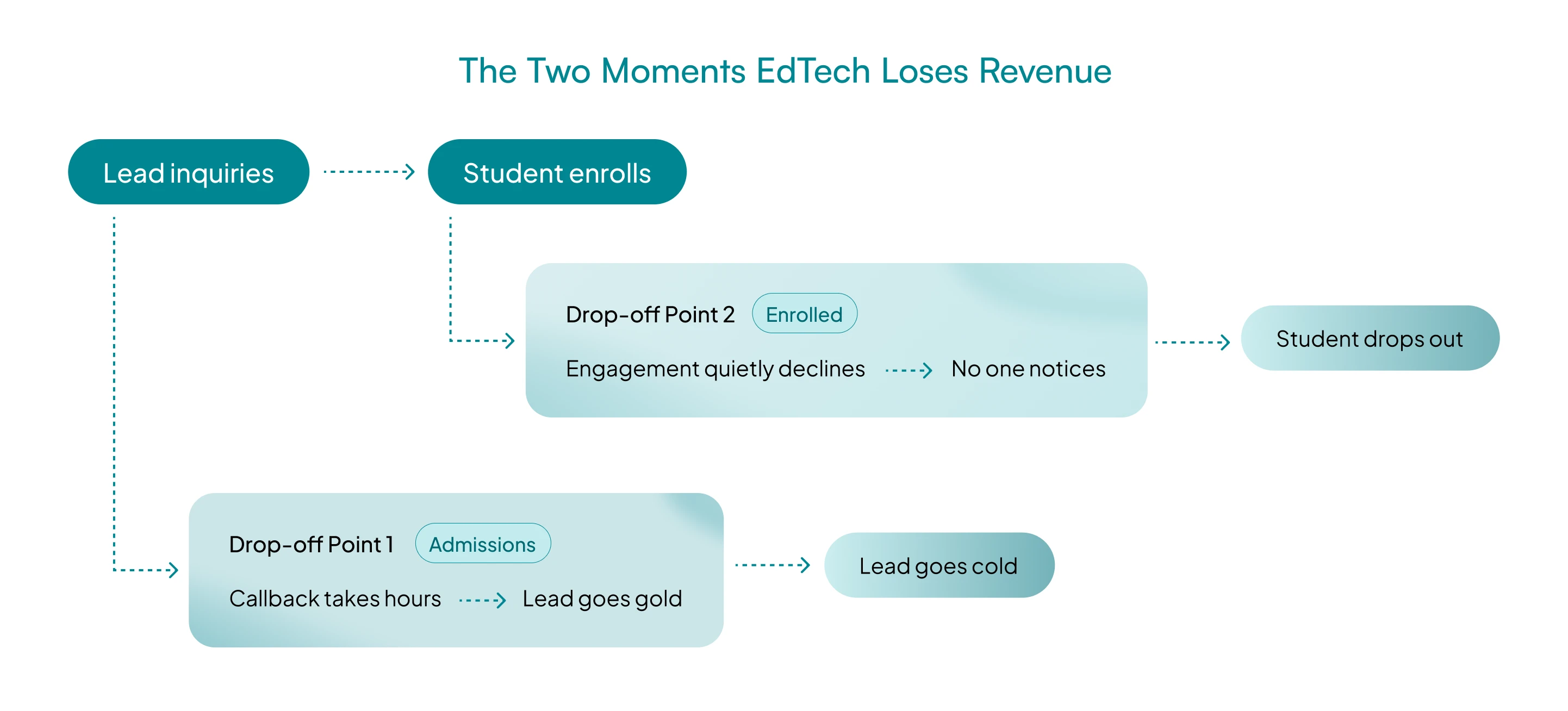
AI enrollment tools are becoming the difference between an institution that grows student enrollment and one that quietly loses prospective students to a faster competitor. EdTech and higher education institutions lose revenue at two moments that usually get treated as separate problems, but share the same root cause. A lead goes cold because the callback came too late. An enrolled student drops off because nobody noticed they were disengaging until it was too late to do anything about it. Both are a learner who needed a timely, relevant response and did not get one.
Deloitte's 2026 Higher Education Trends report found that US college enrollment is projected to decline 13 percent between 2025 and 2041, and that a recent analysis of midsize universities found many at financial risk if enrollment drops even 1 to 3 percent a year over the next five to ten years. Declining enrollment changes what a single lead or a single retained learner is actually worth, for community colleges and large universities alike. This piece looks at how AI enrollment, admissions, and dropout prevention actually get solved, and why speed and continuity matter more than either problem suggests on its own.
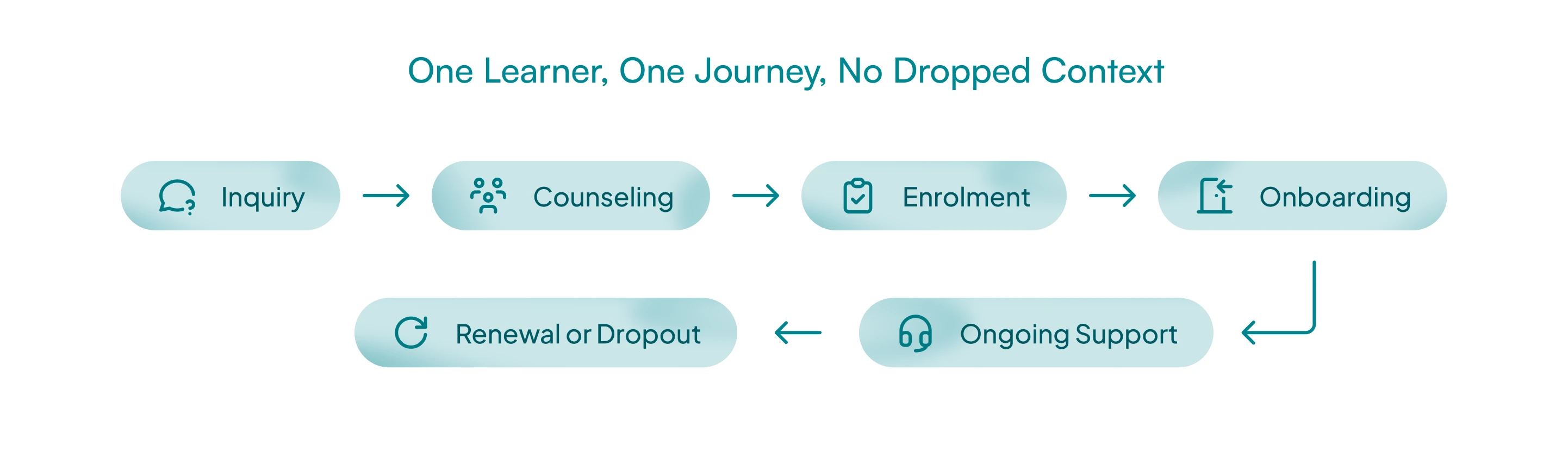
Lead volume in the education sector spikes unpredictably around ad campaigns and batch launches, but admissions teams and enrollment teams stay flat in headcount no matter what the recruitment calendar looks like. Many institutions, from smaller colleges to large universities, are now competing for a shrinking pool of prospective students with the same or smaller marketing budgets, which makes every recruitment strategy more expensive to run and less forgiving of a slow follow-up. A single learner's journey also spans several touchpoints, inquiry, counseling, enrollment, onboarding, and ongoing course delivery, often owned by different teams with no shared context passed between them. A counselor handling a renewed inquiry has no idea the same learner dropped off at payment three weeks earlier, and support handling a course question has no visibility into whether that student is already at risk of leaving.
This is also where the rising cost of running admissions operations manually starts to show. Admissions offices and admissions staff at educational institutions across the enrollment landscape, from university admissions departments to community colleges, spend a large share of their time on repetitive questions, application status checks, and financial aid options that an AI system can answer accurately and immediately, freeing the admissions team to spend their time on the prospective students who actually need a human advisor's judgment. Getting this right is as much about enrollment management as it is about AI tools, the goal is improving enrollment landscape visibility, not just adding software on top of an already strained process.
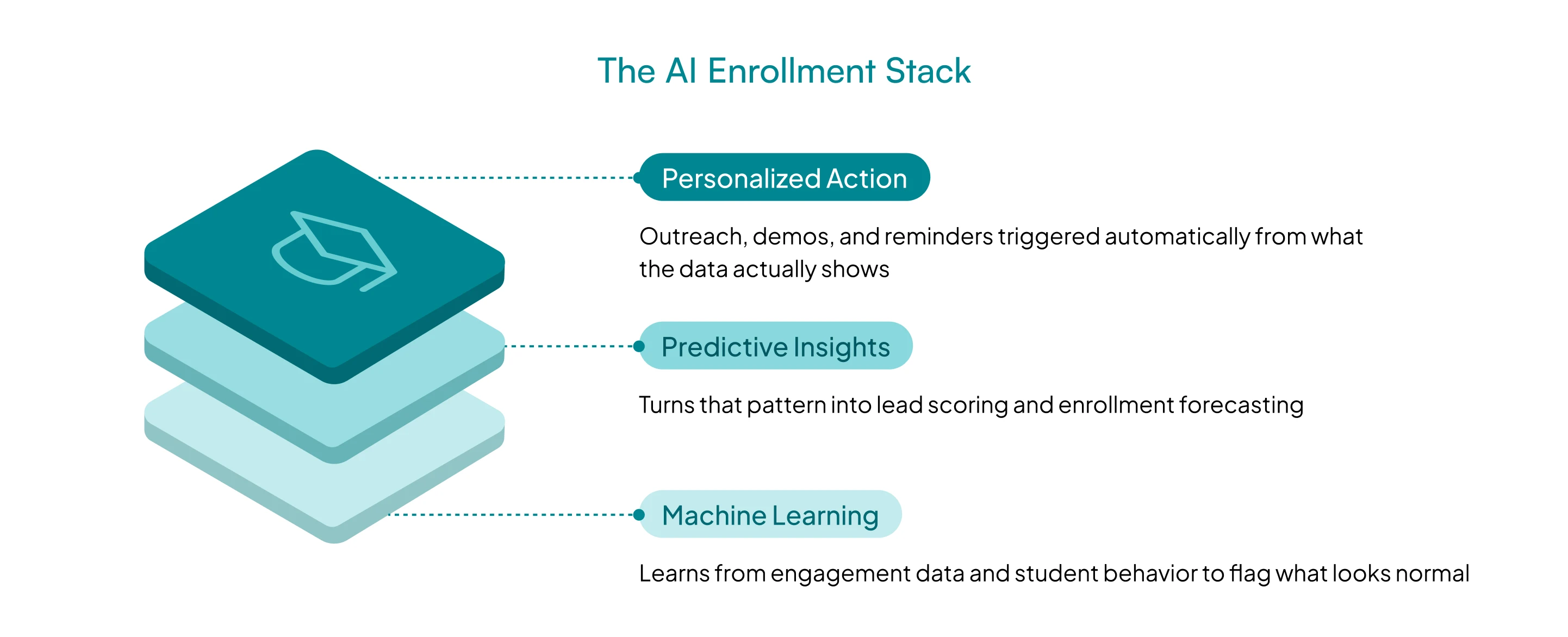
It helps to be precise about what AI enrollment actually means, since the term covers several distinct capabilities, not one single AI tool. Machine learning sits underneath most of the pattern recognition involved, learning from historical engagement data and student behavior to produce predictive insights about which prospective students are likely to enroll and which enrolled students are at risk of leaving. Artificial intelligence applied this way gives admissions teams real time insights instead of a monthly report that is already out of date by the time anyone reads it.
AI powered chatbots and AI chatbots more generally handle the repetitive, high-volume side of this: answering questions about admissions requirements, test scores, application deadlines, and financial aid, the same questions every prospective student asks in slightly different words. Virtual assistants built as genuine AI powered solutions go further, scoring leads using actual engagement data to prioritize which prospective students admissions staff should call personally, and enrollment forecasting that gives institutions a clearer picture of where this year's class is likely to land before it is too late to adjust recruitment strategies. None of this replaces human advisors. It is built to analyze data at a scale no admissions team could manage manually, which is how institutions improve efficiency across the board, so the humans on the team spend their time working to engage students and on building relationships instead of chasing repetitive questions.
The usual failure here is simple and well known: a lead comes in, and the callback takes hours instead of minutes. By the time a counselor reaches out, the prospective student has already looked at two other options or lost the urgency that made them inquire in the first place.
Nugget runs personalized outreach the moment a lead comes in, with personalized communication that reflects what that specific prospective student actually asked about and their stated student interests, books a personalized demo class and counseling sessions directly, and recovers applications that drop off mid-process instead of letting them disappear into a CRM. It gives accurate answers on admissions requirements, financial aid options, and application deadlines immediately, and hands off to a human advisor the moment a question needs real judgment rather than a scripted response. This is the same speed-to-lead principle covered in how AI agents qualify and convert leads through real conversation rather than a static score, applied specifically to the moment a prospective student is most likely to go cold. For admissions teams trying to increase student enrollment without simply spending more on marketing budgets, this kind of personalized outreach at scale is a genuine competitive advantage. Increasing enrollment and bringing in more students both come down to the same underlying skill, the communication skills to answer the right question at the right moment, applied consistently across thousands of conversations rather than just the handful a counselor has time for personally.
A learner who has already said yes is not the same risk as a cold lead, but they still drop off, usually at a form, a verification step, or a payment page, not from a lack of interest but from friction nobody noticed until it was too late. Nugget guides learners through application processing, verification, and payment conversationally, checking application status and clarifying financial aid questions in the same exchange, catching the moment someone stalls and helping them finish instead of generating a support ticket for later. For admissions offices managing application deadlines across hundreds or thousands of files at once, this is often where improved enrollment outcomes actually get won or lost.
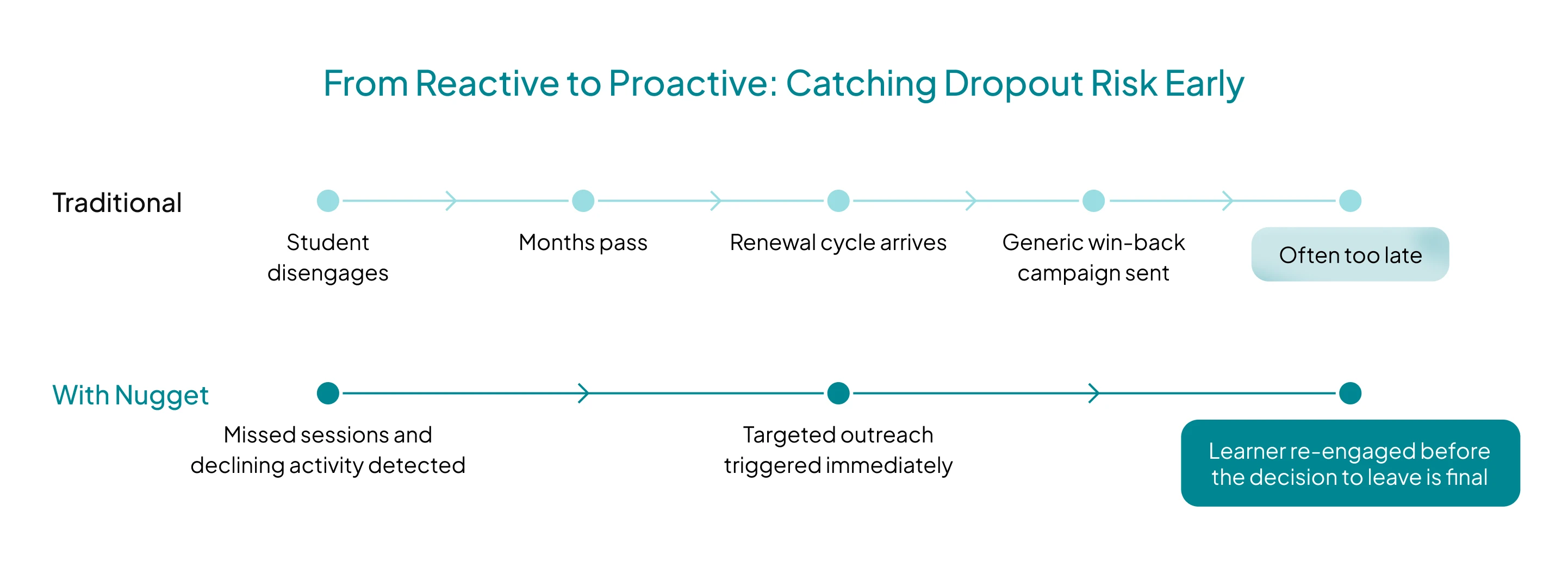
Most dropout prevention in EdTech is reactive. A student stops attending, and nobody reaches out until the next renewal cycle, long after the decision to leave has already been made. Nugget instead triggers outreach from actual student behavior and engagement data, missed sessions, declining activity, automated reminders that go unanswered, instead of a generic retention campaign sent to everyone at the same time regardless of risk. This depends on student records and engagement data staying current and actually being analyzed, not just stored. Picking up on that kind of early signal is the same principle behind detecting frustration or disengagement in a conversation before it becomes an escalation, just applied to a learner's behavior over time instead of a single call. Catching students early, before disengagement hardens into a decision, is consistently cheaper and more effective than any win-back campaign run after the fact.
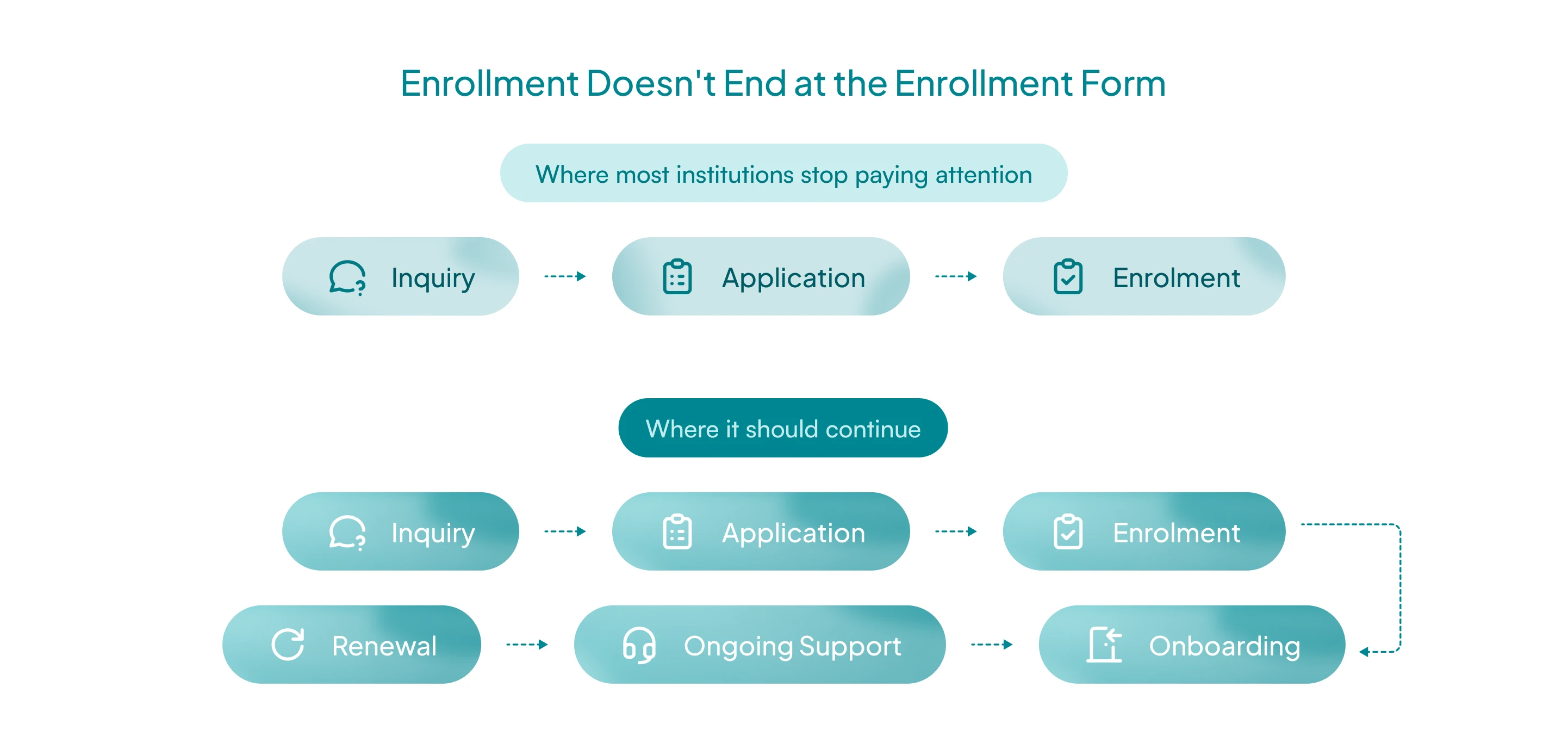
Improving student satisfaction is not a separate initiative from improving enrollment outcomes, it is the same work continued past the point most institutions stop paying attention. Student expectations have shifted well past what a static FAQ page or a once-a-semester newsletter can meet. Students now expect the same responsiveness from their institution that they get from any other service they use, quick, accurate answers, and communication that reflects their actual interests and campus life rather than a generic broadcast. An institution that treats student engagement as something that matters only during the admissions process will keep losing students it already worked hard to recruit.
Admissions and dropout prevention get most of the attention, but a quieter risk sits in between them: an enrolled student with an account issue, a course question, or an exam or result query who cannot get an answer outside counselor hours. Nugget's 24x7 student helpdesk handles account issues, course queries, and exam and result assistance continuously, the same logic behind how an AI agent decides when a query needs to be escalated to a human, so a minor unanswered question does not quietly turn into disengagement before anyone notices.
Every one of these interactions touches personal and academic data, including student records that carry real sensitivity, and in many cases the learner is a minor, which brings parental consent into the picture directly. An agent also has to operate within a clear boundary: it can explain a process, a fee structure, or a curriculum detail, but it should never imply a guarantee about outcomes, placements, or certification value that the institution has not actually made. That boundary is a design requirement, not a disclaimer added at the end of a conversation.
The numbers hold up because the behavior behind them does. Research from the 2007 MIT and InsideSales Lead Response Management Study found that leads called back within 5 minutes are 21 times more likely to qualify than leads called at 30 minutes, which is the clearest evidence that admissions is a speed problem before it is anything else. Institutions using Nugget see a 26 percent improvement in course completion compared to traditional platforms, and proactive re-engagement delivers 30 percent fewer dropouts by reaching learners before disengagement turns into a decision to leave. Set against Deloitte's enrollment outlook, where institutions are already managing a shrinking pool of prospective students, retaining a student who was already going to enroll is consistently cheaper than finding a new one to replace them, and improved enrollment outcomes at this scale are what let smaller colleges compete with large universities that have far bigger marketing budgets.
Admissions and dropout prevention are not two separate problems with two separate tools. They are the same learner, at different points in the same enrollment lifecycle, and the higher education institutions that treat speed and continuity as one connected system, not an admissions team here and a support team there, are the ones that will keep more of the students they already worked to reach, and build the kind of competitive advantage that compounds every single recruitment cycle.
Admissions and dropout prevention have always been treated as two different jobs, run by two different teams, measured by two different metrics. Nugget treats them as one continuous relationship with the learner, from the first inquiry through graduation or renewal, because that is what they actually are. The institutions that close that gap will keep more of the students they already worked hard to reach.
Does Nugget only help with new leads, or also with students who already enrolled?
How does Nugget know when a student is at risk of dropping out?
Is this only for admissions counselors, or does it help the support team too?
TL;DR
A cold lead and a disengaged student share the same root cause, a learner who needed a timely response and did not get one.
Deloitte projects a 13 percent decline in US college enrollment from 2025 to 2041, making every prospective student and every retained learner worth more than before.
Machine learning and predictive insights turn raw engagement data into lead scoring and enrollment forecasting that admissions teams can actually act on.
Leads called back within 5 minutes are 21 times more likely to qualify than leads called at 30 minutes, and application drop-off recovery catches learners before they disappear mid-process.
Behavioral triggers, not renewal-season campaigns, drive a 30 percent reduction in dropouts.
Improving student satisfaction after enrollment is part of the same engagement work that started during recruitment.
A 26 percent improvement in course completion and 30 percent fewer dropouts, both from Nugget's own platform data.