How Airlines Can Use Nugget to Manage Flight Disruptions and Rebooking at Scale
Written by: Manya Singh
Published On: Oct 26, 2026
8 mins

A fog bank rolls into a hub airport before sunrise. Within an hour, forty departures are delayed. A gate agent is explaining the same two rebooking options to the eleventh person in a row, while four hundred more anxious passengers are still waiting in line behind them. The phone lines are already jammed at contact centers. Somewhere in operations, a duty manager is trying to figure out which crews are about to run out of legal flying hours, using a spreadsheet that was last updated twenty minutes ago.
This is the moment every airline's customer experience infrastructure actually gets tested. It is also the moment most of it fails. Not because the airline lacks good people or good intentions, but because the systems built for a calm Tuesday were never designed for major disruptions like this.
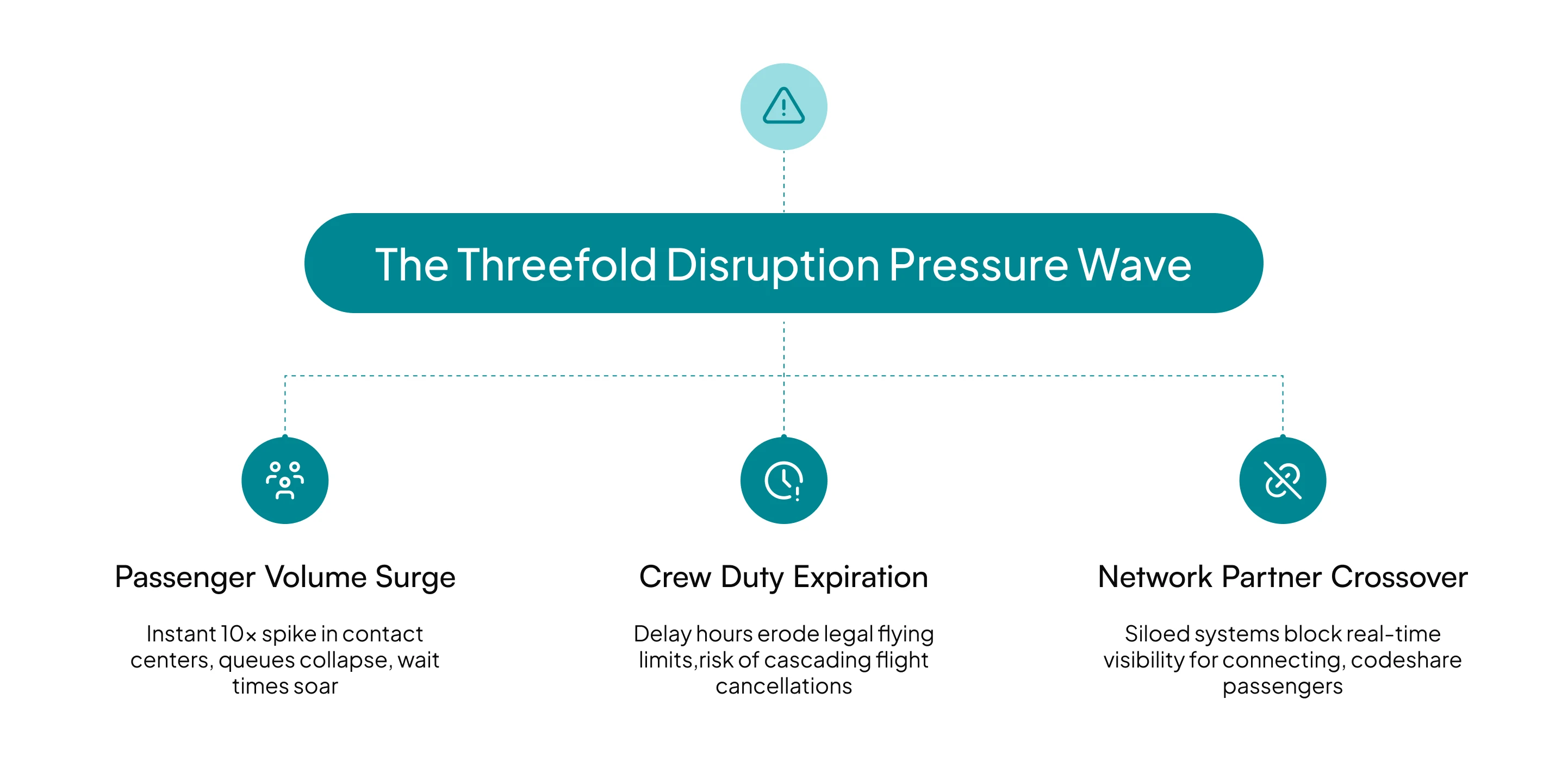
A single weather event, technical issues, or air traffic control delays do not create one problem. They create three at once, and they all hit under intense pressure at the same time.
Passenger volume spikes within minutes as contact centers and chat queues absorb a surge they were never sized for. Crew operations teams scramble against legal duty limits, where every hour of delay quietly eats into how many more hours a crew can legally fly that date. And network recovery teams try to untangle connecting travelers, many of whom are booked on partner flights that have no visibility into what is actually happening upstream.
Deloitte Global's 2026 Airline CEO Survey, which gathered responses from 21 airline chief executives, found that irregular operations recovery has moved to the top of the operational agenda, just behind on time performance. It is the first year irregular operations recovery has emerged in the survey as a named target for AI automation, a sign that airline leadership itself now sees this specific moment, not general customer service, as the place where technology needs to prove itself to minimize financial loss and protect brand loyalty.
That matters because it communicates something most frontline teams already feel: flight disruptions are not edge cases anymore. Effective disruption management is a recurring test of whether an airline's operations can actually hold together under pressure to deliver reliable assistance when flights are cancelled.
Most of the solutions many airlines already have were not built for this test, and the gaps in their disruption management strategy are specific.
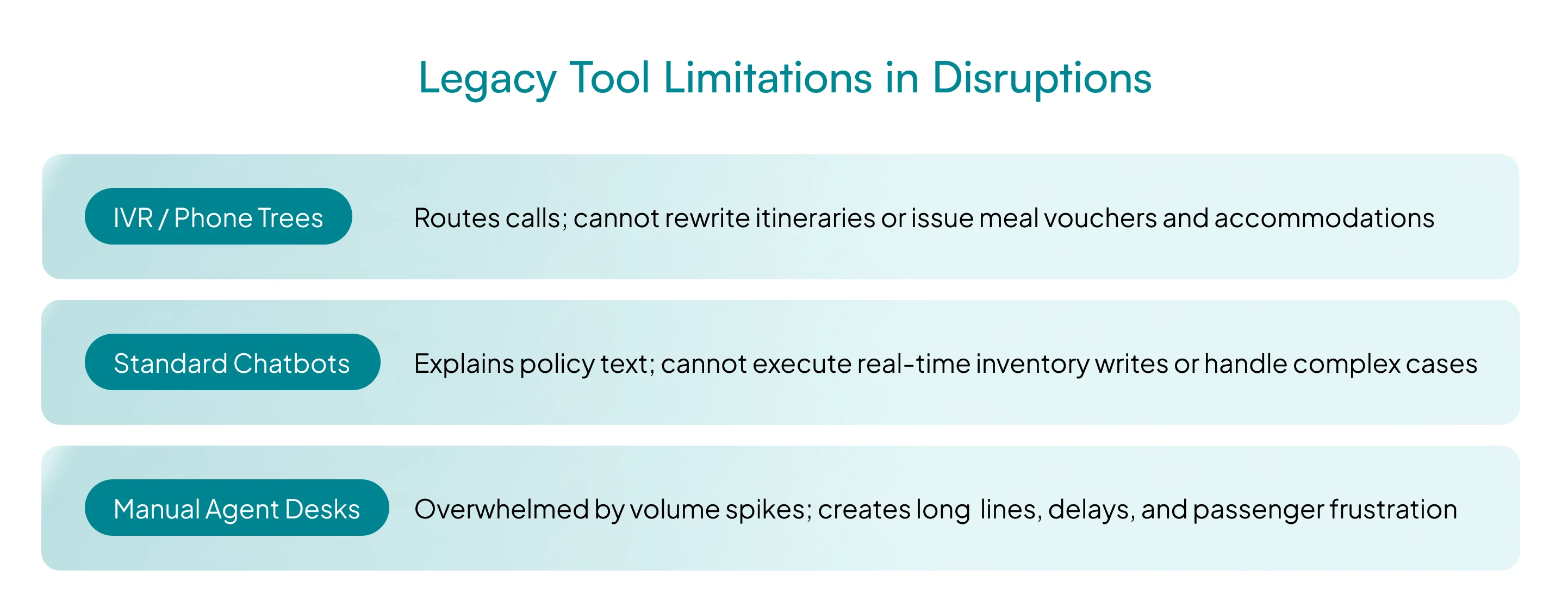
An IVR can route a call to the right queue, but it cannot rewrite a booking or adjust inventory. A chatbot can explain a change fee policy in plain language, but it cannot actually execute a refund, issue meal vouchers or hotel accommodation, or confirm a new seat on alternative flights. And the passenger facing team handling phone calls usually has no visibility into what the crew operations team already knows about the recovery plan, so two parts of the same airline end up telling two different stories to affected passengers at the same time.
This is also exactly the moment a bad automated experience costs an airline the most. Gartner's September 2026 survey of 3,566 B2B and B2C customers found that only 27 percent of customers would be willing to try a chatbot again after a negative experience. During a disruption, when every touchpoint is already tense, a failed automated interaction does not just frustrate one passenger. It destroys customer satisfaction, damages brand loyalty, and pushes them straight back into the same overloaded phone queue, eliminating any chance to stay ahead of the crisis.
Rewind the same morning, but this time Nugget's effective disruption management platform is already running.
The moment a cancellation or severe flight delays are confirmed, affected passengers receive proactive communication directly across multiple channels, before most of them have even noticed the delay on the airport departure board. By keeping passengers informed in real time, a disrupted passenger's rebooking is resolved in minutes with personalized rebooking options, rather than after hours of waiting in a physical line or queue. A passenger who starts the rebooking flow but drops off before confirming picks it back up later over WhatsApp or voice channels, and the conversation continues seamlessly from the exact flight details and plan they had already selected.
Meanwhile, the crew operations team is not competing with four hundred anxious travelers for the same stretched support function. They have real time data access to updated duty information, schedule changes, and roster adjustments through the same platform, running in parallel rather than waiting in line behind the passenger crisis.
Same fog bank. Same forty delayed departures. A completely different morning for the aviation industry.
This is not a faster chatbot. The distinction that actually matters is what sits underneath the conversation.
Nugget operates with real time read and write access into the airline's booking infrastructure, not a read only lookup that can describe a policy but cannot act on it. It can handle rebooking across partner and codeshare flights, which is where most automated systems quietly hand the passenger back to a human because the itinerary crosses an airline boundary they were not built to touch.
It is also built for genuine concurrency. A normal day's call volume is not the problem. The problem is the 10x spike in the first hour after a cancellation wave, exactly where traditional phone queues and most digital self service tools collapse. Nugget is designed to hold up at that volume, not just perform well in a calm demo.
And Crew Support runs as its own capability, not an afterthought bolted onto the passenger facing product. This is the part of the story that usually gets left out of airline CX conversations entirely, because most vendors only think about the passenger side. An airline does not stop running internally just because the front line is handling a disruption, and that internal machinery needs the same kind of help the passenger does.
Think of this as the same agent capability, pointed inward. During a disruption, and on any ordinary day, staff across the airline have their own version of the same problem passengers do: a question that needs answering right now, and a system that is too slow, too siloed, or too hard to navigate to answer it.
A few of the ways this plays out across an airline's own workforce:
- Crew duty and schedule queries: A crew member checking how many duty hours they have left before a flight, confirming a roster change, or finding out whether they have been called out for reserve duty, without waiting on hold with crew scheduling.
- Leave and roster requests: Applying for leave, requesting a shift swap, or checking the status of an existing request, handled conversationally instead of through a static portal that nobody enjoys using.
- Policy and HR queries: Questions about reimbursement rules, per diem policy, uniform standards, or union agreement clauses, answered instantly instead of sent to an inbox that gets to it eventually.
- Internal ticketing: Raising a maintenance snag report, logging a safety observation, or requesting ground equipment, captured and routed to the right team without a staff member needing to know which system or which form to use.
- Training and certification tracking: Checking when a recertification is due, confirming training module completion, or flagging that a medical certificate or visa is close to expiry, before it becomes a compliance problem.
- Ground operations coordination: Gate change notifications, baggage handling coordination, and catering or cabin supply requests, kept moving even when the operations team is fully absorbed in disruption recovery.
- Operational guidance and SOP lookups: A quick, reliable answer pulled from the actual standard operating procedure or regulatory document, instead of a staff member guessing or hunting through a shared drive.
- Fatigue and safety reporting: A simple way to submit a fatigue report or safety occurrence that gets routed to the right team immediately, rather than sitting in a queue because the reporting process itself felt like too much friction.
None of this is a separate product bolted on for internal use. It is the same agent platform, context layer, and write access model, just pointed at the airline's own staff instead of its passengers. During a disruption specifically, this matters more, because the people managing the recovery are also the people most likely to get blocked by exactly these friction points at the worst possible time.
McKinsey's State of AI in 2025 research found that 62 percent of organizations are now experimenting with AI agents. The gap between experimenting and actually scaling is exactly where most AI initiatives stall, and it is the gap that matters most in a moment like a disruption event, where the system, passenger facing and staff facing alike, either holds up at full volume or it does not.
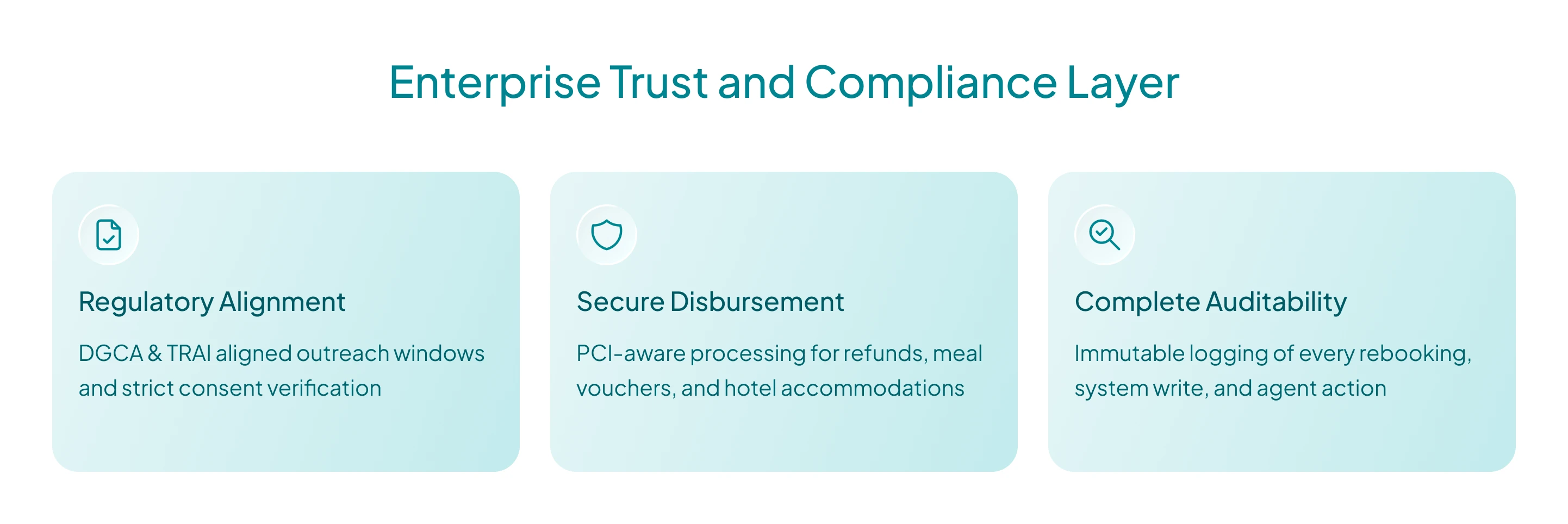
None of this works without trust, especially during severe disruption events. Every interaction uses DGCA and TRAI aligned consent and outreach windows, so passengers are never contacted outside regulated boundaries. Real time communication handles refunds, meal vouchers, and hotel accommodation with PCI-compliant payment security, protecting passengers from fraud while resolving claims. Every automated action generates a complete audit trail, allowing airlines to review exactly what rebooking options were offered, what flight details were updated, and what accommodation was approved long after the weather clears.
The proof is already running in production for airline communication and recovery. Nugget resolves disruption related queries and rebooking requests in minutes rather than hours, with up to 70 percent of eligible queries handled without requiring manual intervention from human agents.
That same rebooking talk and interaction, instead of being treated purely as an operational cost to absorb, becomes a business opportunity. Disruption-related interactions generate up to 15 percent more ancillary revenue per booking when the system can guide passengers toward upgraded seats, preferred fare classes, or added baggage while adjusting their travel plans to their final destination.
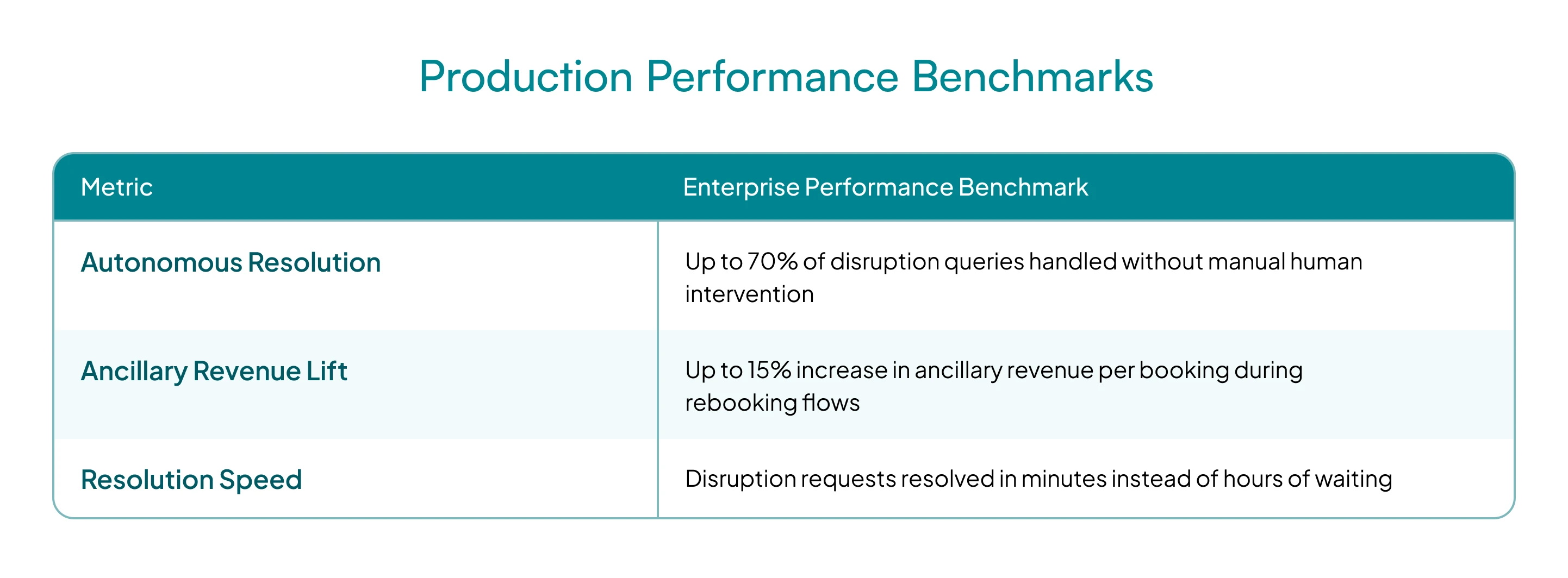
Those numbers reflect Nugget's deep infrastructure: real time data write access, massive concurrency, and parallel crew support that empower airlines to manage disruptions smoothly.
Same fog bank. Same forty delayed flights. But this time the recovery scales with the disruption instead of collapsing under it.
Passengers are rebooked onto alternative flights before they have finished reading the delay notice. Crew teams have the flight details and duty information they need without waiting behind a passenger crisis. The gate agent is not explaining the same two options for the twelfth time, because most passengers received proactive communication and never needed to reach her in the first place.
Flight disruptions will always happen; weather does not check an airline's operational calendar. What changes is whether that disruption becomes a full-blown crisis or simply another operational event the airline has built the ability to absorb, protecting customer experience, brand loyalty, and operational efficiency for the future.
Can Nugget actually rebook a passenger, or does it just explain the options?
What happens if a passenger starts rebooking and does not finish?
Does this only help passengers, or does it help the airline's operations too?
TL;DR
A single flight disruption hits passenger service, crew operations, and network recovery all at once, and most legacy airline systems were built to handle only one of those at a time.
IVRs and chatbots can explain policies but cannot execute a rebooking, issue meal vouchers, or process accommodation, pushing affected passengers into long queues.
Gartner's September 2026 survey found only 27 percent of customers would try a chatbot again after a bad experience, meaning a failed automated interaction during flight disruptions damages customer satisfaction and brand loyalty.
Provides flight disruption management with real time data write access into booking systems, rebooks across codeshare networks, handles massive concurrency, and runs Crew Support in parallel.
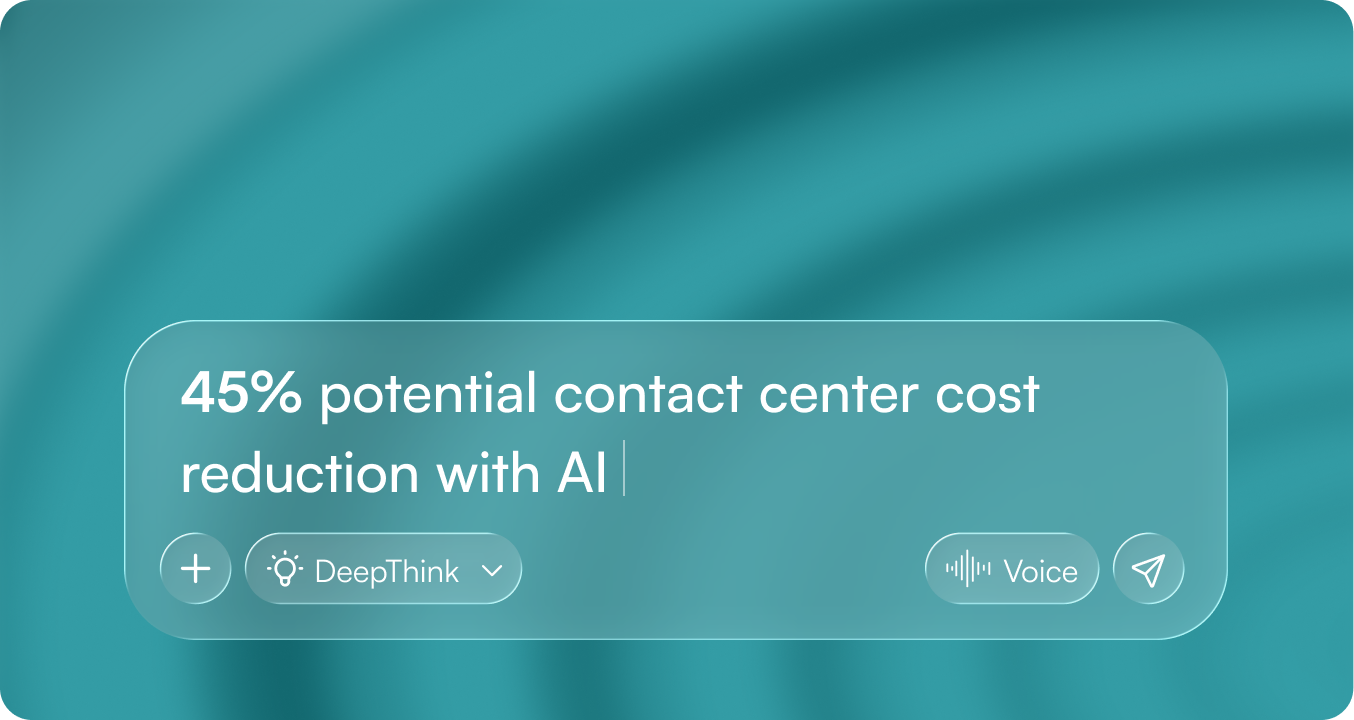
Up to 70 percent of disruption queries are resolved without manual intervention, travelers are rebooked in minutes, and ancillary revenue increases by up to 15% per booking.
Deloitte's 2026 Airline CEO Survey highlights effective disruption management as a top operational priority, while McKinsey's State of AI in 2025 research shows 62 percent of organizations are now experimenting with AI agents.