The Complete Guide to AI Customer Support
Written by: Manya Singh
Published On: Sep 14, 2026

Let's skip the part where we say AI customer support is "transforming customer service." You already know that. The useful question is what AI customer support actually is in production: AI agents that handle customer interactions across voice, chat, and email by understanding intent, retaining context, pulling from live enterprise systems, taking actions, and resolving requests end to end instead of just deflecting tickets.
That distinction matters for mid-to-large enterprises with high interaction volumes especially in e-commerce, logistics, financial services, telecom, healthcare, travel, hospitality, and EdTech because most teams are no longer deciding whether to try AI, but whether they can make it work reliably without a heavy engineering lift.
McKinsey has found that 62% of organizations are at least experimenting with AI agents, while nearly two-thirds of respondents say their organizations have not yet begun scaling AI across the enterprise. Crucially, McKinsey identifies workflow redesign as a key success factor and notes that organizations seeing the most value are redesigning workflows around AI.
Vendors routinely advertise 90%+ automation, containment, or resolution rates for specific use cases. The problem is that these numbers rarely tell you what happens across broader customer service functions, where edge cases, integrations, language variation, escalation logic, and changing customer behavior affect performance. A headline automation number is not the same thing as reliable resolution at scale, which is why scaling AI customer support requires more than model selection or a chatbot launch.
What shifted recently is not primarily model capability. It is the executive mandate. Gartner found that 91% of support leaders and customer service teams are now under pressure from executive leadership to pursue implementing AI. So this piece focuses on what usually gets missed: how AI customer support has evolved from chatbots to more agentic systems, the architecture behind support agents, where multi-channel deployments break, which industry use cases create the most value and risk, and what operating practices actually improve resolution, cost efficiency, and customer satisfaction over time.
The enterprises getting real results from AI customer service are not the ones moving fastest. They are the ones that got honest about what customer support production actually requires before they signed anything, particularly when deploying AI customer support solutions across real customer interactions.
Most explainers treat this as a taxonomy. It is actually a progression in customer service solutions, and understanding it operationally matters more than understanding it technically.
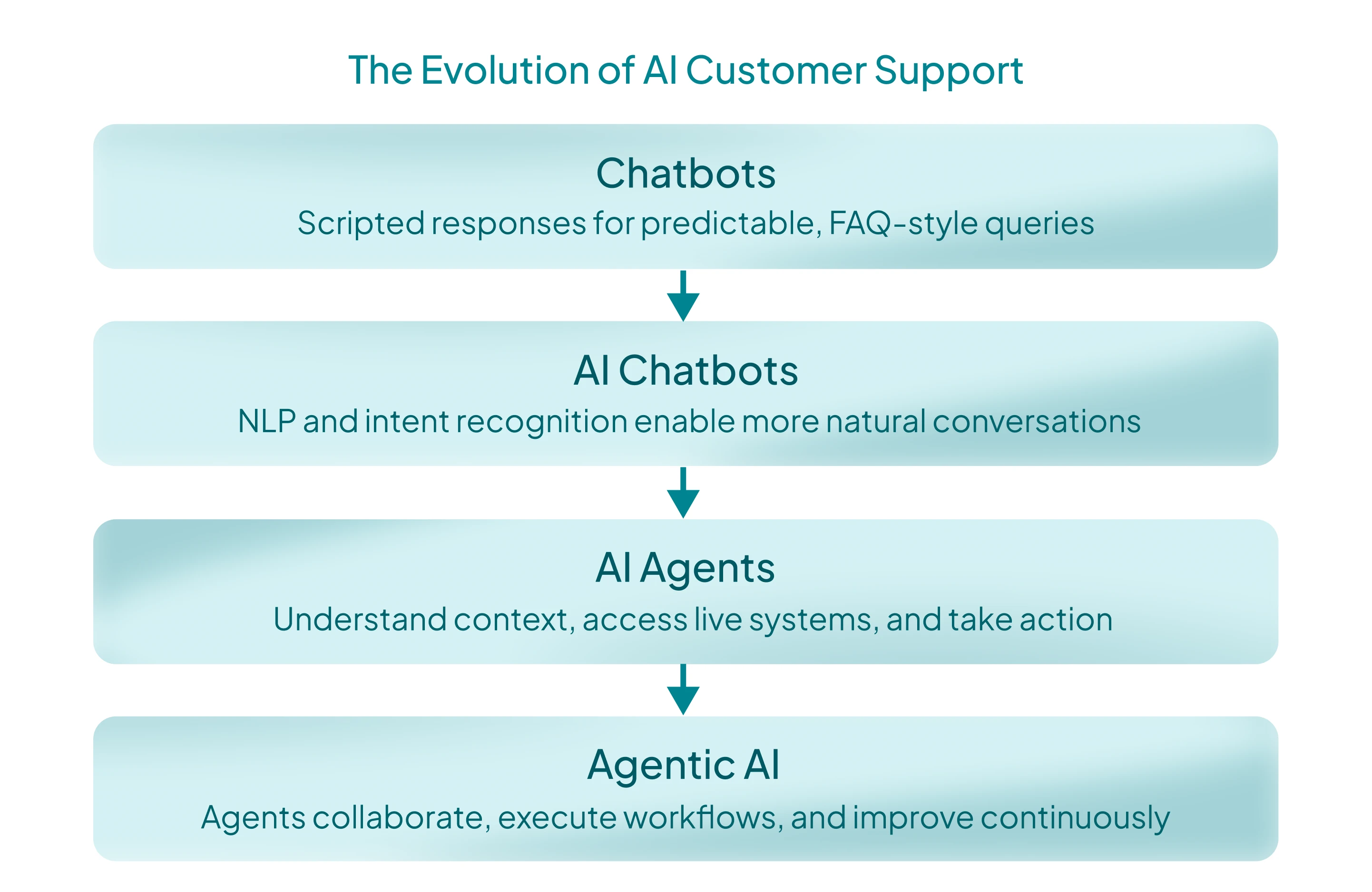
The metric shift that tracks this progression: deflection rate was the chatbot metric. Containment rate was the AI chatbot metric. Resolution rate is the AI agent metric. Outcome rate, whether the customer's actual problem was solved and stayed solved, is the agentic AI metric. Containment is the most commonly shown. Resolution is the most commonly hidden.
Natural Language Processing (NLP)
Natural Language Understanding (NLU)
Dialogue Management
Large Language Models (LLMs)
Live System Integration
Context Retention
Voice
Chat
Social Messaging
The Omnichannel Problem
The demo is built on cooperative inputs: a participant who speaks clearly, follows expected flows, and asks pre-planned questions.
Production is built on real life: a customer calling from a moving car with a connection drop, mixing English and Spanish in the same sentence, asking about an account edge case that sits across two different backend systems.
The difference is evaluation. Gartner research points to a fundamental shift from testing AI systems in controlled environments to continuously monitoring their behavior in production, where performance can vary across use cases, data, models, and real-world conditions.
When a logic error fires in a demo, it affects one conversation. When it fires in production, it replicates across every active conversation simultaneously. At 50,000 daily support interactions, a 2% error rate is 1,000 bad customer experiences per day. Containment rate hides this: a system can contain 85% of conversations and resolve 45% of them. The unresolved 40% show up as repeat contacts, escalations, churn, and negative customer satisfaction scores.
Knowledge Base Gaps
Poor Escalation Logic
Linguistic Diversity
QA Coverage Gaps
Flawed Campaign Orchestration
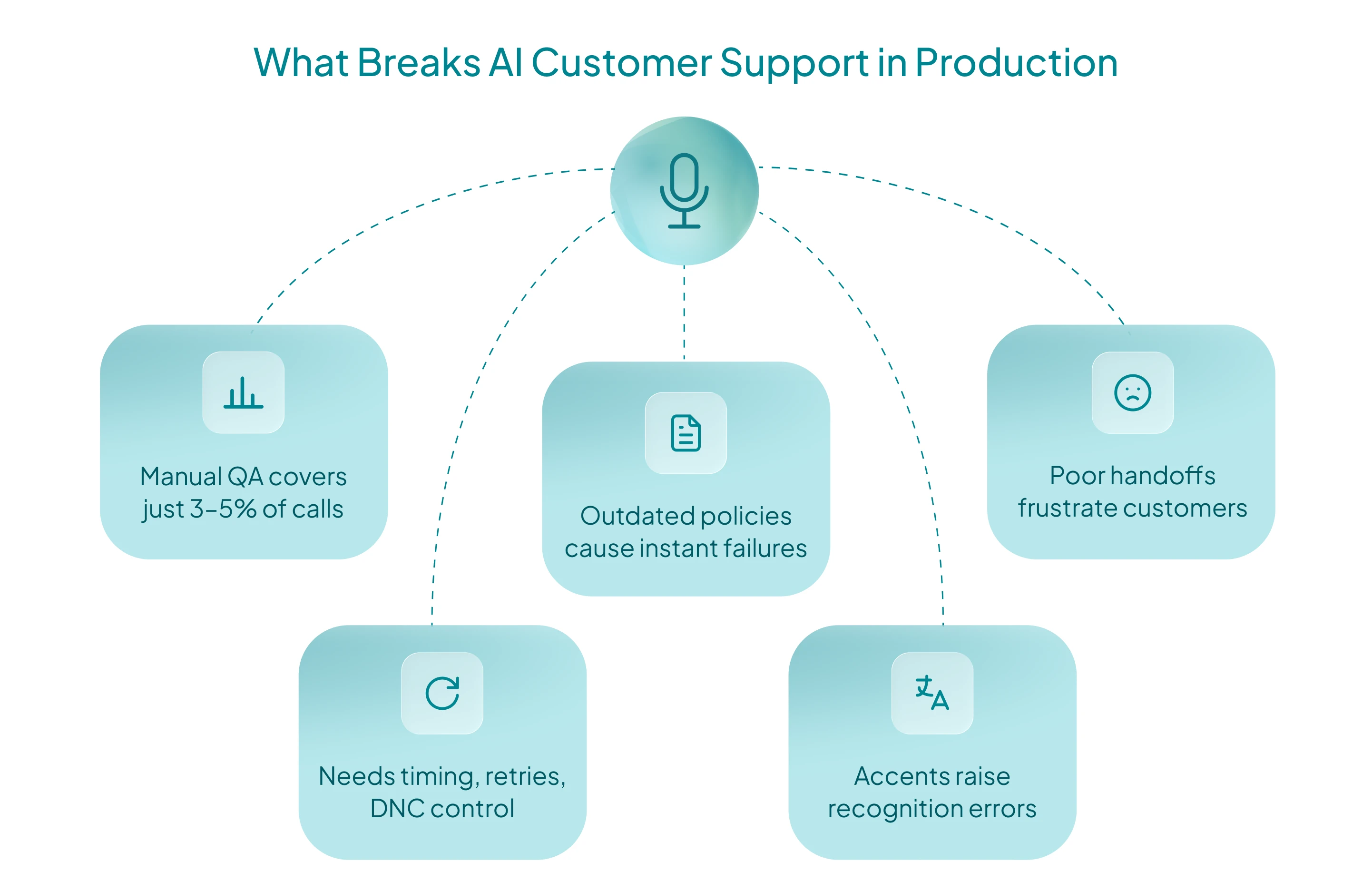
AI fails incrementally through quality drift. As customer behavior shifts, product policies update, and LLM versions change, output quality degrades in ways that standard infrastructure monitoring never catches.
Traditional tools tell you if the system is up or track basic ticket volume, but they cannot evaluate whether responses are accurate or if resolution rates are holding. AI customer support observability requires an infrastructure layer that inspects every conversation, runs sentiment analysis to analyze customer sentiment and monitor customer sentiment, correlates outcomes to agent behavior, and surfaces degradation before it impacts customer experience.
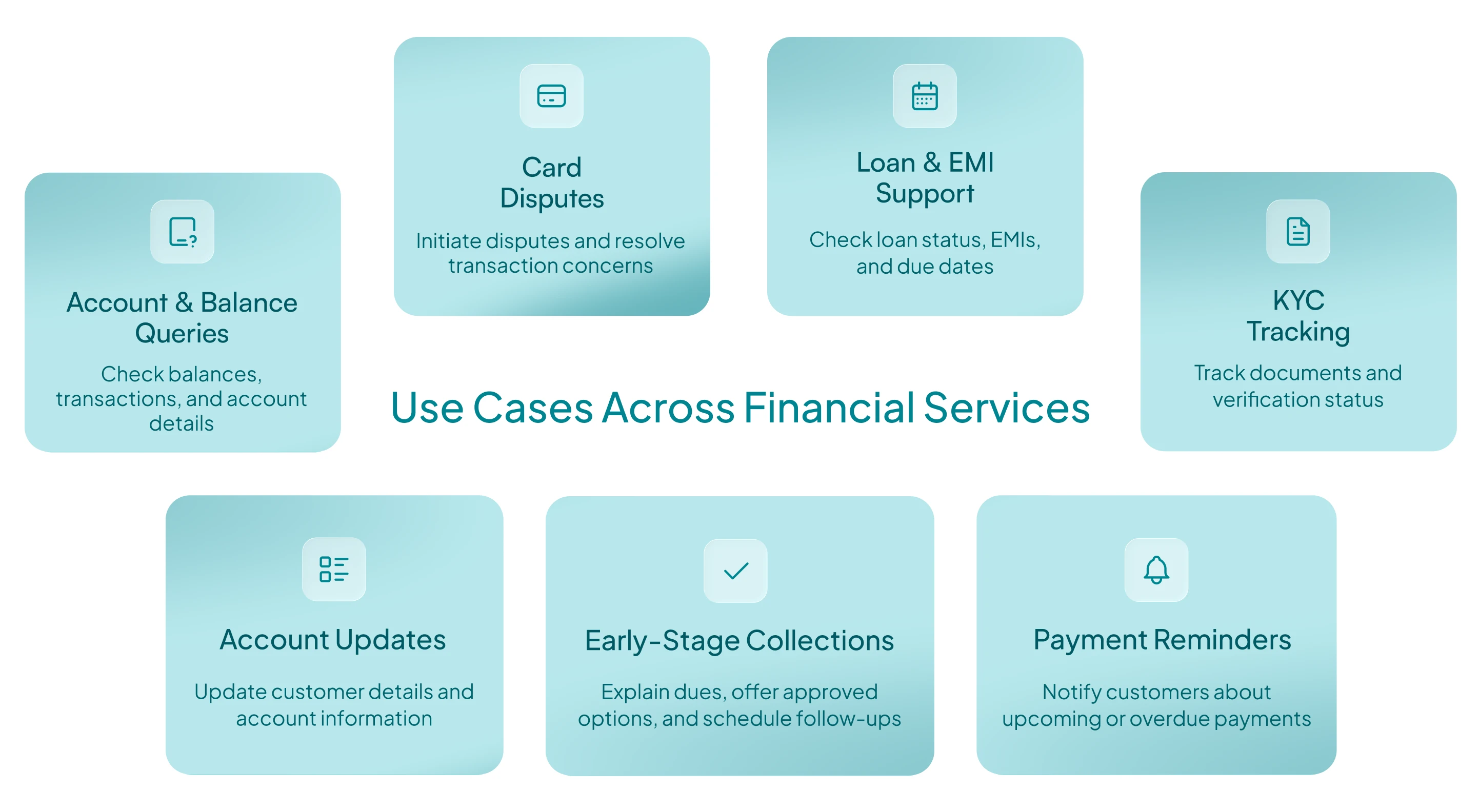
- High-Value Use Cases: Balance and transaction inquiries, card dispute initiation, loan and EMI status queries, KYC document tracking, account updates, payment reminders, and structured early-stage collections are strong starting points for AI customer support. These interactions are typically high-volume, policy-driven, and connected to structured customer data.
- Where AI Creates More Value: The opportunity extends beyond answering account questions. AI agents can authenticate customers, retrieve live financial information, explain transactions, initiate service requests, schedule callbacks, and execute defined workflows across banking systems. In collections, for example, an AI agent can identify the account context, explain outstanding amounts, offer approved repayment options, and schedule follow-ups within a single conversation.
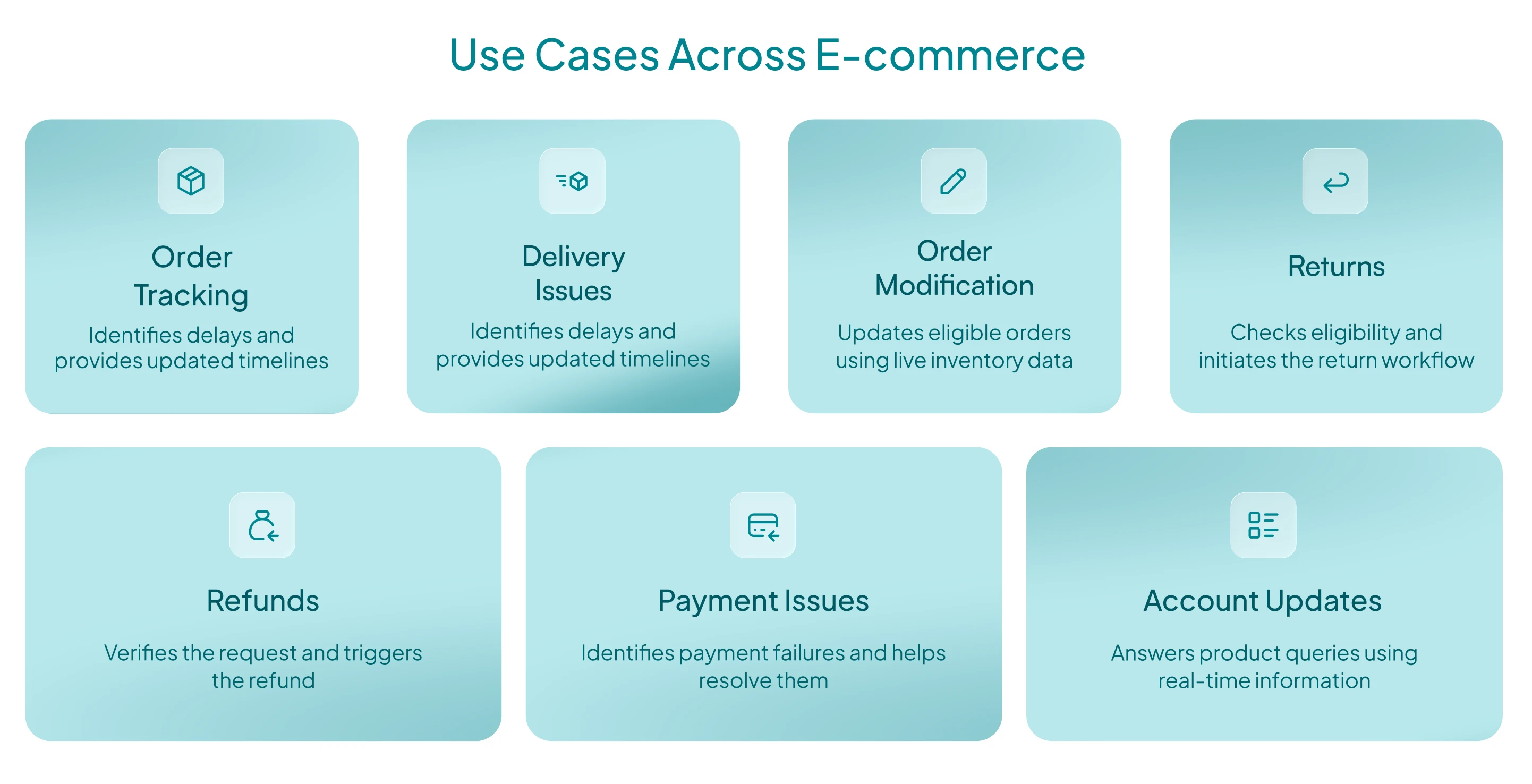
- High-Value Use Cases: "Where is my order?" queries, delivery updates, order modifications, returns, refunds, payment issues, and product-related questions represent some of the highest-volume opportunities for AI customer support.
- Where AI Creates More Value: E-commerce AI becomes significantly more useful when it moves beyond tracking information to actually resolving the underlying issue. An agent connected to order management, inventory, payments, and logistics systems can check an order, identify a delay, modify eligible orders, initiate returns, and trigger refunds without requiring a human agent to coordinate each step.
- High-Value Use Cases: Appointment confirmations and rescheduling, medication refill reminders, billing and insurance inquiries, pre-visit instructions, post-discharge check-ins, and chronic disease adherence outreach are well suited to AI customer support.
- Where AI Creates More Value: Healthcare AI can take on a significant amount of administrative communication without adding pressure to already stretched clinical teams. A voice agent can confirm appointments, provide preparation instructions, answer billing questions, send reminders, and coordinate follow-ups in the patient's preferred language.
- High-Value Use Cases: Billing inquiries, payment issues, outage status, plan changes, service activation, technical troubleshooting, and proactive outage notifications are natural fits for AI customer support.
- Where AI Creates More Value: Telecom is particularly well suited to AI because many support interactions depend on real-time network, billing, and account data. An AI agent can identify a customer, check service status, diagnose common issues, explain charges, recommend eligible plans, and execute account changes through connected systems.
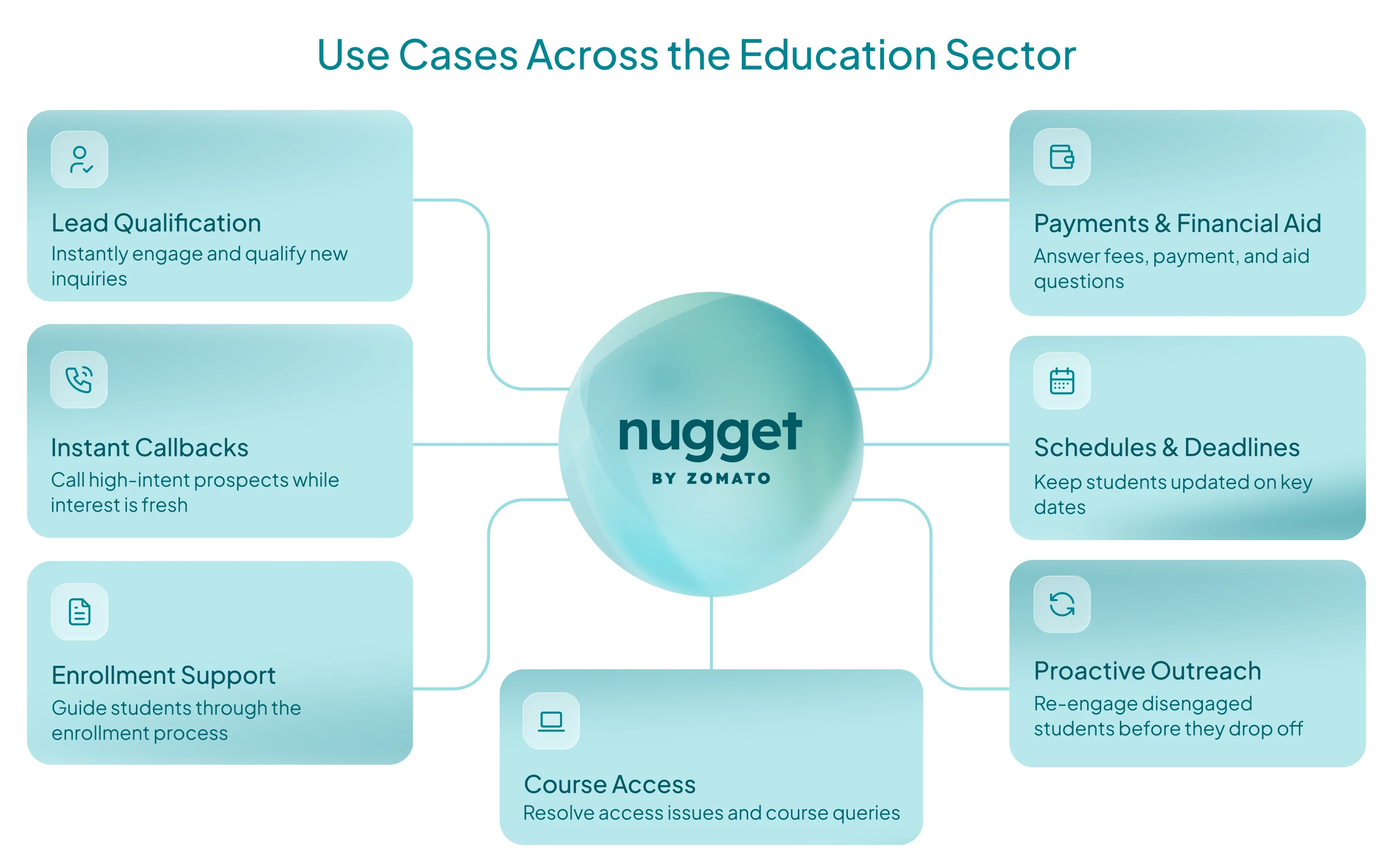
- High-Value Use Cases: Lead qualification, instant callbacks, course access assistance, payment and financial aid queries, enrollment support, schedule and deadline questions, and proactive outreach to disengaged students.
- Where AI Creates More Value: In admissions, speed can directly influence conversion. An AI voice agent can respond to a new inquiry within seconds, understand the student's requirements, answer basic questions, qualify intent, and schedule a counselor conversation. For enrolled students, the same infrastructure can resolve routine administrative queries while identifying opportunities for proactive intervention.
- High-Value Use Cases: Booking confirmations, room and reservation queries, check-in support, airport transfers, rebooking, disruption management, refund requests, and loyalty-related inquiries.
- Where AI Creates More Value: Travel and hospitality interactions are often time-sensitive, making speed a critical part of the experience. An AI agent connected to reservation and booking systems can check availability, present options, modify bookings, confirm selections, and handle rebooking within the same interaction.
Financial Services
E-Commerce and D2C
Healthcare
Telecom
EdTech
Hospitality and Travel
Across industries, the pattern is consistent: the highest-value AI customer support deployments are not built around answering more questions. They are built around understanding the customer, accessing the right context, taking action across enterprise systems, and completing the underlying job to be done.
Map Interaction Volume First
Start with High-Volume, Well-Defined Use Cases
Design Escalation Paths Before Agent Flows
Define Resolution Metrics Before Launch
Run Real-Condition Testing
Build a Continuous Improvement Loop
Measure What the Business Cares About
The most sophisticated enterprise deployments run orchestration layers that utilize intelligent routing to route between specialized agents (such as billing, technical support, or account management) while preserving context across transitions. This shifts the support function from passively processing contacts to actively executing resolutions, preventing issues, and transforming customer service from a traditional cost center into a value driver.
By blending AI assistance, response suggestions, and agent assistance with machine learning, organizations can enhance customer service, enhance customer interactions, and enhance agent productivity while driving greater customer satisfaction.
Before Nugget became a platform, its technology was already running inside Zomato, handling real customers, edge cases, and production volume. By the time it became available to enterprises, Nugget had handled 2.2 billion customer conversations in production across the very conditions that expose AI's weaknesses: latency, integrations, language variation, escalations, and unpredictable customer behavior.
That experience shaped the platform around a simple reality: an AI agent is only as effective as the systems around it. Nugget combines conversational intelligence with real-time customer context, enterprise integrations, workflow orchestration, guardrails, QA, and observability to move interactions from intent to action to resolution.
Nugget also gives teams visibility into what is happening across live conversations, helping them identify resolution gaps, monitor agent behavior, and continuously improve workflows without turning every change into an engineering project. Automated QA and observability make it possible to evaluate interactions at scale rather than relying on small manual samples.
The advantage of 2.2 billion production conversations is not just the number. It is the operational experience behind it. Enterprises using Nugget do not have to discover every production failure mode from scratch. They start with a platform shaped by what happens when AI customer support meets real customers, real systems, and real scale.
AI customer support has moved well beyond answering FAQs. The real shift is toward AI agents that can understand context, reason through problems, access live systems, take action, and verify that the outcome actually happened.
But production success is not about choosing the most sophisticated architecture or chasing the highest automation rate. It comes down to whether the system can operate reliably across real customers, real workflows, real enterprise systems, and real-world edge cases. That means measuring verified resolution rather than deflection, designing for safe execution, maintaining strong observability, and knowing when human intervention is necessary.
The next phase of AI customer support will belong to systems that do more than generate a response. They will understand what needs to happen, execute it across the business, and take responsibility for getting the customer to the right outcome.
How is AI customer support different from a chatbot?
What is the difference between containment rate and resolution rate?
How long does it take to deploy AI customer support?
TL;DR
Most enterprises have AI pilots. Far fewer have scaled AI customer support into reliable, organization-wide operations.
The shift from chatbots to AI agents is a shift from answering questions to actually resolving customer problems and handling complex issues.
Demos are controlled. Production is not. Scale, integrations, edge cases, language variation, and failures expose the difference quickly.
Every industry has high-value support use cases for AI, but each also has failure modes that need to be designed for upfront.
Successful ai customer support depends as much on evaluation, observability, integrations, and operational design as it does on the underlying model.
The enterprises getting the most from AI customer support are not simply choosing better models. They are building the infrastructure required to make AI work reliably in the real world to deliver exceptional service.