Nugget in Telecom: Automating Billing, Outages, and Plan Management at Scale
Written by: Manya Singh
Published On: Oct 29, 2026
13 mins

AI in telecom has moved past the pilot stage and into the part of the business where it actually has to hold up: billing, outages, and plan management. These three categories drive the overwhelming majority of telecom support volume, and each one fails in a different way. A billing dispute needs an explanation the customer actually believes, not a scripted apology. An outage needs the truth, in real time, before the customer has to ask for it. A plan change or recharge needs to actually happen in the conversation, not get logged as a request for someone else to action later.
Most telecom support infrastructure was not built to do any of these three things well, let alone all three at once, and the industry faces a widening gap between what customers expect and what legacy systems can deliver. This piece looks at how AI in telecommunications actually solves each one, and at why the opportunity for AI solutions in telecom extends well past the support queue into network performance, fraud detection, and the rest of how an operator runs.
The telecom industry is structurally harder than most sectors asking the same question about AI adoption. A single operator can carry a subscriber base in the tens or hundreds of millions, split across prepaid and postpaid segments that behave like two different businesses with two different sets of customer needs. On top of that sits a physical network layer, towers, fiber, and field technicians, that most customer experience systems were never built to connect to, and a set of legacy systems that were never designed with AI implementation in mind.
McKinsey's research on AI in telecom found that virtually all telcos surveyed are now piloting AI in some form, yet only 57 percent report actually scaling AI use cases across multiple domains, with customer service and network operations leading that scaled adoption. The gap between piloting and scaling is exactly where billing, outage, and plan management automation tends to stall, usually because a system that works for one segment or one channel was never designed to hold up across all of them at once, and because many telecom companies still lack the skilled professionals needed to move from a proof of concept to a production deployment.
It helps to be precise about what is actually doing the work here, because "AI" in telecom covers several distinct AI technologies, not one single tool. Machine learning algorithms sit underneath most of the pattern recognition in this piece, learning from historical data and usage patterns to flag what looks normal and what does not. Deep learning extends that further, picking up subtler structure in vast amounts of unstructured data, like the free-form text of a support ticket or the raw signal coming off a cell tower. Generative AI is what makes a conversation feel like a conversation rather than a decision tree, turning a customer's actual question into a response grounded in their real account and usage data rather than a scripted answer pulled from a menu of options.
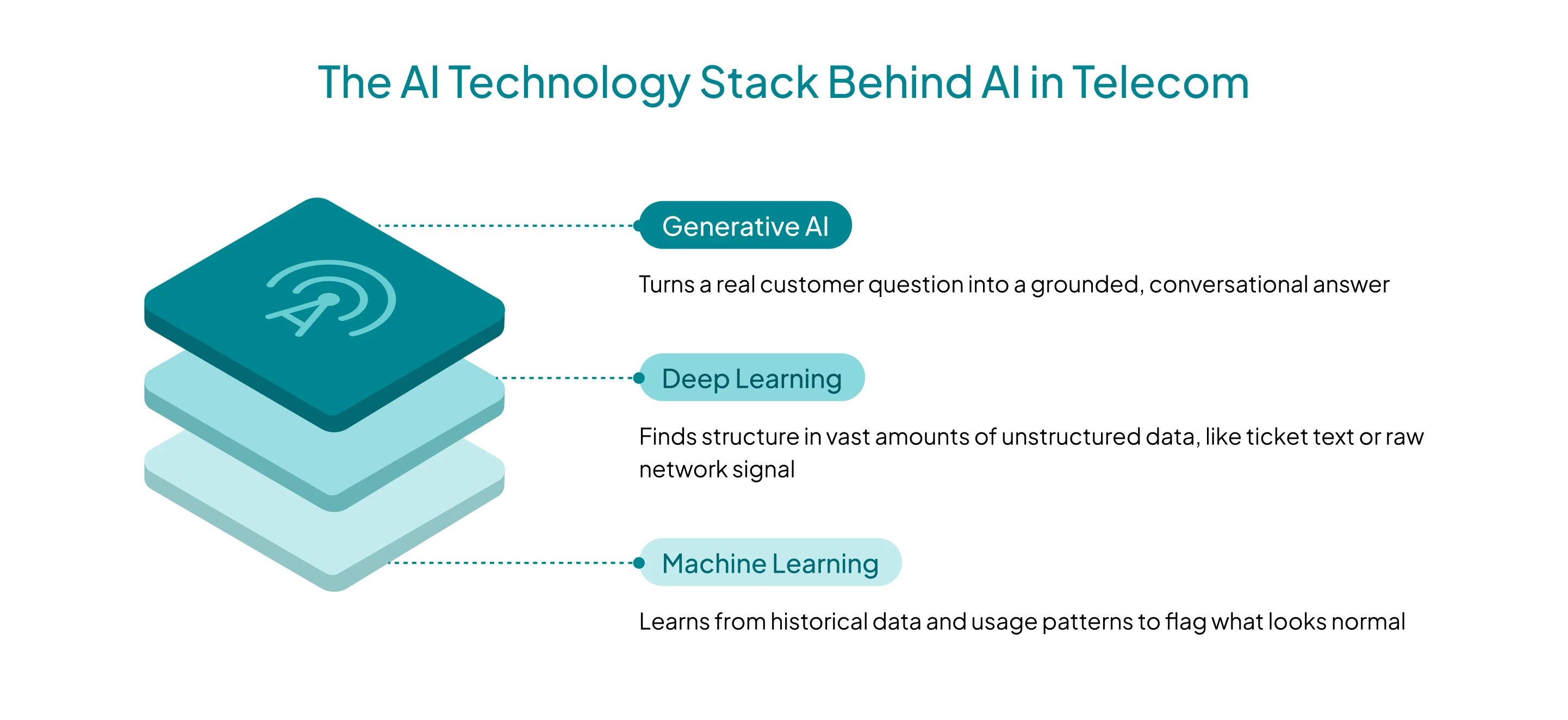
Artificial intelligence in telecom is rarely just one of the AI powered chatbots bolted onto a website. It is these AI systems working together rather than in isolation. AI models trained on a telecom operator's own historical data get better at recognizing what a genuine billing dispute looks like versus what a routine question looks like, and the same underlying AI applications that explain a charge to a customer can, with the right access, also flag a fraud pattern or a network fault. This is also why evaluating AI tools for telecom is less about which vendor has the flashiest demo and more about whether the AI technologies underneath can actually read and act on an operator's real data, in production, at full subscriber volume.
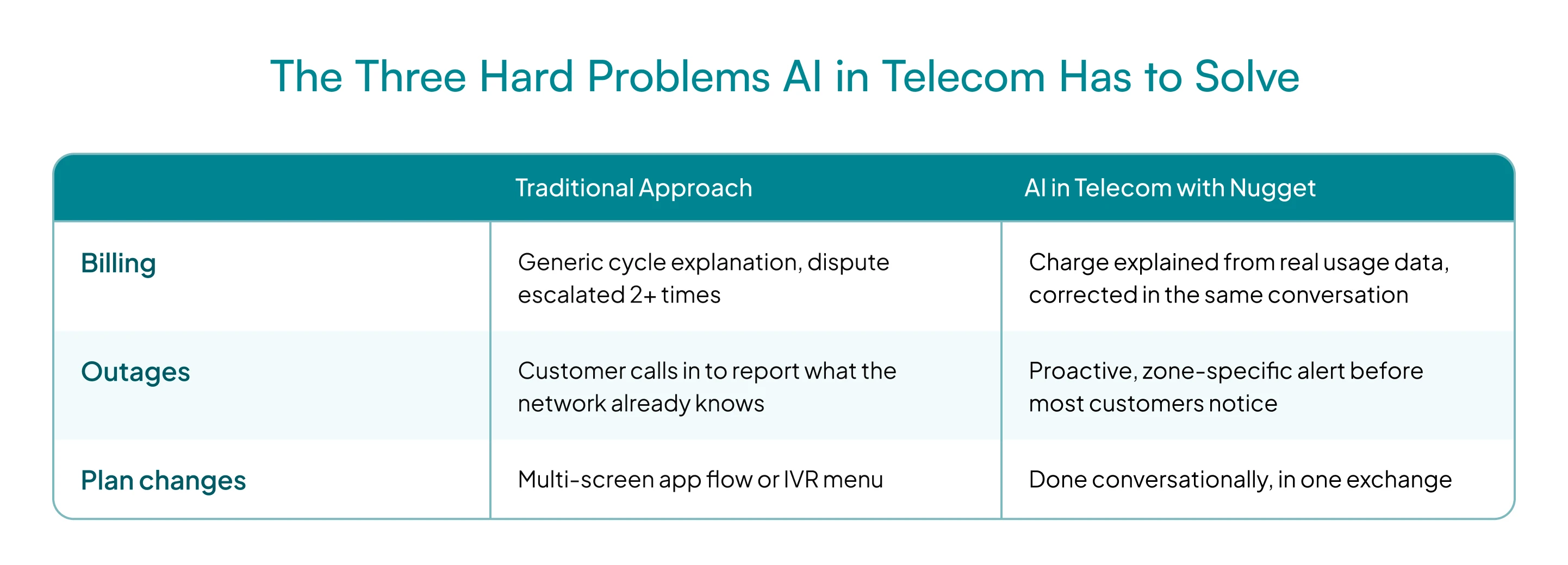
The usual failure here is an AI powered chatbot that can display a bill but cannot do anything about it. A customer sees an unfamiliar charge, asks why, and gets a generic explanation of how billing cycles work instead of an answer tied to their actual usage. The dispute gets escalated, often more than once, before anyone with real access to the billing and rating data looks at it directly, and customer satisfaction drops a little further with every handoff.
Nugget resolves this inside the same conversation by running data analysis on actual usage and rating data to explain the specific charge in plain language, and executing a correction on the spot when one is warranted. This kind of AI driven resolution depends on data analytics that can reach into a live billing system rather than a static report, and it reflects the same execution-over-explanation principle covered in how agentic AI moves systems from generating answers to actually taking action, applied directly to the moment a customer is most likely to feel like they are being brushed off. Getting this right is one of the clearest, fastest wins available from implementing AI in a telecom support organization.
Billing and plan management are the visible, customer-facing half of AI in telecom. Network performance and network management are the half that customers never see directly, but feel immediately the moment something goes wrong. Telecom networks generate an enormous volume of network data every second, call records, signal quality readings, latency measurements, and equipment health signals, and most of it goes completely unexamined until something breaks.
This is where anomaly detection earns its keep. Machine learning models trained on normal network behavior and typical network traffic patterns can flag unusual network activity long before it becomes a customer-facing fault, the earliest signs of a degrading tower, a congested route, or a piece of equipment drifting out of healthy operating range. Fault management shifts from reactive to predictive once an operator can see that pattern early enough to act on it, and in some cases automatically reroute traffic around an emerging problem before it ever turns into a service disruption.
Digital twins, virtual models of physical network infrastructure, are increasingly used alongside this to simulate network expansion and network planning decisions before a single piece of equipment is deployed, testing how a change in one part of a network might ripple through the rest of it. Edge computing adds another layer, processing network data closer to where it is generated instead of routing everything back to a central system, which matters when the whole point is catching an anomaly in something close to real time. Put together, this is what intelligent networks actually mean in practice: infrastructure management that uses live network resources data to optimize itself continuously, not a network that simply reports problems after they have already affected service reliability. Done well, this kind of network efficiency becomes one of the clearest sources of operational efficiency a telecom operator has access to, and a genuine competitive edge against operators still running on dashboards and after-the-fact incident reports, catching service disruptions before a subscriber ever notices one.
The default pattern during an outage is reactive. The network already knows a fault exists well before most affected customers do, yet the customer usually finds out by calling in, waiting on hold, and asking a question the operator could have already answered. That gap between what the network knows and what the customer has been told is where most outage related frustration actually comes from, and it is a direct consequence of network management and customer support running as two disconnected systems.
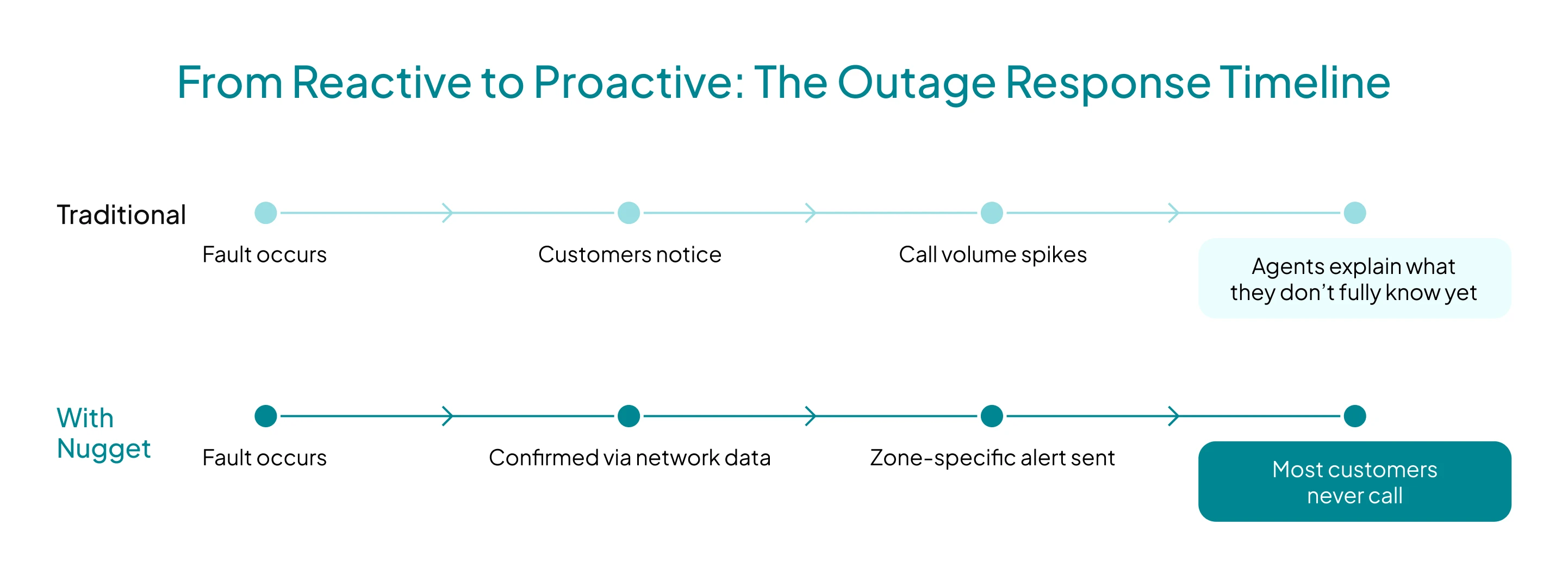
Nugget closes that gap with proactive, zone specific outage notifications the moment a fault is confirmed, so a large share of calls never need to happen in the first place. For the calls that still come in, live inbound assistance during an outage keeps responses grounded in the actual fault status rather than a generic acknowledgment. Detecting real frustration in those customer interactions, rather than just logging a complaint, is also where sentiment signals captured from tone and word choice become useful, flagging the calls that need a human escalated immediately instead of a standard queue position.
This is the highest volume, lowest complexity category, and also the one where friction compounds the most. An app that requires three screens to switch plans, an IVR menu that takes a minute to reach the right option, and a language barrier that turns a simple recharge into a frustrating back and forth all add up to support tickets that never needed to exist in the first place.
Nugget handles plan changes, recharges, data and calling pack suggestions, and personalized upgrade recommendations conversationally, over voice or chat, in the customer's own language. Virtual assistants built this way automate tasks that used to require a human agent for even the most routine tasks, using a customer's actual usage patterns to suggest genuinely tailored services instead of a generic upsell. A customer renewing a plan or activating roaming support gets it done in the same exchange, not routed to a separate self-service flow they may or may not complete, and that kind of intelligent automation is what actually moves the needle on customer engagement over time, not just a single transaction.
Every one of these interactions touches sensitive customer data, billing information, usage history, sometimes identity documents during onboarding, which makes data privacy a design requirement rather than an afterthought. The same AI models that explain a bill or flag a network anomaly can also be trained to recognize suspicious patterns in account activity: a SIM swap request that does not match a customer's usual behavior, a sudden cluster of international calls on an account that has never made one, or login activity from a location and device combination that has never shown up before.
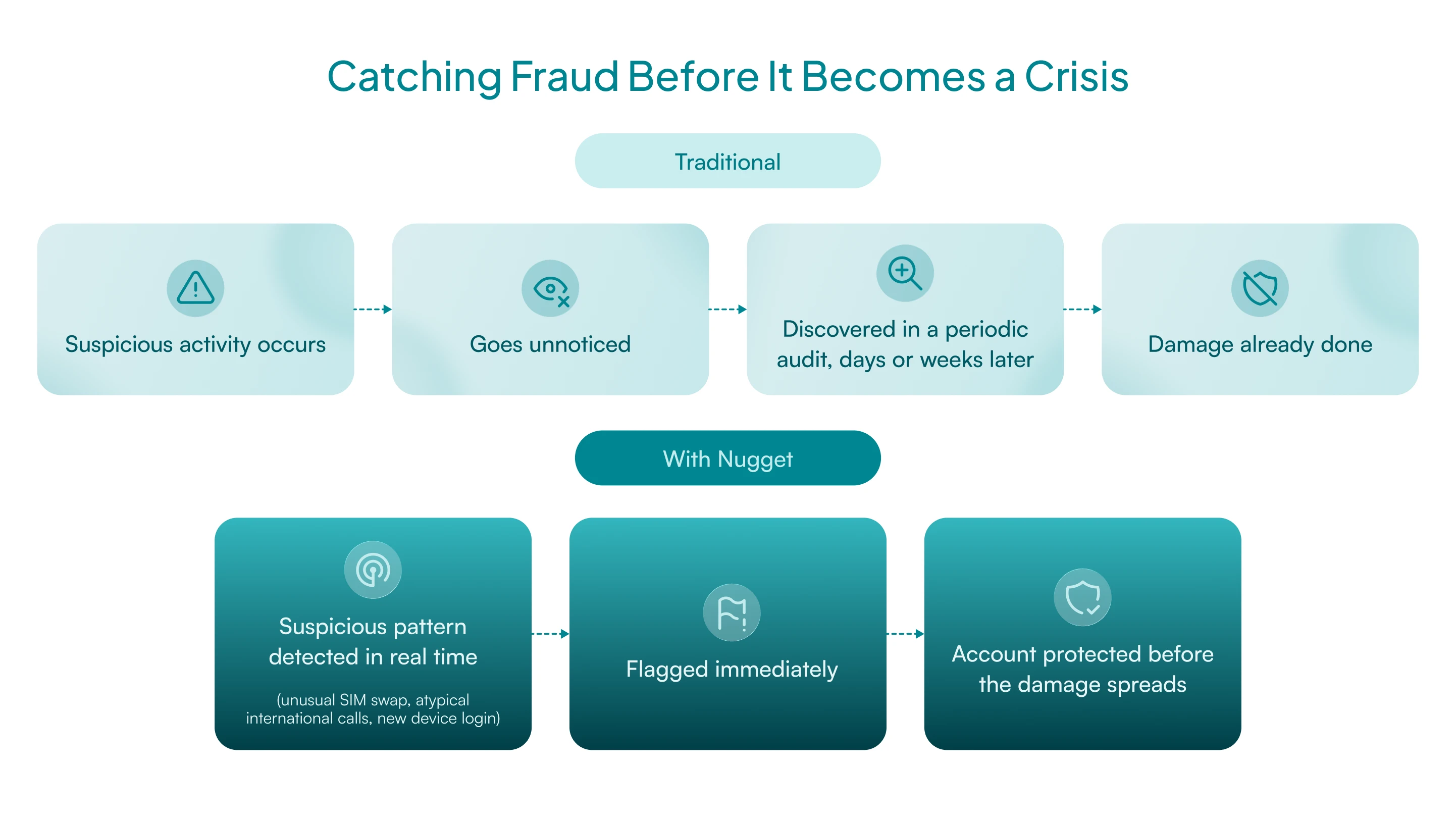
Fraud detection built this way works continuously in the background rather than as a periodic audit, catching cyber threats and account takeover attempts closer to the moment they start rather than after the damage is already done. This matters more in telecom than in almost any other sector, since a compromised account is rarely just a billing problem, it is often the entry point for a much larger fraud attempt elsewhere. Handling this responsibly means every AI system touching customer data is held to the same data privacy standard as the billing and support systems it sits alongside, not a separate, lower bar.
Billing, outages, and plan management are where most of the conversation about AI in telecommunications stops, but they are not where the opportunity ends. The same underlying agent platform, the same context layer, and the same write access model extend naturally into parts of a telecom operator's business that rarely get discussed in the same breath as customer support.
- Field operations and network support. Technicians checking job assignment status, confirming spare parts availability, and escalating a fault with full context attached, instead of a ticket that arrives stripped of the detail they actually need, which is also where better resource allocation starts.
- Retail and channel partner support. Store staff and distributors checking stock levels, commission payouts, and promotion eligibility without waiting on a regional manager who is already handling a dozen other requests.
- Enterprise and B2B account servicing. Bulk SIM provisioning status and leased line fault queries for business customers, who typically have less patience for a consumer grade support queue and a much higher cost of downtime.
- Collections and retention. Overdue postpaid bill follow-up and promise to pay capture, the same approach already covered in how AI voice agents handle debt collection conversations with consistency and compliance, applied to telecom's own collections flow. Churn prevention sits right alongside this, with at risk subscriber identification and personalized retention offers reaching a customer before they decide to leave rather than after.
- Internal HR and IT helpdesk. Policy queries, leave requests, and IT ticketing for the operator's own workforce, the same agent capability simply pointed inward at staff instead of outward at subscribers, freeing up more resources for the maintenance needs and field work that still require a person on site.
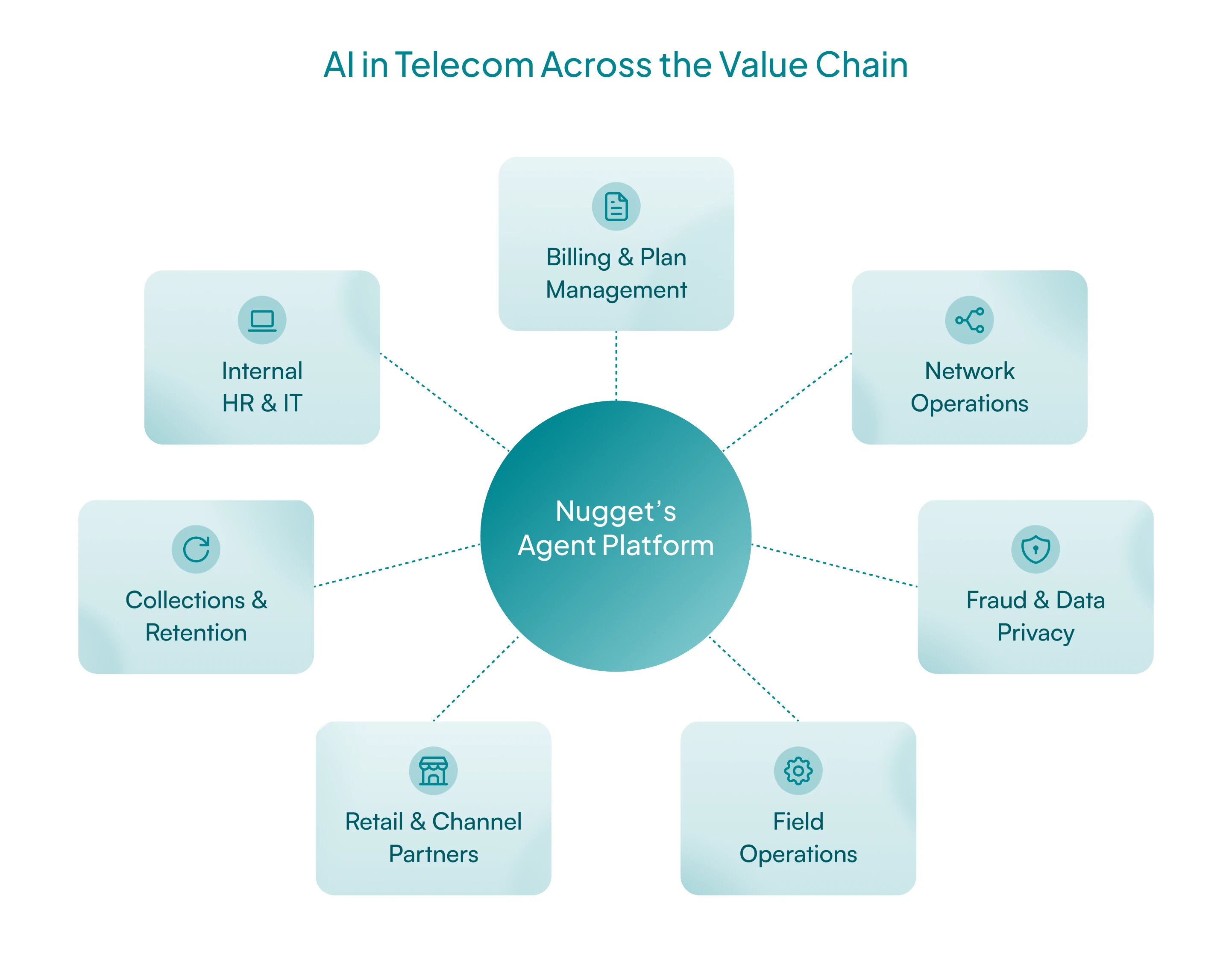
None of this requires a separate product. It is the same platform, extended to wherever a conversation, a query, or a request is currently moving slower than it needs to, and it is how telecom providers and telecom operators turn AI adoption from a support-desk project into an operational efficiency program that touches the whole business.
Telecom carries its own specific compliance weight, and getting it wrong is not a minor issue. Every interaction is built around TRAI and DND aligned outreach, honoring subscriber consent preferences across voice, WhatsApp, SMS, web, and app channels, with consent logged and audit ready rather than assumed. Recharges and bill payments are handled with PCI aware practices, and onboarding or KYC journeys follow approved regulatory processes rather than a shortcut built for speed. None of this is bolted on afterward. It is part of the same system handling the billing question, the outage update, or the fraud detection check running quietly underneath both.
The numbers hold up because the architecture behind them does. Telecom operators using Nugget see up to 75 percent of subscriber queries resolved entirely through self-service, with no wait and no transfer to a human agent. Cost per interaction drops by as much as 68 percent, from roughly 4.60 dollars to 1.46 dollars, once routine billing, outage, and plan management queries stop requiring a live agent for every single one. And churn remains the number one reason this matters at all, since subscribers are five times more likely to leave after a poor support experience, which makes intervening before that experience happens far more valuable than trying to win the customer back afterward.
These figures sit alongside a broader industry pattern. Deloitte's 2026 Global Telecommunications Industry Outlook describes a crisis of customer value and brand loyalty in the industry, finding that up to 77 percent of consumers feel no loyalty to their provider and only 47 percent stay with their primary operator beyond five years, with operators needing to shift toward personalization, proactive service and seamless digital experiences. That gap is the opportunity, and it is why integrating AI across billing, network management, and fraud detection at the same time, rather than adopting AI one function at a time, is quickly becoming the competitive edge that separates telecom companies pulling ahead from the ones standing still, both in customer satisfaction and in operational costs.
Billing, outages, and plan management are the baseline every operator has to get right simply to keep pace with subscriber expectations. The real differentiation is increasingly happening past that baseline, in network optimization, fraud detection, field operations, channel support, B2B servicing, and the internal workforce running the operator itself. Contact centers already restructuring around what AI agents can actually resolve are the clearest sign of where this is heading, and the telecom sector, with its scale and its physical network layer, has more ground to cover there than almost any other industry.
Can Nugget actually correct a billing error, or does it just explain the charge?
Does Nugget help with network performance, or only customer-facing support?
Is this only for customer facing support, or does it help internal teams too?
TL;DR
Billing disputes need real explanation, outages need real-time truth, and plan changes need execution, not just information, and most telecom support systems were not built to do all three well.
Subscriber bases in the tens or hundreds of millions, a prepaid and postpaid split that behaves like two businesses, legacy systems, and a physical network layer most CX systems were never built to connect to.
McKinsey found virtually all telcos are piloting AI, but only 57 percent report scaling it across multiple domains, led by customer service and network operations.
Machine learning, deep learning, and generative AI work together across billing explanation, network anomaly detection, and fraud detection, not just customer-facing conversation.
Billing corrections grounded in real usage data, proactive zone specific outage alerts, conversational plan changes and recharges, and continuous fraud detection on sensitive customer data.
Network optimization, field operations, retail and channel partners, enterprise B2B servicing, collections and churn prevention, and internal HR and IT support all run on the same platform.
Up to 75 percent self-served resolution, cost per interaction down 68 percent from 4.60 to 1.46 dollars, and churn risk 5x higher after a poor support experience, against a backdrop where Deloitte found up to 77 percent of consumers feel no loyalty to their provider.