AI Sentiment Analysis: Detecting Sentiment Enterprises Can Act On
Written by: Manya Singh
Last updated: Aug 24, 2026
18 mins

In the high-stakes world of enterprise operations, customer experience has reached an uncomfortable tipping point. Companies spend tens of millions of dollars building seamless products, scaling omni-channel support, and optimizing operational throughput, yet they remain systematically blind to how their customers actually feel while interacting with their brand.
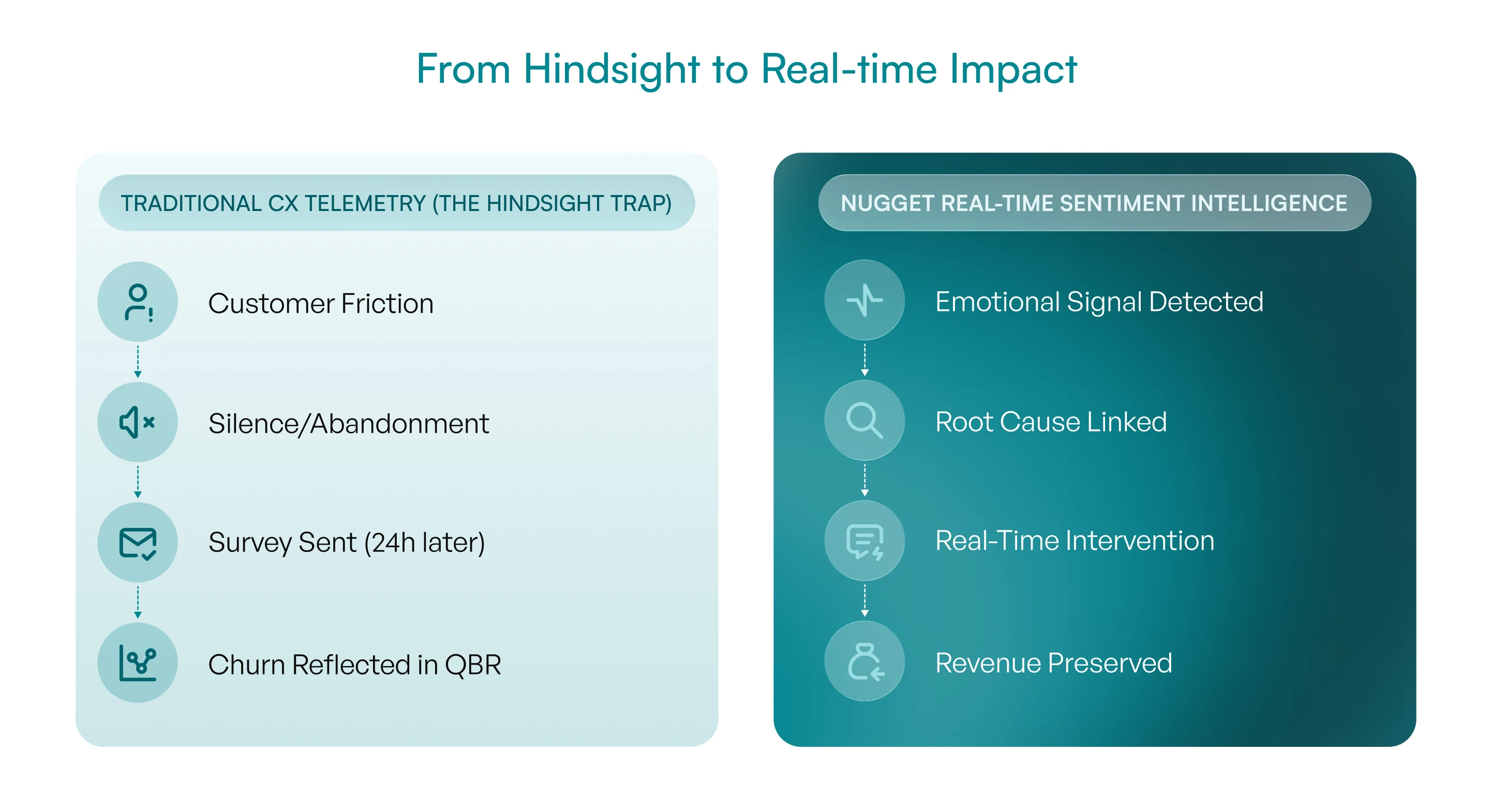
The fundamental breakdown is not a lack of data, it is a reliance on outdated telemetry. For years, executives have treated quarterly CSAT scores and post-call survey responses as the definitive pulse of customer sentiment. But evaluating real-time customer emotions with delayed survey responses is like attempting to navigate a high-speed vehicle by looking exclusively in the rearview mirror. By the time negative sentiment registers on an executive dashboard, the customer has already escalated, complained publicly, or quietly walked away to a competitor.
Modern AI Sentiment Analysis is not about collecting more feedback forms or tagging textual data as positive, negative, or neutral. It represents a fundamental shift from trailing survey collection to real-time AI powered sentiment analysis. By detecting subtle acoustic, linguistic, and behavioral signals as experiences unfold, modern systems conduct deep customer sentiment analysis, linking those emotional signals directly to enterprise root causes and resolving operational friction before revenue is lost.
Let's be honest about how enterprises manage customer experience: you are driving at high speeds while looking exclusively in the rearview mirror.
For decades, the enterprise playbook for measuring customer sentiment has remained stubbornly unchanged. A customer encounters a problem, navigates a fragmented support journey, maybe gets their issue resolved, and closes the interaction. Hours or days later, an automated system sends an email or SMS asking:
"How did we do? Rate us on a scale of 1 to 10."
NPS, CSAT, post-chat feedback forms, and traditional CSAT survey responses.
The fundamental flaw in this architecture is time. Customer emotion moves in milliseconds; enterprise reporting moves in quarterly business reviews. By the time a sharp drop in sentiment reflects on an executive dashboard, the customer has already escalated, complained on public channels, or quietly migrated to a competitor.
According to research from McKinsey & Company , improving customer experience can reduce customer churn by nearly 15% while boosting win rates by 40%. Yet, most enterprises are attempting to capture this value using historical hindsight rather than active customer feedback analysis.
This creates a massive visibility gap. You are not managing customer sentiment in real time; you are conducting a post-mortem on lost revenue.
Most executive teams genuinely believe they understand customer sentiment. They point to pristine CSAT charts showing an 85% satisfaction score and assume everything is working as intended.
In reality, they are looking at a hyper-skewed sample.
The vast majority of your customers never fill out a survey. You are basing your enterprise strategy on a vocal minority of hyper-satisfied advocates or furious detractors, while completely ignoring the silent majority in the middle.
The silent majority does not give qualitative data feedback in text fields. They communicate sentiment indirectly through subtle human language markers:
- Through Tone: Subtle changes in voice pitch, cadence, and the emotional tone behind spoken human emotions.
- Through Behavior: Repeated account logins within a short timeframe, erratic cursor movements, or sudden spikes in typing speed.
- Through Hesitation: Long pauses before answering a prompt, indicating confusion or distrust in the system.
- Through Repeated Contacts: Calling back three times in 24 hours because the initial answer lacked clarity.
- Through Abandonment: Quietly closing the browser window mid-workflow and never returning.
The challenge facing the enterprise has never been a lack of customer data or unstructured data. The challenge is that traditional architectures lack a modern sentiment analysis system capable of interpreting indirect emotional signals at scale.
If your definition of sentiment analysis is a basic natural language processing model that tags customer messages as positive, neutral, or negative, your technology stack is stuck in 2018.
Basic sentiment classification using simple positive or negative words is a commodity, and frankly, it is useless for enterprise decision-making. Knowing that a ticket contains negative sentiment tells an operations lead nothing about how to fix it.
Modern, enterprise-grade AI Sentiment Analysis is the continuous detection and interpretation of subtle emotional signals hidden across real-time interactions, textual data, and customer behavior. An advanced AI sentiment analysis tool does not simply ask "is this customer happy?" It leverages deep learning and artificial intelligence to evaluate machine learning models that answer high-stakes questions:
- Is frustration compounding across turns?
- Is trust breaking down during an identity verification step?
- Is confusion emerging due to poorly written documentation?
- Is the customer displaying signs of resignation before abandoning the cart?
- What is the exact mathematical probability that this session will result in a supervisor escalation within the next 30 seconds?
This is not basic rule based sentiment analysis or surface-level sentiment classification; it is real-time behavioral telemetry designed to analyze text data and human language dynamically.
To build a sentiment analysis platform capable of capturing actionable insights, you have to look far beyond simple keywords. Modern AI Sentiment Analysis relies on three distinct layers of signal detection to determine sentiment accurately.
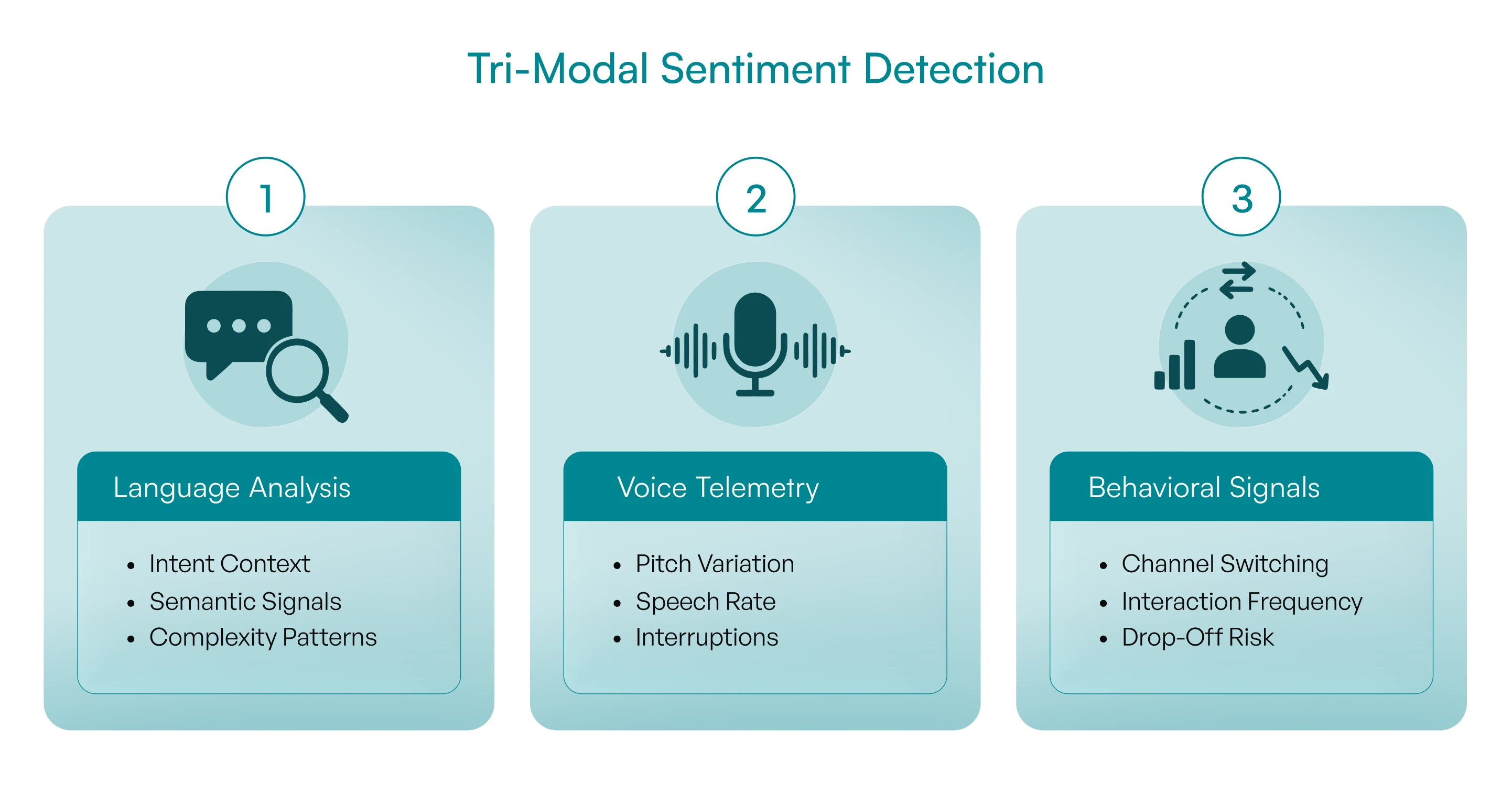
- Intent and Context Alignment: Identifying when words deviate from underlying intent using a sophisticated sentiment analysis model.
- Aspect Based Sentiment Analysis: Isolating specific components of an interaction, such as evaluating customer feedback regarding pricing separately from product usability.
- Word Choice and Semantic Shifts: Tracking subtle lexical choices, such as a customer shifting from "I need help with my account" to "You guys keep locking me out."
- Sentence Structure: Analyzing syntax complexity. Frustrated users often revert to short, clipped, high-urgency phrasing or long, rambling descriptions of repeated systemic failures.
- Pacing and Speech Rate: Sudden spikes in words-per-minute indicate rising anxiety or impatience; significant slowdowns often indicate confusion.
- Interruptions: Tracking how often a caller speaks over the AI or human agent, a primary signal of compounding negative sentiment.
- Pauses and Dead Air: Identifying long periods of silence following a prompt, signaling that the user did not understand the instructions.
- Energy and Stress Shifts: Detecting frequency shifts and acoustic strain in the human voice that precede verbal anger.
- Multi-Contact Frequency: A customer reaching out twice in four hours is inherently displaying high frustration, regardless of how polite their text message reads.
- Repeated Workflow Retries: Entering the same credit card details or address three times in a row indicates extreme friction.
- Channel Switching: Starting an interaction on a web chat, giving up, and immediately calling the voice line within 60 seconds is a massive indicator of impending churn.
- Drop-Offs: The precise millisecond a user abandons a workflow reveals exactly which step caused cognitive overload.
Language Analysis
Text processing goes deeper than dictionary lookups of positive and negative sentiments. Modern sentiment analysis algorithms analyze textual data through semantic intent, natural language processing, and deep learning:
Voice Analysis
In voice channels, text transcriptions omit more than half of the emotional payload. A transcript reading "That works" can express genuine agreement or extreme sarcasm depending entirely on acoustics.
Advanced voice AI sentiment analysis technologies analyze raw acoustic audio streams in real time:Behavioral Analysis
This is where true AI Sentiment Analysis leaves traditional CX tools behind. Customers routinely say one thing while their behavior tells an entirely different story. Behavior is almost always a stronger indicator of customer sentiment than language alone.
Key behavioral markers in a modern sentiment analysis solution include:If detecting emotion were simple, every legacy CRM would have solved it a decade ago. The reason applying sentiment analysis fails in many production environments comes down to the sheer complexity of human emotions, regional variations, and linguistic nuance.
- Retail and E-commerce: Frustration is fast, high-volume, and expressed through rapid demands for refunds or cancellations across online reviews and social media comments.
- Banking and Wealth Management: Frustration is cold, precise, and legalistic. A banking customer saying "I am reviewing my statements with my advisor" represents a catastrophic drop in their calculated sentiment score that standard sentiment analysis software misses.
- Healthcare: Frustration is mixed with high anxiety and vulnerability. High-effort interactions in healthcare demand empathetic pacing , not fast transactional closure.
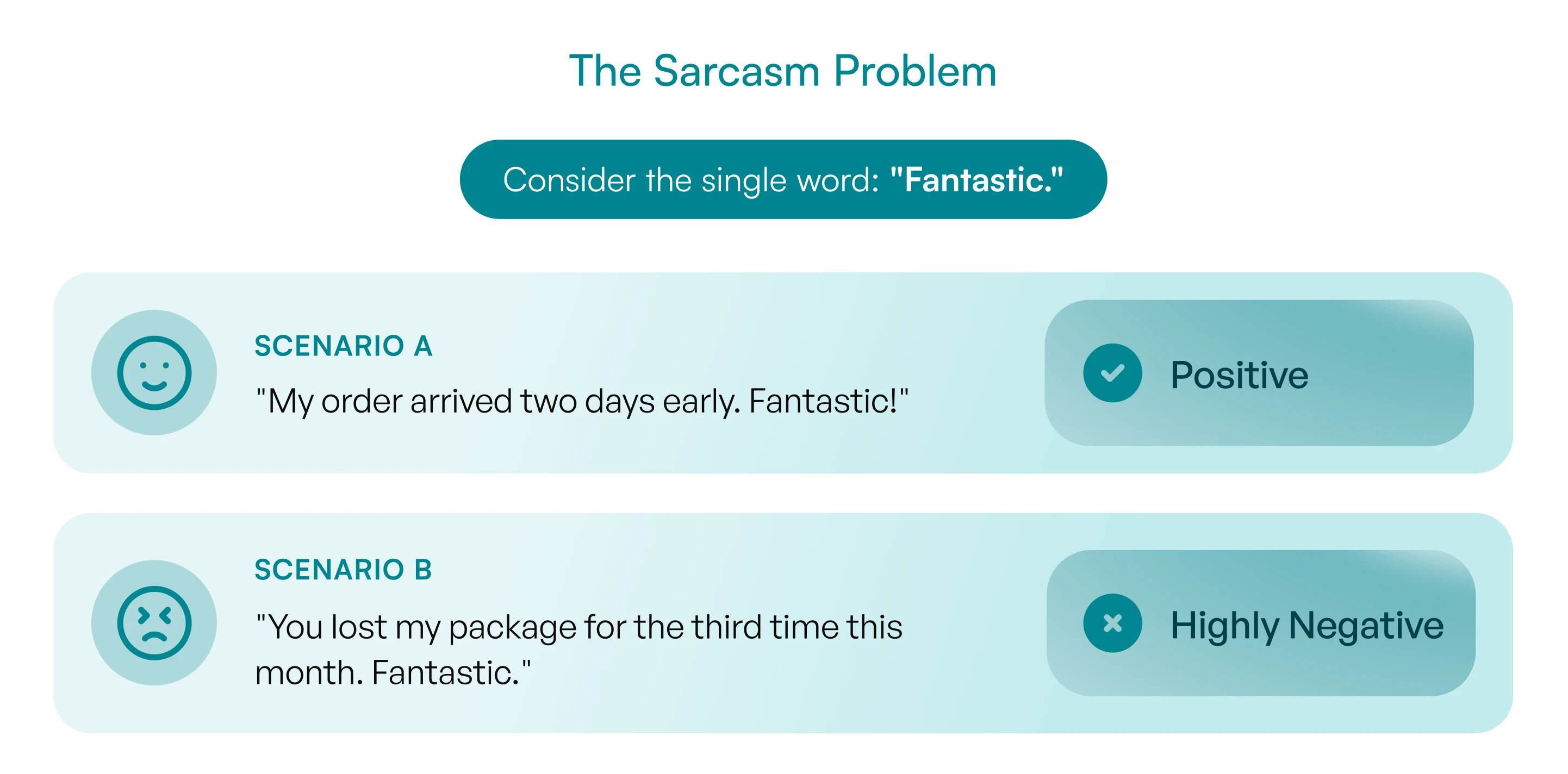
The Sarcasm Problem
Consider the single word: "Fantastic."
Scenario A: "My order arrived two days early. Fantastic!" -> Positive SentimentScenario B: "You lost my package for the third time this month. Fantastic." -> Extreme Negative SentimentStandard analysis tools that rely on positive or negative words mark Scenario B as a positive interaction because of the word "Fantastic." Without broad context windows and advanced sentiment analysis software, your system will actively report high customer satisfaction during major operational outages.
The Resignation Trap
Industry Context Variance
Frustration manifests differently depending on the domain:
Cultural, Regional, and Multilingual Nuance
Here is the core thesis every CX leader needs to grasp: Detecting sentiment is no longer a competitive advantage. Knowing what to do with it is.
Most enterprise software can generate a chart telling you that 35% of your callers exhibited negative sentiment on Tuesday. That is passive sentiment detection. It is diagnostic at best, and useless at worst.
Sentiment Intelligence bridges the gap between raw sentiment data and actionable insights that drive operational decisions.
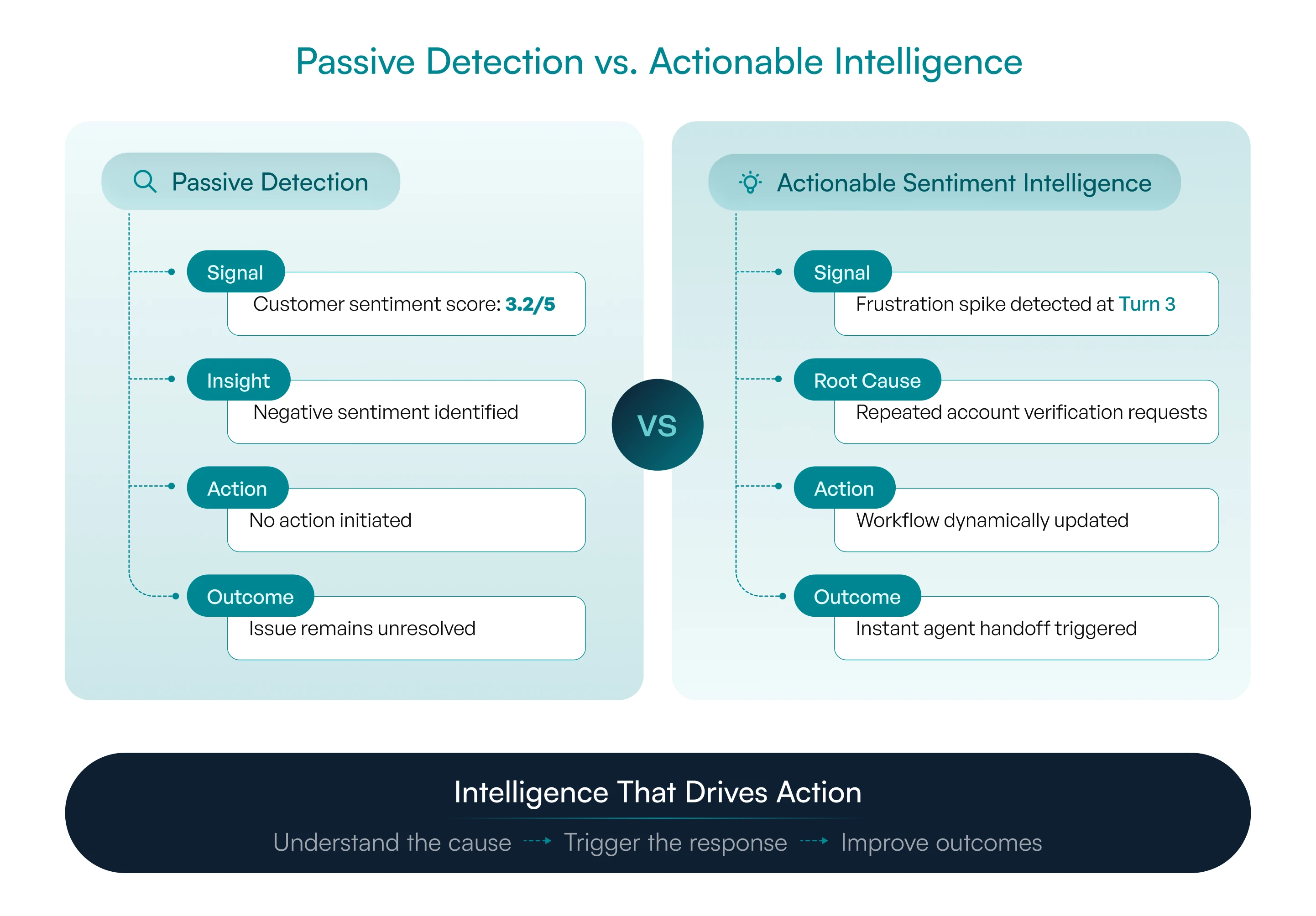
Sentiment Intelligence does not just inform you that a customer is furious; it tells you why they are furious, pinpoints the precise workflow step that caused the friction, and executes a real-time intervention before the customer churns.
According to research from Gartner , high-effort customer experiences are the single greatest driver of brand disloyalty, with 96% of customers who experience high effort becoming more disloyal. Sentiment Intelligence exists to analyze text data, identify high-effort friction points while they are happening, and dismantle them automatically.
When you deploy real-time AI Sentiment Analysis across your operations, it moves from a passive reporting metric to an operational engine that impacts key business metrics.
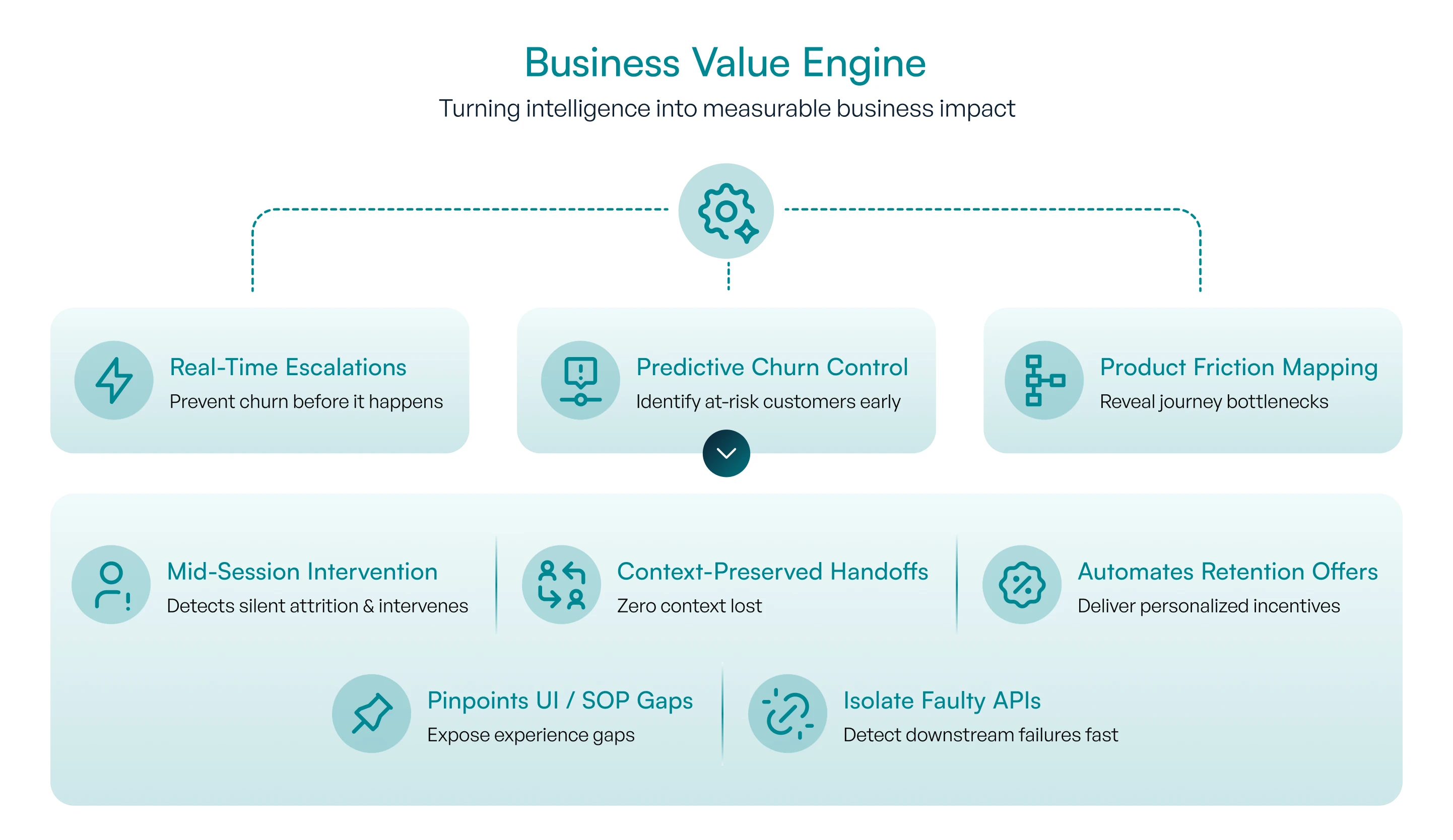
Eliminating Unnecessary Escalations for Customer Support Teams
Improving Real Resolution Rates
Detecting Journey Friction in Real Time
Identifying Predictive Churn Risk and Sentiment Trends
Continuous Agent Performance Optimization
In the modern enterprise, executive dashboards are dominated by financial and operational metrics:
- ARR / Revenue
- Customer Lifetime Value (LTV)
- Net Retention Rate (NRR)
- Customer Acquisition Cost (CAC)
These are all lagging indicators. They tell you what happened in your business last month, last quarter, or last year.
Customer sentiment is a leading indicator. Emotion changes before behavior changes. Behavior changes before key business metrics reflect the damage.
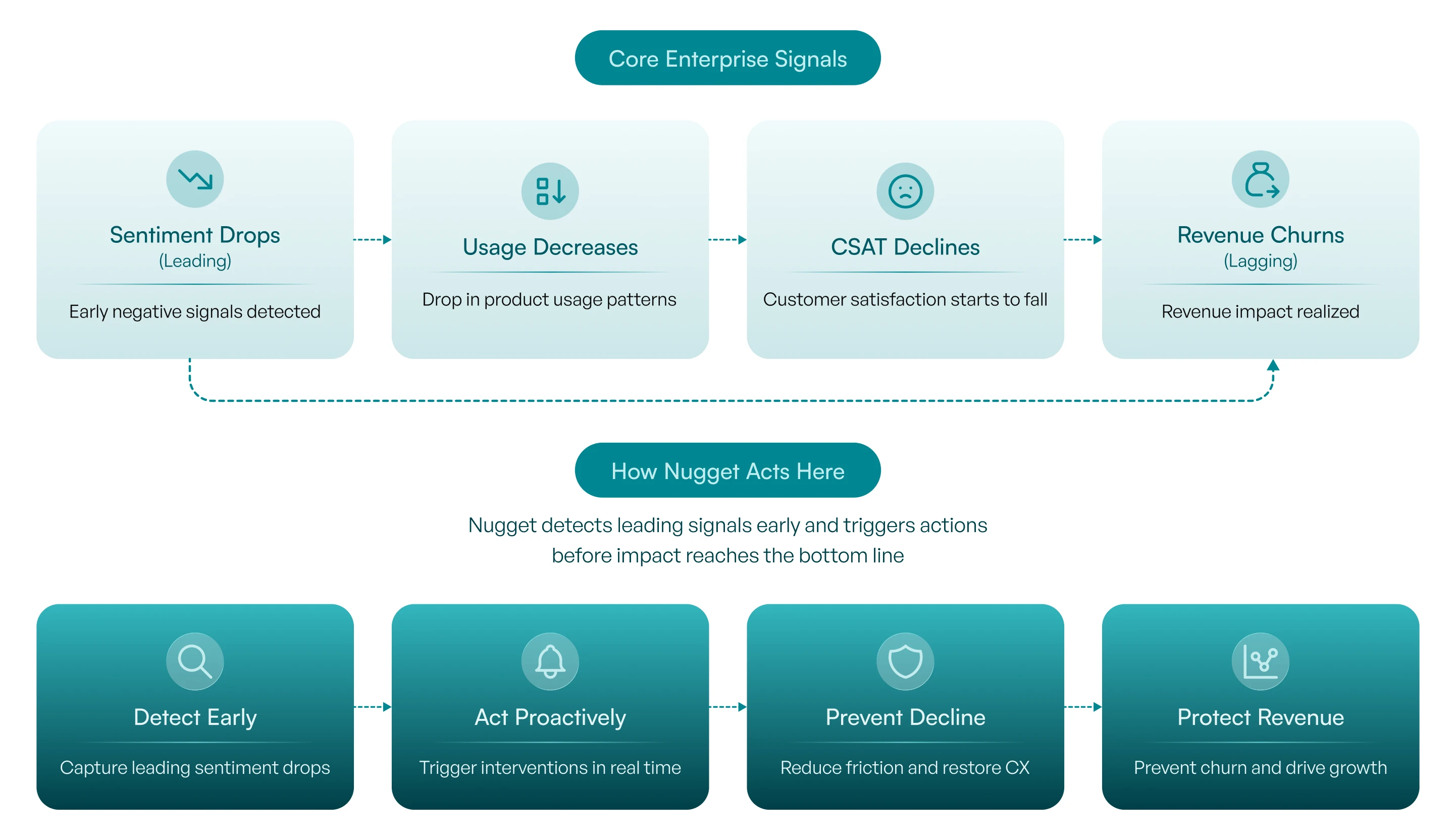
- A drop in calculated customer sentiment appears before a drop in product usage.
- A spike in hesitation appears before a spike in canceled subscriptions.
- A breakdown in conversational trust appears before a public negative review on social media platforms or news articles.
The enterprises that dominate the next decade will monitor how customers feel with the exact same rigor, infrastructure, and real-time operational response that they apply to server latency and cash flow.
- The Challenge: High security compliance requirements (KYC/AML) create substantial friction during customer onboarding and wire transfers.
- The Sentiment Signal: Sudden pauses, hesitation signals, and tense phrasing during identity verification steps.
- Operational Outcome: The sentiment analysis solution detects cognitive overload and dynamically routes the user to a video-enabled verification specialist, preventing application drop-off while maintaining strict compliance.
- The Challenge: High cart abandonment rates caused by unexpected shipping fees, delivery delays, or complex return policies.
- The Sentiment Signal: Rapid channel switching from order tracking pages to live chat, accompanied by high-urgency negative words regarding delivery timelines.
- Operational Outcome: The AI sentiment analysis tool flags the order as "High Churn Risk," automatically issuing a proactive tracking update and a shipping discount before the customer requests a cancellation.
- The Challenge: Mass churn driven by hidden price increases, plan confusion, or localized network outages.
- The Sentiment Signal: Customers calling with sarcasm or resignation phrasing ("I guess I'll just have to look elsewhere") during routine billing inquiries.
- Operational Outcome: Real-time customer sentiment analysis flags the account mid-call, surfacing a custom retention offer directly on the agent's screen or enabling the AI agent to execute a plan downgrade rather than losing the account entirely.
- The Challenge: Patients navigating complex appointment scheduling, insurance coverage verifications, and post-procedure care under high emotional stress.
- The Sentiment Signal: Tremors or acoustic strain in voice interactions, paired with repeated clarification requests around coverage costs.
- Operational Outcome: The AI agent automatically drops transactional pacing, shifts to a high-empathy conversational model, and offers a direct handoff to a nurse navigator with full context preserved.
- The Challenge: Public backlash spreading rapidly across social media platforms, social media posts, news articles, and online reviews.
- The Sentiment Signal: Spikes in negative sentiment across social media comments, brand sentiment trackers, and public forums analyzing large volumes of unstructured data.
- Operational Outcome: An enterprise sentiment analysis system aggregates overall sentiment and social media sentiment in real time, alerting PR and brand reputation management teams to emerging crises before they impact customer acquisition.
Financial Services & Banking
E-Commerce & Retail
Telecommunications & Subscription Services
Healthcare & HealthTech
Brand Reputation and Social Media Monitoring
The future of customer experience is not about sending more post-interaction survey responses or manufacturing artificially high CSAT scores. It is about understanding customer sentiment and deeply analyzing human emotions while experiences are actively unfolding.
AI Sentiment Analysis is fundamentally evolving from a passive, post-hoc analysis tool into an active operational layer.
Detecting that a customer is upset after they have already churned is a failure of telemetry. Capturing emotional signals in real time, connecting them directly to backend operational root causes, and resolving the friction before it damages the business relationship, that is the standard for modern enterprise artificial intelligence.
The brands that master real-time Sentiment Intelligence today will build an unshakeable competitive advantage. Those still relying on quarterly survey responses and trailing CSAT metrics will continue to wonder why their best customers are quietly walking out the door.
How accurate is AI sentiment analysis compared to human QA teams?
Can sentiment analysis work accurately across multiple languages and regional dialects?
How does real-time sentiment analysis integrate with existing CRM platforms?
TL;DR
- The Survey Mirage: Standard CSAT and NPS surveys leave you completely blind to how the silent majority of your customers feel.
- Beyond Basic Categorization: Modern AI Sentiment Analysis has evolved from simple positive or negative words tagging into multimodal sentiment analysis that evaluates intent, hesitation, tone, and behavioral patterns across large volumes of customer data in real time.
- Behavior Speaks Loudest: Behavioral cues like rapid channel switching, repeated retries, and high-pacing typing are often far stronger indicators of impending churn than spoken or written language.
- Context Is Everything: Without domain-specific context, sentiment analysis based architectures break down over basic human nuances like sarcasm, resignation ("that's fine"), and industry-specific friction thresholds.
- From Detection to Intelligence: The future of CX is not knowing that a customer is frustrated, but automatically linking that emotional signal to backend root causes to trigger real-time operational interventions.