AI for Sales: Lead Qualification, Outreach and Conversion
Written by: Manya Singh
Published On: Sep 24, 2026
14 mins

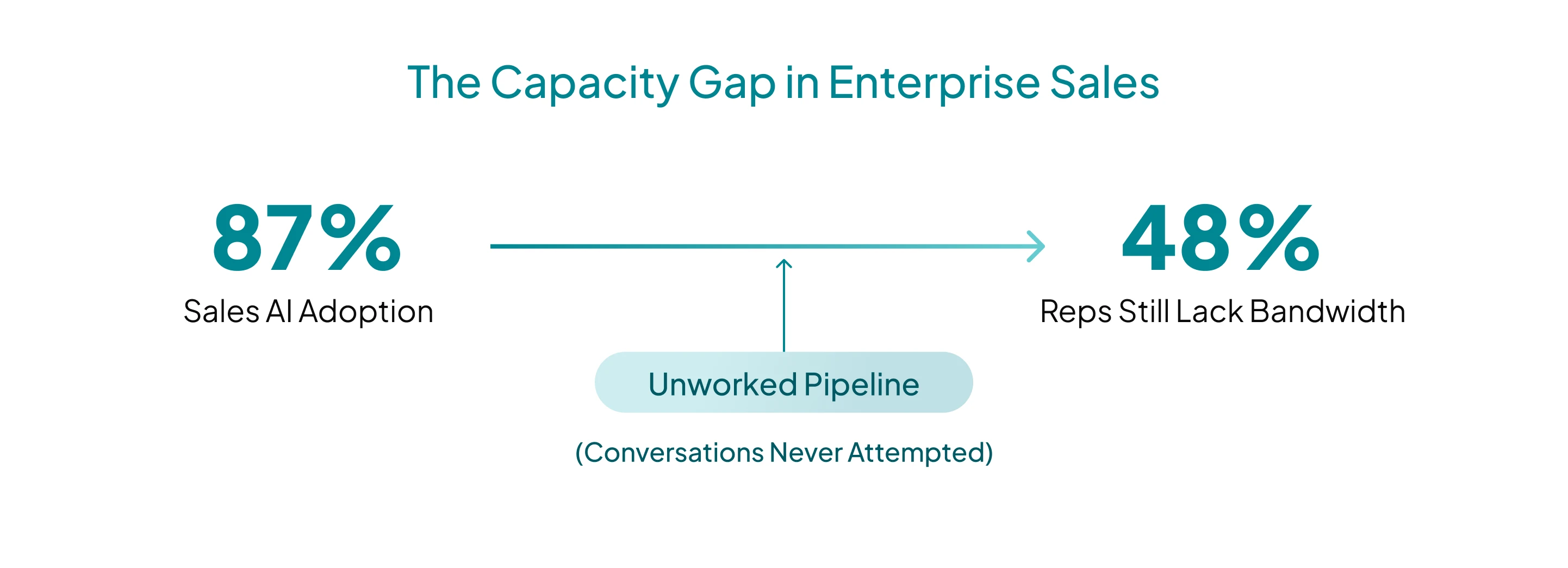
87% of sales organizations now use some form of AI in sales for prospecting, sales forecasting, lead scoring or drafting emails, according to Salesforce.
That gap suggests the category has been solving the wrong thing. Almost everything written about AI for sales assumes a sales team of humans whose throughput needs improving.
The framing breaks when your revenue conversations outnumber your sellers by four orders of magnitude. A consumer-facing enterprise does not have a productivity problem. It has a capacity problem.
So the useful question is not how much faster AI technology can make your reps, it is what happens to the sales conversation nobody was ever going to have.
That question has an unfashionable answer.
The average seller spends 40% of their time selling, and the category treats that as the primary issue in sales operations.
Run the arithmetic anyway. Take a seller from 40% to 60% and you have gained a fifth of one person. Rep productivity is a multiplier on a number that is already small.
The Unworked Pipeline is demand that is identified, in-market, and never gets a conversation because nobody had the capacity to have it:
- A cart abandoned at the payment step
- An onboarding journey stopped at document upload
- A renewal 40 days out that nobody will call
- A customer who asked a product question in the support queue and got a support answer, when what they were doing was trying to buy
None of those are lost deals, because closing deals requires somebody to have had the conversation in the first place.
If capacity is the constraint, the fix is deploying autonomous AI agents that can hold the conversation itself, in numbers no team could staff.
Ask the category how AI in sales qualifies a lead and you get one answer: enrich the record, score the intent, sort the list.
A score tells you who to call, but it does not make the call. And what decides whether someone is qualified usually is not in the record at all.
Conversational lead qualification is the practice of establishing fit, intent and next steps inside a live two-way exchange with the customer. To work at volume it has to:
- Hold a messy message together: Real people write one sentence containing three intents, two typos and a photo.
- Ask in the customer's own language: Adapt to the dialect, the code-switching and the specific words they use for your product.
- Read what it is shown: The qualifying fact often arrives as an ID or a photo rather than a sentence.
- Take the action in the same conversation: Qualification that ends in a routing decision has only created work for somebody else.
There is a friction here that almost nobody names, which is asking a customer for information you already hold.
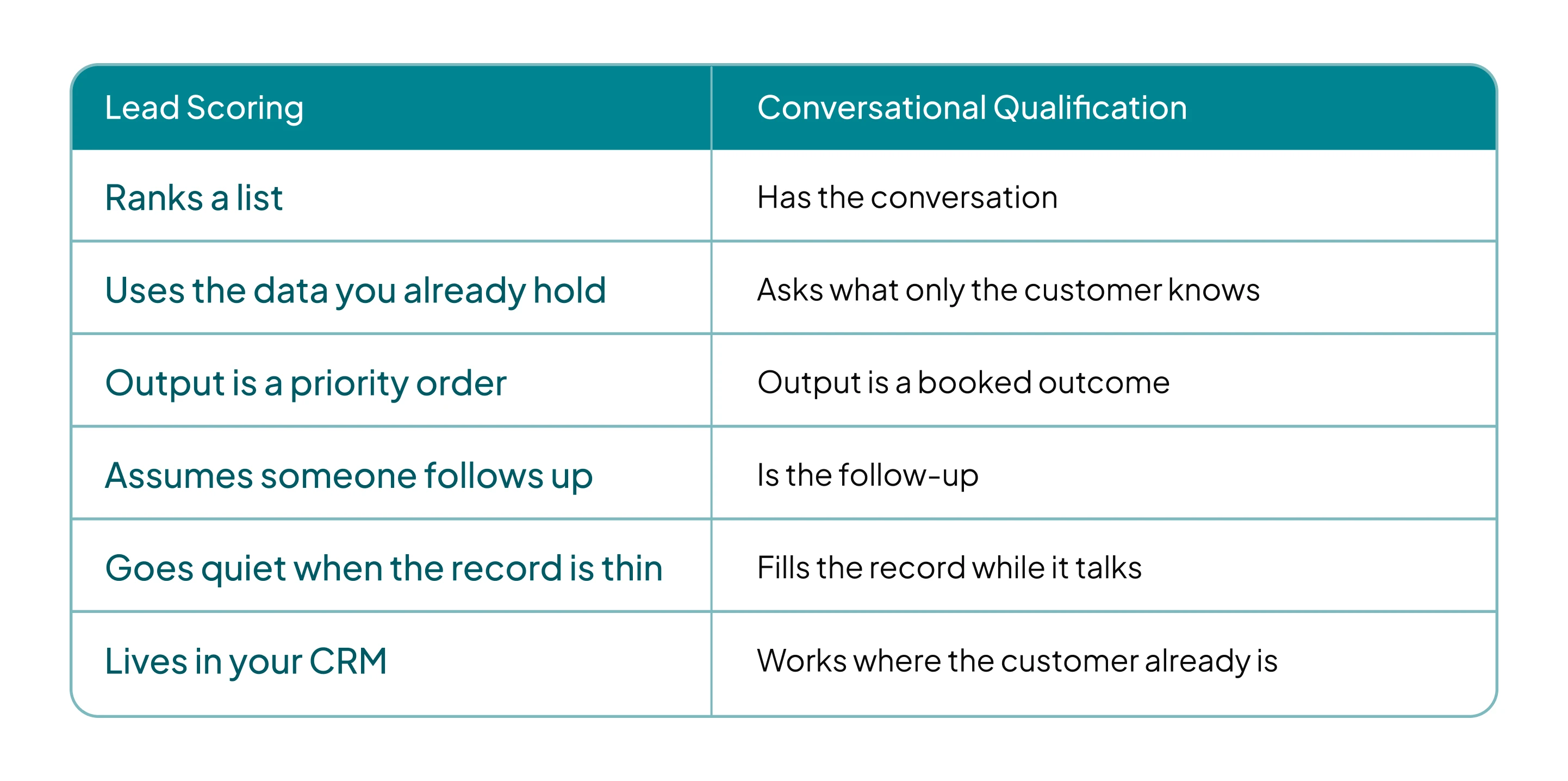
A qualified lead that nobody follows up on is just a well-labeled score, which makes the next stage the one that decides whether any of this produces revenue.
Search for advice on AI in sales outreach and you get a thousand articles about message quality, all offering better subject lines.
At consumer volume the binding constraint is not how good the message is. It is whether the conversation happens at all, and whether it happens while the intent is still live.
Outreach at this scale is not a batch send using sales prospecting tools. It is an AI agent working a customer toward an outcome, which requires:
- A goal rather than a touch: The agent works the objective until it is met or genuinely dead.
- A trigger tied to a signal rather than a calendar: Triggers such as cart abandonment or a policy lapsing in 30 days.
- Consent checked per channel: Opt-out on WhatsApp is not opt-out on voice, and treating them as one turns a revenue program into a compliance problem.
- A callback that is kept, plus handback after a human: The follow-up returns to the agent seamlessly.
It also has to happen where the customer already is. Dot & Key's revenue conversations arrive roughly 50% on WhatsApp and 40% on voice, which is why voice AI is already running enterprise sales motions.
Reach and timing get you the conversation, and then the conversation has to avoid costing you the deal.
On a support conversation, an AI that invents an answer is embarrassing. On a sales conversation, an AI that invents a price is a liability.
An agent improvises a discount that does not exist, or tells a customer they qualify for a product they do not. Either one leaves you holding a commitment you never approved.
This is why grounding is a commercial control rather than a safety checkbox. It means AI in sales answers only from your approved catalog, pricing and policy.
Getting there takes more than a well-written prompt. The mechanism relies on multi-agent validation powered by generative AI checking the response before the customer ever hears it.
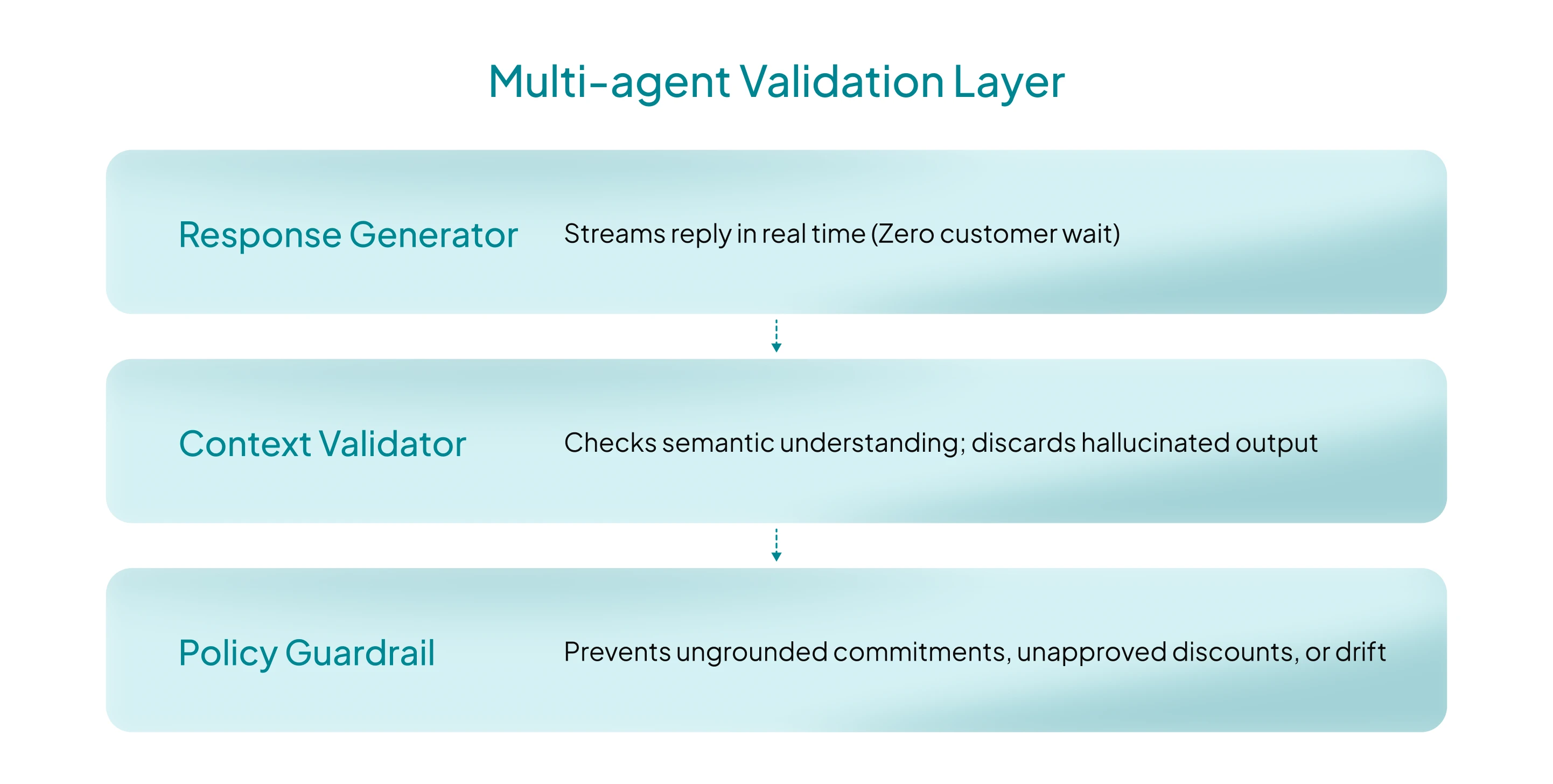
All of that runs in the idle time while the agent is already speaking, so correctness costs nothing the customer perceives.
And correctness is not hygiene. 86% of consumers say responsiveness and accuracy strongly influence their purchasing decisions, according to Zendesk.
Knowing what it cannot say is also knowing when to stop talking, which turns out to be the most valuable thing an agent does.
Here is the finding that should reframe this category for sales leaders. Gartner expects that by 2030, 75% of B2B buyers will prefer sales experiences that prioritize human interaction over AI.
The goal was never to eliminate sales professionals or remove humans from the conversation. It was to make sure the human arrives at the right moment, briefed.
Most systems treat escalation as a failure metric to be minimized, when it is actually the moment the deal is won or dropped. A good agent has to:
- Recognize low confidence: Spot an out-of-scope intent, or a customer repeating themselves. That third signal is the one most systems miss.
- Contain the conversation by inventing nothing: No improvised policy, numbers or commitments.
- Hand over warm rather than cold: Ensure seamless transition without forcing the customer to re-authenticate.
- Learn from every escalation: Bucket and review failures so the same gap does not recur.
What Travels With the Customer
- Cold Transfer: Customer → Queue → New agent. Travels with them: nothing. Re-verifies identity, re-explains the problem.
- Warm Transfer: Customer → Briefed seller. Travels with them: Full transcript, AI summary, reason for escalation, verified identity.
Those four steps hold anywhere in the funnel, which raises the question of where the losses are concentrated.
Marketing generates the demand and sales works the demand, and the seam between them is where most of the Unworked Pipeline lives.
The mechanics are familiar. Marketing teams score and pass a lead, sales works the top slice, and the rest ages out of relevance in a nurture queue.
Look at what is sitting in that queue:
- The pricing-page visitor who never filled in a form
- The promo click that landed on a product page and stopped
- The free trial that expired without a single conversation
- The abandoned cart, which is a marketing-qualified buying signal with no sales conversation attached to it
Each one is somebody who told you what they wanted and then heard nothing back.
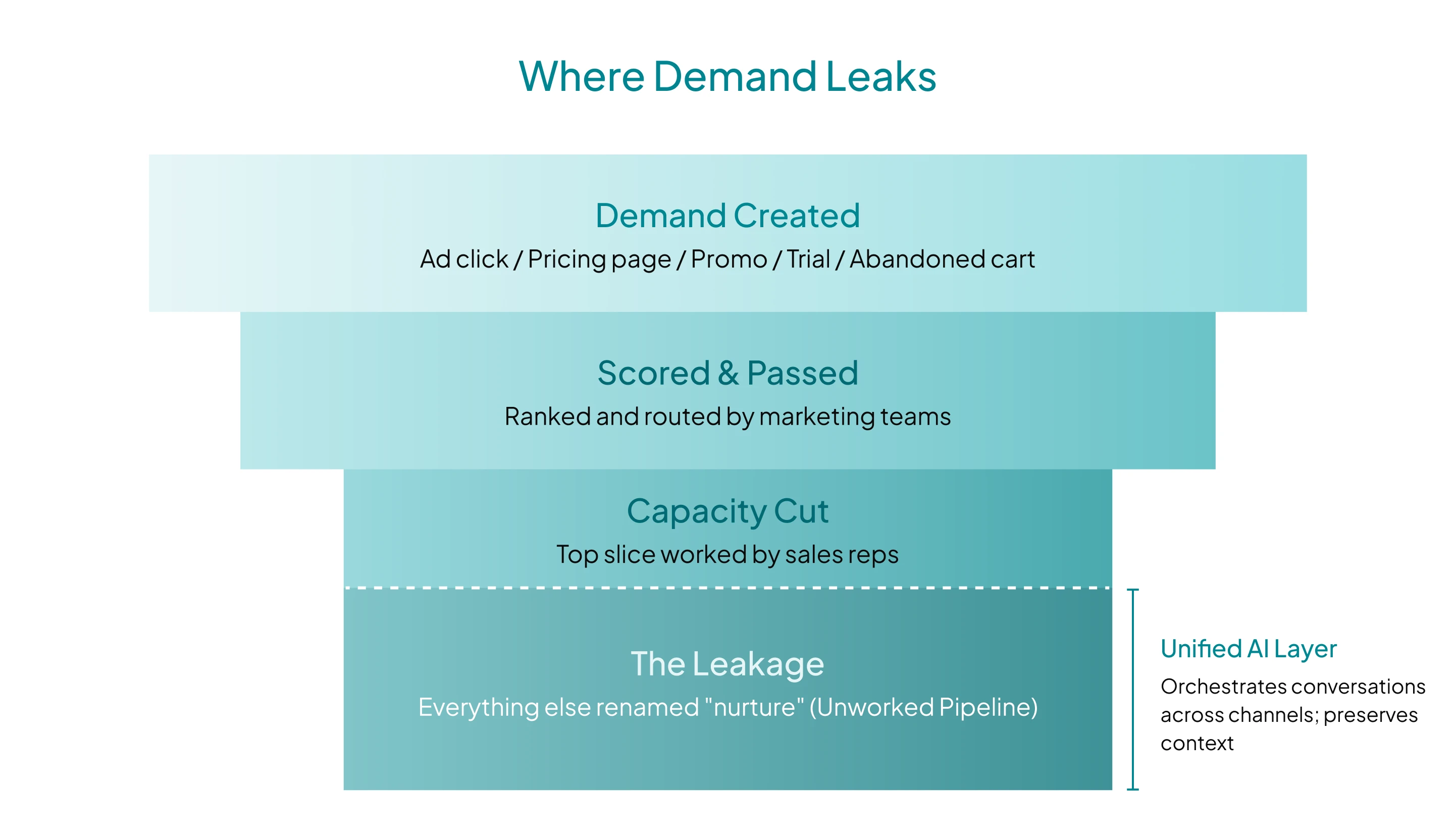
A conversation layer does not belong on the marketing side or the sales side of that seam; it belongs across it, because the customer does not experience the seam at all. This is the orchestration requirement that turns a signal into a conversation.
Fix the seam and you have changed what your sales pipeline is capable of. Which leaves the question a demo cannot answer: where does any of this actually hold up?
Every conversation about AI in sales eventually lands on the underlying model: which one, how good is it, does it sound like a person.
That is the wrong layer, because the model is the cheapest and most replaceable part of the system. What decides whether sales AI produces revenue is the orchestration around it, and whether performance holds as volume and complexity rise. According to research on agentic AI returns, the gap between pilots and production is where most of the value is won or lost.
That second point is where most deployments quietly fail. Automation plateaus on easy conversations, the agent degrades on complex tasks, and the dashboard still looks healthy.
Nugget by Zomato was built inside one of the world's largest customer operations, on real traffic, before it was offered to anyone else. From that deployment:
- 11 million monthly tickets handled through Nugget
- Automation increased from 60% to 80%+
- Agent handling time reduced from 13 minutes to 9
- Human support workforce reduced from 4,000+ to around 1,000
- Support cost reduced from $20M to $9M
Dot & Key, a D2C skincare business, demonstrates proof at a different scale:
- AI resolution increased from 40% to 80%+
- Manual escalations dropped from around 200 to around 20
- Implementation completed in four weeks against 1 lakh+ queries a month (down from three months)
Now for the part a vendor is not supposed to volunteer: those are support-side numbers. They are evidence that a conversation layer holds up under real load, not a claim about closed-won revenue.
What they do establish is this post's argument: the layer that resolved 11 million conversations a month is the same layer a revenue conversation runs on. And Studies of agentic AI deployments point the same way, toward orchestration rather than model choice as the determinant of return.
Rep productivity is a real gain, but expanding total conversational capacity is the whole game.
The counter-argument is also true: buyers are not asking for fewer human interactions, and Gartner's research shows human conversation is becoming more valuable, not less. The point of automating the first mile is that a person is free for the mile that matters.
So here is the number to go and find this week. Count your Unworked Pipeline, which means the conversations your funnel identified and nobody ever had.
That number is your actual business case for AI in sales, and it is almost certainly larger than the rep-productivity case somebody put in front of you.
What is the primary benefit of using AI in sales?
How does AI in sales differ from traditional lead scoring?
Will AI in sales replace human sales representatives?
TL;DR
Reps aren't the bottleneck. Most revenue conversations at consumer volume never reach a seller. Success should be measured in expanded capacity, not just rep efficiency.
Unworked pipeline is the real waste. The biggest revenue loss comes from identified, in-market demand that received zero outreach because human teams ran out of hours.
Qualification requires conversation. Lead scoring tells you who to call, but only a live two-way exchange can capture real-time intent, timing, and buying signals.
Grounding protects conversion. AI sales tools must operate under strict guardrails. An agent that improvises a discount creates a binding commitment you never approved.
Bridge the marketing-sales seam. A single conversation engine across channels prevents demand from leaking into unworked nurture queues.