The Hidden Cost of Channel-Switching: Why Context Loss Is an Expensive CX Problem
Written by: Manya Singh
Published On: Nov 16, 2026
7 mins

A customer starts on chat, gets escalated to a phone call, and has to explain the issue from scratch, again. Nobody on either end of that call thinks much of it. It happens so often across so many businesses that it barely registers as a problem anymore.
It is a problem. Every time a customer has to repeat themselves, that is repeated agent time, longer resolution, and a customer who trusts the business a little less than they did one channel ago. Multiply that across multiple channels, every customer touchpoint, every day, and the hidden cost of channel-switching stops being a minor annoyance and starts looking like an actual line item.
This piece covers why channel-switching keeps happening, what it actually costs a business, and what a genuinely connected omnichannel customer experience looks like once context stops getting dropped at every handoff.
Most businesses did not design for an omnichannel approach from day one. Channels got added over time, chat, WhatsApp, voice, email, social, each one often running on a different platform, built or bought at a different point, with no shared memory connecting any of them.
Customers experience this as one relationship with one business. The business, underneath the surface, is often running it as four or five disconnected ones. A support agent on a phone call has no visibility into the chat conversation that happened an hour earlier. A support team member handling an email has no idea the same customer already explained the issue once over WhatsApp. Multiple departments touch the same customer journey, and none of them can see what the others already know.
It is easy to file channel-switching friction under "bad customer experience" and move on. The actual cost is more specific, and more measurable, than that.
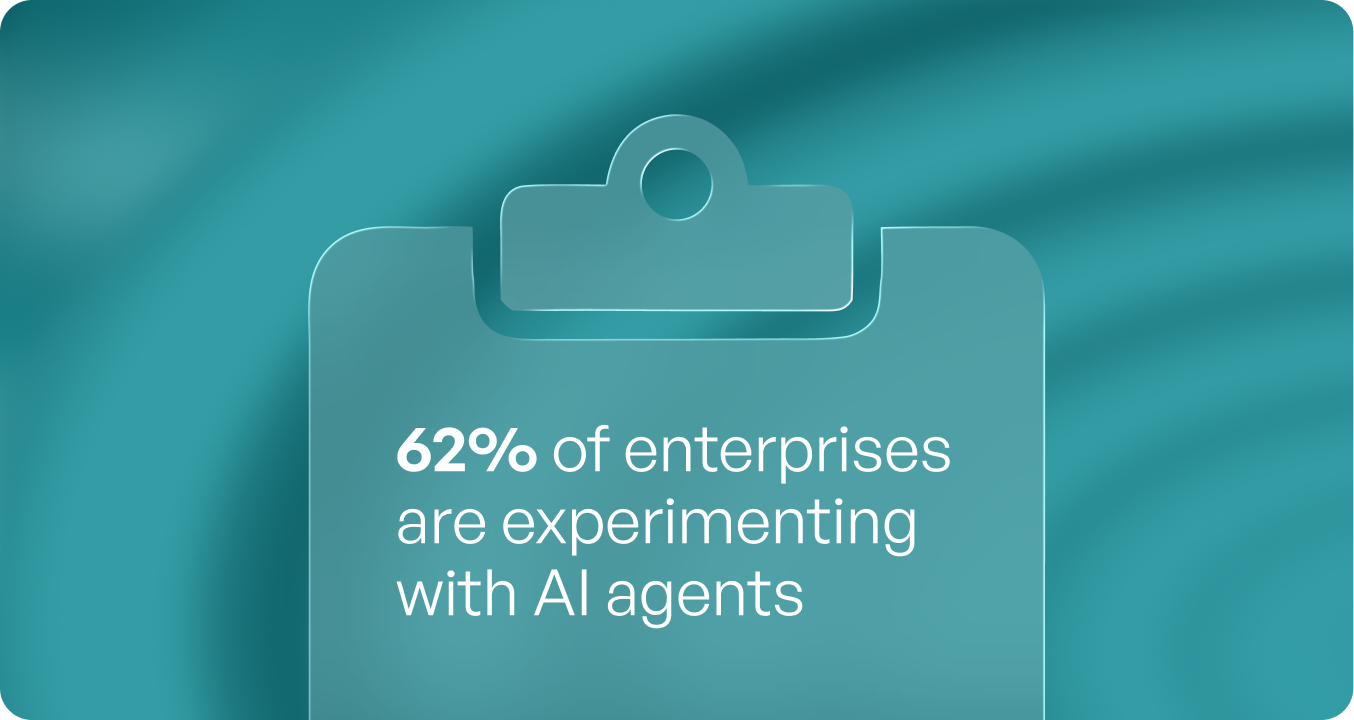
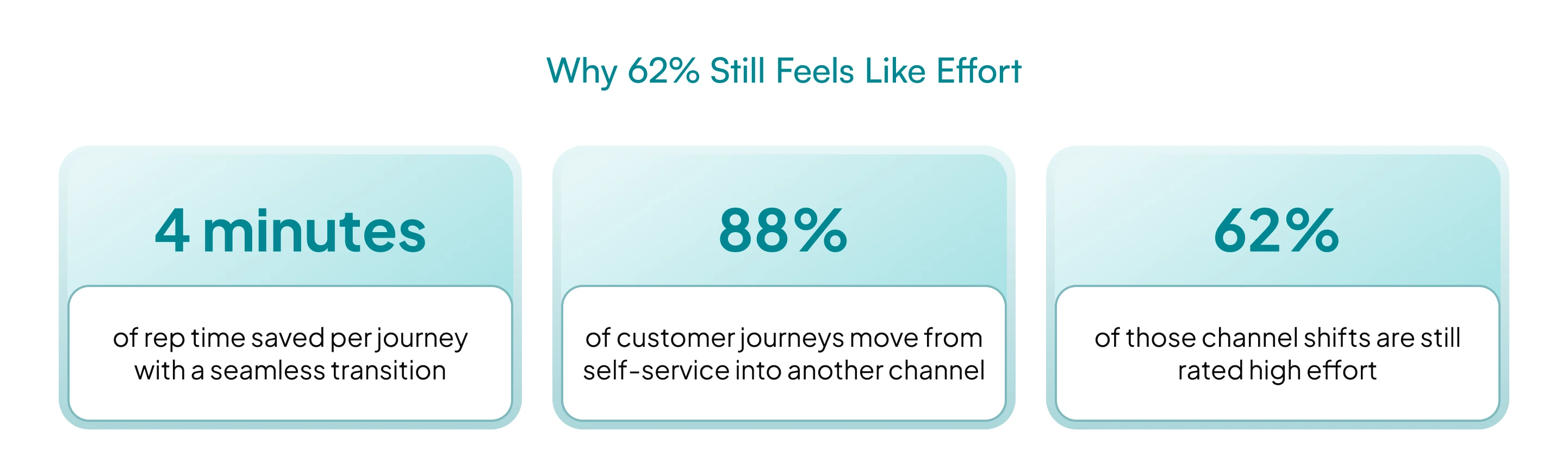
Gartner's research on customer service channel shifts found that seamless transitions between channels save an average of 4 minutes of costly rep time per customer journey, simply because reps are not forced to ask customers to repeat information already provided. The same research found that 88 percent of customer journeys begin in self-service and transition into one or more additional channels, yet 62 percent of those channel shifts are still considered high effort by the customers going through them. Customers who experienced seamless transitions reported significantly higher satisfaction than those stuck in high-effort ones, and a meaningful share who had a smooth transition spent less time in assisted channels overall, meaning the cost saving compounds rather than being a one-time win.
Four minutes sounds small until it is multiplied by every channel switch happening across a contact center every single day. That is agent productivity disappearing into a problem that a connected system would have prevented entirely, and it shows up nowhere on a standard CX dashboard, which is exactly what makes it a hidden cost rather than an obvious one.
The cost is not abstract. It shows up in specific, recognizable moments across the customer journey:
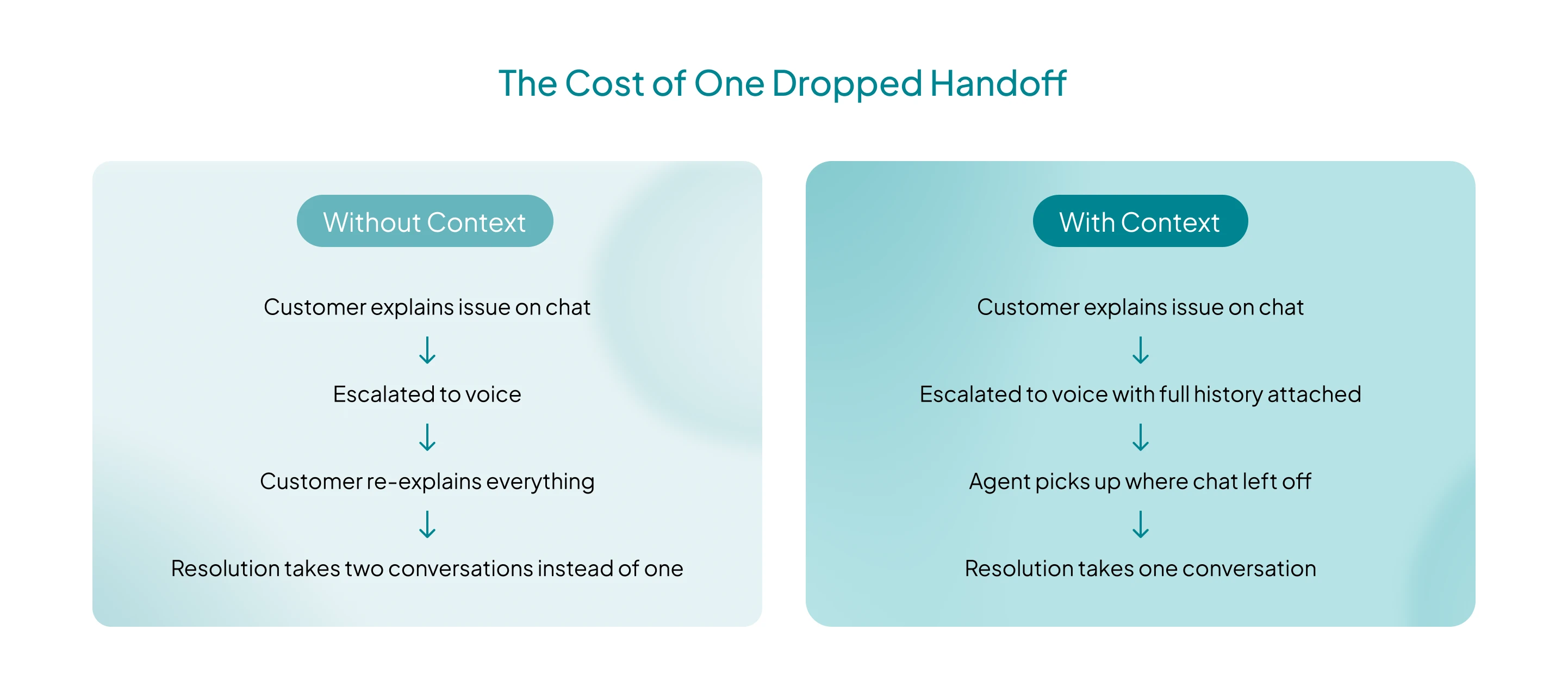
- A customer re-explains an issue after being transferred from chat to voice, because the full chat transcript never made it to the agent who picked up the call.
- A returning customer's purchase history and personal details do not carry over from the app to a phone call, so a support agent has to ask questions the business already has the answers to.
- An agent opens a call with "can you walk me through what happened," on an issue that was already fully described in an earlier conversation on a different channel.
- A customer who prefers one of their preferred channels gets pushed into a different one mid-issue, with no continuity, because that is simply where the escalation path happens to route.
Each of these moments is small on its own. Across an entire customer journey, and across every customer going through it, they add up to the four minutes Gartner's research points to, repeated at scale.
Being present on multiple communication channels is not the same as being omnichannel. A business can have chat, voice, WhatsApp, and email all running, fully staffed, and still fail every customer who moves between them, because having channels is not the same as connecting them.
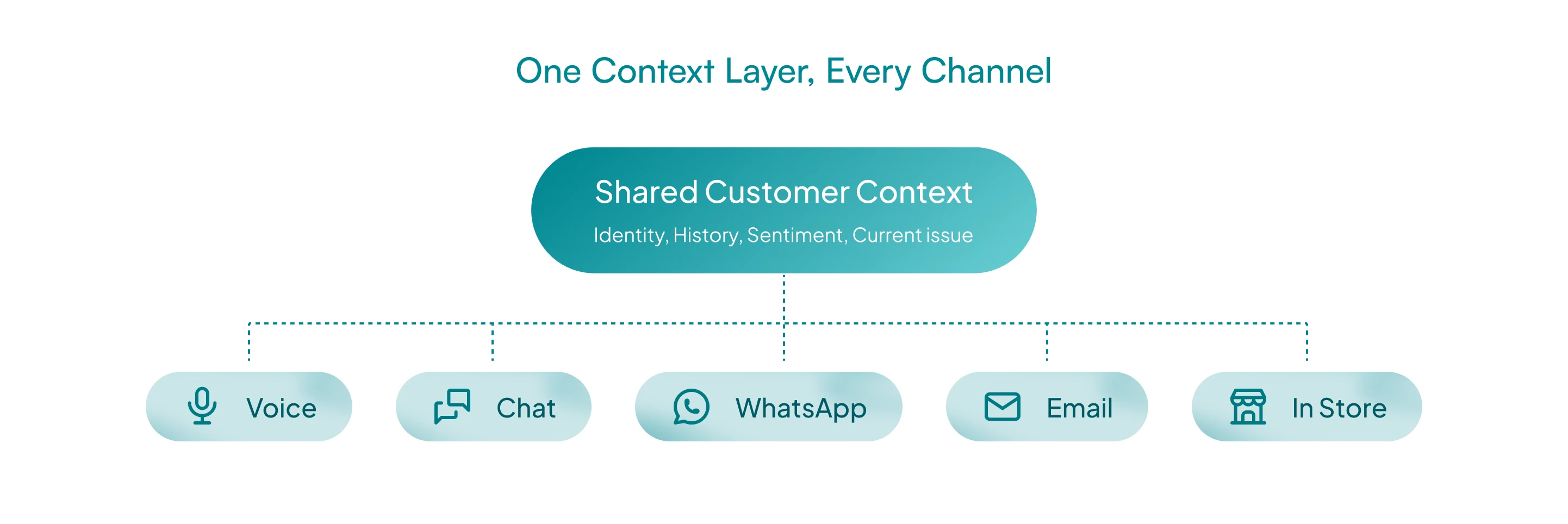
Nugget's omnichannel platform is built around one continuous context layer underneath every channel, not a separate tool bolted onto each one. Customer data, conversation history, sentiment, and current issue status move with the customer across digital channels and offline channels alike, so a conversation that starts on one channel and continues on another is still one conversation, not two. Support agents and voice agents working a case see the same customer context regardless of which channel the customer is currently on, which means personalized interactions replace generic ones, and a support team can actually centralize customer data instead of reconstructing it conversation by conversation.
This also means consistent messaging and consistent branding across every touchpoint, in store, on digital channels, or over phone calls, because the same underlying context and the same customer journey mapping inform every interaction, not just the one happening right now.
The payoff for closing this gap is not just a nicer-sounding customer experience. It shows up in measurable outcomes:
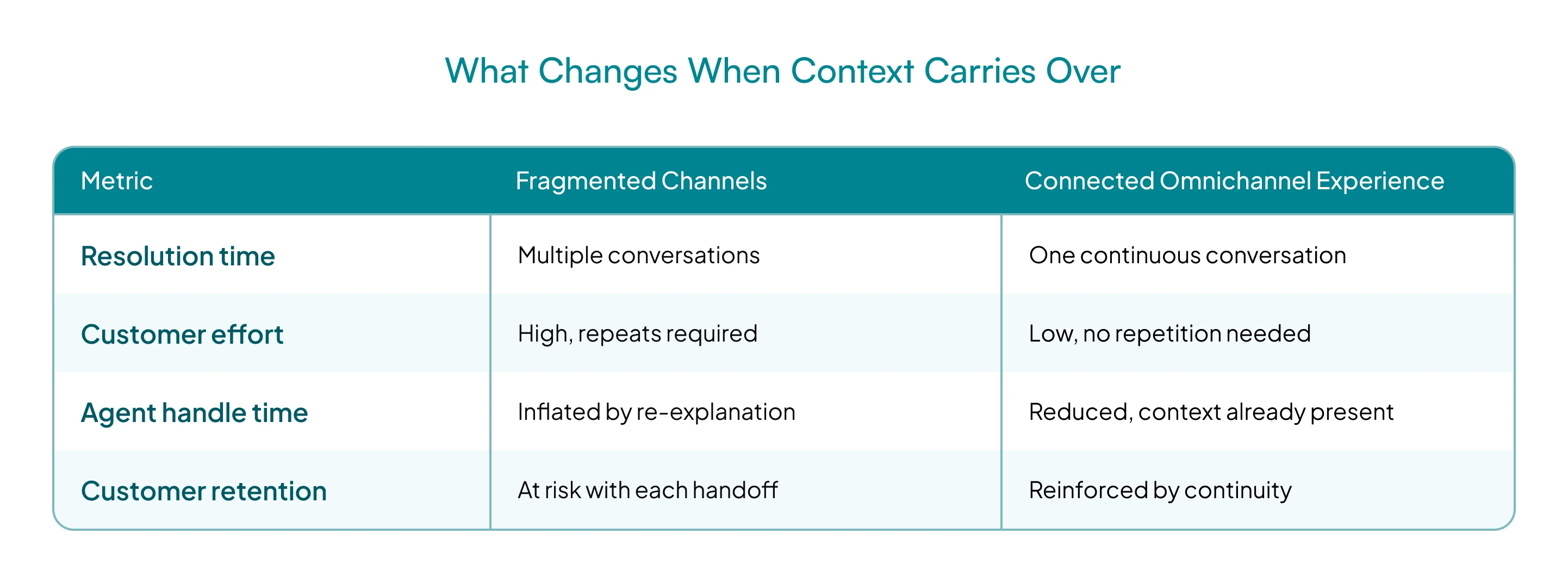
- Faster resolution: An agent who already has full context isn't starting cold, which means issues close in one conversation instead of two or three.
- Improved customer satisfaction: Nobody has to repeat themselves, which is consistently one of the biggest drivers of customer satisfaction and customer loyalty in any customer feedback analysis.
- Lower operational cost: Repeated explanation time disappears from average handle time, freeing up agent capacity across the contact center without adding headcount.
- Stronger customer retention: A good omnichannel customer experience is a direct lever on whether an existing customer stays or leaves, since customer expectations around continuity have only gotten higher, not lower.
- Better insight for the business: When all the data from every channel lives in one place, a business can actually analyze data across the full customer journey, gain insights into customer behavior, and build detailed customer personas instead of relying on fragmented, channel-specific analytics tools.
This also strengthens how a business connects customer acquisition and ongoing engagement. A successful omnichannel strategy is not only about fixing broken handoffs, it is also what lets a business anticipate customer needs ahead of time and engage customers consistently, whether they first discover the brand through online shopping, a brick and mortar store, or a referral that leads straight to a support conversation.
An effective omnichannel strategy is not a marketing department initiative layered on top of a customer service team's existing tools. Omnichannel marketing and omnichannel support have to run on the same underlying customer data, or the strategy breaks at the exact moment a customer moves from a marketing touchpoint into a support conversation.
A genuinely successful omnichannel customer experience strategy, the kind built around real omnichannel customer support rather than a channel checklist, means a customer service team can see customer messages and customer experience data from every channel in one place, track customer interactions across multiple touchpoints without gaps, and understand customer preferences well enough to know which of the different channels a given customer actually wants to be reached on. Consumers expect this consistency by default now, across brick and mortar stores, apps, voice, and chat alike. Enabling businesses to deliver a seamless customer experience across multiple platforms depends on treating every channel as an extension of one customer relationship, not a separate queue competing for the same customer's attention.
This is also where customer engagement and customer touchpoints stop being tracked separately from support. A customer experience strategy that connects omnichannel customer service, omnichannel marketing strategy, and omnichannel retail under one shared view of the customer is what actually works to enhance customer satisfaction over time, delivering a consistent experience instead of a disconnected set of channel-specific wins that look good individually but add friction the moment a customer crosses between them. The valuable insights that come from seeing the full picture are what make that consistency possible in the first place.
The key benefits compound from there: existing customers stay engaged through consistent, relevant contact instead of repetitive outreach, key performance indicators around retention and satisfaction improve together rather than trading off against each other, and the business builds meaningful relationships with customers precisely because the experience feels like one relationship instead of several disconnected ones.
The cost of channel-switching is invisible on most dashboards and real on nearly every call where it happens. Fixing it is rarely about adding another channel. It is about connecting the ones a business already has, so artificial intelligence and support teams alike are working from the same customer context no matter where a conversation started or where it ends up.
Isn't this just a problem with having too many channels?
How does Nugget actually carry context between channels?
What's the first sign a business has a channel-switching problem?
TL;DR
Channel-switching has a real, measurable cost, not just a frustrating one.
Gartner research found seamless channel transitions save an average of 4 minutes of rep time per customer journey.
88% of customer journeys move from self-service into another channel, yet 62% of those shifts are still rated high effort.
The cost shows up in re-explained issues, lost purchase history, and repeated questions across the customer journey.
Being omnichannel means one shared context layer underneath every channel, not just a presence on each one.
Getting this right improves resolution time, customer satisfaction, operational cost, and customer retention all at once.