Voice AI Latency: Why the Industry Is Measuring the Wrong Metric
Written by: Manya Singh
Published On: Sep 28, 2026
10 mins

The conference floor is full of voice AI vendors quoting lightning-fast numbers. You've seen the decks: "Sub-400ms response times!" "The fastest conversational engine on the market!"
Yet almost every enterprise buyer who signs based on those pitch decks experiences the exact same disappointment six weeks later: the agent feels slower in production than it did in the vendor demo.
Nobody explains why this gap exists, but every CX leader feels it in their operational metrics. The issue is not that vendors are lying about their benchmark numbers. It is that the industry is measuring the wrong metric entirely.
When evaluating an
AI voice agent
, voice AI latency isn't just a technical speed specification. It is a trust metric. Measuring it as a best-case average hides the exact operational friction that breaks customer trust when volume spikes.
Most vendors sell you on median latency, often expressed as an average response time recorded in a controlled environment. But averages are fundamentally misleading in enterprise telephony.
What latency actually costs your enterprise isn't measured in milliseconds. It is measured in business outcomes: callers constantly talking over the bot, abandoned calls during unexpected dead air, repeat contact volume, and unnecessary escalations to human agents.
None of those costly failures are predicted by a best-case average. They are predicted by the tail, specifically the worst 5% of your calls (the P95 metric).
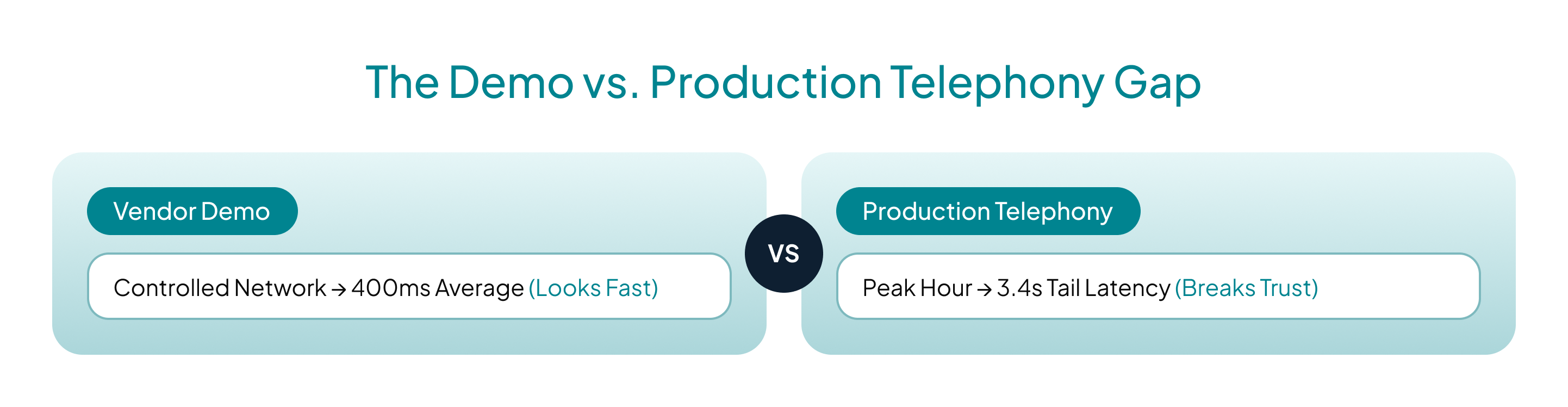
A voice AI system averaging 1.4 seconds that hits 3.4 seconds on one call in twenty doesn't feel slightly slow to that twentieth customer. It feels completely broken.
Worse, the system degrades on the calls that matter most: the busy morning hour, the angry customer demanding a fast answer, or the complex, multi-step transaction. According to research from
Gartner
, 91% of customer service leaders are under executive pressure to implement AI, but AI-powered customer service initiatives fail at nearly four times the rate of other software projects when they lack production reliability.
The honest claim for an enterprise buyer isn't "fastest." It is "consistent." Consistency is what customer satisfaction tracks, because predictability builds user trust.
There is a dirty secret in conversational design that speed-obsessed vendors ignore: past a certain point, faster stops being better.
Human conversation naturally operates on a
200 to 300 millisecond gap between turns
. However, when an AI agent responds in under 500 milliseconds on a complex voice line, it creates a psychological uncanny valley. Replies that fire back too quickly read as unnatural and interruptive, making the caller feel rushed. Conversely, response gaps that stretch past 1.5 seconds read as inattentive or frozen.
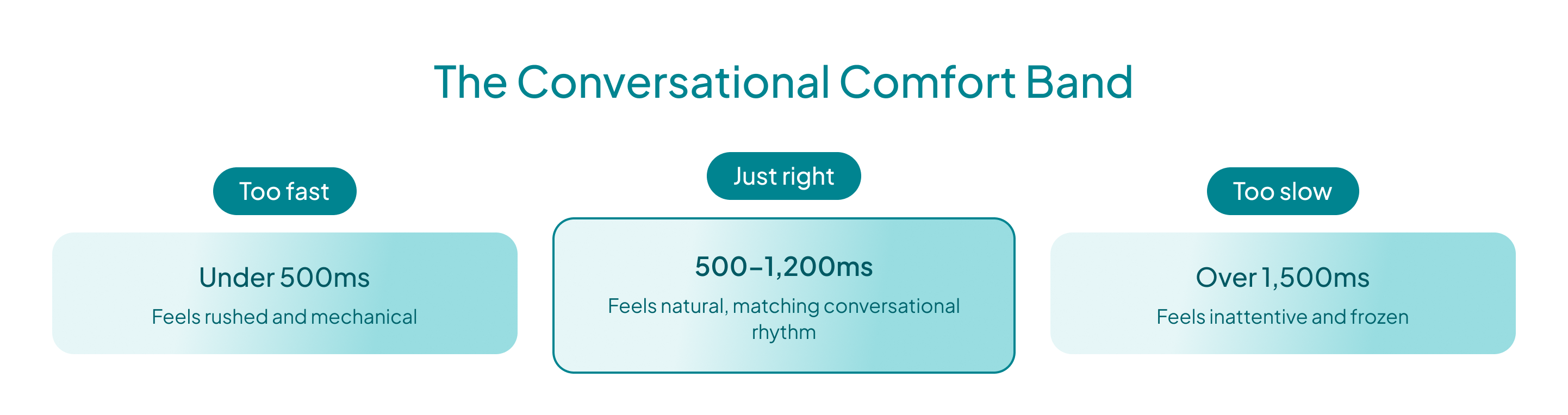
There is a natural comfort band for human speech. Sprinting below it wins a benchmark demo, but it makes the AI agent feel like it isn't actually listening to what the user said.
Voice AI latency is a hygiene factor. Below the natural comfort threshold, raw speed buys you nothing. In real-world customer support, a 400ms agent that misunderstands the customer's intent loses every single time to a 1,200ms agent that delivers a verified resolution.
To understand why traditional voice stacks struggle with voice AI latency, you don't need a full system teardown. You just need to understand two key engineering constraints that faster foundation models alone cannot fix.
1. Endpointing vs. LLM Generation
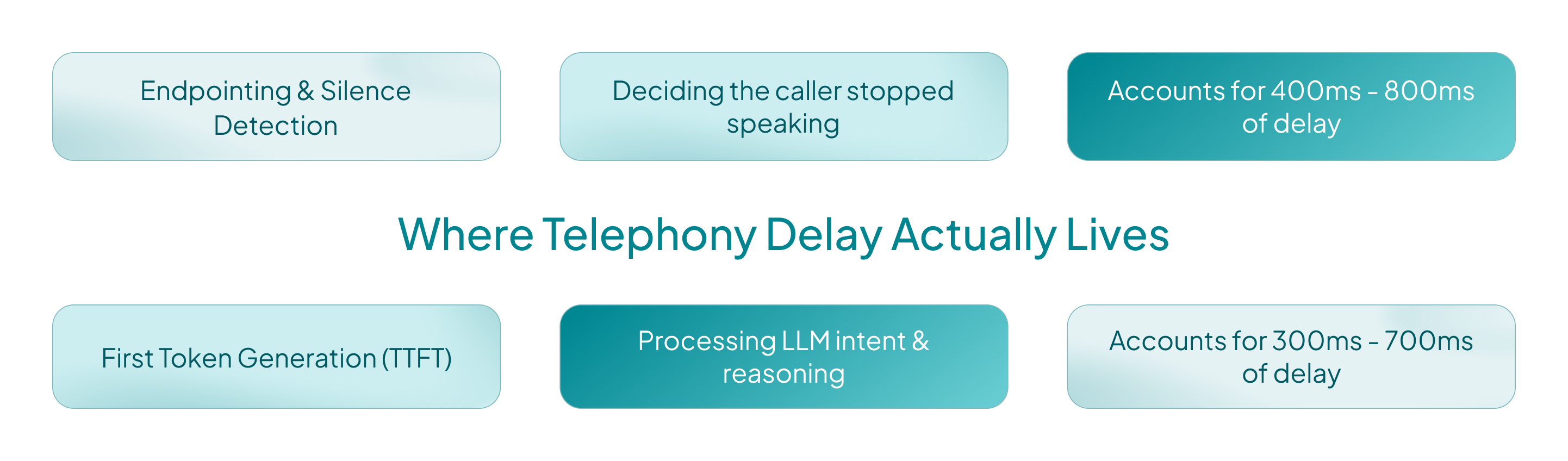
Most of the delay in a voice call doesn't happen inside the language model. It lives in two specific places:
Endpointing: The time the system takes to confidently decide the caller has finished their sentence rather than just taking a breath.
Time-to-First-Token (TTFT): The time it takes for the model to begin generating its response.
Swapping in a faster LLM doesn't resolve an overly cautious endpointing algorithm that waits 800 milliseconds of dead silence just to verify the user stopped talking.
2. The Mechanics of Barge-InBarge-in (when a user interrupts the agent mid-sentence) is where fast voice stacks quietly fail in production.
Interrupting mid-sentence means the orchestration layer must instantly cancel audio generation already in flight, clear the context buffer, and recalculate user intent. When a caller gets cut off or hears a jarring audio stutter, it looks like a rudeness problem. In reality, it is a backend voice AI latency problem caused by poor state management.
Beyond conversational orchestration, a voice AI platform relies on an underlying digital stack where physical and structural constraints dictate performance. To truly improve network latency issues, enterprise teams must understand the root causes of network latency that trigger slow response times across distributed systems.
At a fundamental level, latency refers to the time delay experienced when data travels across a network connection. How latency is measured in production environments comes down to Round Trip Time (RTT), evaluating the time it takes for a user's request to travel from a client device to a server and back.

Physical network distance plays a massive role in data transmission. When data passes through multiple network devices and intermediate network hops, geographical separation adds unavoidable time delays.
Distance Data Travels: The greater the network distance between a user and the primary data center, the higher the overall latency.
Routing Path Variations: Transmitting information across different network paths can introduce additional latency if routers direct users traffic across congested routes.
Cellular and Wireless Constraints: Callers using a mobile connection or a public wireless network frequently experience high latency networks caused by signal interference, physical barriers, and fluctuating bandwidth.
Edge Routing Infrastructure: Companies deploy a content delivery network (CDN) to reduce network latency by serving cached content closer to the edge, keeping data geographically closer to the caller.
High bandwidth is often confused with fast transmission speeds, but internet speed and latency are distinct concepts. Bandwidth determines how much data can pass through a pipeline at once, whereas latency measures how fast those data units move.
Network Congestion: When high volume traffic saturates network infrastructure, routers queue data packets, leading to increased latency and data packet loss.
Data Volume and Packet Loss: When packet loss occurs, the network must retransmit missing data units, causing severe audio latency, choppy voice feeds, and slow response metrics.
Optimizing Data Pathways: To fix latency spikes, enterprise engineers configure low latency network routing protocols that prioritize real-time audio data over bulk background transmissions.
Server latency and operational latency occur after a data request hits the backend stack. Even if your network performance is clean, internal processing bottlenecks can affect latency across the board.
Database Queries: When systems retrieve data from databases geographically closer or fetch sensor data across complex web environments, unindexed queries introduce severe storage delays.
Hardware and Disk Latency: Reading instructions from legacy storage media creates mechanical latency and disk latency, slowing down real-time LLM context building.
Application Architecture: Render blocking resources, heavy software dependencies, and poorly optimized code negatively impact application performance, creating compounding network performance issues across high frequency operations.
Understanding how these elements interact allows technical teams to reduce latency, fix high latency bottlenecks, and improve network latency systematically.
- The High-Stakes Friction: A customer calling about a suspected fraudulent charge is already in a state of high anxiety.
- The Latency Impact: A 3-second delay during identity verification creates immediate panic, causing the caller to repeatedly say "Hello?" and trigger false agent transfers.
- The Resolution: Implementing low-latency, deterministic workflows via contact center automation ensures identity checks occur smoothly without dead air.
- The High-Stakes Friction: Peak holiday shopping periods create massive concurrent call spikes for order modifications.
- The Latency Impact: As system concurrency surges, unmanaged P95 latency causes the AI to drop barge-in states, forcing callers to listen to stale promotional scripts.
- The Resolution: Scaling backend infrastructure to guarantee flat latency profiles keeps containment high even during 5x traffic spikes.
- The High-Stakes Friction: Patients calling for prescription refills or post-discharge check-ins require careful, empathetic pacing.
- The Latency Impact: Ultra-fast sub-400ms responses feel clinical and uncaring, while 2-second gaps make the patient feel ignored.
- The Resolution: Utilizing real-time AI sentiment analysis allows the agent to dynamically adjust its pacing to match patient emotional cues.
Financial Services & Banking
E-Commerce & Retail
Healthcare & Patient Services
At Nugget, we approach voice AI latency from a fundamental principle: enterprise buyers shouldn't care about best-case demo speeds. They need guaranteed operational stability in production.
Having processed billions of live customer conversations inside high-volume production environments, we engineered our voice architecture around three explicit business commitments: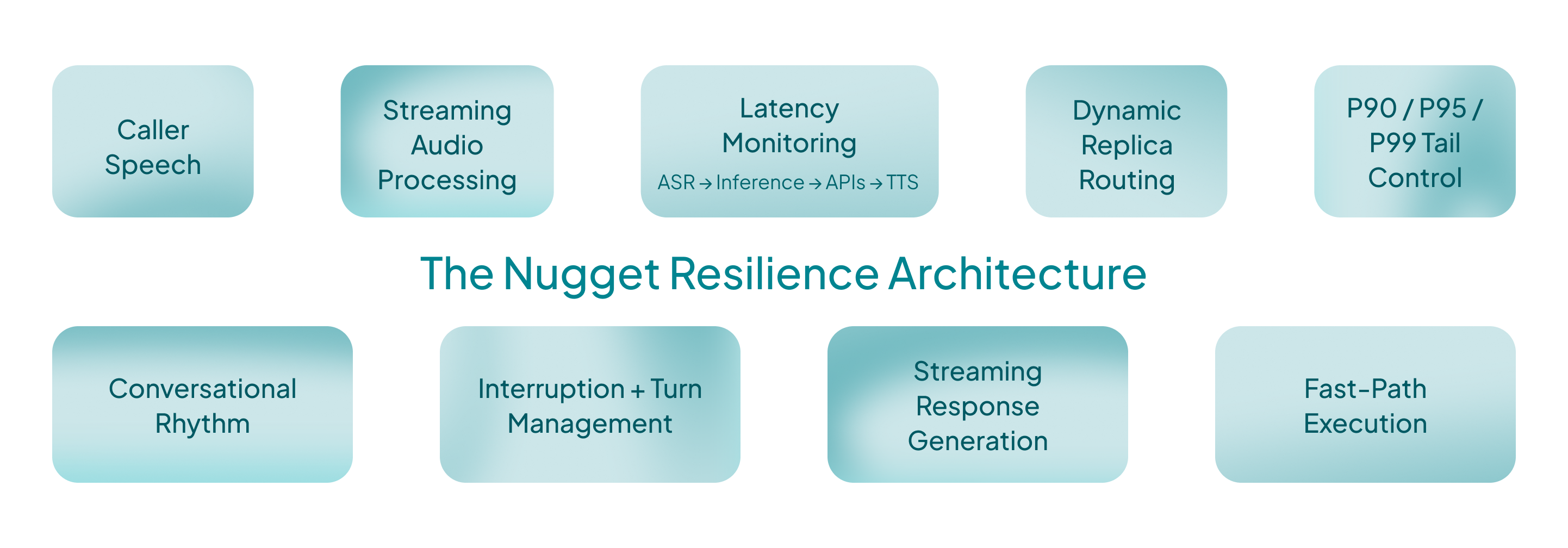
We Optimize for When the Reply Starts, Not When It Finishes
We Engineer for the Bad Tail, Not the Best Case
Latency Holds Under Heavy Concurrency
Before signing a contract with any voice AI platform, take control of the technical evaluation by using this three-part buyer's test during their live demo:
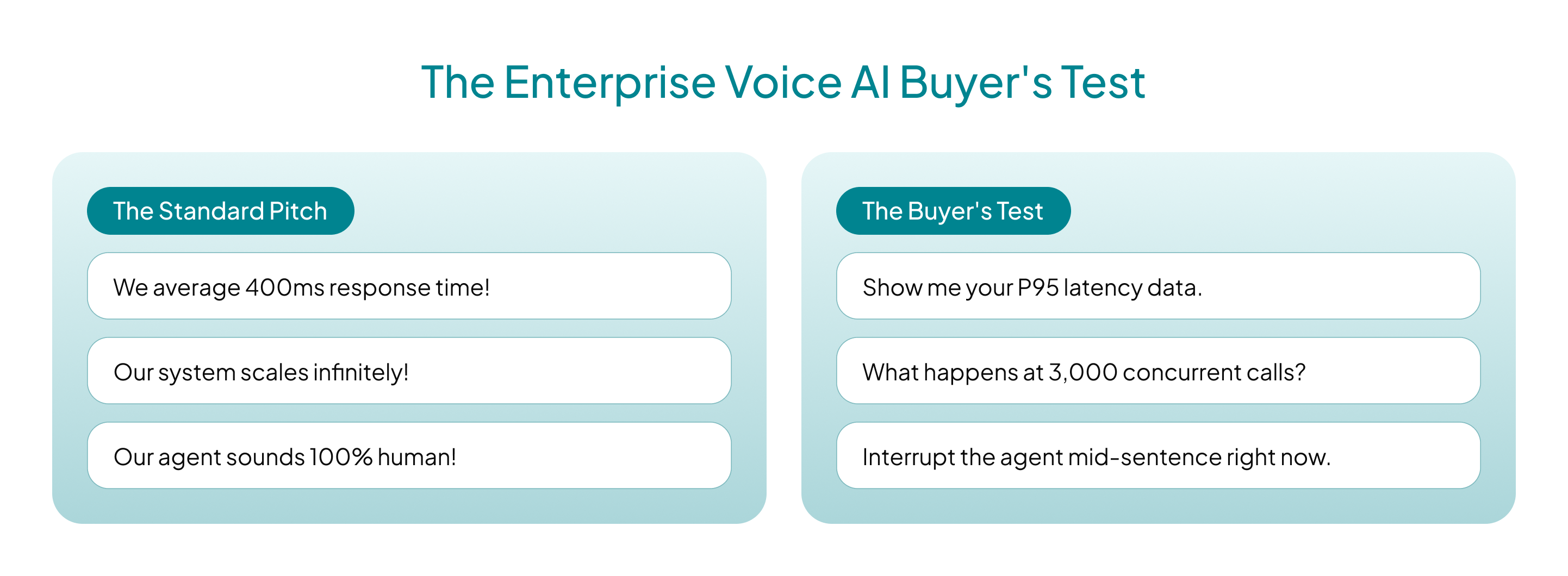
"Don't show me your average. Show me your P95 latency data from a live enterprise deployment." (If they can only produce best-case averages, they are hiding tail degradation.)
"What happens to your latency curve when concurrency spikes to 3,000 simultaneous calls?" (Tests whether their platform infrastructure can survive peak seasonal volume.)
"Interrupt the demo agent mid-sentence right now while it reads a complex policy." (Reveals whether their barge-in architecture clears buffers cleanly or stutters under pressure.)
The market for AI voice agents is maturing rapidly. Enterprise decision-makers can no longer afford to select platforms based on vanity speed metrics designed for pitch decks.
Fast response times are useless if the agent hallucinates, drops context during an interruption, or spikes to a 4-second delay during peak call hours. When evaluating
agentic AI systems
, prioritize architectural consistency, robust tail-latency controls, and proven concurrency resilience over raw benchmark claims.
Businesses prefer low latency, low network latency, and high system stability because reliability drives enterprise performance. The future of enterprise voice AI isn't about building the fastest model. It is about building the most reliable conversational partner at scale.
What is voice AI latency, and how is it measured?
How do underlying network performance issues affect voice AI calls?
What is the difference between average latency and P95 latency?
TL;DR
- Vendor demos quote best-case average response times, but real-world customer churn is driven by the worst 5% of calls (P95 tail latency).
- Replies under 500ms feel interruptive and rushed, while delays over 1.5s feel broken. The goal is natural consistency between 500ms and 1,200ms.
- A 1,200ms response that correctly resolves an issue always outperforms a 400ms response that gets the answer wrong.
- Interrupting an agent mid-sentence requires instant state cancellation. Poor barge-in handling manifests as audio stutters and dropped context.
- Managing causes of network latency, server latency, and packet delivery ensures your platform maintains low latency across high-volume environments.