Conversational AI in Banking: The Opportunity and the Bottlenecks
Written by: Manya Singh
Published On: Sep 28, 2026
8 mins

Banking customers expect seamless, round-the-clock service. They want to check account balances, dispute charges, and update account details instantly, on their terms, and through their preferred channels. Yet financial institutions face structural constraints that consumer software companies never worry about. Financial institutions operate under strict regulatory frameworks, depend on decades-old core banking systems, and must maintain air-tight security protocols. Every one of the customer interactions carries compliance risk, financial liability, and strict customer data privacy requirements.
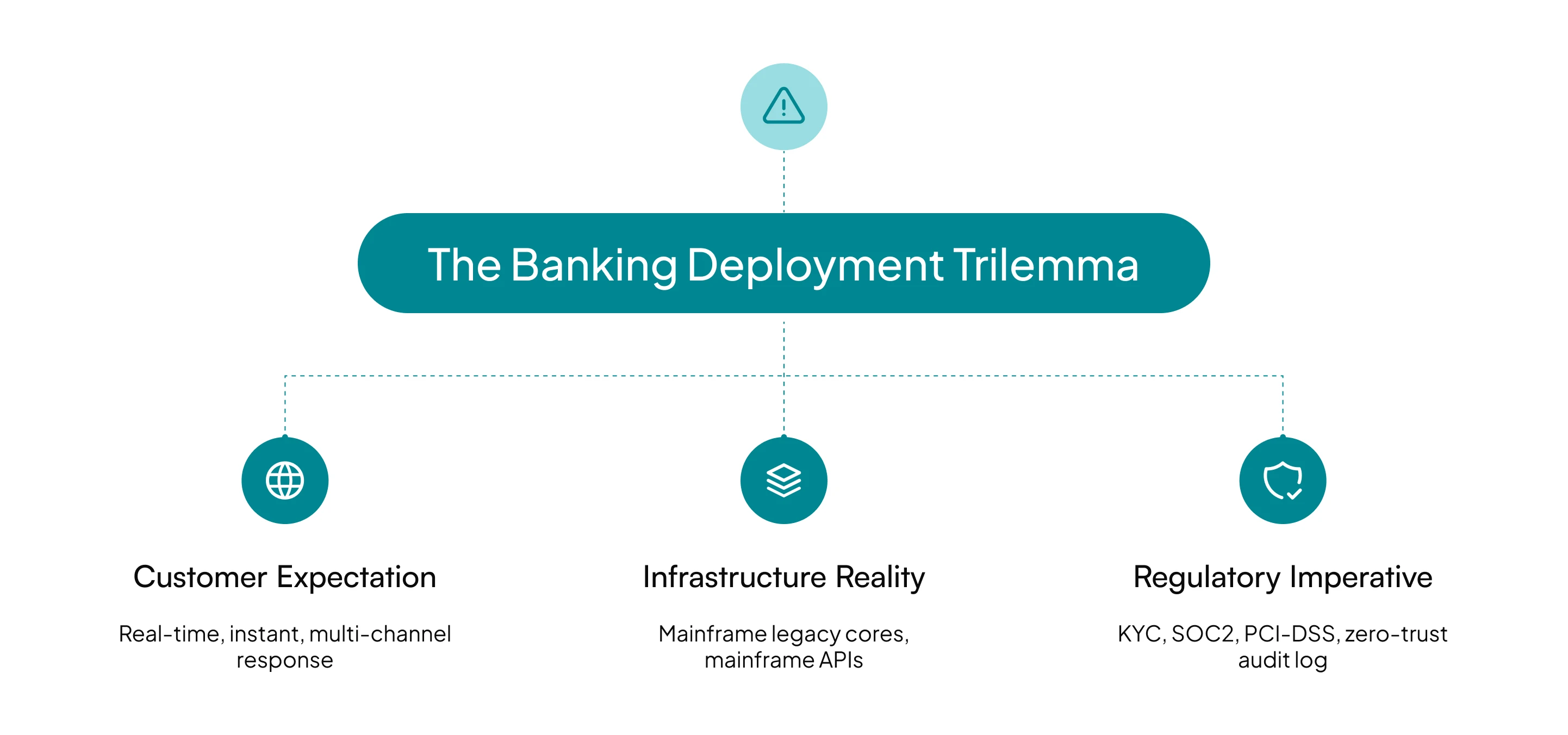
Because of these hurdles, deploying conversational AI in banking is vastly different from building a simple web widget for e-commerce. Modern banking customers expect banks to offer effortless digital journeys, but a retail bot can make a reasonable guess about an item's availability, while a banking system cannot guess account data or initiate transferring money without absolute certainty.
Executing a successful conversational banking strategy means using artificial intelligence to automate routine tasks while giving human agents full context during escalations. This guide breaks down what conversational banking and banking conversational AI actually look like in production, where conversational AI delivers value, why implementations stall, and the precise architecture required to make it work.
In the banking sector, conversational AI in banking refers to an integrated network of voicebots, virtual assistants, and an AI agent working across communication channels to process human language within strict banking-grade security, accuracy, and compliance parameters.
Generic conversational tools focus on casual dialogue, basic intent matching, and broad automated answers. In contrast, enterprise AI in banking operates under fundamentally different rules:
- Authentication Before Action: A retail bot might show a product catalog to an unauthenticated visitor. A virtual assistant providing banking customer service cannot share transaction details or modify account settings without executing zero-trust Multi-Factor Authentication (MFA) or biometric verification.
- Deterministic Execution: The system cannot guess or invent responses when processing financial workflows. It requires strict guardrails, code-level business rules, and real-time verification across backend systems.
- Regulatory Logging: Every conversation, intent shift, and transactional write-back must be captured in an immutable, searchable audit trail to satisfy compliance audits.
Rather than focusing on generic features, successful institutions build their conversational AI deployment around high-volume, structural support paths across their digital channels.
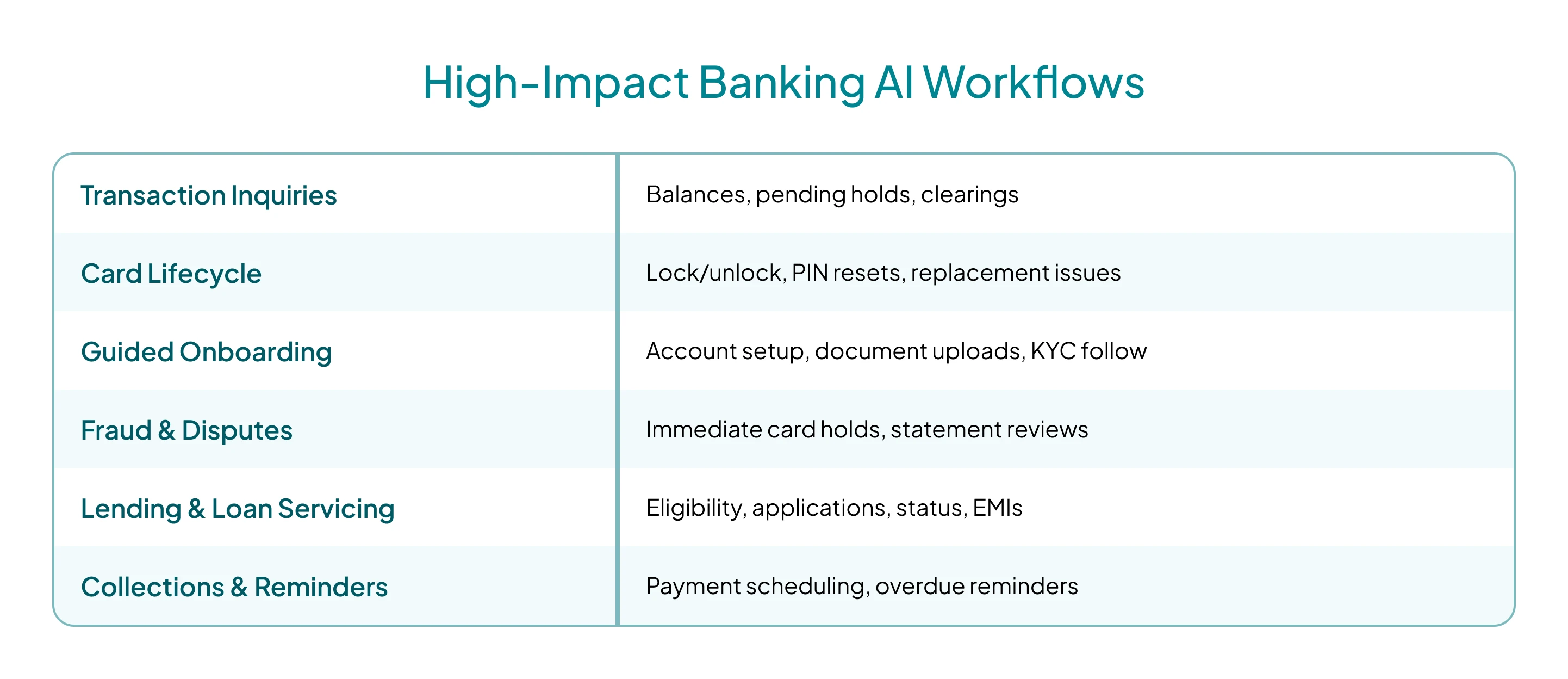
Balance and Transaction Inquiries
Card Lifecycle Management
Loan & KYC Guided Journeys
Fraud Alerts and Dispute Initiation
Collections and Payment Reminders
Deploying conversational AI in banking requires an enterprise architecture where safety, security, and integration layers wrap directly around core intelligence engines.
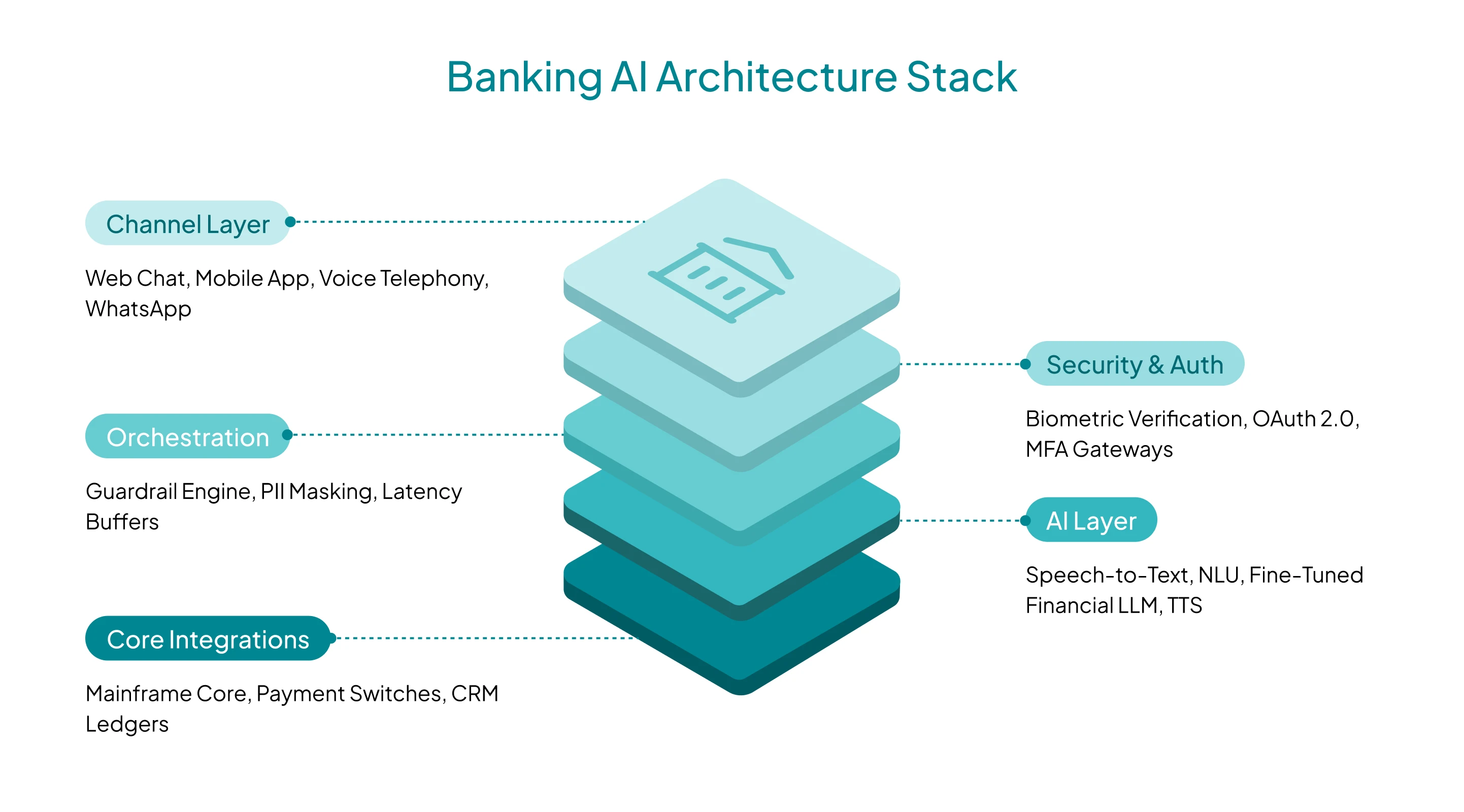
The Security & Authentication Gateway
In-Stream PII Masking & Guardrail Engines
Real-Time Observability & Quality Assurance
State-Aware Contextual Escalation
Implementing conversational AI in banking delivers quantifiable economic ROI when evaluated on operational resolution rather than simple call containment.
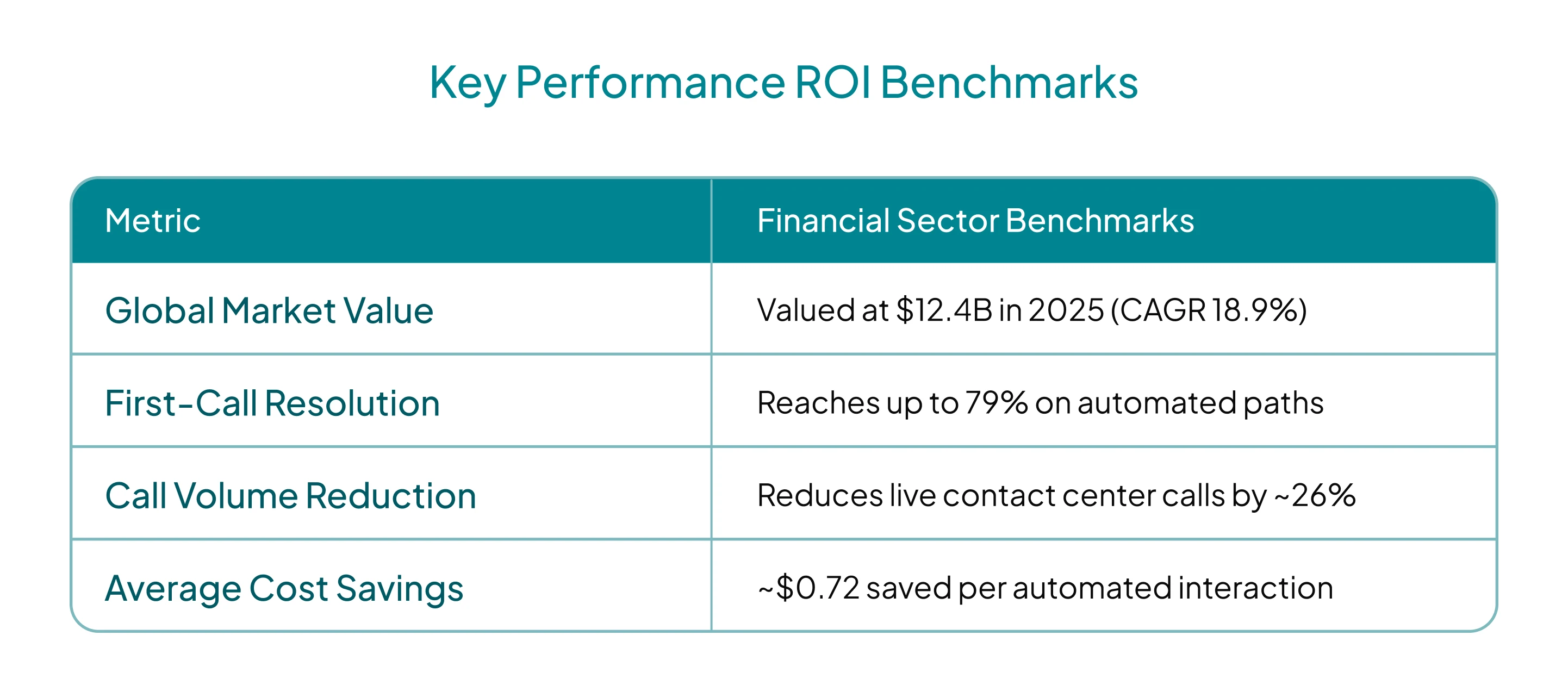
Recent market data highlights the tangible impact of conversational AI across the banking sector:
- Cost Impact: McKinsey's Global Banking Annual Review 2025 found that AI, including conversational AI deployed across service operations, could bring gross reductions of up to 70% in certain cost categories, netting a 15-20% decrease in banks' aggregate cost base once rising technology spend is factored in.
- Adoption and Trust Gap: Deloitte's Consumer Banking Survey 2025, based on a survey of 2,027 US banking customers, found that while chatbots are now nearly ubiquitous in banking, 37% of respondents had still never interacted with one, and 74% said they still preferred a human agent for routine queries, a reminder that deployment and adoption are not the same thing.
- Market Trajectory: Juniper Research's June 2026 study forecasts that global conversational AI service revenue will more than triple from $2.4 billion in 2026 to $8.5 billion by 2030, driven substantially by the shift from scripted chatbots to agentic AI capable of completing tasks, not just answering questions.
The Pilot Purgatory Trap
Hallucination Risk and Compliance Exposure
Customer Frustration with Mismanaged Containment
Conversational AI in banking has evolved from simple web widgets into core operational infrastructure. Financial institutions can no longer rely on rigid decision-tree bots that route callers through static FAQ flows while deflecting requests.
Building a successful conversational AI in banking deployment requires choosing platforms that handle the complexities of financial services out of the box. That means managing identity authentication, legacy mainframe integrations, sub-second latency targets, and strict compliance logging.
When implemented with deterministic execution frameworks and native observability layers, conversational AI helps financial institutions cut contact costs, protect data, elevate customer retention, and deliver modern digital experiences that keep pace with customer expectations.
How does conversational AI in banking ensure security and regulatory compliance?
What is the difference between a traditional chatbot and conversational AI in banking?
How long does it take to deploy enterprise conversational AI in a retail bank?
TL;DR
Unlike retail tools, conversational AI in banking requires multi-factor authentication or biometric verification before revealing personal data or writing to ledgers.
The highest ROI comes from automating targeted paths like balance lookups, card replacements, fraud alerts, and guided KYC onboarding.
Deployments fail due to legacy system delays, unhandled barge-in, and dropped context, not because the synthetic voice sounded unnatural.
Tracking call containment leads to user frustration; evaluating cost per resolved contact reflects true operational efficiency.
Successful deployments require in-stream PII redaction, deterministic policy guardrails, and continuous 100% conversation observability to ensure compliance.