From Ten Tools to One: How Supertails Runs Customer Experience on Nugget
Written by: Manya Singh
Nov 25, 2026
10 mins
Supertails is an integrated, healthcare-led pet care platform built for modern pet parenting in India. The company brings together products, veterinary consultations, behavioural support and digital care under one trusted ecosystem. Founded in 2021 and headquartered in Bengaluru, Supertails focuses on simplifying pet parenting by providing reliable access to expert guidance, healthcare and everyday pet needs, supporting pets and their families across every stage of life.
In pet care, a delayed medicine order is more than an inconvenience; it can affect an animal’s well-being. Getting customer experience right, and recovering fast when something goes wrong, is central to the business.
Over five years, Supertails grew across five to six teams, including sales, customer experience, onboarding, and retention, each running its own SOPs and adding its own tools along the way.
As Supertails scaled into a nationwide platform, its customer experience stack, the full set of systems a team relies on to see, understand, and act on a customer's issue, grew in step. What it didn't grow in was capability: the ability of that stack to give any one agent, on any one channel, a complete and current picture of the customer in front of them.
Each team added the tool that solved its own immediate need, a ticketing system here, a calling platform there, a chatbot somewhere else. Over the years, Supertails had assembled a customer experience stack that was wide but not connected, capable of handling individual tasks but not of carrying a single customer's context from one tool to the next.
That gap showed up in four ways:

Disconnected systems

Fragile automation

No cross-channel memory

Complex partner ecosystem
Supertails had already evaluated other AI-native platforms. They were capable, but built for engineering teams: ticketing interfaces modeled on developer issue trackers, and new requirements that meant custom development and multi-week scoping cycles. With five to six teams changing their SOPs constantly, that pace couldn’t keep up with the business.
Nugget was different in where control sits. Most of what the team needed was available out of the box, and the CX team could configure it themselves.

We are a startup. My SOPs change every day, maybe twice a day. I can change the workflows as quickly as my SOPs change. It's all out of the box, with no custom development and no going back to someone to ask how to set it up. It's intuitive and self-explanatory.
 Prasanth Gandla, Head of Customer Experience, Supertails

Four parts of the platform carried the decision.

No code workflows

AI agents with guardrails

One omnichannel workspace

Integrations and event-driven actions
I’ve been working for 13 years and managing tools for 10, including bigger and more expensive ones. Nothing was this easy to manage, or had this many capabilities out of the box.
Integration depth was the team’s biggest concern going in, given how many systems were involved. Most of it proved straightforward enough for the Supertails team to set up without a heavy engineering lift.
Supertails began with a small, deliberate rollout, automating simpler WhatsApp journeys first. These included vaccination reminders, pet-parenting tips, and grooming guidance, with a human team member taking over the conversation once a customer responded.
The real test came with the telephony cutover. Supertails had run its previous complex telephony and ticketing setup for about three years, and all of its roughly 100 phone numbers had to be remapped and connected to Nugget.
The transition couldn't be phased because the telephony system could only connect to one platform at a time. The team tested in silos before going live in a single 36-hour push. Twenty people tested all 100 lines, placing an estimated 1,000–2,000 test calls overnight, before moving every line to Nugget the following morning.
The biggest shift was giving agents one screen instead of ten. Order history, customer state, previous bad experiences, sentiment signals, and even recommended next steps now sit in a single view. This information is brought together through smart plugs and iframes, without requiring agents to switch between systems.
A lot of different tools' information has been brought into one place: user history, customer state, previous bad experiences, even recommended next steps. All of it is on one screen for an agent. You don't have to shuffle between tools or hunt for where to find a piece of information.
Actions across systems are connected too. When the supply chain team logs an update in the ERP, such as a stock-out or a failed delivery, Nugget can automatically approve the resulting refund or cancellation and update the ticket, with no agent bridging the two systems. Prasanth estimates that 20 to 30 percent of these supply-chain-triggered refunds and cancellations now run automatically, and the team is still closing that gap.
Supertails has drawn a clear boundary around anything involving medical judgment. Nugget’s chat agent is designed to recognize conversations involving prescriptions, medicine recommendations, irate customers, or severely delayed orders. Where possible they check order status first, then escalate to the right human team rather than trying to resolve sensitive issues on their own.
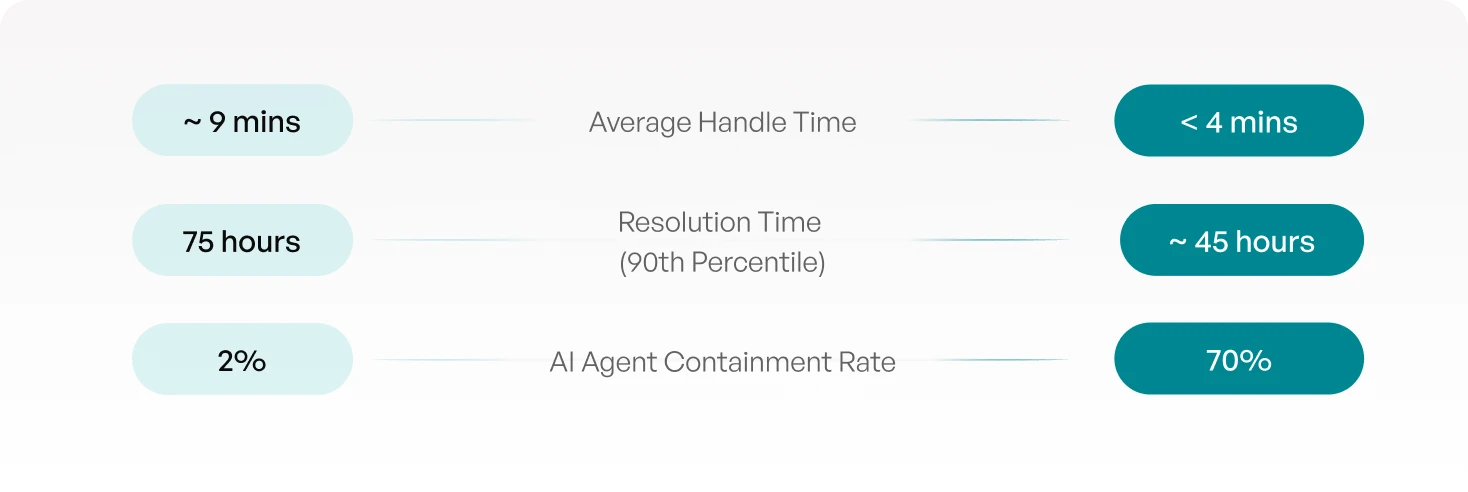
A first-time pet parent chasing a delayed medicine order never sees the systems behind Supertails’ support. What they notice is that whoever answers, an AI or human agent, already knows their order and what went wrong last time, and doesn’t ask them to explain it twice. Making that experience better is now where Supertails’ customer experience team spends its time.
Whenever we come up with a use case, it's one call to the Nugget team asking, can we do this? Most of the time the answer is, it's already there, just look at this configuration, you can do it yourself.