AI in Healthcare Customer Support: What Can Actually Be Automated?
Written by: Manya Singh
Published On: Nov 27, 2026
6 mins

Most conversations about AI in customer support start with "can AI help." In healthcare, that's the wrong starting question. The right one is narrower and more important: where, specifically, does automation help, and where does it need to stop.
The stakes are different here than in almost any other category. A delayed appointment reminder or a billing error at a retail company is an inconvenience. A missed medication reminder, a mishandled prescription question, or a wrong piece of information passed to an anxious patient is not just a bad customer experience, it can be a real safety issue. A US healthcare call center handling the wrong kind of query with an automated system isn't making a minor mistake. It's making a mistake that can delay care.
This piece is about drawing that line clearly: what a healthcare call center can safely automate today, and where clinical judgment has to stay with a licensed human, no exceptions.
Three things make a healthcare contact center structurally different from a typical customer service operation.
The emotional state of the caller is different. Patients calling a medical answering service or a provider's support line are often anxious, in pain, or calling on behalf of a sick family member. The tone and patience required is simply higher than a retail return call.
The compliance layer is heavier. Every call touching patient data in the US falls under HIPAA, which means a healthcare call center isn't just optimizing for speed, it's operating under a legal obligation to protect that information at every step, including inside whatever automated system handles the call.
And the cost of a wrong answer is categorically different. In most industries, a wrong answer from a bot gets corrected on a follow-up call. In healthcare, a wrong answer about a prescription, a symptom, or a care instruction can directly affect patient safety, not just patient satisfaction.
Patient trust reflects this difference. Deloitte's Center for Health Solutions surveyed more than 1,000 US consumers and found that 30 percent don't trust health information generated by AI, up 7 percentage points from the prior survey. That's a trust gap moving in the wrong direction, and it's the backdrop every healthcare automation decision has to be made against.
A real healthcare call center, built around AI agents, can safely and effectively handle a specific, well-defined set of tasks:
- Appointment scheduling, rescheduling, and reminders: Booking, confirming, and sending appointment reminders is low-risk, high-volume, and exactly the kind of task that frees up human staff for patient-facing work.
- Insurance verification and benefits explanation: Confirming coverage and explaining benefits in plain language is a factual lookup task, not a clinical one.
- Prescription refill requests: Routing a refill request, confirming pharmacy details, and providing status updates don't require clinical judgment, approving the refill itself still does, and stays with a pharmacist or provider.
- Billing questions and payment processing: Explaining a charge and processing a payment is administrative work that a healthcare call center can automate the same way any other industry does.
- Pre-visit instructions and specialty routing: Giving standard pre-visit instructions and routing a patient to the right specialty based on stated symptoms is support, not diagnosis, as long as the system never implies a medical conclusion.
- Post-visit follow-up and satisfaction check-ins: Checking in after a visit and collecting feedback is exactly the kind of task that improves patient experience without touching clinical territory.
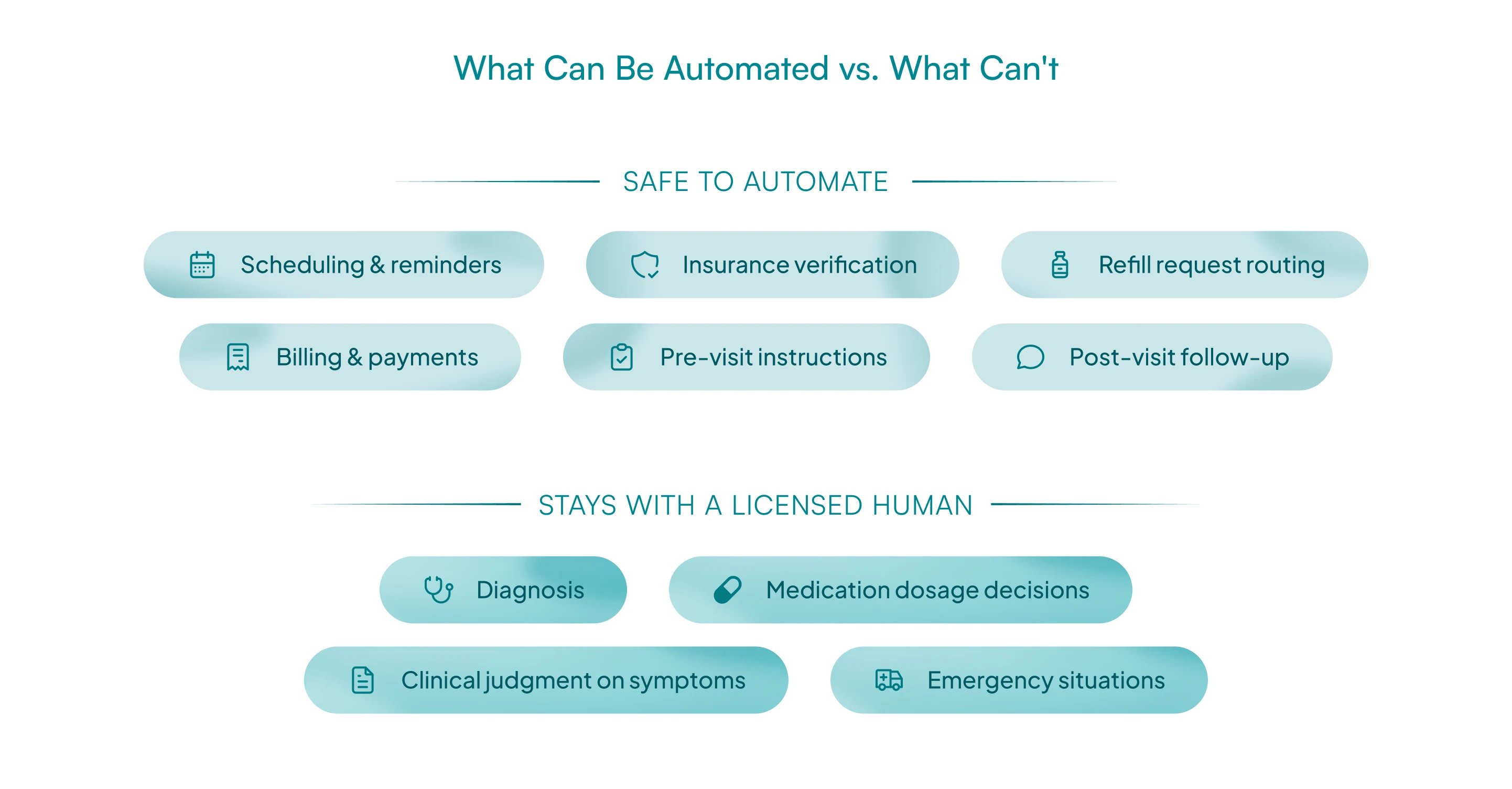
Anything involving a diagnosis, a medication dosage decision, or clinical judgment about symptoms stays with a licensed professional. That line doesn't bend based on how confident the AI system sounds or how simple the question seems.
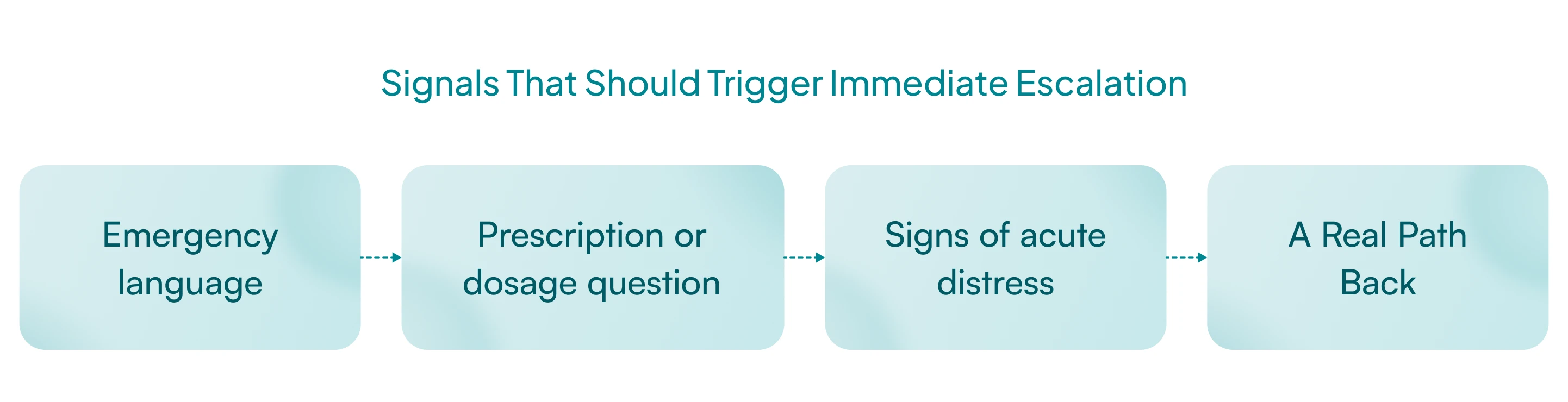
A well-built healthcare AI agent is tuned to recognize specific signals and escalate immediately rather than attempt an answer: a caller describing what sounds like a medical emergency, a question about a prescription or dosage, or language suggesting the patient is in acute distress. The system's job in those moments isn't to be helpful by answering, it's to be helpful by getting the patient to a human fast.
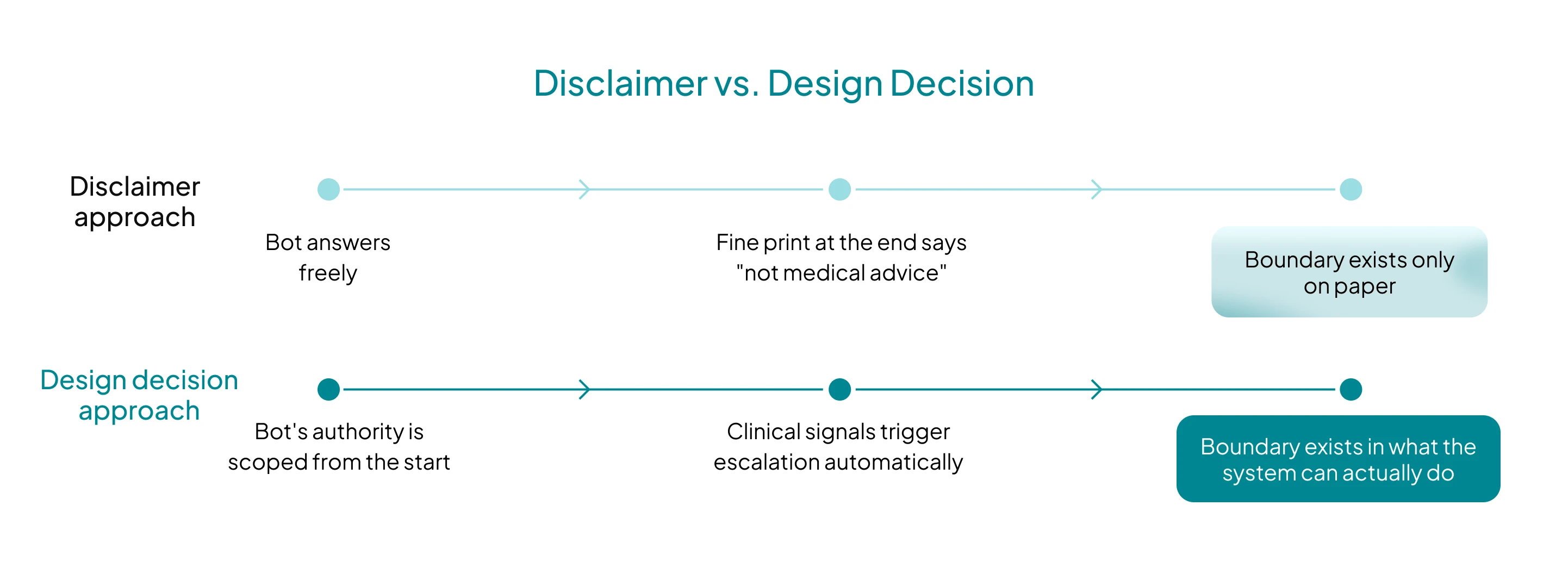
A boundary that only exists as fine print at the end of a call isn't a real boundary. It has to be built into what the system is actually authorized to do, the same way a boundary between gathering facts and making a coverage decision has to be built into an insurance claims agent, or between reporting loan status and giving financial advice has to be built into a lending agent.
A healthcare AI agent that occasionally drifts into clinical territory because nobody constrained it that way isn't a feature with a rough edge. It's a liability waiting to surface, and in a sensitive industry like this one, that liability lands on patients first, not just on the business.
Every interaction touching patient data needs to be HIPAA compliant by design, not by retrofit. That means encrypted handling of protected health information, documented consent for any outbound communication, and a full audit trail of what an AI system said, did, and escalated on a patient's behalf.
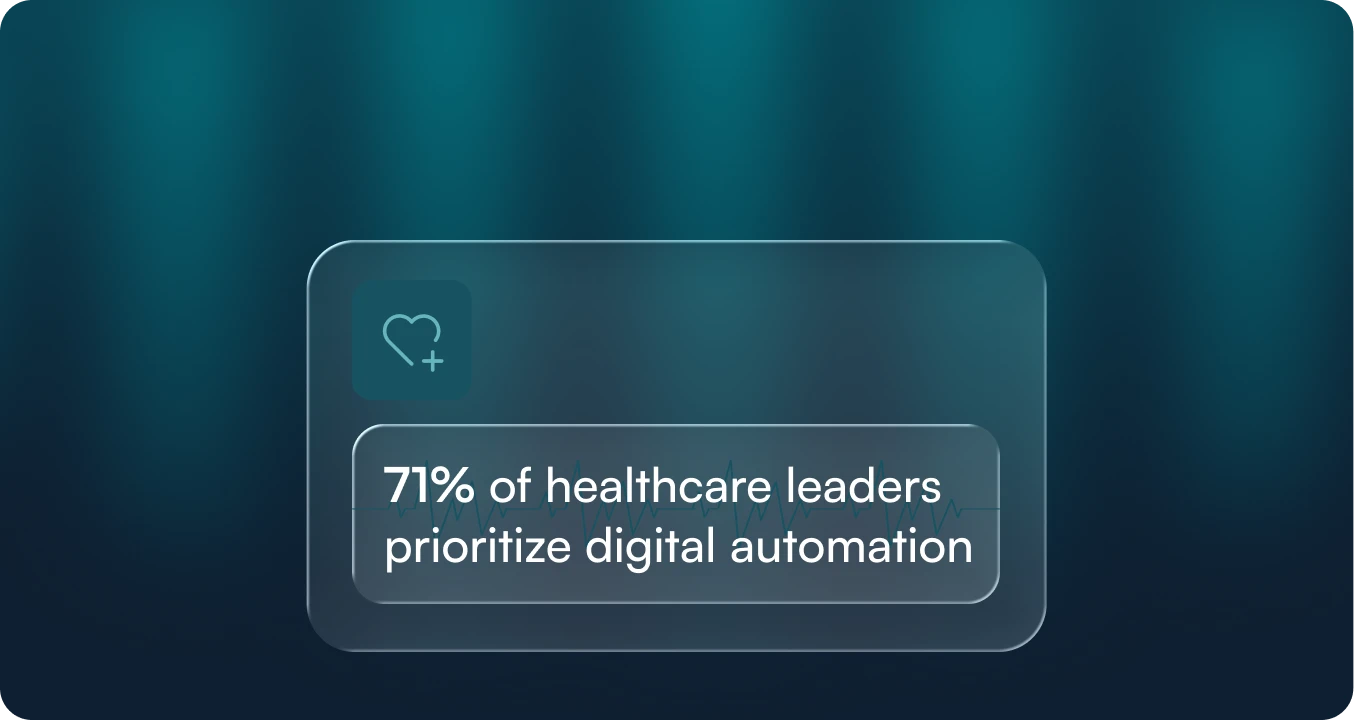
This matters more, not less, as adoption grows. Deloitte's 2026 US Healthcare Outlook, based on a survey of 120 US health plan and health system C-suite executives, found that more than 80 percent of healthcare leaders believe generative and agentic AI can deliver real value across clinical and administrative functions in 2026. But the same research found that 49 percent of organizations are still experimenting, 18 percent haven't adopted AI at all, and only about a third are using it at any real scale. The gap between belief and execution is exactly where compliance discipline either gets built in from the start or gets bolted on later under pressure.
Separate Deloitte research, a September 2025 survey of 100 US healthcare technology executives across health systems and health plans, found that adoption hurdles for agentic AI in healthcare are easing, with organizations increasing investment even as they work through how quickly they can scale past pilot programs. The pattern across this research is consistent: healthcare organizations see the potential clearly, and the ones that get real value are the ones that scale deliberately rather than deploying broadly before the clinical boundaries are actually built in.
Integration with electronic health record and practice management systems is rarely simple, and a healthcare call center's AI agent is only as useful as the patient data it can actually see. Patient trust in automated healthcare interactions starts from a more skeptical baseline than retail or banking, which means the bar for a good first experience is higher for making the switch. And keeping a system calibrated as medical guidance, formularies, and provider networks change requires ongoing maintenance, not a one-time setup.
The question was never whether AI belongs in healthcare customer support. It's where. A healthcare call center that automates scheduling, verification, billing, and routine follow-up while keeping every clinical judgment with a licensed human isn't cutting corners, it's the only version of this that actually earns patient trust over time.
Can AI in healthcare customer support ever answer medical questions directly?
Is a healthcare call center automatically HIPAA compliant if it uses AI?
What's the easiest, lowest-risk place for a healthcare provider to start with automation?
TL;DR
Healthcare customer support carries higher stakes than most industries, a wrong answer can affect patient safety, not just satisfaction.
Deloitte found 30% of US consumers don't trust AI-generated health information, up 7 points from the prior survey.
Scheduling, insurance verification, prescription refill logistics, billing, and post-visit follow-up can all be safely automated today.
Anything touching diagnosis, dosage, or clinical judgment has to stay with a licensed human, with no exceptions.
That boundary has to be a built-in design decision, not an after-the-fact disclaimer.
Deloitte found over 80% of US healthcare leaders believe in AI's value, but only about a third are using it at real scale, the gap where compliance discipline matters most.